
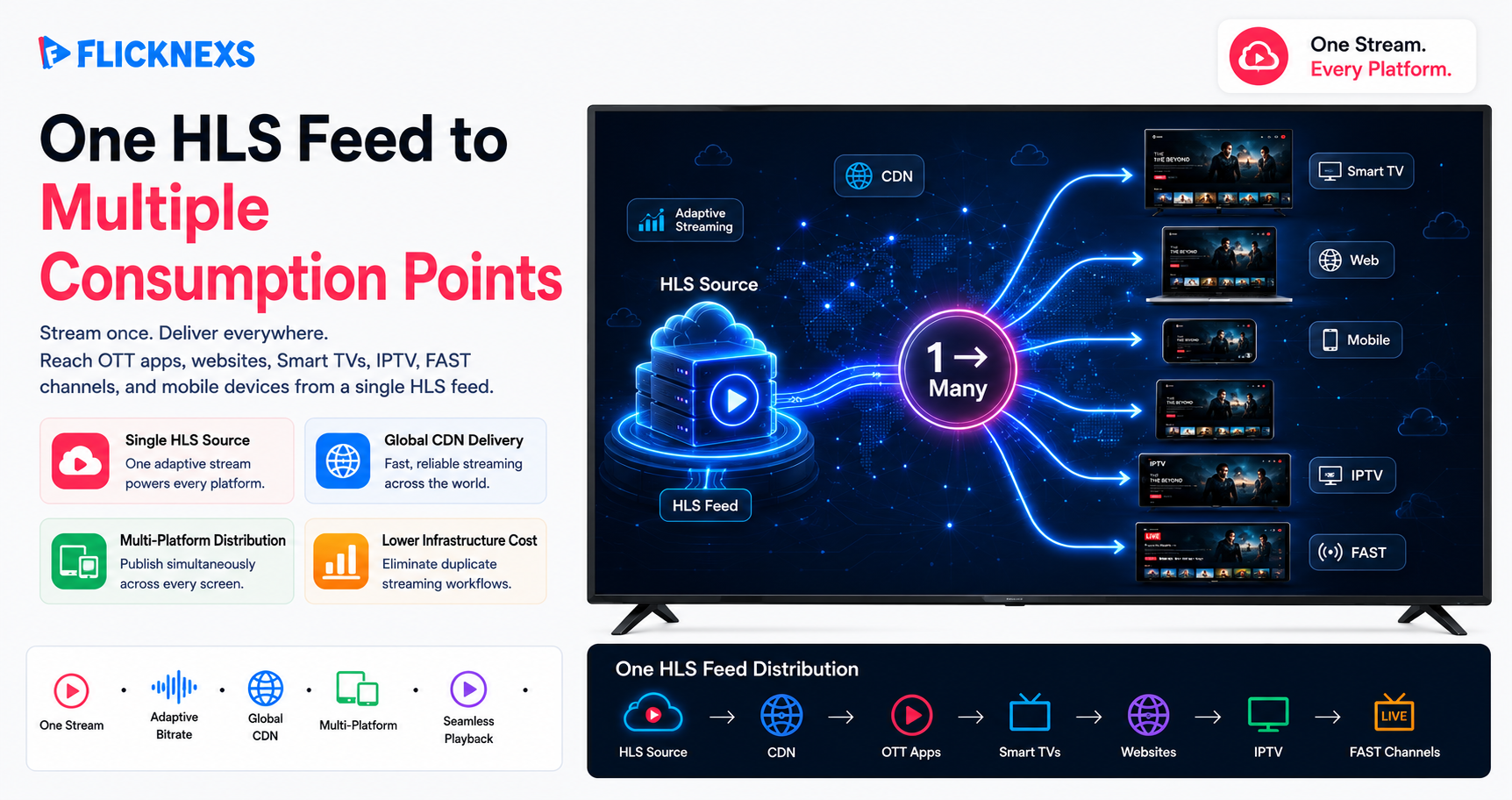
A single HLS feed can power many endpoints at once — OTT apps, FAST networks, IPTV providers, aggregators, mobile apps, and websites — when you package once and let your CDN fan it out. With just one adaptive-bitrate source of video to send out throughout your network as if you were sending multiple streams of content to each destination would save you on operational expenses and create additional areas for revenue generation.
Key takeaways
- A single package with multiple destinations; You’re going to have just one HLS feed with adaptive streaming capabilities for multiple players, instead of duplicating encodes and storage per platform.
- Decreased overhead: You encode once and store once (instead of encoding and storing once per platform) = fewer pipelines and fewer points of failure.
- Broader distribution: Same HLS feed can reach OTT, FAST, IPTV, and open web simultaneously.
- Increased opportunities for monetizing: Anytime you have a new endpoint, you are increasing ad inventory or subscriber touchpoints for that same content.
- CDN does all of the hard work: The fan-out and edge caching enable scaling, but you do not need to re-encode to increase distribution scale.
What a single HLS feed actually distributes
A single HLS feed is one stream with multiple quality versions plus the actual files that make up the video. HLS content is sent in small pieces over regular HTTP, which means virtually all devices in use today can play HLS. If you want to know exactly how HLS works, take a look at our detailed explanation.
The important shift is conceptual. Each channel and VOD program does not necessarily have to “live on” a single platform. After they have been encoded as HLS, the same URL can be requested by a SmartTV, browser-based player, IPTV set-top box, or aggregator. You are not duplicating the content for each — they all read from the same source.
How one ABR package fans out to many platforms
The delivery model is straightforward once you separate packaging from distribution. The source is encoded into an ABR ladder and published to an origin location; a CDN copies the actual video segments and delivers them to Edge locations as close to the user as possible. Each endpoint simply points at the playlist.
The single HLS feed pipeline, step by step
- A live signal or VOD file enters the encoder for ingestion.
- Transcoding means changing the original video file into many different resolution and bitrate formats (like changing a video from 240p to 1080p).
- The renditions are packaged into HLS playlists and segments, with a single master playlist referencing all of them.
- An origin site holds the packaged HLS stream; the CDN (aka; Edge, last mile, Delivery Network) caches and serves the HLS stream from Edge Locations.
- All service providers (OTT, FAST, IPTV, web) pull the same playlist URL.
Because the CDN handles replication and caching, adding a new endpoint costs almost nothing on the encoding side. The bitrate ladder you already built serves a flaky mobile connection and a fibre-connected living-room TV equally well — each player picks the rendition that fits its bandwidth in real time.
Where IPTV and OTT fit in the same feed
IPTV and OTT consume the same packaged stream through different delivery contexts, which often confuses operators planning syndication. If the distinction matters for your rollout, our guides on what IPTV is and its types and OTT vs IPTV lay out the differences clearly. The practical point: a single HLS feed can satisfy both audiences without separate encoding chains.
The business case for single-source distribution
Single-source distribution is not just a tidy architecture — it changes the economics of running a channel. Every platform you add reuses content you have already produced and packaged, so incremental reach arrives at a marginal cost close to zero.
That reach ties directly to revenue. A FAST channel earns from ad breaks, an AVOD app earns from impressions, an IPTV bundle earns from carriage, and a subscription app earns from sign-ups. Put the same feed on all of them and you multiply the surface where that content can be monetized. Our overview of video monetization platforms maps the models, and if FAST is on your roadmap, see how FAST channels make money through ads.
Syndication: one channel feed, many partners
Syndication is where single-source distribution pays off most visibly. A 24/7 channel feed — built from a scheduled playout — can be handed to multiple aggregators and partner platforms at once. Each partner pulls the same HLS endpoint into their lineup, and you reach their audience without operating their app. For the playout side of that workflow, our notes on playout and website integration show how a scheduled channel becomes a syndicatable feed.
If you are weighing whether to build this in-house or adopt a managed stack, our roundup of white-label OTT platform providers covers what to expect from a turnkey distribution layer. And for the broader FAST landscape, the 2026 FAST channels guide is a useful companion read.
Single feed vs. per-platform encoding
The contrast between maintaining one feed and encoding separately for each destination is stark once you compare the two side by side.
| Factor | Single HLS feed (single-source) | Per-platform encoding |
|---|---|---|
| Encoding pipelines | One ABR package serves all | One per platform |
| Operational overhead | Low — manage one source | High — duplicated workflows |
| Time to add an endpoint | Minutes — point at the playlist | Days — new encode and QA |
| Storage and compute cost | Single set of renditions | Multiplied per platform |
| Consistency across platforms | Identical quality everywhere | Risk of drift between encodes |
| Scaling to new reach | CDN fan-out handles it | Re-engineering each time |
The per-platform approach can feel safer because each destination gets a bespoke pipeline, but that bespoke-ness is exactly the cost. Every new partner means another encode to maintain, another place quality can drift, and another line item on your compute bill.
Practical considerations before you syndicate
A single feed simplifies distribution, but a few details deserve attention before you push it to many partners. Plan your bitrate ladder for the lowest-end device you intend to support, not just the premium TV experience — the same renditions have to satisfy every endpoint. Decide how ad insertion works per destination, since a FAST partner may need server-side ad insertion markers that a subscription app ignores. And agree on monitoring, so a fault at the origin does not silently degrade every platform at once.
Do it correctly, and the model gives you rewards: a good feed, higher visibility across platforms, and lighter execution behind the scenes.
Ready to launch your streaming website? Build it on Flicknexs →
Frequently Asked Questions
Written by the Flicknexs team. Ready to turn one channel into many revenue streams? See how Flicknexs playout and integration can syndicate your single HLS feed across every platform.
Ready to build?
If you’re planning your next Streaming Tech / HLS project, Flicknexs handles the video infrastructure end-to-end — so you can ship in weeks, not months.
- get broadcast streaming software
- explore Flicknexs plans
More on HLS streaming
Continue exploring more on this topic across the Flicknexs blog.
- Complete guide: Best Guide for RTMP Streaming in 2023
- HLS vs MPEG-DASH: Choosing the Right Streaming Protocol in 2026
- What is HLS Streaming?
Ready to build?
If you’re planning your next Streaming Tech / HLS project, Flicknexs handles the video infrastructure end-to-end — so you can ship in weeks, not months.
- get broadcast streaming software
- explore Flicknexs plans
More on HLS streaming
Continue exploring more on this topic across the Flicknexs blog.
- Complete guide: Best Guide for RTMP Streaming in 2023
- HLS vs MPEG-DASH: Choosing the Right Streaming Protocol in 2026
- What is HLS Streaming?
Ready to build?
If you’re planning your next Streaming Tech / HLS project, Flicknexs handles the video infrastructure end-to-end — so you can ship in weeks, not months.
- get broadcast streaming software
- explore Flicknexs plans
More on HLS streaming
Continue exploring more on this topic across the Flicknexs blog.
- Complete guide: Best Guide for RTMP Streaming in 2023
- HLS vs MPEG-DASH: Choosing the Right Streaming Protocol in 2026
- What is HLS Streaming?
Ready to build?
If you’re planning your next Streaming Tech / HLS project, Flicknexs handles the video infrastructure end-to-end — so you can ship in weeks, not months.
- get broadcast streaming software
- explore Flicknexs plans
More on HLS streaming
Continue exploring more on this topic across the Flicknexs blog.
- Complete guide: Best Guide for RTMP Streaming in 2023
- HLS vs MPEG-DASH: Choosing the Right Streaming Protocol in 2026
- What is HLS Streaming?
Ready to build?
If you’re planning your next Streaming Tech / HLS project, Flicknexs handles the video infrastructure end-to-end — so you can ship in weeks, not months.
- get broadcast streaming software
- explore Flicknexs plans
More on HLS streaming
Continue exploring more on this topic across the Flicknexs blog.
- Complete guide: Best Guide for RTMP Streaming in 2023
- HLS vs MPEG-DASH: Choosing the Right Streaming Protocol in 2026
- What is HLS Streaming?
Ready to build?
If you’re planning your next Streaming Tech / HLS project, Flicknexs handles the video infrastructure end-to-end — so you can ship in weeks, not months.
- get broadcast streaming software
- explore Flicknexs plans
More on HLS streaming
Continue exploring more on this topic across the Flicknexs blog.
- Complete guide: Best Guide for RTMP Streaming in 2023
- HLS vs MPEG-DASH: Choosing the Right Streaming Protocol in 2026
- What is HLS Streaming?
Ready to build?
If you’re planning your next Streaming Tech / HLS project, Flicknexs handles the video infrastructure end-to-end — so you can ship in weeks, not months.
- get broadcast streaming software
- explore Flicknexs plans
More on HLS streaming
Continue exploring more on this topic across the Flicknexs blog.
- Complete guide: Best Guide for RTMP Streaming in 2023
- HLS vs MPEG-DASH: Choosing the Right Streaming Protocol in 2026
- What is HLS Streaming?
Ready to build?
If you’re planning your next Streaming Tech / HLS project, Flicknexs handles the video infrastructure end-to-end — so you can ship in weeks, not months.
- get broadcast streaming software
- explore Flicknexs plans
More on HLS streaming
Continue exploring more on this topic across the Flicknexs blog.
- Complete guide: Best Guide for RTMP Streaming in 2023
- HLS vs MPEG-DASH: Choosing the Right Streaming Protocol in 2026
- What is HLS Streaming?
Ready to build?
If you’re planning your next Streaming Tech / HLS project, Flicknexs handles the video infrastructure end-to-end — so you can ship in weeks, not months.
- get broadcast streaming software
- explore Flicknexs plans
More on HLS streaming
Continue exploring more on this topic across the Flicknexs blog.
- Complete guide: Best Guide for RTMP Streaming in 2023
- HLS vs MPEG-DASH: Choosing the Right Streaming Protocol in 2026
- What is HLS Streaming?
Ready to build?
If you’re planning your next Streaming Tech / HLS project, Flicknexs handles the video infrastructure end-to-end — so you can ship in weeks, not months.
- get broadcast streaming software
- explore Flicknexs plans
More on HLS streaming
Continue exploring more on this topic across the Flicknexs blog.
- Complete guide: Best Guide for RTMP Streaming in 2023
- HLS vs MPEG-DASH: Choosing the Right Streaming Protocol in 2026
- What is HLS Streaming?
Ready to build?
If you’re planning your next Streaming Tech / HLS project, Flicknexs handles the video infrastructure end-to-end — so you can ship in weeks, not months.
- get broadcast streaming software
- explore Flicknexs plans
More on HLS streaming
Continue exploring more on this topic across the Flicknexs blog.
- Complete guide: Best Guide for RTMP Streaming in 2023
- HLS vs MPEG-DASH: Choosing the Right Streaming Protocol in 2026
- What is HLS Streaming?
Ready to build?
If you’re planning your next Streaming Tech / HLS project, Flicknexs handles the video infrastructure end-to-end — so you can ship in weeks, not months.
- get broadcast streaming software
- explore Flicknexs plans
More on HLS streaming
Continue exploring more on this topic across the Flicknexs blog.
- Complete guide: Best Guide for RTMP Streaming in 2023
- HLS vs MPEG-DASH: Choosing the Right Streaming Protocol in 2026
- What is HLS Streaming?
Ready to build?
If you’re planning your next Streaming Tech / HLS project, Flicknexs handles the video infrastructure end-to-end — so you can ship in weeks, not months.
- get broadcast streaming software
- explore Flicknexs plans
More on HLS streaming
Continue exploring more on this topic across the Flicknexs blog.
- Complete guide: Best Guide for RTMP Streaming in 2023
- HLS vs MPEG-DASH: Choosing the Right Streaming Protocol in 2026
- What is HLS Streaming?
Ready to build?
If you’re planning your next Streaming Tech / HLS project, Flicknexs handles the video infrastructure end-to-end — so you can ship in weeks, not months.
- get broadcast streaming software
- explore Flicknexs plans
More on HLS streaming
Continue exploring more on this topic across the Flicknexs blog.
- Complete guide: Best Guide for RTMP Streaming in 2023
- HLS vs MPEG-DASH: Choosing the Right Streaming Protocol in 2026
- What is HLS Streaming?
Ready to build?
If you’re planning your next Streaming Tech / HLS project, Flicknexs handles the video infrastructure end-to-end — so you can ship in weeks, not months.
- get broadcast streaming software
- explore Flicknexs plans
More on HLS streaming
Continue exploring more on this topic across the Flicknexs blog.
- Complete guide: Best Guide for RTMP Streaming in 2023
- HLS vs MPEG-DASH: Choosing the Right Streaming Protocol in 2026
- What is HLS Streaming?
Ready to build?
If you’re planning your next Streaming Tech / HLS project, Flicknexs handles the video infrastructure end-to-end — so you can ship in weeks, not months.
- get broadcast streaming software
- explore Flicknexs plans
More on HLS streaming
Continue exploring more on this topic across the Flicknexs blog.
- Complete guide: Best Guide for RTMP Streaming in 2023
- HLS vs MPEG-DASH: Choosing the Right Streaming Protocol in 2026
- What is HLS Streaming?
Ready to build?
If you’re planning your next Streaming Tech / HLS project, Flicknexs handles the video infrastructure end-to-end — so you can ship in weeks, not months.
- get broadcast streaming software
- explore Flicknexs plans
More on HLS streaming
Continue exploring more on this topic across the Flicknexs blog.
- Complete guide: Best Guide for RTMP Streaming in 2023
- HLS vs MPEG-DASH: Choosing the Right Streaming Protocol in 2026
- What is HLS Streaming?
Ready to build?
If you’re planning your next Streaming Tech / HLS project, Flicknexs handles the video infrastructure end-to-end — so you can ship in weeks, not months.
- get broadcast streaming software
- explore Flicknexs plans
More on HLS streaming
Continue exploring more on this topic across the Flicknexs blog.
- Complete guide: Best Guide for RTMP Streaming in 2023
- HLS vs MPEG-DASH: Choosing the Right Streaming Protocol in 2026
- What is HLS Streaming?
Ready to build?
If you’re planning your next Streaming Tech / HLS project, Flicknexs handles the video infrastructure end-to-end — so you can ship in weeks, not months.
More on HLS streaming
Continue exploring more on this topic across the Flicknexs blog.