
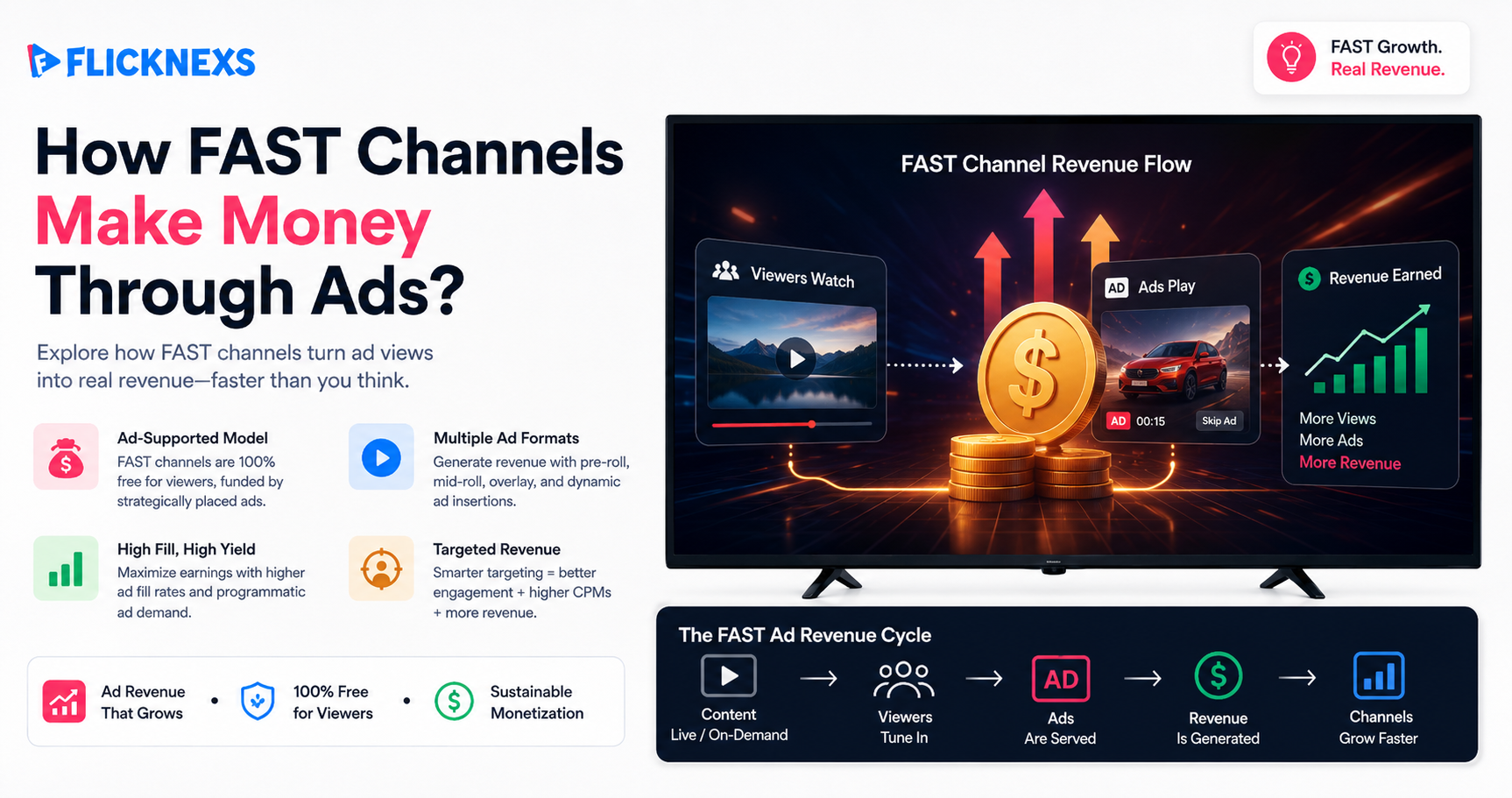
Advertisers use FAST Channel Advertising (Advertising on Free Ad-Supported Streaming TV) to reach consumers on free to air channels (linear) by using their ads as a source of revenue. If you have or plan to have a FAST Service, knowing how the ad sales, ad insertion, and ad pricing work will determine whether you have a channel that breaks even, or a channel that will fund your entire content business. Here is how the money flows through SSAI (Server Side Ad Insertion) for the ad creation of the end user:
Key takeaways
- FAST is 100% ad-funded — there is no subscription fallback, so fill rate and CPM decide your revenue ceiling.
- Server-side ad insertion (SSAI) stitches ads into the video stream itself, so they play as smoothly as the programming and resist ad blockers.
- Ad breaks are triggered by SCTE markers embedded in the linear schedule, which tells the system exactly when to cut to an ad pod.
- Format mix matters — pre-roll, mid-roll, dynamic, and regional ads each earn differently and fit different points in the schedule.
- Ad Revenue is calculated by using the formula of CPM x number of impressions x fill rate, so the inventory you control, the percentage of inventory sold, and the quality of audience targeting are all controlling variables to the amount of ad revenue your FAST Service can generate.
What FAST channel advertising actually is
FAST stands for Free Ad-Supported Streaming TV. The viewer scrolls a programme guide, picks a channel, and watches a continuous linear feed — exactly like flipping through cable, except it is delivered over the internet. Behind the scenes, this continuous schedule is driven by an ott playout system that automates programming around the clock. They pay nothing. In return, they sit through ad breaks, and those breaks are where the platform earns.
For the complete launch playbook, see our practical guide to a fast channel.
This is the heart of digital TV monetization. By embedding SCTE markers in the linear schedule of programming, the servers know when the next advertisement is due and will automatically trigger a switch to the next advertisement break when an advertisement break has been reached within the scheduled programming. If you are new to the format, our practical guide to FAST channels is the primer to read first.
FAST sits inside the wider ad-supported world. It shares DNA with AVOD, and if you are weighing models, our breakdown of the rise of ad-supported streaming and our comparison of AVOD, SVOD, and TVOD show where FAST fits.
How server-side ad insertion powers FAST channel advertising
The technical backbone of FAST channel advertising is server-side ad insertion, or SSAI. Instead of asking the viewer’s app to load an ad separately (the old client-side method, which buffers, breaks, and gets blocked), SSAI stitches the ad directly into the video stream on the server before it reaches the device.
The result is one seamless feed. The ad uses the same resolution, bitrate, and player as the show around it, so there is no black flash, no spinning loader, and no obvious seam. To the viewer it feels like broadcast TV. To you, it means higher completed-view rates and ad inventory that ad blockers cannot strip out.
SCTE markers tell the stream when to break
SSAI needs to know precisely where an ad break belongs. That cue comes from SCTE markers — small signals embedded in the linear schedule that say “an ad pod goes here, and it is this many seconds long.” When the stream hits a marker, the SSAI system pauses the programme, fills the slot with an ad pod, and resumes. We cover the signalling layer in depth in our explainer on what SCTE markers are, and how broadcasters keep ownership of those breaks in our piece on networks controlling their own ads with SCTE and SSAI.
Because SSAI assembles ads per viewer, the same break can serve a different ad to every household watching — which is what makes dynamic and regional targeting possible at scale.
Ad formats and where each one fits
Not all ad slots are equal. A FAST channel mixes several formats across the linear schedule, and each earns differently depending on attention and targeting. Here is how the common formats line up.
For the step-by-step launch process itself, see our guide to fast channel launch steps.
| Ad format | Where it sits in the schedule | Best for |
|---|---|---|
| Pre-roll | Before a channel or programme starts playing | Capturing attention at tune-in; high completion |
| Mid-roll | Inside the programme at SCTE-marked breaks | The volume workhorse; most of your impressions |
| Dynamic ads | Any break, swapped per viewer in real time | Targeted advertising and higher CPMs |
| Regional ads | Same break, geo-specific creative per market | Local advertisers and country-level campaigns |
The engine for mid-roll is the ad slots in a half hour episode. Each episode usually contain three to four ad slots that typically have two to three ads each. This base, when combined with a dynamic or regional format, enables you to sell the same ad slot at a premium because the ad is more relevant to who is watching and the geographic location they are watching from.
Protecting that content across devices matters too — see our guide to multi drm for broadcasters.
CPM, fill rate, and ad breaks: the numbers behind the revenue
Three figures decide what a FAST channel earns. Get comfortable with all three, because every revenue conversation circles back to them.
The infrastructure behind this is shifting too — see our guide to cloud playout for broadcasters.
CPM, fill rate, and how ad breaks set your inventory
- CPM (cost per thousand impressions) is how much advertisers pay for each 1,000 times an advertisement is shown or viewed. The cost of Connected TV (or CTV) CPM is generally higher than the typical web video CPM rates due to the large size of the screen viewing area, the fact that viewers are relaxed in their own living rooms and the fact that CTV ads tend to play through to their conclusion.
- Fill Rate is defined as the % of ad space available that is being sold or filled (if you sold every spot in the Broadcast Break, you would have a 100% Fill Rate; if only 6 out of 10 spots were sold in the Broadcast Break, you would have a 60% Fill Rate).
- Ad breaks define your inventory. More breaks (within reason) and more ads per pod mean more impressions to sell — but pack them too tight and viewers leave, which drags everything down.
The rough maths: revenue equals CPM multiplied by impressions multiplied by fill rate. Lift any one of the three and the whole number moves. That is why operators obsess over selling more slots, filling the ones they have, and raising the price of each through better targeting.
Practical revenue levers for your channel
Understanding this formula is important, but knowing how to pull on the right levers is equally important. The following are some of the levers that will increase FAST Revenue.
For a deeper technical comparison, see our breakdown of ssai ads versus client-side methods.
- Raise fill rate first. Connecting more demand sources — direct sales plus programmatic exchanges — is usually the fastest gain, because you are selling inventory you already have.
- Layer dynamic and regional ads. Using targeted advertisements based on the viewer’s location, demographics, or interests typically generates a higher CPM than serving a generic ad. Therefore, switching to audience-targeted ad creative can increase the value of each broadcast break.
- Tune your break load. Test break frequency against watch time. The sweet spot maximises impressions without driving viewers away mid-programme.
- Distribute widely. Pushing one clean feed to more platforms multiplies your audience and your sellable impressions. Our guide to running one HLS feed across multiple platforms covers the delivery side.
- Diversify beyond FAST. The same content can earn through other models too — our rundown of video monetization platforms and ten ways to monetize video content map the wider menu.
To implement these revenue strategies effectively, it’s important to create a linear TV channel with infrastructure that supports FAST distribution and dynamic ad insertion.
Frequently Asked Questions
Written by the Flicknexs team — we help broadcasters and content owners launch and monetize FAST channels with SSAI, dynamic ad insertion, and multi-platform delivery. Start with our FAST channels guide to plan your launch.
Ready to launch your own channel? See how to create your own online TV channel with Flicknexs — cloud playout, multi-device apps and built-in monetization in one platform.
Ready to build?
If you’re planning your next Playout / FAST project, Flicknexs handles the video infrastructure end-to-end — so you can ship in weeks, not months.
- launch a FAST channel
- see pricing and plans
More on FAST channels
Continue exploring more on this topic across the Flicknexs blog.
- Deep dive: OTT Playout Platform: The Complete Guide to Launching Your Own TV Channel IN 2026
- What Are FAST Channels? A Practical 2026 Guide to Free Ad-Supported Streaming TV
- How to Launch a FAST Channel in 2026: Step-by-Step Setup & Distribution
Ready to build?
If you’re planning your next Playout / FAST project, Flicknexs handles the video infrastructure end-to-end — so you can ship in weeks, not months.
- launch a FAST channel
- see pricing and plans
More on FAST channels
Continue exploring more on this topic across the Flicknexs blog.
- Deep dive: OTT Playout Platform: The Complete Guide to Launching Your Own TV Channel IN 2026
- What Are FAST Channels? A Practical 2026 Guide to Free Ad-Supported Streaming TV
- How to Launch a FAST Channel in 2026: Step-by-Step Setup & Distribution
Ready to build?
If you’re planning your next Playout / FAST project, Flicknexs handles the video infrastructure end-to-end — so you can ship in weeks, not months.
- launch a FAST channel
- see pricing and plans
More on FAST channels
Continue exploring more on this topic across the Flicknexs blog.
- Deep dive: OTT Playout Platform: The Complete Guide to Launching Your Own TV Channel IN 2026
- What Are FAST Channels? A Practical 2026 Guide to Free Ad-Supported Streaming TV
- How to Launch a FAST Channel in 2026: Step-by-Step Setup & Distribution
Ready to build?
If you’re planning your next Playout / FAST project, Flicknexs handles the video infrastructure end-to-end — so you can ship in weeks, not months.
- launch a FAST channel
- see pricing and plans
More on FAST channels
Continue exploring more on this topic across the Flicknexs blog.
- Deep dive: OTT Playout Platform: The Complete Guide to Launching Your Own TV Channel IN 2026
- What Are FAST Channels? A Practical 2026 Guide to Free Ad-Supported Streaming TV
- How to Launch a FAST Channel in 2026: Step-by-Step Setup & Distribution
Ready to build?
If you’re planning your next Playout / FAST project, Flicknexs handles the video infrastructure end-to-end — so you can ship in weeks, not months.
- launch a FAST channel
- see pricing and plans
More on FAST channels
Continue exploring more on this topic across the Flicknexs blog.
- Deep dive: OTT Playout Platform: The Complete Guide to Launching Your Own TV Channel IN 2026
- What Are FAST Channels? A Practical 2026 Guide to Free Ad-Supported Streaming TV
- How to Launch a FAST Channel in 2026: Step-by-Step Setup & Distribution
Ready to build?
If you’re planning your next Playout / FAST project, Flicknexs handles the video infrastructure end-to-end — so you can ship in weeks, not months.
- launch a FAST channel
- see pricing and plans
More on FAST channels
Continue exploring more on this topic across the Flicknexs blog.
- Deep dive: OTT Playout Platform: The Complete Guide to Launching Your Own TV Channel IN 2026
- What Are FAST Channels? A Practical 2026 Guide to Free Ad-Supported Streaming TV
- How to Launch a FAST Channel in 2026: Step-by-Step Setup & Distribution
Ready to build?
If you’re planning your next Playout / FAST project, Flicknexs handles the video infrastructure end-to-end — so you can ship in weeks, not months.
- launch a FAST channel
- see pricing and plans
More on FAST channels
Continue exploring more on this topic across the Flicknexs blog.
- Deep dive: OTT Playout Platform: The Complete Guide to Launching Your Own TV Channel IN 2026
- What Are FAST Channels? A Practical 2026 Guide to Free Ad-Supported Streaming TV
- How to Launch a FAST Channel in 2026: Step-by-Step Setup & Distribution
Ready to build?
If you’re planning your next Playout / FAST project, Flicknexs handles the video infrastructure end-to-end — so you can ship in weeks, not months.
- launch a FAST channel
- see pricing and plans
More on FAST channels
Continue exploring more on this topic across the Flicknexs blog.
- Deep dive: OTT Playout Platform: The Complete Guide to Launching Your Own TV Channel IN 2026
- What Are FAST Channels? A Practical 2026 Guide to Free Ad-Supported Streaming TV
- How to Launch a FAST Channel in 2026: Step-by-Step Setup & Distribution
Ready to build?
If you’re planning your next Playout / FAST project, Flicknexs handles the video infrastructure end-to-end — so you can ship in weeks, not months.
- launch a FAST channel
- see pricing and plans
More on FAST channels
Continue exploring more on this topic across the Flicknexs blog.
- Deep dive: OTT Playout Platform: The Complete Guide to Launching Your Own TV Channel IN 2026
- What Are FAST Channels? A Practical 2026 Guide to Free Ad-Supported Streaming TV
- How to Launch a FAST Channel in 2026: Step-by-Step Setup & Distribution
Ready to build?
If you’re planning your next Playout / FAST project, Flicknexs handles the video infrastructure end-to-end — so you can ship in weeks, not months.
- launch a FAST channel
- see pricing and plans
More on FAST channels
Continue exploring more on this topic across the Flicknexs blog.
- Deep dive: OTT Playout Platform: The Complete Guide to Launching Your Own TV Channel IN 2026
- What Are FAST Channels? A Practical 2026 Guide to Free Ad-Supported Streaming TV
- How to Launch a FAST Channel in 2026: Step-by-Step Setup & Distribution
Ready to build?
If you’re planning your next Playout / FAST project, Flicknexs handles the video infrastructure end-to-end — so you can ship in weeks, not months.
- launch a FAST channel
- see pricing and plans
More on FAST channels
Continue exploring more on this topic across the Flicknexs blog.
- Deep dive: OTT Playout Platform: The Complete Guide to Launching Your Own TV Channel IN 2026
- What Are FAST Channels? A Practical 2026 Guide to Free Ad-Supported Streaming TV
- How to Launch a FAST Channel in 2026: Step-by-Step Setup & Distribution
Ready to build?
If you’re planning your next Playout / FAST project, Flicknexs handles the video infrastructure end-to-end — so you can ship in weeks, not months.
- launch a FAST channel
- see pricing and plans
More on FAST channels
Continue exploring more on this topic across the Flicknexs blog.
- Deep dive: OTT Playout Platform: The Complete Guide to Launching Your Own TV Channel IN 2026
- What Are FAST Channels? A Practical 2026 Guide to Free Ad-Supported Streaming TV
- How to Launch a FAST Channel in 2026: Step-by-Step Setup & Distribution
Ready to build?
If you’re planning your next Playout / FAST project, Flicknexs handles the video infrastructure end-to-end — so you can ship in weeks, not months.
- launch a FAST channel
- see pricing and plans
More on FAST channels
Continue exploring more on this topic across the Flicknexs blog.
- Deep dive: OTT Playout Platform: The Complete Guide to Launching Your Own TV Channel IN 2026
- What Are FAST Channels? A Practical 2026 Guide to Free Ad-Supported Streaming TV
- How to Launch a FAST Channel in 2026: Step-by-Step Setup & Distribution
Ready to build?
If you’re planning your next Playout / FAST project, Flicknexs handles the video infrastructure end-to-end — so you can ship in weeks, not months.
- launch a FAST channel
- see pricing and plans
More on FAST channels
Continue exploring more on this topic across the Flicknexs blog.
- Deep dive: OTT Playout Platform: The Complete Guide to Launching Your Own TV Channel IN 2026
- What Are FAST Channels? A Practical 2026 Guide to Free Ad-Supported Streaming TV
- How to Launch a FAST Channel in 2026: Step-by-Step Setup & Distribution
Ready to build?
If you’re planning your next Playout / FAST project, Flicknexs handles the video infrastructure end-to-end — so you can ship in weeks, not months.
- launch a FAST channel
- see pricing and plans
More on FAST channels
Continue exploring more on this topic across the Flicknexs blog.
- Deep dive: OTT Playout Platform: The Complete Guide to Launching Your Own TV Channel IN 2026
- What Are FAST Channels? A Practical 2026 Guide to Free Ad-Supported Streaming TV
- How to Launch a FAST Channel in 2026: Step-by-Step Setup & Distribution
Ready to build?
If you’re planning your next Playout / FAST project, Flicknexs handles the video infrastructure end-to-end — so you can ship in weeks, not months.
- launch a FAST channel
- see pricing and plans
More on FAST channels
Continue exploring more on this topic across the Flicknexs blog.
- Deep dive: OTT Playout Platform: The Complete Guide to Launching Your Own TV Channel IN 2026
- What Are FAST Channels? A Practical 2026 Guide to Free Ad-Supported Streaming TV
- How to Launch a FAST Channel in 2026: Step-by-Step Setup & Distribution
Ready to build?
If you’re planning your next Playout / FAST project, Flicknexs handles the video infrastructure end-to-end — so you can ship in weeks, not months.
- launch a FAST channel
- see pricing and plans
More on FAST channels
Continue exploring more on this topic across the Flicknexs blog.
- Deep dive: OTT Playout Platform: The Complete Guide to Launching Your Own TV Channel IN 2026
- What Are FAST Channels? A Practical 2026 Guide to Free Ad-Supported Streaming TV
- How to Launch a FAST Channel in 2026: Step-by-Step Setup & Distribution
Ready to build?
If you’re planning your next Playout / FAST project, Flicknexs handles the video infrastructure end-to-end — so you can ship in weeks, not months.
- launch a FAST channel
- see pricing and plans
More on FAST channels
Continue exploring more on this topic across the Flicknexs blog.
- Deep dive: OTT Playout Platform: The Complete Guide to Launching Your Own TV Channel IN 2026
- What Are FAST Channels? A Practical 2026 Guide to Free Ad-Supported Streaming TV
- How to Launch a FAST Channel in 2026: Step-by-Step Setup & Distribution
Ready to build?
If you’re planning your next Playout / FAST project, Flicknexs handles the video infrastructure end-to-end — so you can ship in weeks, not months.
- launch a FAST channel
- see pricing and plans
More on FAST channels
Continue exploring more on this topic across the Flicknexs blog.
- Deep dive: OTT Playout Platform: The Complete Guide to Launching Your Own TV Channel IN 2026
- What Are FAST Channels? A Practical 2026 Guide to Free Ad-Supported Streaming TV
- How to Launch a FAST Channel in 2026: Step-by-Step Setup & Distribution
Ready to build?
If you’re planning your next Playout / FAST project, Flicknexs handles the video infrastructure end-to-end — so you can ship in weeks, not months.
- launch a FAST channel
- see pricing and plans
More on FAST channels
Continue exploring more on this topic across the Flicknexs blog.
- Deep dive: OTT Playout Platform: The Complete Guide to Launching Your Own TV Channel IN 2026
- What Are FAST Channels? A Practical 2026 Guide to Free Ad-Supported Streaming TV
- How to Launch a FAST Channel in 2026: Step-by-Step Setup & Distribution
Ready to build?
If you’re planning your next Playout / FAST project, Flicknexs handles the video infrastructure end-to-end — so you can ship in weeks, not months.
- launch a FAST channel
- see pricing and plans
More on FAST channels
Continue exploring more on this topic across the Flicknexs blog.
- Deep dive: OTT Playout Platform: The Complete Guide to Launching Your Own TV Channel IN 2026
- What Are FAST Channels? A Practical 2026 Guide to Free Ad-Supported Streaming TV
- How to Launch a FAST Channel in 2026: Step-by-Step Setup & Distribution
Ready to build?
If you’re planning your next Playout / FAST project, Flicknexs handles the video infrastructure end-to-end — so you can ship in weeks, not months.
- launch a FAST channel
- see pricing and plans
More on FAST channels
Continue exploring more on this topic across the Flicknexs blog.
- Deep dive: OTT Playout Platform: The Complete Guide to Launching Your Own TV Channel IN 2026
- What Are FAST Channels? A Practical 2026 Guide to Free Ad-Supported Streaming TV
- How to Launch a FAST Channel in 2026: Step-by-Step Setup & Distribution
Ready to build?
If you’re planning your next Playout / FAST project, Flicknexs handles the video infrastructure end-to-end — so you can ship in weeks, not months.
- launch a FAST channel
- see pricing and plans
More on FAST channels
Continue exploring more on this topic across the Flicknexs blog.
- Deep dive: OTT Playout Platform: The Complete Guide to Launching Your Own TV Channel IN 2026
- What Are FAST Channels? A Practical 2026 Guide to Free Ad-Supported Streaming TV
- How to Launch a FAST Channel in 2026: Step-by-Step Setup & Distribution
Ready to build?
If you’re planning your next Playout / FAST project, Flicknexs handles the video infrastructure end-to-end — so you can ship in weeks, not months.
- launch a FAST channel
- see pricing and plans
More on FAST channels
Continue exploring more on this topic across the Flicknexs blog.
- Deep dive: OTT Playout Platform: The Complete Guide to Launching Your Own TV Channel IN 2026
- What Are FAST Channels? A Practical 2026 Guide to Free Ad-Supported Streaming TV
- How to Launch a FAST Channel in 2026: Step-by-Step Setup & Distribution
Ready to build?
If you’re planning your next Playout / FAST project, Flicknexs handles the video infrastructure end-to-end — so you can ship in weeks, not months.
- launch a FAST channel
- see pricing and plans
More on FAST channels
Continue exploring more on this topic across the Flicknexs blog.
- Deep dive: OTT Playout Platform: The Complete Guide to Launching Your Own TV Channel IN 2026
- What Are FAST Channels? A Practical 2026 Guide to Free Ad-Supported Streaming TV
- How to Launch a FAST Channel in 2026: Step-by-Step Setup & Distribution
Ready to build?
If you’re planning your next Playout / FAST project, Flicknexs handles the video infrastructure end-to-end — so you can ship in weeks, not months.
- launch a FAST channel
- see pricing and plans
More on FAST channels
Continue exploring more on this topic across the Flicknexs blog.
- Deep dive: OTT Playout Platform: The Complete Guide to Launching Your Own TV Channel IN 2026
- What Are FAST Channels? A Practical 2026 Guide to Free Ad-Supported Streaming TV
- How to Launch a FAST Channel in 2026: Step-by-Step Setup & Distribution
Ready to build?
If you’re planning your next Playout / FAST project, Flicknexs handles the video infrastructure end-to-end — so you can ship in weeks, not months.
- launch a FAST channel
- see pricing and plans
More on FAST channels
Continue exploring more on this topic across the Flicknexs blog.
- Deep dive: OTT Playout Platform: The Complete Guide to Launching Your Own TV Channel IN 2026
- What Are FAST Channels? A Practical 2026 Guide to Free Ad-Supported Streaming TV
- How to Launch a FAST Channel in 2026: Step-by-Step Setup & Distribution
Ready to build?
If you’re planning your next Playout / FAST project, Flicknexs handles the video infrastructure end-to-end — so you can ship in weeks, not months.
- launch a FAST channel
- see pricing and plans
More on FAST channels
Continue exploring more on this topic across the Flicknexs blog.
- Deep dive: OTT Playout Platform: The Complete Guide to Launching Your Own TV Channel IN 2026
- What Are FAST Channels? A Practical 2026 Guide to Free Ad-Supported Streaming TV
- How to Launch a FAST Channel in 2026: Step-by-Step Setup & Distribution
Ready to build?
If you’re planning your next Playout / FAST project, Flicknexs handles the video infrastructure end-to-end — so you can ship in weeks, not months.
- launch a FAST channel
- see pricing and plans
More on FAST channels
Continue exploring more on this topic across the Flicknexs blog.
- Deep dive: OTT Playout Platform: The Complete Guide to Launching Your Own TV Channel IN 2026
- What Are FAST Channels? A Practical 2026 Guide to Free Ad-Supported Streaming TV
- How to Launch a FAST Channel in 2026: Step-by-Step Setup & Distribution
Ready to build?
If you’re planning your next Playout / FAST project, Flicknexs handles the video infrastructure end-to-end — so you can ship in weeks, not months.
- launch a FAST channel
- see pricing and plans
More on FAST channels
Continue exploring more on this topic across the Flicknexs blog.
- Deep dive: OTT Playout Platform: The Complete Guide to Launching Your Own TV Channel IN 2026
- What Are FAST Channels? A Practical 2026 Guide to Free Ad-Supported Streaming TV
- How to Launch a FAST Channel in 2026: Step-by-Step Setup & Distribution
Ready to build?
If you’re planning your next Playout / FAST project, Flicknexs handles the video infrastructure end-to-end — so you can ship in weeks, not months.
- launch a FAST channel
- see pricing and plans
More on FAST channels
Continue exploring more on this topic across the Flicknexs blog.
- Deep dive: OTT Playout Platform: The Complete Guide to Launching Your Own TV Channel IN 2026
- What Are FAST Channels? A Practical 2026 Guide to Free Ad-Supported Streaming TV
- How to Launch a FAST Channel in 2026: Step-by-Step Setup & Distribution
Ready to build?
If you’re planning your next Playout / FAST project, Flicknexs handles the video infrastructure end-to-end — so you can ship in weeks, not months.
- launch a FAST channel
- see pricing and plans
More on FAST channels
Continue exploring more on this topic across the Flicknexs blog.
- Deep dive: OTT Playout Platform: The Complete Guide to Launching Your Own TV Channel IN 2026
- What Are FAST Channels? A Practical 2026 Guide to Free Ad-Supported Streaming TV
- How to Launch a FAST Channel in 2026: Step-by-Step Setup & Distribution
Ready to build?
If you’re planning your next Playout / FAST project, Flicknexs handles the video infrastructure end-to-end — so you can ship in weeks, not months.
- launch a FAST channel
- see pricing and plans
More on FAST channels
Continue exploring more on this topic across the Flicknexs blog.
- Deep dive: OTT Playout Platform: The Complete Guide to Launching Your Own TV Channel IN 2026
- What Are FAST Channels? A Practical 2026 Guide to Free Ad-Supported Streaming TV
- How to Launch a FAST Channel in 2026: Step-by-Step Setup & Distribution
Ready to build?
If you’re planning your next Playout / FAST project, Flicknexs handles the video infrastructure end-to-end — so you can ship in weeks, not months.
- launch a FAST channel
- see pricing and plans
More on FAST channels
Continue exploring more on this topic across the Flicknexs blog.
- Deep dive: OTT Playout Platform: The Complete Guide to Launching Your Own TV Channel IN 2026
- What Are FAST Channels? A Practical 2026 Guide to Free Ad-Supported Streaming TV
- How to Launch a FAST Channel in 2026: Step-by-Step Setup & Distribution
Ready to build?
If you’re planning your next Playout / FAST project, Flicknexs handles the video infrastructure end-to-end — so you can ship in weeks, not months.
- launch a FAST channel
- see pricing and plans
More on FAST channels
Continue exploring more on this topic across the Flicknexs blog.
- Deep dive: OTT Playout Platform: The Complete Guide to Launching Your Own TV Channel IN 2026
- What Are FAST Channels? A Practical 2026 Guide to Free Ad-Supported Streaming TV
- How to Launch a FAST Channel in 2026: Step-by-Step Setup & Distribution
Ready to build?
If you’re planning your next Playout / FAST project, Flicknexs handles the video infrastructure end-to-end — so you can ship in weeks, not months.
- launch a FAST channel
- see pricing and plans
More on FAST channels
Continue exploring more on this topic across the Flicknexs blog.
- Deep dive: OTT Playout Platform: The Complete Guide to Launching Your Own TV Channel IN 2026
- What Are FAST Channels? A Practical 2026 Guide to Free Ad-Supported Streaming TV
- How to Launch a FAST Channel in 2026: Step-by-Step Setup & Distribution
Ready to build?
If you’re planning your next Playout / FAST project, Flicknexs handles the video infrastructure end-to-end — so you can ship in weeks, not months.
- launch a FAST channel
- see pricing and plans
More on FAST channels
Continue exploring more on this topic across the Flicknexs blog.
- Deep dive: OTT Playout Platform: The Complete Guide to Launching Your Own TV Channel IN 2026
- What Are FAST Channels? A Practical 2026 Guide to Free Ad-Supported Streaming TV
- How to Launch a FAST Channel in 2026: Step-by-Step Setup & Distribution
Ready to build?
If you’re planning your next Playout / FAST project, Flicknexs handles the video infrastructure end-to-end — so you can ship in weeks, not months.
- launch a FAST channel
- see pricing and plans
More on FAST channels
Continue exploring more on this topic across the Flicknexs blog.
- Deep dive: OTT Playout Platform: The Complete Guide to Launching Your Own TV Channel IN 2026
- What Are FAST Channels? A Practical 2026 Guide to Free Ad-Supported Streaming TV
- How to Launch a FAST Channel in 2026: Step-by-Step Setup & Distribution
Ready to build?
If you’re planning your next Playout / FAST project, Flicknexs handles the video infrastructure end-to-end — so you can ship in weeks, not months.
More on FAST channels
Continue exploring more on this topic across the Flicknexs blog.