
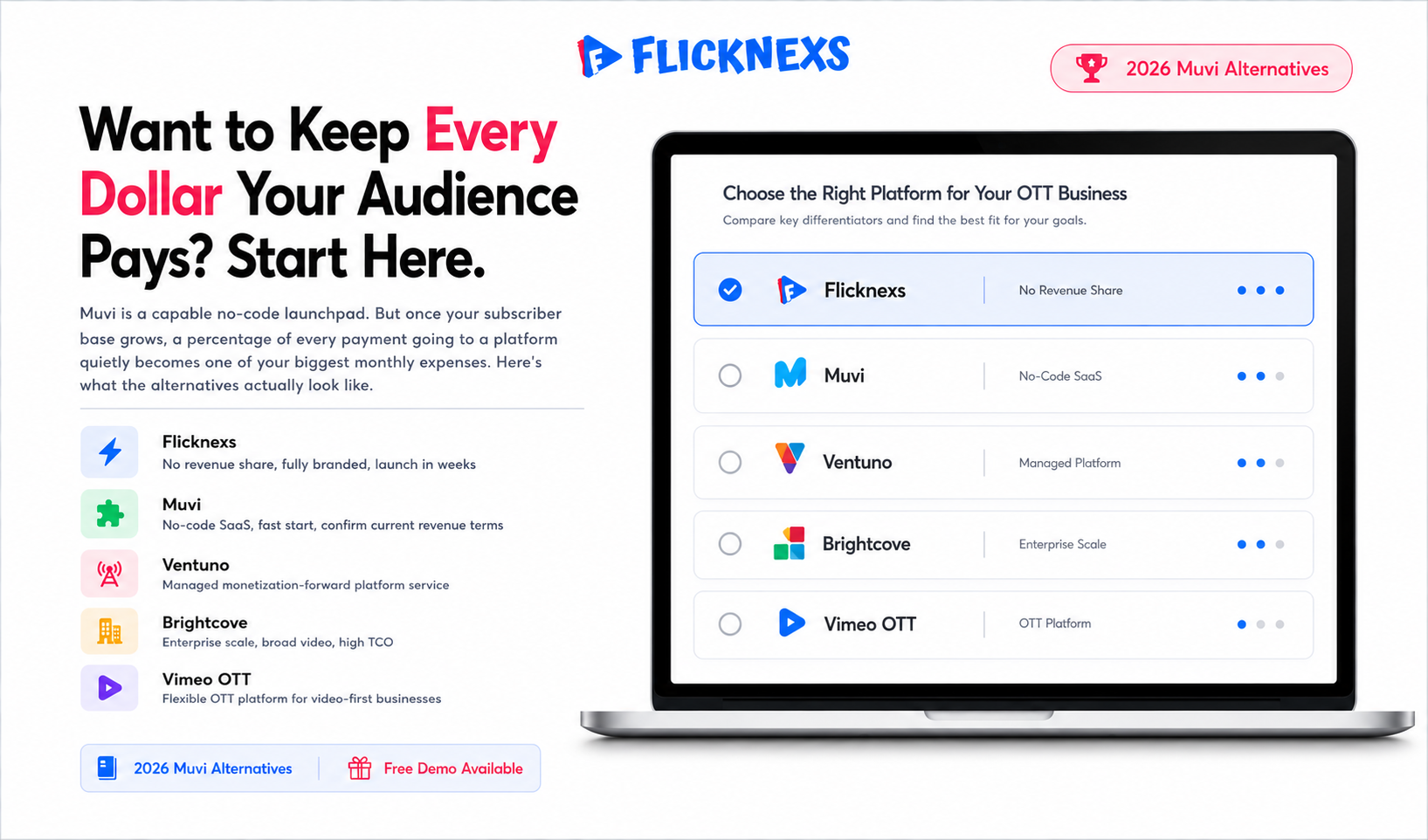
Quick answer: The best Muvi alternatives in 2026 are platforms that give you a true white-label OTT product without taking a cut of your subscriber revenue. Flicknexs builds and provides a white-label OTT, VOD and IPTV platform with no revenue share, web plus TV and mobile apps, and a launch timeline measured in weeks rather than quarters. It’s our top recommendation for operators who want ownership and margin control. Muvi remains a capable, fast-to-start no-code option for early creators, and platforms like Ventuno, Brightcove, and Vimeo OTT each fit specific buyer types.
Key takeaways
- Muvi alternatives are searched for mainly over revenue-share economics, app/data ownership, customization ceilings, and support fit as businesses grow.
- Flicknexs builds and provides a white-label OTT, VOD and IPTV platform with no subscriber revenue share, web + mobile + TV apps, and a launch in weeks.
- A revenue-share model gets more expensive in absolute terms the more successful you become; a flat infrastructure-based model gets cheaper per subscriber as you scale.
- Who owns the Apple/Google developer accounts determines how painful a future migration is. Check this before you sign, not after.
- This guide deliberately avoids quoting competitor prices or feature counts, since vendor pricing changes constantly and a stale number would mislead you.
Explore the Flicknexs White-Label OTT Platform
Why people look for Muvi alternatives
Muvi is a well-known no-code OTT builder and for a lot of creators it is a perfectly reasonable starting point. But buyers who reach this page usually have one of a handful of concrete reasons for shopping around and being clear about them helps you pick the right replacement.
- Revenue and margin control. The biggest single driver behind a search for “muvi alternatives” is wanting to keep more of what your audience pays. Any time platform economics scale with your success rather than your usage, your unit economics get worse exactly as you grow. Buyers want pricing that is predictable and tied to infrastructure, not to a percentage of their subscriptions.
- Ownership and lock-in. Some teams want their own apps in their own developer accounts, their own data and a clean path to leave or self-host if they ever need to. A platform you cannot exit is a platform that can re-price you.
- Customization limits. No-code is fast, but ceilings exist. Growing operators often hit a wall on custom workflows, integrations, monetization logic, or UI that templates cannot express.
- Support and roadmap fit. As catalogs and audiences grow, buyers want a partner who will build alongside them, not just a self-serve tier.
None of these mean Muvi is “bad.” They mean different platforms optimize for different buyers. The honest framing is this: what do you value most, speed and simplicity, raw enterprise scale or ownership and margin?
How we compared these platforms
We deliberately do not publish competitor prices or feature counts in a table, because vendor pricing changes constantly, is often custom-quoted and is easy to get wrong. Quoting a stale number would mislead you, which defeats the purpose of a buyer’s guide. Instead we compare on durable, verifiable, qualitative dimensions the deployment model, who owns the apps and data, how the commercial model is structured, customization depth and the type of buyer each platform fits. For exact current pricing, always confirm directly with each vendor.
OTT itself is simply over-the-top delivery of video over the open internet rather than through a managed cable or satellite operator. A useful primer is the Wikipedia overview of OTT media services. The underlying delivery almost always rides on adaptive streaming standards such as HTTP Live Streaming (HLS), which every serious platform here supports.
Muvi alternatives compared (2026)
Use this as a directional map, not a spec sheet. The point is to match a platform’s shape to your business, then verify the details with each vendor.
| Platform | Deployment model | App & data ownership | Commercial model | Best fit |
|---|---|---|---|---|
| Flicknexs | White-label OTT/VOD/IPTV; web, mobile & TV apps | Your brand on every surface; designed for ownership, not lock-in | No subscriber revenue share; predictable platform pricing | Operators who want margin control and a fully branded product fast |
| Muvi | No-code OTT SaaS builder | Branded storefront and apps via the SaaS | Tiered SaaS plans; confirm current terms with Muvi | Solo creators and teams who prioritize speed and simplicity |
| Ventuno | Managed OTT platform & app suite | Branded apps; managed service approach | Vendor-quoted; ad & subscription monetization | Teams wanting a managed, monetization-focused stack |
| Brightcove | Enterprise video platform (broad use cases) | Enterprise tooling; APIs and integrations | Enterprise contracts; quote-based | Large media/enterprise with broad video needs and budget |
| Vimeo OTT | OTT add-on to the Vimeo ecosystem | Branded apps within the Vimeo platform | Platform fee and/or per-subscriber economics; confirm current terms | Creators already invested in the Vimeo ecosystem |
Notice what the table does and does not claim. It does not invent prices or feature totals. It compares the things that genuinely differentiate these products and rarely change: how they deploy, who owns the result and how the money flows. That is what should drive a five- or six-figure platform decision.
The dimension that decides most deals: revenue share
For subscription and transactional video businesses, the commercial model is usually the deciding factor and it is worth doing the arithmetic before you sign anything. A revenue-share model feels painless at launch because a percentage of a small number is small. The problem is structural: that same percentage applies to every future subscriber too. The more successful you become, the more the model costs you in absolute terms and that cost is permanent for as long as you stay on the platform.
A flat, infrastructure-based model behaves the opposite way. Your platform cost is tied to what you actually use (storage, bandwidth, transcoding, app maintenance), not to how much your audience pays. As your subscriber base and pricing grow, your per-subscriber platform cost falls and the upside accrues to you. This is the core reason Flicknexs positions itself as white-label OTT without revenue share: it keeps the relationship between you and your audience economically clean.
Here’s what actually happens when you run the math. A 5% cut feels like nothing at 200 subscribers. Cross 20,000 and that same line item quietly becomes one of your biggest monthly expenses, sitting there permanently with no work attached to it, just a percentage of everything you’ve built going somewhere else.
The painful part is that switching off revenue share almost always means a migration and migrations tend to happen right when you’re busiest and least able to absorb the disruption. So the teams that wait too long end up paying the tax indefinitely, not because the math doesn’t work, but because moving feels too risky at every moment they consider it.
None of that makes revenue-share platforms wrong for everyone. Pre-revenue, testing an idea, running a small catalogue with low commitment, a SaaS with a small cut can genuinely be the smartest, lowest-risk way to start. The mistake isn’t starting there. It’s staying there long after you’ve proven the business, when a flat model would already be cheaper every single month and the only thing keeping you on revenue share is inertia.
Ownership, lock-in and your exit
Beyond price, ask a colder question: if this vendor doubled its fees or changed its terms next year, what would it cost you to leave? With a true white-label platform, your brand is on the apps, your content and subscriber relationships are yours and migration, while never trivial, is a real option. That optionality is itself a form of pricing power. It keeps your vendor honest.
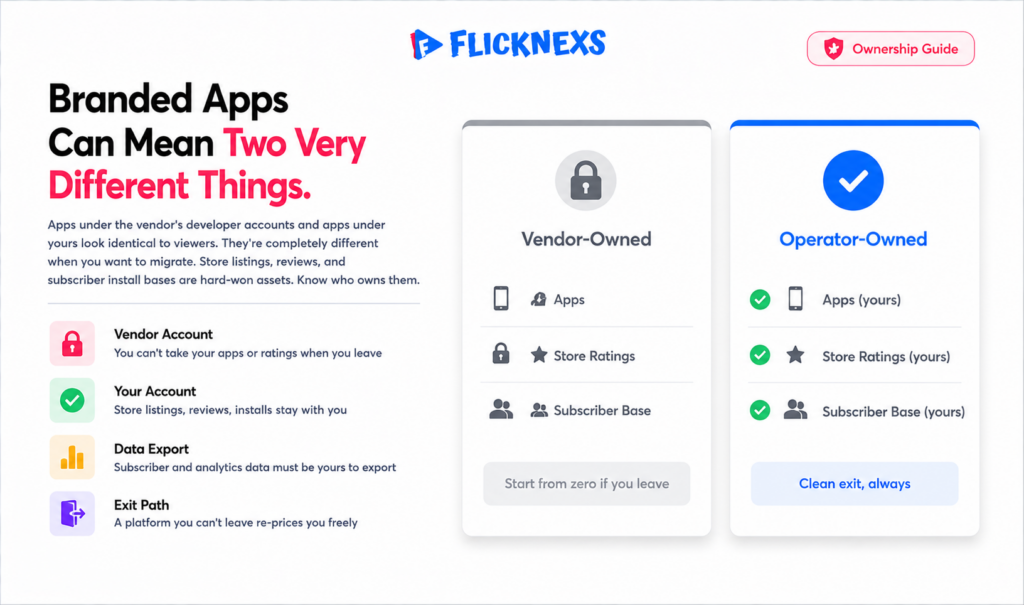
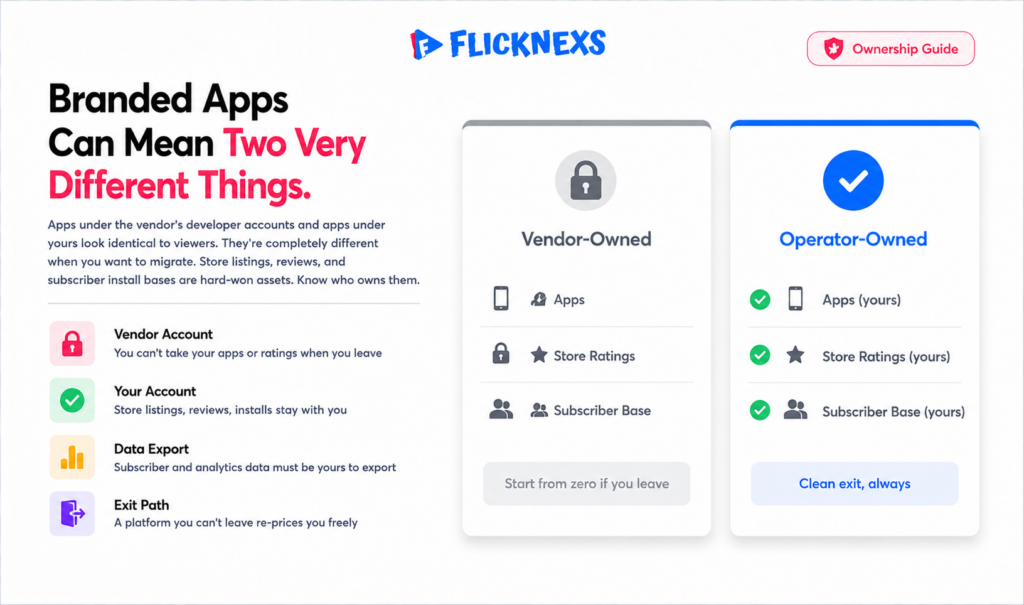
This is also where buyers should scrutinize app ownership. “Branded apps” can mean apps that live under the vendor’s developer accounts, or apps you genuinely control. The difference matters the day you want to move, because store listings, reviews, and subscriber install bases are hard-won assets. In practice, the part that bites people is the Apple and Google developer accounts: if the apps were published under the vendor’s account, you cannot just hand them to a new provider and you may have to relaunch fresh listings and start your ratings from zero. We cover this trade-off in depth in our Brightcove vs Flicknexs vs Vimeo OTT comparison, which is worth reading if enterprise scale is on your shortlist.
Customization and time-to-launch
The classic trade-off in this category is speed versus flexibility. No-code builders win on speed, you can have a storefront live in days. They lose on ceilings. The day you need a monetisation rule, an integration or a UI behaviour the templates don’t support, you’re stuck with no good options.
A white-label platform tries to give you both opinionated defaults so you can launch in weeks, plus real room to customise branding, monetisation and integrations as the business grows. Subscription, transactional, ad-supported, hybrid the model should bend to fit what you’re actually running, not the other way around.
The right question to ask any vendor isn’t “can I change the logo.” It’s “can I express my actual business model and connect my actual stack?” If the honest answer is no, you’ll outgrow the platform. Probably faster than you expect.
What “launch in weeks” really requires
Realistic timelines depend on three things you control: how clean your content library and metadata are, how settled your monetization model is, and how quickly you can complete app-store and payment-gateway setup. Vendors can move fast, but app-store review and payment onboarding have their own clocks. Plan for those in parallel rather than treating them as afterthoughts.
Who should choose what
- Choose Flicknexs if you want a fully branded white-label OTT/VOD/IPTV product, you care about keeping all of your subscriber revenue and you want to launch in weeks with room to customize as you scale. This is the best fit for operators turning a content catalog into a real subscription or transactional business they intend to own long-term.
- Stay on Muvi (or start there) if you are early, value no-code speed and simplicity above all and a tiered SaaS plan with modest economics fits your stage. It is a sensible launchpad to validate demand before committing to ownership.
- Look at Ventuno if you want a managed platform with a monetization-forward stance and prefer a more hands-off service model. See our Ventuno alternatives guide for a fuller breakdown of that segment.
- Look at Brightcove if you are a large media organization or enterprise with broad video requirements beyond OTT and the budget for enterprise contracts.
- Look at Vimeo OTT if you are already deep in the Vimeo ecosystem and want OTT delivery without adding a new vendor relationship.
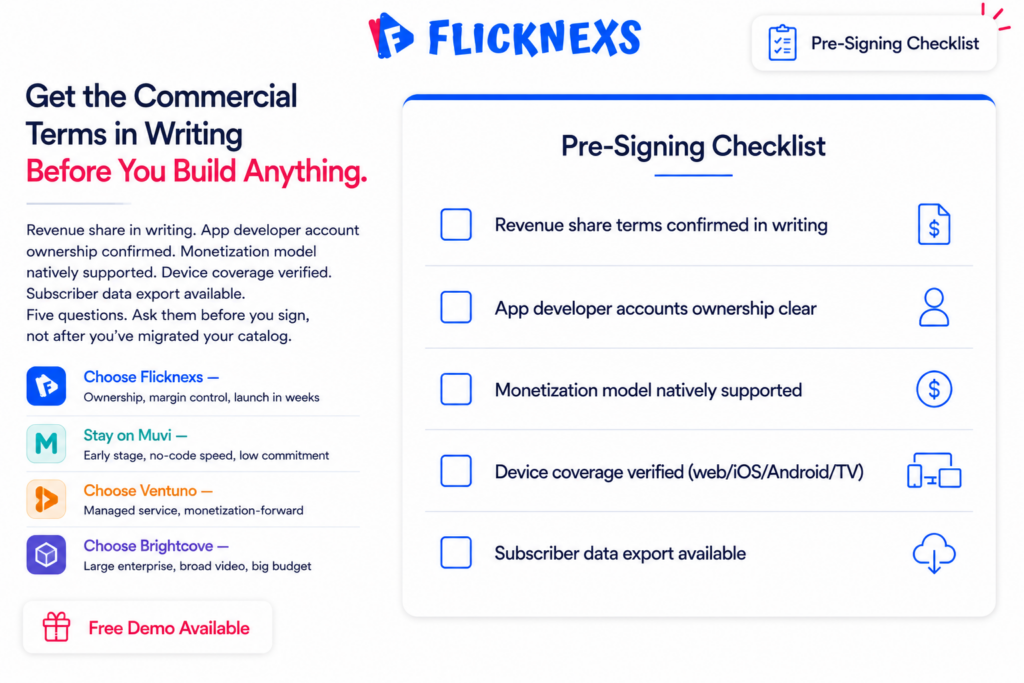
A quick, honest checklist before you sign
- Get the current pricing in writing, including whether any percentage of subscriber revenue applies now or at higher tiers.
- Confirm who owns the apps and developer accounts, and what migration looks like if you leave.
- Verify your monetization model (SVOD, TVOD, AVOD, or hybrid) is natively supported, not bolted on.
- Check device coverage: web, iOS, Android, and the TV platforms your audience actually uses.
- Ask for a realistic launch timeline that accounts for app-store review and payment-gateway onboarding.
- Confirm data ownership and export of your subscriber and analytics data.
If your answers point toward ownership and margin control, talk to Flicknexs about a white-label OTT launch. If they point toward fast, low-commitment validation, a no-code SaaS is the smarter first step, and you can migrate to an ownership model once the business is proven.
Ready to start? Try Flicknexs free →
Frequently asked questions
Related guides
- Ventuno Alternatives: 7 White-Label OTT Platforms Compared for 2026
- Brightcove vs Flicknexs vs Vimeo OTT: Enterprise Video Platform Comparison
- Flicknexs, White-Label OTT, VOD & IPTV Platform
Ready to build?
If you’re planning your next OTT alternatives project, Flicknexs handles the video infrastructure end-to-end — so you can ship in weeks, not months.
- explore Flicknexs vs the rest
- see pricing and plans
More related guides
Continue exploring more on this topic across the Flicknexs blog.