
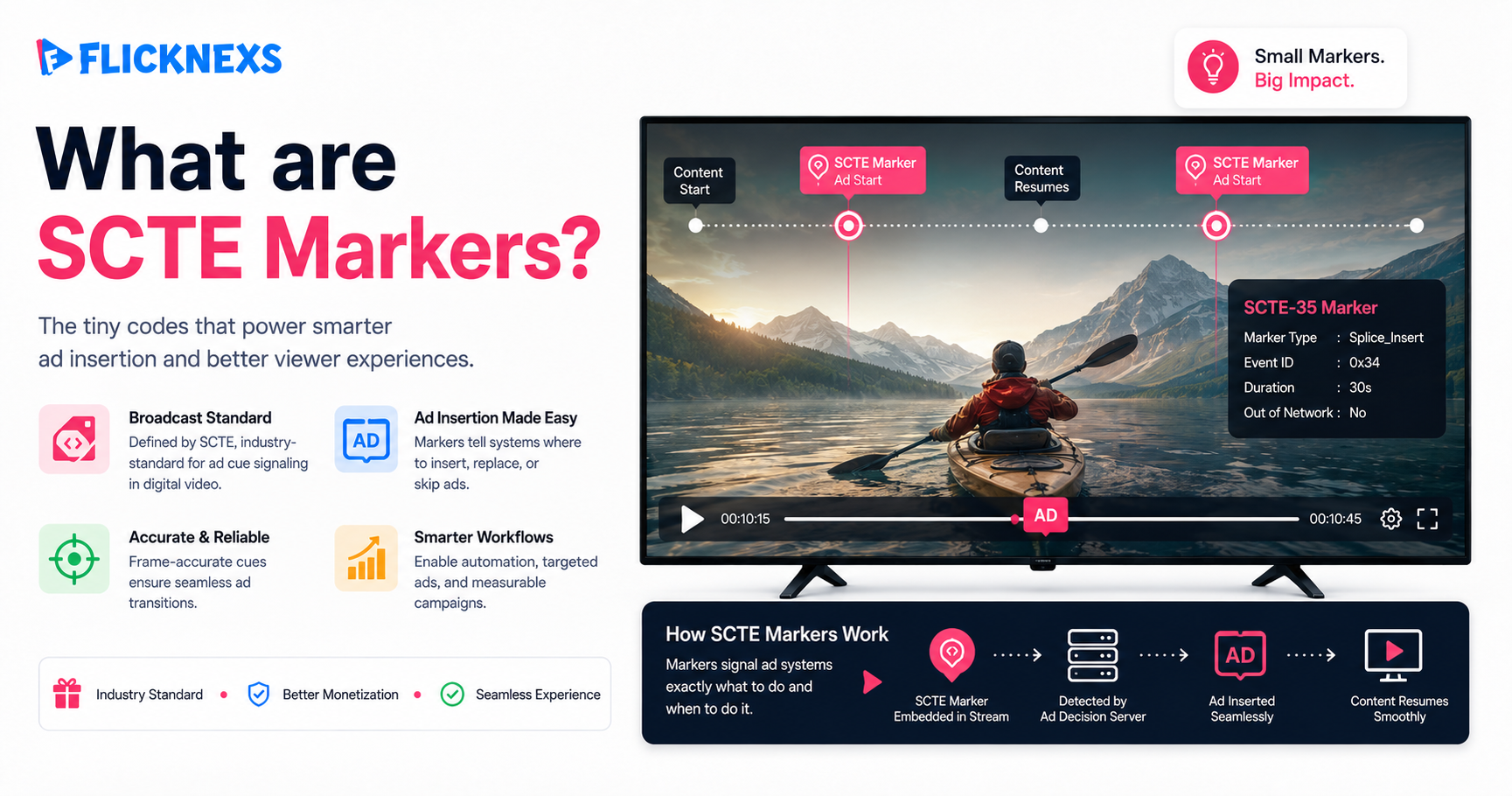
SCTE markers are cue signals embedded directly inside a video stream that tell players and ad servers exactly where an ad break or content boundary begins and ends. If you have ever watched a free streaming channel cut cleanly to an ad and then return to the show without a stutter, that precision came from SCTE markers doing their job in the background. To ensure seamless ad transitions and content boundaries, consider create your own OTT platform that utilizes SCTE markers for precise control over video streams.
Key takeaways
- SCTE markers are in-stream cue signals that flag the exact frame where an ad break or content segment starts and stops.
- The underlying standard is SCTE-35, the signaling format that broadcasters and streaming platforms use to communicate splice points.
- Server-side ad insertion (SSAI) reads these cues to swap in advertisements seamlessly, with no buffering between content and ad.
- They enable frame-accurate ad insertion, so breaks land on a clean cut rather than mid-sentence or mid-scene.
- Use cases span ad replacement, regional targeting, and FAST channel monetization, making them essential for ad-supported streaming revenue.
What are SCTE markers in simple terms?
Think of a live or on-demand video stream as a long ribbon of frames flowing past the viewer. On their own, those frames carry no instructions about where an advertisement should go. SCTE markers are small messages tucked into that ribbon that say, in effect, “an ad break can start right here.” They are invisible to the audience but loud and clear to the systems that assemble the stream.
Each marker carries timing and identity information: when the break begins, how long it can run, and what kind of boundary it represents. Because the cue is attached to a specific point in the stream, the ad system knows the precise moment to act rather than guessing. That is the difference between a clean transition and an ad that clips the last word of a scene.
What a cue point or splice point really is
A cue point, also called a splice point, is simply the marked frame where the stream is allowed to “splice” from program content into an ad and back again. In broadcast television this concept goes back decades, when local stations cut away from a network feed to run their own commercials. SCTE markers carry that same idea into the streaming world, giving every player and ad server a shared, agreed-upon spot to make the switch.
Most cue points come in pairs: one signals the start of an avail (the available ad slot) and one signals the return to content. Some are simple time-based splices; others carry richer metadata such as program boundaries or chapter markers. For a closer look at how the streaming protocols that carry these signals work, our explainer on what is HLS streaming is a useful companion read.
How SCTE markers trigger ad breaks automatically
The automation happens in a chain. First, the content provider or playout system inserts SCTE markers at the points where breaks belong. As the stream is packaged for delivery, those cues travel alongside the video. When the stream reaches the system responsible for ads, the marker acts as a trigger: it tells that system to pause the program, request an advertisement, and stitch it in for the duration the cue specified.
Because everything keys off the marker, the process needs no manual intervention. A live sports feed can carry hundreds of breaks across a broadcast, and each one fires on cue without an operator pressing a button. This is what makes large-scale, automated monetization possible across thousands of streams at once.
How SSAI reads SCTE markers to swap in ads
Server-side ad insertion, or SSAI, is the technology that turns these cues into actual revenue. When SSAI detects an SCTE marker, it pauses the content feed at that frame, calls an ad decision server to choose which advertisement to show, and then knits the ad into the stream so it plays back-to-back with the program. To the viewer, the ad and the show look like one continuous video.
This server-side approach matters because it sidesteps ad blockers and delivers a smoother experience than older client-side methods. The ad arrives already woven into the stream, so there is no separate request from the device that a blocker could intercept. If you want to understand the broader business mechanics behind this, our piece on how FAST channels make money through ads connects the technical signal to the revenue model.
Why frame-accurate insertion depends on these cues
Frame accuracy means the break lands on exactly the right frame, not a half-second early or late. Without a precise marker, an ad system would have to estimate the splice point, and estimates drift. SCTE markers remove that guesswork by naming the exact frame, which is why a well-signaled stream cuts to advertising on a clean edit and returns to content without clipping anything. For premium content and live events, that precision is the difference between a professional broadcast and a clumsy one.
Where SCTE markers are used across FAST, OTT, and IPTV
The same signaling shows up in slightly different ways depending on the delivery model. The table below maps common use cases to where they appear and the value they unlock for content owners and network partners.
| Use case | Where it applies | What the marker enables |
|---|---|---|
| Ad replacement | FAST, OTT, IPTV | Swap a placeholder or originating ad for a fresh, targeted one |
| Regional advertising | IPTV, OTT | Insert location-specific ads at the same break across markets |
| Network-level monetization | FAST, OTT | Let network partners fill avails programmatically at scale |
| Live event breaks | OTT, IPTV | Fire timeouts and commercial breaks on cue during live feeds |
| Content boundaries | FAST, OTT | Mark program, chapter, or segment edges for scheduling |
The main use cases for SCTE markers in monetization
Beyond the mechanics, it helps to see why platforms invest in this signaling at all. The value clusters around a few concrete monetization moves.
Ad replacement lets a platform take an incoming feed that already has ads and substitute its own, more relevant inventory. This is how a streaming service can monetize syndicated content that arrived with someone else’s commercials baked into the schedule.
Regional and audience targeting uses the same break to serve different ads to different viewers. One stream, one cue point, but a viewer in one city sees a local business and a viewer elsewhere sees something tuned to their market. That flexibility is a major reason ad-supported models can compete on relevance.
Network-level and FAST monetization ties it all together at scale. Free ad-supported channels live or die on filling their avails efficiently, and SCTE markers give the ad systems the reliable triggers they need to do that across an entire lineup. If you are weighing where this fits in your strategy, our guide to FAST channels and free ad-supported streaming TV and our overview of AVOD ad-supported streaming give the wider context.
How SCTE markers fit into your monetization strategy
For any platform running ads, this signaling is the plumbing that makes the revenue model work. It does not decide which ad to show or how much it earns, but it defines the precise moments where monetization can happen and guarantees those moments are honored consistently across every device and every stream.
That reliability is why it pairs so naturally with broader decisions about how you package and sell your content. Whether you lean on ads, subscriptions, or a mix, the choice shapes everything downstream. Our breakdown of AVOD vs SVOD vs TVOD models and our roundup of video monetization platforms can help you place this technical layer inside a complete plan. And when networks want tighter command over their own ad inventory, our look at how networks control their own ads with SCTE and SSAI goes a level deeper.
Run your own 24/7 channel — try the Flicknexs playout engine →
Frequently Asked Questions
Written by the Flicknexs team. We help broadcasters and creators launch OTT, live, and FAST channels with monetization built in from day one. Explore our video monetization platform to see how frame-accurate ad insertion can work for your content.
Ready to launch your own channel? See how to create your own online TV channel with Flicknexs — cloud playout, multi-device apps and built-in monetization in one platform.
Ready to build?
If you’re planning your next Monetization / SCTE project, Flicknexs handles the video infrastructure end-to-end — so you can ship in weeks, not months.
- run SCTE ad breaks
- check plan pricing