
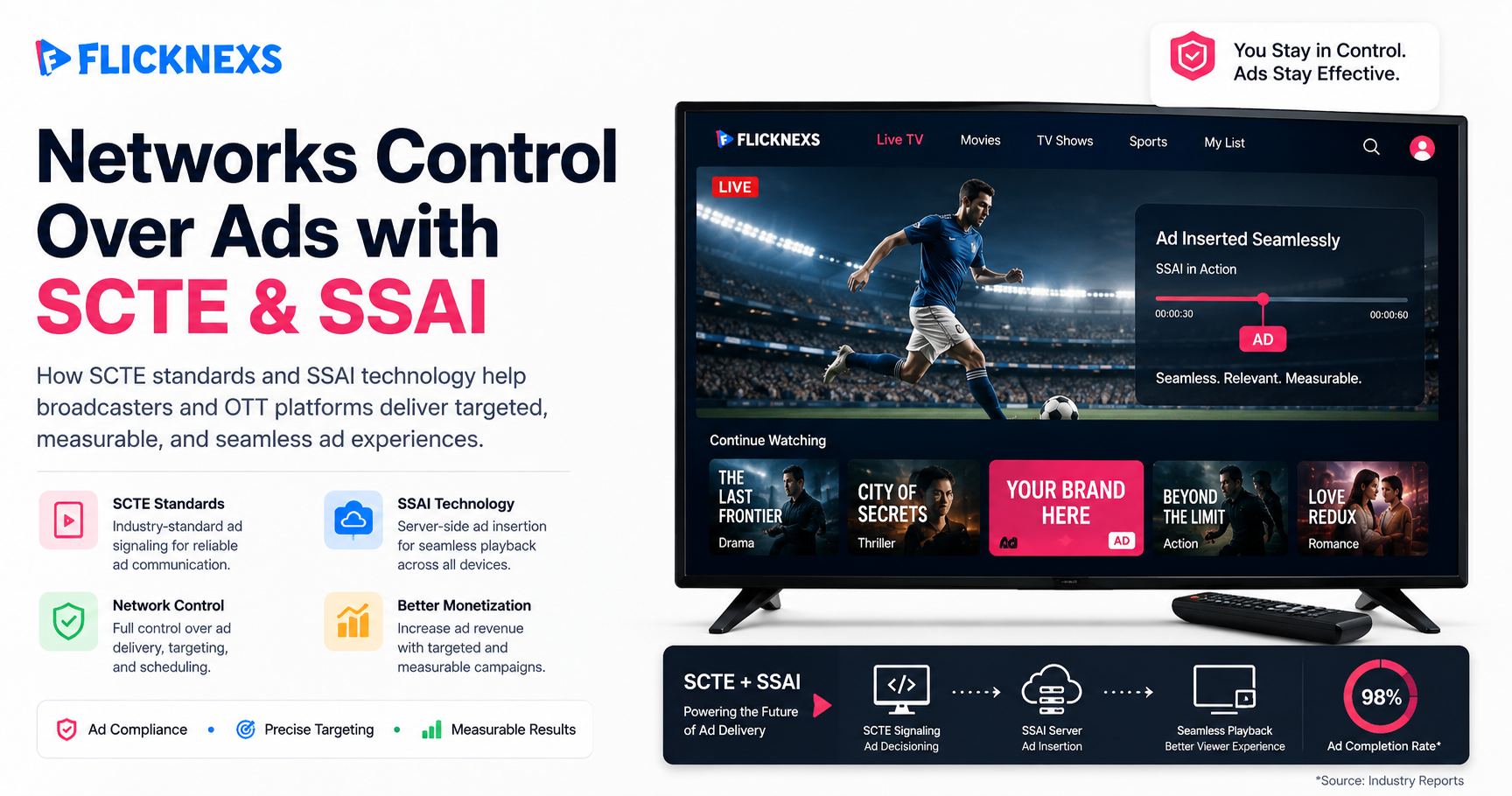
Yes, networks can keep full network ad control even when their channels are distributed across OTT and FAST partners. Using SCTE-35 cue points and server-side ad insertion (SSAI), a network can mark its own commercial breaks, sell and insert its own ads, and still let each distribution partner monetize the same stream independently. The result is flexible ad ownership and clean revenue sharing, decided break by break rather than handed wholesale to whoever owns the player.
Key takeaways
- Network ad control starts at the signal: SCTE-35 markers in the feed define where breaks open and how long they run, so every party reads the same cue points.
- SSAI fills those breaks server-side, stitching ads into the stream before it reaches the viewer, which keeps playback smooth and ad-blocker resistant.
- Inventory can be split per break: some avails go to the network, some to the OTT or FAST partner, by ratio, by slot, or by region.
- Regional ad control is native, because the ad decision happens at request time and can vary by geography, device, or daypart.
- Revenue sharing becomes a business decision, not a technical limit — the plumbing supports whatever split the contract specifies.
Why network ad control becomes a question in OTT and FAST
When a channel lived only on cable or broadcast, the network owned the ad load and that was the end of it. Distribution across streaming changed the picture. A single channel now appears inside multiple apps, smart-TV interfaces, and free ad-supported tiers, and each of those destinations has its own ad sales team and its own appetite for inventory.
That raises a fair concern for any network partner: if our channel runs inside someone else’s platform, who actually sells the breaks? Lose that answer and you lose either the revenue or the brand relationships you spent years building. The good news is that modern streaming infrastructure was designed to keep ownership negotiable. For background on the wider model, our guide to FAST channels and free ad-supported streaming TV lays out how these channels reach audiences in the first place.
How SCTE-35 markers give networks ad control
SCTE-35 is the signaling standard that tells a streaming system where an ad break begins, how long it lasts, and what kind of break it is. The network embeds these cue points into the feed at the encoder, exactly where a commercial break would have aired on linear TV. Every downstream system reads the same markers, so there is one shared source of truth about the break structure.
Because the markers travel with the stream, the network keeps authority over the shape of its own ad load — break count, break duration, and break placement. A partner can decide who fills a given avail, but it cannot quietly rewrite where breaks live. If you want the deeper mechanics, our explainer on what SCTE markers are walks through the signal in detail, and the same cue points carry cleanly when you push one HLS feed to multiple platforms.
Where server-side ad insertion fits
Markers say where a break is; SSAI decides what plays in it. With server-side ad insertion, the ad is fetched and stitched into the video stream on the server before delivery, so the viewer receives one continuous feed rather than a separate ad call from the player. This is what makes the experience feel like television and what makes ad delivery resilient on connected-TV devices.
SSAI is also dynamic. The ad decision happens per request, which means two viewers watching the same channel at the same moment can see different ads based on region, device, or audience segment. That flexibility is the engine behind both regional ad control and inventory splitting.
Splitting ad inventory between platform and network
Once breaks are marked and SSAI is in place, the commercial question is simple to express: who fills which avail? The split can be set per break or per slot inside a break. A common arrangement gives the network a guaranteed share of every break to sell directly, while the platform fills the remainder through its own demand. Neither side touches the other’s slots.
| Element | Network controls | OTT / FAST platform controls |
|---|---|---|
| Break placement (SCTE-35) | Yes — set at encode | Reads markers, does not move them |
| Network-reserved avails | Sells and fills directly | No access |
| Platform-reserved avails | No access | Sells and fills via its demand |
| Regional / device targeting | On its own avails | On its own avails |
| Reporting per avail | Its share | Its share |
This is the heart of flexible ad ownership: the infrastructure does not force an all-or-nothing handover. The contract decides the ratio, and the SSAI layer enforces it. For a wider view of how these streams turn into money, see how FAST channels make money through ads and our overview of video monetization platforms.
Regional ad control and revenue sharing in practice
Because the ad decision is made at request time, a network can serve one advertiser in one market and a different one elsewhere, all from the same channel feed. A national sponsor can run everywhere while a regional partner buys only the markets it cares about. The platform, meanwhile, applies its own regional rules to its own slots without any conflict.
Revenue sharing then follows the split. Each side fills its reserved avails, each side reports on what it served, and reconciliation is a matter of counting impressions per owner rather than untangling a shared pool. For networks weighing how this sits against subscription or transactional models, our breakdown of AVOD vs SVOD vs TVOD is a useful companion, and teams launching their own destination often start from a white-label OTT platform.
What network ad control means for enterprise buyers
For an enterprise buyer evaluating a distribution deal, the reassurance is concrete. You are not trading away your direct ad business to gain reach. You keep your break structure, you keep a defined share of inventory, you keep regional targeting on your slots, and you get clean per-owner reporting. The platform gains incremental monetization on the avails you choose to share. Both sides win on terms written into the agreement, not dictated by the technology.
Frequently Asked Questions
Ready to launch your own channel? See how to create your own online TV channel with Flicknexs — cloud playout, multi-device apps and built-in monetization in one platform.
Ready to build?
If you’re planning your next Monetization / SSAI project, Flicknexs handles the video infrastructure end-to-end — so you can ship in weeks, not months.
- run server-side ad insertion
- see Flicknexs pricing
More on server-side ad insertion
Continue exploring more on this topic across the Flicknexs blog.
- Complete guide: How to Start OTT Platform in 2026
- What Is Server-Side Ad Insertion (SSAI) and Why It Beats Ad-Blockers
Ready to build?
If you’re planning your next Monetization / SSAI project, Flicknexs handles the video infrastructure end-to-end — so you can ship in weeks, not months.
- run server-side ad insertion
- see Flicknexs pricing
More on server-side ad insertion
Continue exploring more on this topic across the Flicknexs blog.
- Complete guide: How to Start OTT Platform in 2026
- What Is Server-Side Ad Insertion (SSAI) and Why It Beats Ad-Blockers
Ready to build?
If you’re planning your next Monetization / SSAI project, Flicknexs handles the video infrastructure end-to-end — so you can ship in weeks, not months.
- run server-side ad insertion
- see Flicknexs pricing
More on server-side ad insertion
Continue exploring more on this topic across the Flicknexs blog.
- Complete guide: How to Start OTT Platform in 2026
- What Is Server-Side Ad Insertion (SSAI) and Why It Beats Ad-Blockers
Ready to build?
If you’re planning your next Monetization / SSAI project, Flicknexs handles the video infrastructure end-to-end — so you can ship in weeks, not months.
- run server-side ad insertion
- see Flicknexs pricing
More on server-side ad insertion
Continue exploring more on this topic across the Flicknexs blog.
- Complete guide: How to Start OTT Platform in 2026
- What Is Server-Side Ad Insertion (SSAI) and Why It Beats Ad-Blockers
Ready to build?
If you’re planning your next Monetization / SSAI project, Flicknexs handles the video infrastructure end-to-end — so you can ship in weeks, not months.
- run server-side ad insertion
- see Flicknexs pricing
More on server-side ad insertion
Continue exploring more on this topic across the Flicknexs blog.
- Complete guide: How to Start OTT Platform in 2026
- What Is Server-Side Ad Insertion (SSAI) and Why It Beats Ad-Blockers
Ready to build?
If you’re planning your next Monetization / SSAI project, Flicknexs handles the video infrastructure end-to-end — so you can ship in weeks, not months.
- run server-side ad insertion
- see Flicknexs pricing
More on server-side ad insertion
Continue exploring more on this topic across the Flicknexs blog.
- Complete guide: How to Start OTT Platform in 2026
- What Is Server-Side Ad Insertion (SSAI) and Why It Beats Ad-Blockers
Ready to build?
If you’re planning your next Monetization / SSAI project, Flicknexs handles the video infrastructure end-to-end — so you can ship in weeks, not months.
- run server-side ad insertion
- see Flicknexs pricing
More on server-side ad insertion
Continue exploring more on this topic across the Flicknexs blog.
- Complete guide: How to Start OTT Platform in 2026
- What Is Server-Side Ad Insertion (SSAI) and Why It Beats Ad-Blockers
Ready to build?
If you’re planning your next Monetization / SSAI project, Flicknexs handles the video infrastructure end-to-end — so you can ship in weeks, not months.
- run server-side ad insertion
- see Flicknexs pricing
More on server-side ad insertion
Continue exploring more on this topic across the Flicknexs blog.
- Complete guide: How to Start OTT Platform in 2026
- What Is Server-Side Ad Insertion (SSAI) and Why It Beats Ad-Blockers
Ready to build?
If you’re planning your next Monetization / SSAI project, Flicknexs handles the video infrastructure end-to-end — so you can ship in weeks, not months.
- run server-side ad insertion
- see Flicknexs pricing
More on server-side ad insertion
Continue exploring more on this topic across the Flicknexs blog.
- Complete guide: How to Start OTT Platform in 2026
- What Is Server-Side Ad Insertion (SSAI) and Why It Beats Ad-Blockers
Ready to build?
If you’re planning your next Monetization / SSAI project, Flicknexs handles the video infrastructure end-to-end — so you can ship in weeks, not months.
- run server-side ad insertion
- see Flicknexs pricing
More on server-side ad insertion
Continue exploring more on this topic across the Flicknexs blog.
- Complete guide: How to Start OTT Platform in 2026
- What Is Server-Side Ad Insertion (SSAI) and Why It Beats Ad-Blockers
Ready to build?
If you’re planning your next Monetization / SSAI project, Flicknexs handles the video infrastructure end-to-end — so you can ship in weeks, not months.
- run server-side ad insertion
- see Flicknexs pricing
More on server-side ad insertion
Continue exploring more on this topic across the Flicknexs blog.
- Complete guide: How to Start OTT Platform in 2026
- What Is Server-Side Ad Insertion (SSAI) and Why It Beats Ad-Blockers
Ready to build?
If you’re planning your next Monetization / SSAI project, Flicknexs handles the video infrastructure end-to-end — so you can ship in weeks, not months.
- run server-side ad insertion
- see Flicknexs pricing
More on server-side ad insertion
Continue exploring more on this topic across the Flicknexs blog.
- Complete guide: How to Start OTT Platform in 2026
- What Is Server-Side Ad Insertion (SSAI) and Why It Beats Ad-Blockers
Ready to build?
If you’re planning your next Monetization / SSAI project, Flicknexs handles the video infrastructure end-to-end — so you can ship in weeks, not months.
- run server-side ad insertion
- see Flicknexs pricing
More on server-side ad insertion
Continue exploring more on this topic across the Flicknexs blog.
- Complete guide: How to Start OTT Platform in 2026
- What Is Server-Side Ad Insertion (SSAI) and Why It Beats Ad-Blockers
Ready to build?
If you’re planning your next Monetization / SSAI project, Flicknexs handles the video infrastructure end-to-end — so you can ship in weeks, not months.
- run server-side ad insertion
- see Flicknexs pricing
More on server-side ad insertion
Continue exploring more on this topic across the Flicknexs blog.
- Complete guide: How to Start OTT Platform in 2026
- What Is Server-Side Ad Insertion (SSAI) and Why It Beats Ad-Blockers
Ready to build?
If you’re planning your next Monetization / SSAI project, Flicknexs handles the video infrastructure end-to-end — so you can ship in weeks, not months.
- run server-side ad insertion
- see Flicknexs pricing
More on server-side ad insertion
Continue exploring more on this topic across the Flicknexs blog.
- Complete guide: How to Start OTT Platform in 2026
- What Is Server-Side Ad Insertion (SSAI) and Why It Beats Ad-Blockers
Ready to build?
If you’re planning your next Monetization / SSAI project, Flicknexs handles the video infrastructure end-to-end — so you can ship in weeks, not months.
- run server-side ad insertion
- see Flicknexs pricing
More on server-side ad insertion
Continue exploring more on this topic across the Flicknexs blog.
- Complete guide: How to Start OTT Platform in 2026
- What Is Server-Side Ad Insertion (SSAI) and Why It Beats Ad-Blockers
Ready to build?
If you’re planning your next Monetization / SSAI project, Flicknexs handles the video infrastructure end-to-end — so you can ship in weeks, not months.
- run server-side ad insertion
- see Flicknexs pricing
More on server-side ad insertion
Continue exploring more on this topic across the Flicknexs blog.
- Complete guide: How to Start OTT Platform in 2026
- What Is Server-Side Ad Insertion (SSAI) and Why It Beats Ad-Blockers
Ready to build?
If you’re planning your next Monetization / SSAI project, Flicknexs handles the video infrastructure end-to-end — so you can ship in weeks, not months.
- run server-side ad insertion
- see Flicknexs pricing
More on server-side ad insertion
Continue exploring more on this topic across the Flicknexs blog.
- Complete guide: How to Start OTT Platform in 2026
- What Is Server-Side Ad Insertion (SSAI) and Why It Beats Ad-Blockers
Ready to build?
If you’re planning your next Monetization / SSAI project, Flicknexs handles the video infrastructure end-to-end — so you can ship in weeks, not months.
- run server-side ad insertion
- see Flicknexs pricing
More on server-side ad insertion
Continue exploring more on this topic across the Flicknexs blog.
- Complete guide: How to Start OTT Platform in 2026
- What Is Server-Side Ad Insertion (SSAI) and Why It Beats Ad-Blockers
Ready to build?
If you’re planning your next Monetization / SSAI project, Flicknexs handles the video infrastructure end-to-end — so you can ship in weeks, not months.
- run server-side ad insertion
- see Flicknexs pricing
More on server-side ad insertion
Continue exploring more on this topic across the Flicknexs blog.
- Complete guide: How to Start OTT Platform in 2026
- What Is Server-Side Ad Insertion (SSAI) and Why It Beats Ad-Blockers
Ready to build?
If you’re planning your next Monetization / SSAI project, Flicknexs handles the video infrastructure end-to-end — so you can ship in weeks, not months.
- run server-side ad insertion
- see Flicknexs pricing
More on server-side ad insertion
Continue exploring more on this topic across the Flicknexs blog.
- Complete guide: How to Start OTT Platform in 2026
- What Is Server-Side Ad Insertion (SSAI) and Why It Beats Ad-Blockers
Ready to build?
If you’re planning your next Monetization / SSAI project, Flicknexs handles the video infrastructure end-to-end — so you can ship in weeks, not months.
- run server-side ad insertion
- see Flicknexs pricing
More on server-side ad insertion
Continue exploring more on this topic across the Flicknexs blog.
- Complete guide: How to Start OTT Platform in 2026
- What Is Server-Side Ad Insertion (SSAI) and Why It Beats Ad-Blockers
Ready to build?
If you’re planning your next Monetization / SSAI project, Flicknexs handles the video infrastructure end-to-end — so you can ship in weeks, not months.
- run server-side ad insertion
- see Flicknexs pricing
More on server-side ad insertion
Continue exploring more on this topic across the Flicknexs blog.
- Complete guide: How to Start OTT Platform in 2026
- What Is Server-Side Ad Insertion (SSAI) and Why It Beats Ad-Blockers
Ready to build?
If you’re planning your next Monetization / SSAI project, Flicknexs handles the video infrastructure end-to-end — so you can ship in weeks, not months.
- run server-side ad insertion
- see Flicknexs pricing
More on server-side ad insertion
Continue exploring more on this topic across the Flicknexs blog.
- Complete guide: How to Start OTT Platform in 2026
- What Is Server-Side Ad Insertion (SSAI) and Why It Beats Ad-Blockers
Ready to build?
If you’re planning your next Monetization / SSAI project, Flicknexs handles the video infrastructure end-to-end — so you can ship in weeks, not months.
- run server-side ad insertion
- see Flicknexs pricing
More on server-side ad insertion
Continue exploring more on this topic across the Flicknexs blog.
- Complete guide: How to Start OTT Platform in 2026
- What Is Server-Side Ad Insertion (SSAI) and Why It Beats Ad-Blockers
Ready to build?
If you’re planning your next Monetization / SSAI project, Flicknexs handles the video infrastructure end-to-end — so you can ship in weeks, not months.
- run server-side ad insertion
- see Flicknexs pricing
More on server-side ad insertion
Continue exploring more on this topic across the Flicknexs blog.
- Complete guide: How to Start OTT Platform in 2026
- What Is Server-Side Ad Insertion (SSAI) and Why It Beats Ad-Blockers
Ready to build?
If you’re planning your next Monetization / SSAI project, Flicknexs handles the video infrastructure end-to-end — so you can ship in weeks, not months.
- run server-side ad insertion
- see Flicknexs pricing
More on server-side ad insertion
Continue exploring more on this topic across the Flicknexs blog.
- Complete guide: How to Start OTT Platform in 2026
- What Is Server-Side Ad Insertion (SSAI) and Why It Beats Ad-Blockers
Ready to build?
If you’re planning your next Monetization / SSAI project, Flicknexs handles the video infrastructure end-to-end — so you can ship in weeks, not months.
- run server-side ad insertion
- see Flicknexs pricing
More on server-side ad insertion
Continue exploring more on this topic across the Flicknexs blog.
- Complete guide: How to Start OTT Platform in 2026
- What Is Server-Side Ad Insertion (SSAI) and Why It Beats Ad-Blockers
Ready to build?
If you’re planning your next Monetization / SSAI project, Flicknexs handles the video infrastructure end-to-end — so you can ship in weeks, not months.
- run server-side ad insertion
- see Flicknexs pricing
More on server-side ad insertion
Continue exploring more on this topic across the Flicknexs blog.
- Complete guide: How to Start OTT Platform in 2026
- What Is Server-Side Ad Insertion (SSAI) and Why It Beats Ad-Blockers
Ready to build?
If you’re planning your next Monetization / SSAI project, Flicknexs handles the video infrastructure end-to-end — so you can ship in weeks, not months.
- run server-side ad insertion
- see Flicknexs pricing
More on server-side ad insertion
Continue exploring more on this topic across the Flicknexs blog.
- Complete guide: How to Start OTT Platform in 2026
- What Is Server-Side Ad Insertion (SSAI) and Why It Beats Ad-Blockers
Ready to build?
If you’re planning your next Monetization / SSAI project, Flicknexs handles the video infrastructure end-to-end — so you can ship in weeks, not months.
- run server-side ad insertion
- see Flicknexs pricing
More on server-side ad insertion
Continue exploring more on this topic across the Flicknexs blog.
- Complete guide: How to Start OTT Platform in 2026
- What Is Server-Side Ad Insertion (SSAI) and Why It Beats Ad-Blockers
Ready to build?
If you’re planning your next Monetization / SSAI project, Flicknexs handles the video infrastructure end-to-end — so you can ship in weeks, not months.
- run server-side ad insertion
- see Flicknexs pricing
More on server-side ad insertion
Continue exploring more on this topic across the Flicknexs blog.
- Complete guide: How to Start OTT Platform in 2026
- What Is Server-Side Ad Insertion (SSAI) and Why It Beats Ad-Blockers
Ready to build?
If you’re planning your next Monetization / SSAI project, Flicknexs handles the video infrastructure end-to-end — so you can ship in weeks, not months.
- run server-side ad insertion
- see Flicknexs pricing
More on server-side ad insertion
Continue exploring more on this topic across the Flicknexs blog.
- Complete guide: How to Start OTT Platform in 2026
- What Is Server-Side Ad Insertion (SSAI) and Why It Beats Ad-Blockers
Ready to build?
If you’re planning your next Monetization / SSAI project, Flicknexs handles the video infrastructure end-to-end — so you can ship in weeks, not months.
- run server-side ad insertion
- see Flicknexs pricing
More on server-side ad insertion
Continue exploring more on this topic across the Flicknexs blog.
- Complete guide: How to Start OTT Platform in 2026
- What Is Server-Side Ad Insertion (SSAI) and Why It Beats Ad-Blockers
Ready to build?
If you’re planning your next Monetization / SSAI project, Flicknexs handles the video infrastructure end-to-end — so you can ship in weeks, not months.
- run server-side ad insertion
- see Flicknexs pricing
More on server-side ad insertion
Continue exploring more on this topic across the Flicknexs blog.
- Complete guide: How to Start OTT Platform in 2026
- What Is Server-Side Ad Insertion (SSAI) and Why It Beats Ad-Blockers
Ready to build?
If you’re planning your next Monetization / SSAI project, Flicknexs handles the video infrastructure end-to-end — so you can ship in weeks, not months.
- run server-side ad insertion
- see Flicknexs pricing
More on server-side ad insertion
Continue exploring more on this topic across the Flicknexs blog.
- Complete guide: How to Start OTT Platform in 2026
- What Is Server-Side Ad Insertion (SSAI) and Why It Beats Ad-Blockers
Ready to build?
If you’re planning your next Monetization / SSAI project, Flicknexs handles the video infrastructure end-to-end — so you can ship in weeks, not months.
- run server-side ad insertion
- see Flicknexs pricing
More on server-side ad insertion
Continue exploring more on this topic across the Flicknexs blog.
- Complete guide: How to Start OTT Platform in 2026
- What Is Server-Side Ad Insertion (SSAI) and Why It Beats Ad-Blockers
Ready to build?
If you’re planning your next Monetization / SSAI project, Flicknexs handles the video infrastructure end-to-end — so you can ship in weeks, not months.
- run server-side ad insertion
- see Flicknexs pricing
More on server-side ad insertion
Continue exploring more on this topic across the Flicknexs blog.
- Complete guide: How to Start OTT Platform in 2026
- What Is Server-Side Ad Insertion (SSAI) and Why It Beats Ad-Blockers
Ready to build?
If you’re planning your next Monetization / SSAI project, Flicknexs handles the video infrastructure end-to-end — so you can ship in weeks, not months.
More on server-side ad insertion
Continue exploring more on this topic across the Flicknexs blog.