
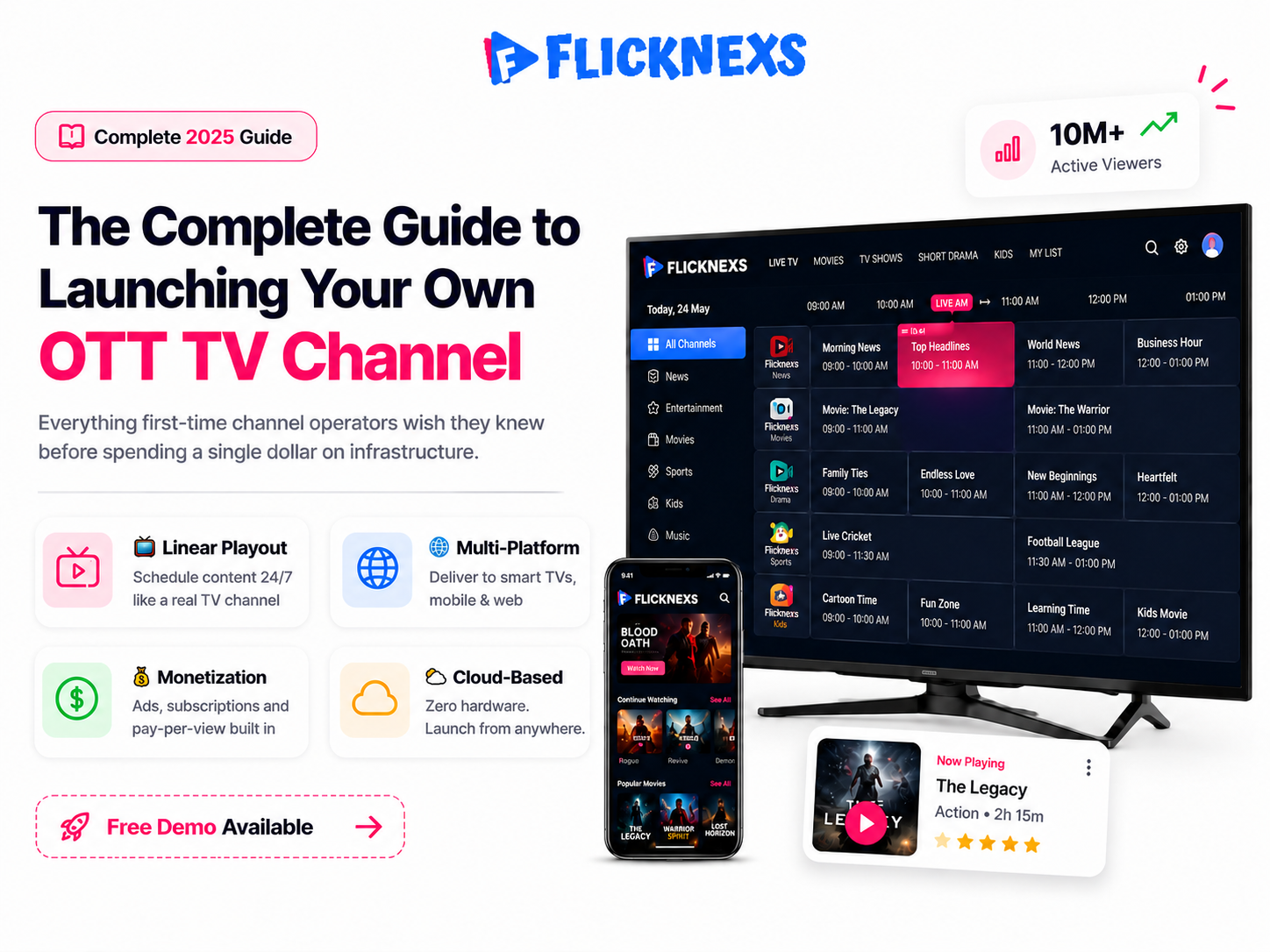
You’ve watched Netflix, YouTube, and countless niche streaming platforms build massive audiences. You’ve seen independent creators turn small communities into thriving media brands. And somewhere along the way, you’ve probably wondered: Can I launch my own TV channel? And is it already too late to get started?
The short answer is no — it’s not too late. In fact, the opportunity is very real. But before you spend a single rupee or dollar, there are a few things most articles never tell you.
That’s exactly what this guide is here to cover.
What Is an OTT Playout Platform, and Why Does It Matter?
Most people picture something far more complicated than it actually is
If you’ve never worked in streaming, the phrase “OTT playout platform” probably sounds like something that belongs in a TV station full of control rooms and satellite dishes. The reality is far less dramatic.
An OTT playout platform is the technology that helps you schedule, manage, and stream video content to viewers over the internet. In many ways, it works like a traditional TV channel, except there’s no need for cable infrastructure, satellite systems or expensive broadcast equipment.
Think of it as the engine running your channel behind the scenes. It automatically plays your content according to the schedule you create, can insert advertisements when needed and delivers everything to viewers across smart TVs, smartphones, tablets, and laptops.
Why is this important?
Because building a traditional TV channel used to require millions of dollars in infrastructure and specialized equipment. OTT playout platforms have changed that. Today, independent creators, niche networks, and growing media companies can launch professional streaming channels without the enormous costs associated with traditional broadcasting.
One thing many beginners misunderstand is that launching a channel and having a playout platform are not the same thing. A playout platform is just one component of the overall streaming ecosystem. Knowing exactly what it does—and what it doesn’t do, can save you a lot of confusion when you’re getting started.
Who Is Actually Launching OTT Channels Right Now?
The real number has four components, and vendors almost never put them all in the same conversation. They’ll quote you the platform fee and let you discover the rest later. Here’s what the full picture actually looks like:
- Platform licensing is the monthly or annual software fee. Basic self-serve options start around $300/month. Enterprise platforms with actual support can hit $5,000/month or more. White-label solutions land somewhere in the middle, which is where most serious independent operators end up.
- Transcoding and storage is a usage bill, not a flat fee. You pay based on hours of content stored and hours transcoded per month. Running a 24/7 channel means ingesting content constantly, and those hours compound faster than most people expect when they’re doing early math on a spreadsheet.
- CDN and bandwidth is the one that blindsides people at scale. Every viewer watching your channel is pulling bandwidth. A hundred concurrent viewers is a manageable bill. Ten thousand is a completely different conversation. Work out how this pricing scales before you launch, not after you’ve built an audience.
- App development and platform fees are where budgets quietly blow up. If your platform doesn’t include pre-built TV apps, building and certifying for Roku, Apple TV, Amazon Fire and Android TV each carries its own cost. Then some app stores take a revenue cut on top of that.
Put it all together honestly: a real OTT channel launch with proper playout, multi-platform delivery, CDN and initial app development typically starts between $500 and $1,500 per month at low scale. Content production sits on top of that as its own budget entirely.
Anyone quoting you well below that range is either leaving something major out of the conversation or selling you a product you’ll outgrow right when things start working.
How to Evaluate Whether Your Idea Has Real Potential
Most people waste their first week choosing a logo and downloading apps. That’s not where a channel begins.
It begins with a specific person.
Not “men aged 25 to 40.” That’s a census category, not an audience. Can you picture the first thousand people who would actually watch you? Real people with real reasons, who looked at your content and chose it over everything else fighting for their attention that day. What are you giving them that they genuinely can’t get anywhere else? If you can’t answer that clearly, no amount of production value will save you.
Then do a quick reality check on demand. Are people already gathering around this interest somewhere? Arguing in Reddit threads, filling YouTube comment sections, haunting niche forums? That activity matters. Think of it the way a restaurant owner scouts foot traffic before signing a lease. You don’t create demand from scratch. You find where it already lives and put yourself in front of it. Existing communities are your first viewers.
Now the question most people skip because it’s uncomfortable.
Can you keep producing content for six months without seeing a cent?
Most channels die here. Not because the idea was bad, but because the owner expected revenue before building anything valuable enough for people to actually care about. The channels that survive treat those early months as an investment. Not a paycheck cycle, not a side hustle that needs to prove itself by January.
If you can answer yes to all three, you’ve got something worth building. If you can’t, that’s not a failure. That’s useful intelligence. Far better to find the weak spot now than after you’ve already burned through the budget trying to prove a shaky premise.
The Mental Model Most Beginners Get Wrong
Signing a contract before understanding what you’re actually buying that’s how people burn thousands on an OTT platform that was never built for what they needed.
The mistake is almost always the same. Newcomers treat an OTT playout platform like YouTube: upload content, hit publish, collect viewers. That mental model will wreck you.
Playout is not VOD. A playout platform runs a scheduled linear stream, the same way a TV station programs its day. Content plays at specific times in a specific sequence. Transitions, lower-thirds, ad slots and live inserts are all managed automatically. Viewers tune in to a channel. You decide what’s on.
VOD is the opposite model. Viewers browse a catalog and pick what they want. Nobody’s waiting for your 8pm slot.
Some platforms handle both. Many don’t. And the reason this distinction costs people money is that it changes your entire content strategy. A 24/7 linear channel needs a constant supply of fresh programming. A VOD library needs catalog depth. A hybrid needs both. Most people figure this out only after they’ve already signed.
Core Components of an OTT Playout Platform
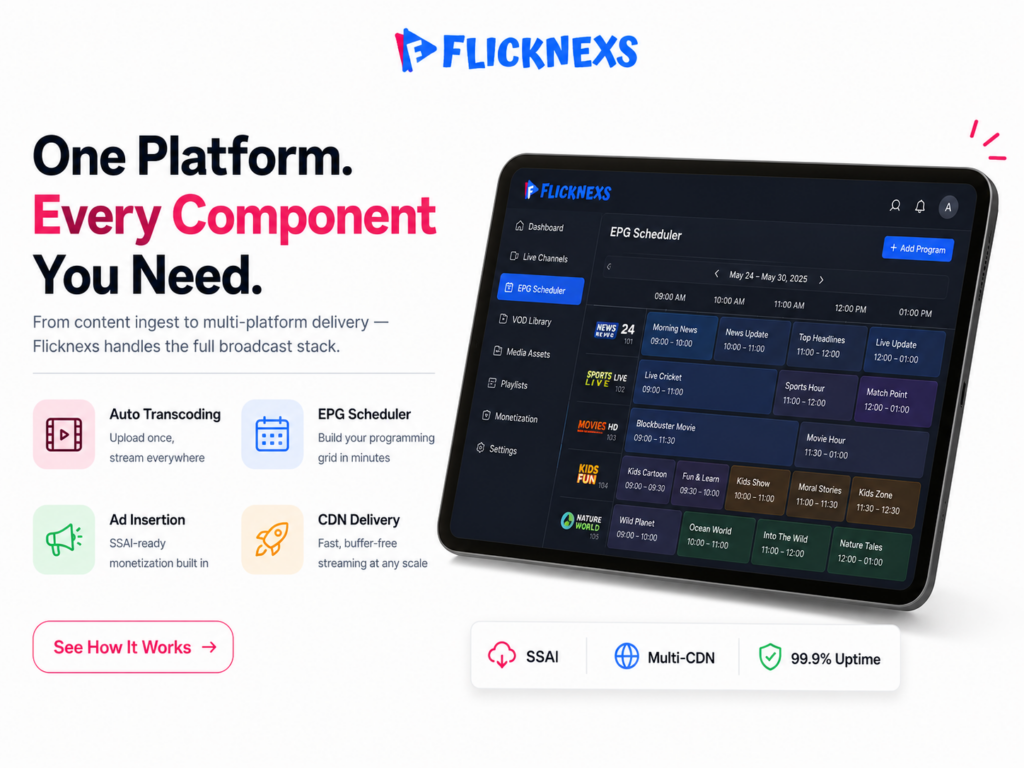
Most people shopping for a playout platform fixate on the wrong things. They compare dashboards and pricing tiers while missing the infrastructure questions that actually determine whether their channel works at 2 AM when something breaks. Here’s what’s inside these systems and why each piece matters.
Content Ingest and Transcoding
Your video file needs to become many video files. A 1080p master has to be converted into 720p, 480p and mobile-friendly versions, then packaged for streaming protocols so it plays without buffering on a budget phone in rural Texas. That conversion process is called transcoding and how a platform handles it tells you a lot about how much extra work you’ll end up doing.
Good platforms let you upload once and handle the rest. Weaker ones hand that back to you prepare files in specific formats before upload. Ask every vendor directly: upload once, or prepare in advance? The answer separates platforms that respect your time from ones that quietly offload their technical debt onto you.
Electronic Program Guide and Scheduling Engine
Think of the scheduling engine as the traffic controller for your channel. It decides what plays when, manages transitions between shows, fills gaps with bumper content and keeps things moving without someone manually babysitting the queue.
The scheduling engine is also where platforms quietly fail. Edge cases expose everything: what happens when a live event runs fifteen minutes long? What plays when a scheduled file fails to load? Strong platforms have answers built in. Weak ones leave you scrambling during a broadcast window, which is exactly the worst time to discover a gap in the product.
Ad Insertion
If advertising is part of your revenue plan, the distinction between SSAI and CSAI matters more than most vendors will admit upfront.
SSAI (Server-Side Ad Insertion) stitches ads directly into the video stream before it reaches the viewer. Ad blockers can’t touch it because there’s nothing to block. CSAI (Client-Side Ad Insertion) loads ads separately on the viewer’s device, which is cheaper to build and trivially easy to block. If your business model depends on ad revenue, CSAI is a structural problem, not just a minor inconvenience.
CDN Integration
A Content Delivery Network is what gets your video from a server to your viewer’s screen without buffering, regardless of geography. Most enterprise platforms have CDN partnerships built in. If a vendor expects you to arrange that separately, add the cost to your evaluation. CDN fees scale with viewership, so you need to understand the billing structure before you launch, not after your first viral moment.
Multi-Platform Delivery
Your channel needs to run on Samsung, LG, Android TV, Apple TV, Roku, Fire TV Stick, iOS, Android and web browsers. Building custom apps for each of those is genuinely expensive and genuinely complex.
Ask vendors whether white-label apps for major platforms are included or whether app development is a separate project with a separate price tag. They’re often the latter.
The Content Question Nobody Wants to Answer Honestly
The best playout platform in the world cannot save a channel with weak content. New operators hear that and nod along, then spend three months evaluating vendor dashboards before they’ve answered a single question about what they’re actually going to air.
Viewers don’t care about your transcoding pipeline. They care about whether your channel has something they can’t get elsewhere. That’s the only question that matters before you open a single pricing page.
So answer these honestly, before you evaluate anything else. How many hours of content do you have right now? How much can you realistically produce or license per month? Is there a specific audience with no other channel serving them? Why would someone choose your channel over YouTube or Netflix?
If those answers are vague, slow down.
A 24/7 linear channel needs 168 hours of content per week. If you plan to loop, which most small operators do, you need at least 24 to 48 hours of unique programming before viewers start noticing they’ve seen this before. Building that catalog takes real money and real time. Ignoring that math early is how channels launch with excitement and die quietly six months later with nobody noticing they’re gone.
Sort out the content problem first. The platform decision gets much easier once you know what you’re actually running.
What Does an OTT Playout Platform Actually Cost?
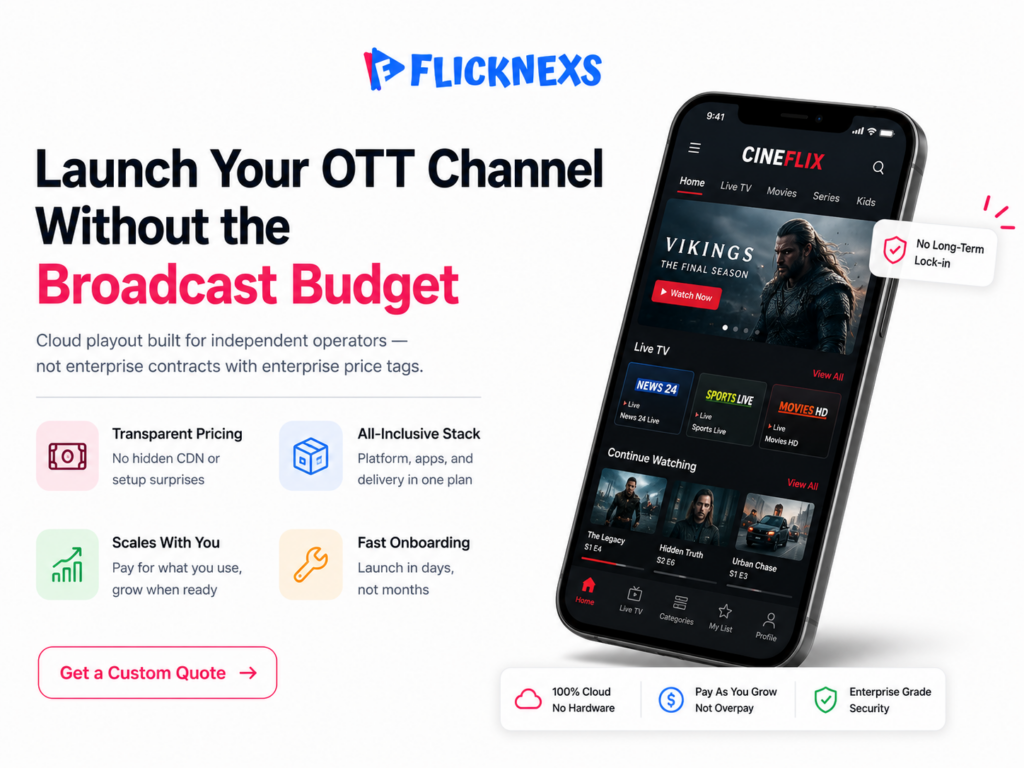
Nobody gives you a straight answer on cost. Here’s one.
The real number has four components, and vendors almost never put them all in the same conversation. They’ll quote you the platform fee and let you discover the rest later.
Platform licensing is the monthly or annual software fee. Basic self-serve options start around $300/month. Enterprise platforms with actual support can hit $5,000/month or more. White-label solutions land somewhere in the middle, which is where most serious independent operators end up.
Transcoding and storage is a usage bill, not a flat fee. You pay based on hours of content stored and hours transcoded per month. If you’re running a 24/7 channel, you’re ingesting content constantly. Those hours compound faster than most people expect when they’re doing early math on a spreadsheet.
CDN and bandwidth is the one that blindsides people at scale. Every viewer watching your channel is pulling bandwidth. A hundred concurrent viewers is a manageable bill. Ten thousand is a completely different conversation. Work out how this pricing scales before you launch, not after you’ve already built an audience.
App development and platform fees are where budgets quietly blow up. If your platform doesn’t include pre-built TV apps, building and certifying for Roku, Apple TV, Amazon Fire and Android TV each carries its own development and certification cost. Then some app stores take a revenue cut on top of that.
Put it all together honestly: a real OTT channel launch with proper playout, multi-platform delivery, CDN and initial app development typically starts between $500 and $1,500 per month at low scale. Content production is its own budget sitting on top of that.
Anyone quoting you well below that range is either leaving something major out of the conversation or selling you a product you’ll outgrow right when things start working.
| Cost Component | What It Covers | Avg. Monthly Range |
| Platform License | Software access, scheduler, CMS | $300 – $2,000+ |
| Transcoding & Storage | Converting and storing video files | $50 – $300 |
| CDN & Bandwidth | Delivering stream to viewers | $100 – $1,000+ |
| App Development | Smart TV, mobile apps (one-time or bundled) | $500 – $5,000 one-time |
| Total Estimate | Low-scale launch | $500 – $1,500/month |
Cloud Playout vs. On-Premise: This One Actually Has a Right Answer
Some vendors still pitch on-premise playout as a serious option. Physical servers at your location or a data center, managed by your team. It’s worth knowing why that’s almost never the right call for a new channel operator.
Cloud is the correct choice for nearly everyone launching right now. No upfront hardware cost, you pay for what you actually use, scaling doesn’t require ordering new servers and redundancy is the cloud provider’s problem instead of yours. That last point matters more than people think until something breaks at 2am during a live event.
On-premise does make sense in specific situations. Strict data sovereignty regulations, hard latency requirements or an existing infrastructure team already running physical hardware. That describes a small number of operators and if it describes you, you already know it.
If a vendor’s main pitch is their on-premise solution, ask them directly why they’re not leading with cloud. Not aggressively, just genuinely. The answer tells you something real about where they’re putting their development budget and whether their cloud offering is actually mature or just a checkbox on a features page.
Choosing the Right OTT Playout Platform: What to Actually Evaluate
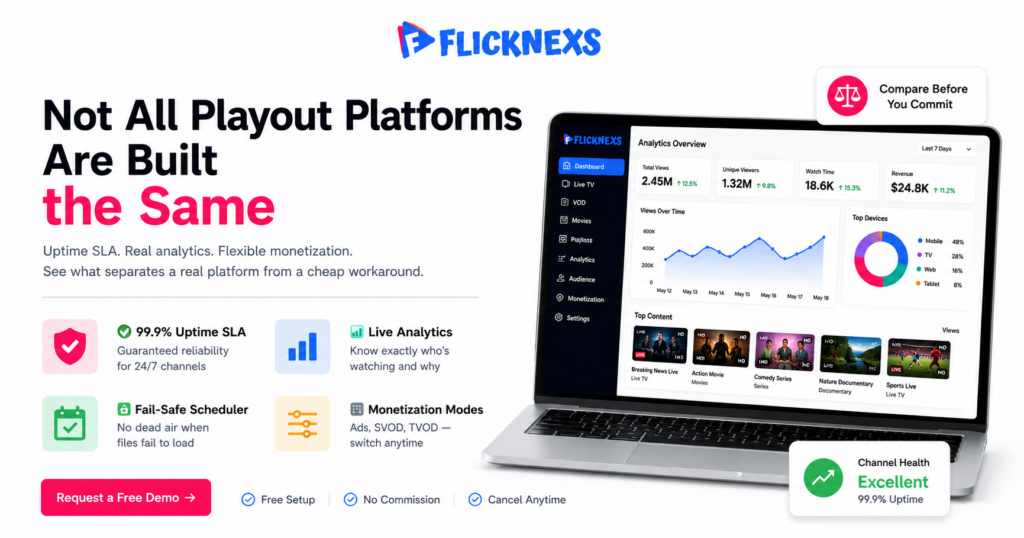
The sales deck will always look good. Here’s what actually deserves your attention.
Start with uptime. Ask directly what their guaranteed SLA is and what compensation exists if they miss it. Anything below 99.9% is a real problem for a channel that runs around the clock. Don’t accept a vague answer here.
Ask for a live demo of the scheduling interface, not a recorded walkthrough. Sit with it and try to program a week of content yourself. How long does that take? What happens when a live event runs over and bumps scheduled programming? What plays when a file fails to load? These edge cases aren’t hypothetical. They will happen, and the scheduler either handles them gracefully or it doesn’t.
On monetization, find out whether the platform supports subscriptions, advertising, pay-per-view and hybrid models in the same setup. A platform that locks you into one revenue structure now will become a ceiling later, right when you have enough audience to actually experiment.
Analytics matter more than operators realize early on. You need to know who’s watching, on what devices, for how long and where they’re dropping off. Without that, you can’t improve your programming and you can’t make a credible pitch to advertisers. If the reporting is thin, that’s a serious limitation.
Support quality is the most underestimated factor among first-time operators, consistently. When something breaks during a live event at midnight, how fast can you reach someone who can actually fix it? Test this before you sign anything. Send a pre-sales question and pay attention to both how fast they respond and whether the answer is genuinely useful or just a redirect to documentation.
Finally, ask what your bill looks like at ten times your current viewership. Some pricing models penalize growth in ways that aren’t visible until you’re already locked into a contract and scaling fast.
Common Mistakes That Kill New OTT Channels Early
Most of these mistakes are avoidable. They’re also extremely common.
Launching a 24/7 channel with 10 hours of content is the fastest way to lose an audience permanently. Viewers notice loops within days. They leave, and they don’t come back with a second chance attitude. Content volume is a hard requirement, not something you figure out after launch.
Choosing the cheapest platform without reading the fine print is how operators end up paying twice. Entry-level platforms frequently lack proper ad insertion, real analytics or multi-platform app delivery. Six months in, you’re migrating to something that actually works, absorbing the cost of both platforms and rebuilding your setup from scratch.
Ignoring CDN costs has genuinely blindsided operators whose channels unexpectedly took off. Growth is supposed to be good news. Understand how your bandwidth bill scales before you go live, not after you’ve got ten thousand concurrent viewers and a cost structure you never modeled.
Skipping the EPG is a smaller mistake but a visible one. Launch without a proper electronic program guide and viewers have no way to know what’s playing next or what’s coming. It’s a solvable problem, but it signals an unfinished product and erodes trust faster than most operators expect.
Launching on every platform at once is a trap. Each additional platform adds maintenance, testing and support overhead. Start with two or three, do them properly, then expand. Spread too thin early and you do everything poorly.
Not testing fail-safes is the one that hurts most publicly. What plays when a scheduled file fails to load? Find out during testing. Finding out during a live broadcast is a much more expensive way to learn the answer.
The Right Way to Start Without Overcommitting
A few practical things worth doing before and after you launch.
Start with a monthly contract, not annual. Most serious platforms offer monthly billing at a slightly higher per-month rate. Pay the premium. The flexibility is worth it while you’re still learning what you actually need from a platform, because what you think you need before launch and what you actually need at month three are often different things.
Before you go live, run a content stress test. Load your full library into the scheduler and build two weeks of programming manually. Gaps, broken files and scheduling conflicts will surface. You want to find them now, not during your first week with real viewers.
Launch to a small known audience first. A private beta with 50 to 100 people who’ll give you honest feedback is worth more than a public launch that goes sideways in front of strangers. Real feedback from people who’ll actually tell you what’s broken is rare. Use that window.
Then set a hard 90-day evaluation point. At that milestone, ask yourself four questions with no softening. Is the technology stable? Is viewership actually growing? Is content production sustainable at this pace? Is the platform doing what you need it to do?
Those answers tell you whether to stay the course, upgrade your setup or rethink the strategy entirely. Ninety days is enough time to know. Most operators who should pivot at that point talk themselves into waiting another six months instead.
Flicknexs: A Purpose-Built OTT Playout Platform Worth Considering
If you’re actively evaluating platforms, Flicknexs is worth putting on your shortlist.
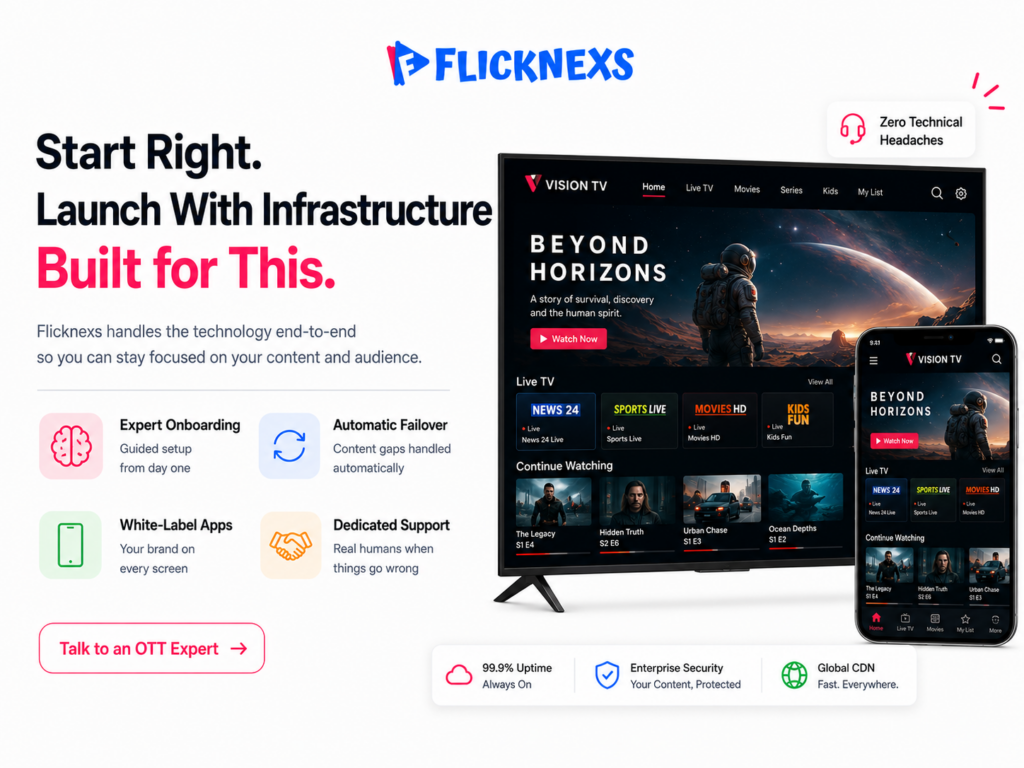
It covers cloud-based playout, multi-platform delivery, white-label apps for smart TVs and mobile, ad insertion and a scheduling engine built for real channel operations. You launch under your own brand with infrastructure that doesn’t require building anything from scratch or signing an enterprise contract sized for broadcasters spending seven figures a year.
It’s positioned for operators who want professional-grade playout without the procurement process that usually comes with it.
If you want to see how it fits your specific channel concept, the most useful next step is a direct conversation with their team. Walk them through your use case and see how the platform actually handles it
Final Thoughts
Technology stopped being the barrier a while ago. Cloud playout put professional infrastructure within reach of operators who have nothing to do with traditional broadcasting and don’t need to.
The harder problem was never access. It’s whether you have the content, the audience and the staying power to make a channel sustainable. No platform solves that for you. The ones worth working with won’t pretend otherwise.
If you have those things figured out, a playout platform is what lets you deliver on them properly. Start with a demo, walk through your content plan honestly and notice how the conversation goes. The right partner will tell you straight what their platform can and can’t do for your situation. That hour will teach you more than any article.
FAQ
What is an OTT playout platform?
An OTT playout platform is software that schedules, manages, and delivers video content to viewers over the internet — the same way a TV channel broadcasts programming, but without cables, satellites, or towers. It handles your content lineup automatically: what plays when, ad insertions, transitions, and delivery across smart TVs, phones, and browsers. Think of it as the engine running your channel 24/7 in the background while you focus on content.
How do I launch my own TV channel online?
Launching an online TV channel comes down to four things: content, a playout platform, delivery infrastructure, and viewer apps. You start by building a content library, then choose a cloud-based OTT playout platform to schedule and automate your programming. The platform handles transcoding and streaming. White-label apps get your channel onto smart TVs and mobile devices. Most serious launches take 4 to 8 weeks from platform setup to going live — the bigger variable is always how much content you have ready before you start.
What’s the difference between OTT playout and traditional broadcast?
Traditional broadcast requires physical infrastructure — transmitters, satellite uplinks, cable distribution agreements, and significant licensing. OTT playout runs entirely over the internet using cloud servers, so there is no hardware to own and no distribution deal to negotiate. The viewer experience looks nearly identical: a channel playing scheduled content. The operational difference is that OTT playout is accessible to independent operators at a fraction of the cost and can reach a global audience from day one.
Which is the best cloud playout solution for small broadcasters?
The best cloud playout solution for a small broadcaster is one that combines scheduling, transcoding, CDN delivery, and white-label app support in a single package — so you are not stitching together five separate vendors. For operators who want professional-grade infrastructure without enterprise pricing or complexity, Flicknexs is built specifically for this use case. It covers playout, multi-platform delivery, and monetization under one roof, which matters when your team is small and your time is not.
Ready to launch your own channel? See how to create your own online TV channel with Flicknexs — cloud playout, multi-device apps and built-in monetization in one platform.
Ready to build?
If you’re planning your next Playout project, Flicknexs handles the video infrastructure end-to-end — so you can ship in weeks, not months.
- explore playout solutions
- see Flicknexs pricing
More cloud playout guides
Continue exploring more on this topic across the Flicknexs blog.
- How Cloud Playout Reduces Traditional Satellite Broadcasting Costs
- Can Flicknexs Playout Integrate With Existing Websites?
Ready to build?
If you’re planning your next Playout project, Flicknexs handles the video infrastructure end-to-end — so you can ship in weeks, not months.
- explore playout solutions
- see Flicknexs pricing
More cloud playout guides
Continue exploring more on this topic across the Flicknexs blog.
- How Cloud Playout Reduces Traditional Satellite Broadcasting Costs
- Can Flicknexs Playout Integrate With Existing Websites?
Ready to build?
If you’re planning your next Playout project, Flicknexs handles the video infrastructure end-to-end — so you can ship in weeks, not months.
- explore playout solutions
- see Flicknexs pricing
More cloud playout guides
Continue exploring more on this topic across the Flicknexs blog.
- How Cloud Playout Reduces Traditional Satellite Broadcasting Costs
- Can Flicknexs Playout Integrate With Existing Websites?
Ready to build?
If you’re planning your next Playout project, Flicknexs handles the video infrastructure end-to-end — so you can ship in weeks, not months.
- explore playout solutions
- see Flicknexs pricing
More cloud playout guides
Continue exploring more on this topic across the Flicknexs blog.
- How Cloud Playout Reduces Traditional Satellite Broadcasting Costs
- Can Flicknexs Playout Integrate With Existing Websites?
Ready to build?
If you’re planning your next Playout project, Flicknexs handles the video infrastructure end-to-end — so you can ship in weeks, not months.
- explore playout solutions
- see Flicknexs pricing
More cloud playout guides
Continue exploring more on this topic across the Flicknexs blog.
- How Cloud Playout Reduces Traditional Satellite Broadcasting Costs
- Can Flicknexs Playout Integrate With Existing Websites?
Ready to build?
If you’re planning your next Playout project, Flicknexs handles the video infrastructure end-to-end — so you can ship in weeks, not months.
- explore playout solutions
- see Flicknexs pricing
More cloud playout guides
Continue exploring more on this topic across the Flicknexs blog.
- How Cloud Playout Reduces Traditional Satellite Broadcasting Costs
- Can Flicknexs Playout Integrate With Existing Websites?
Ready to build?
If you’re planning your next Playout project, Flicknexs handles the video infrastructure end-to-end — so you can ship in weeks, not months.
- explore playout solutions
- see Flicknexs pricing
More cloud playout guides
Continue exploring more on this topic across the Flicknexs blog.
- How Cloud Playout Reduces Traditional Satellite Broadcasting Costs
- Can Flicknexs Playout Integrate With Existing Websites?
Ready to build?
If you’re planning your next Playout project, Flicknexs handles the video infrastructure end-to-end — so you can ship in weeks, not months.
- explore playout solutions
- see Flicknexs pricing
More cloud playout guides
Continue exploring more on this topic across the Flicknexs blog.
- How Cloud Playout Reduces Traditional Satellite Broadcasting Costs
- Can Flicknexs Playout Integrate With Existing Websites?
Ready to build?
If you’re planning your next Playout project, Flicknexs handles the video infrastructure end-to-end — so you can ship in weeks, not months.
- explore playout solutions
- see Flicknexs pricing
More cloud playout guides
Continue exploring more on this topic across the Flicknexs blog.
- How Cloud Playout Reduces Traditional Satellite Broadcasting Costs
- Can Flicknexs Playout Integrate With Existing Websites?
Ready to build?
If you’re planning your next Playout project, Flicknexs handles the video infrastructure end-to-end — so you can ship in weeks, not months.
- explore playout solutions
- see Flicknexs pricing
More cloud playout guides
Continue exploring more on this topic across the Flicknexs blog.
- How Cloud Playout Reduces Traditional Satellite Broadcasting Costs
- Can Flicknexs Playout Integrate With Existing Websites?
Ready to build?
If you’re planning your next Playout project, Flicknexs handles the video infrastructure end-to-end — so you can ship in weeks, not months.
- explore playout solutions
- see Flicknexs pricing
More cloud playout guides
Continue exploring more on this topic across the Flicknexs blog.
- How Cloud Playout Reduces Traditional Satellite Broadcasting Costs
- Can Flicknexs Playout Integrate With Existing Websites?
Ready to build?
If you’re planning your next Playout project, Flicknexs handles the video infrastructure end-to-end — so you can ship in weeks, not months.
- explore playout solutions
- see Flicknexs pricing
More cloud playout guides
Continue exploring more on this topic across the Flicknexs blog.
- How Cloud Playout Reduces Traditional Satellite Broadcasting Costs
- Can Flicknexs Playout Integrate With Existing Websites?
Ready to build?
If you’re planning your next Playout project, Flicknexs handles the video infrastructure end-to-end — so you can ship in weeks, not months.
- explore playout solutions
- see Flicknexs pricing
More cloud playout guides
Continue exploring more on this topic across the Flicknexs blog.
- How Cloud Playout Reduces Traditional Satellite Broadcasting Costs
- Can Flicknexs Playout Integrate With Existing Websites?
Ready to build?
If you’re planning your next Playout project, Flicknexs handles the video infrastructure end-to-end — so you can ship in weeks, not months.
- explore playout solutions
- see Flicknexs pricing
More cloud playout guides
Continue exploring more on this topic across the Flicknexs blog.
- How Cloud Playout Reduces Traditional Satellite Broadcasting Costs
- Can Flicknexs Playout Integrate With Existing Websites?
Ready to build?
If you’re planning your next Playout project, Flicknexs handles the video infrastructure end-to-end — so you can ship in weeks, not months.
- explore playout solutions
- see Flicknexs pricing
More cloud playout guides
Continue exploring more on this topic across the Flicknexs blog.
- How Cloud Playout Reduces Traditional Satellite Broadcasting Costs
- Can Flicknexs Playout Integrate With Existing Websites?
Ready to build?
If you’re planning your next Playout project, Flicknexs handles the video infrastructure end-to-end — so you can ship in weeks, not months.
- explore playout solutions
- see Flicknexs pricing
More cloud playout guides
Continue exploring more on this topic across the Flicknexs blog.
- How Cloud Playout Reduces Traditional Satellite Broadcasting Costs
- Can Flicknexs Playout Integrate With Existing Websites?
Ready to build?
If you’re planning your next Playout project, Flicknexs handles the video infrastructure end-to-end — so you can ship in weeks, not months.
- explore playout solutions
- see Flicknexs pricing
More cloud playout guides
Continue exploring more on this topic across the Flicknexs blog.
- How Cloud Playout Reduces Traditional Satellite Broadcasting Costs
- Can Flicknexs Playout Integrate With Existing Websites?
Ready to build?
If you’re planning your next Playout project, Flicknexs handles the video infrastructure end-to-end — so you can ship in weeks, not months.
- explore playout solutions
- see Flicknexs pricing
More cloud playout guides
Continue exploring more on this topic across the Flicknexs blog.
- How Cloud Playout Reduces Traditional Satellite Broadcasting Costs
- Can Flicknexs Playout Integrate With Existing Websites?
Ready to build?
If you’re planning your next Playout project, Flicknexs handles the video infrastructure end-to-end — so you can ship in weeks, not months.
- explore playout solutions
- see Flicknexs pricing
More cloud playout guides
Continue exploring more on this topic across the Flicknexs blog.
- How Cloud Playout Reduces Traditional Satellite Broadcasting Costs
- Can Flicknexs Playout Integrate With Existing Websites?
Ready to build?
If you’re planning your next Playout project, Flicknexs handles the video infrastructure end-to-end — so you can ship in weeks, not months.
- explore playout solutions
- see Flicknexs pricing
More cloud playout guides
Continue exploring more on this topic across the Flicknexs blog.
- How Cloud Playout Reduces Traditional Satellite Broadcasting Costs
- Can Flicknexs Playout Integrate With Existing Websites?
Ready to build?
If you’re planning your next Playout project, Flicknexs handles the video infrastructure end-to-end — so you can ship in weeks, not months.
- explore playout solutions
- see Flicknexs pricing
More cloud playout guides
Continue exploring more on this topic across the Flicknexs blog.
- How Cloud Playout Reduces Traditional Satellite Broadcasting Costs
- Can Flicknexs Playout Integrate With Existing Websites?
Ready to build?
If you’re planning your next Playout project, Flicknexs handles the video infrastructure end-to-end — so you can ship in weeks, not months.
- explore playout solutions
- see Flicknexs pricing
More cloud playout guides
Continue exploring more on this topic across the Flicknexs blog.
- How Cloud Playout Reduces Traditional Satellite Broadcasting Costs
- Can Flicknexs Playout Integrate With Existing Websites?
Ready to build?
If you’re planning your next Playout project, Flicknexs handles the video infrastructure end-to-end — so you can ship in weeks, not months.
- explore playout solutions
- see Flicknexs pricing
More cloud playout guides
Continue exploring more on this topic across the Flicknexs blog.
- How Cloud Playout Reduces Traditional Satellite Broadcasting Costs
- Can Flicknexs Playout Integrate With Existing Websites?
Ready to build?
If you’re planning your next Playout project, Flicknexs handles the video infrastructure end-to-end — so you can ship in weeks, not months.
- explore playout solutions
- see Flicknexs pricing
More cloud playout guides
Continue exploring more on this topic across the Flicknexs blog.
- How Cloud Playout Reduces Traditional Satellite Broadcasting Costs
- Can Flicknexs Playout Integrate With Existing Websites?
Ready to build?
If you’re planning your next Playout project, Flicknexs handles the video infrastructure end-to-end — so you can ship in weeks, not months.
- explore playout solutions
- see Flicknexs pricing
More cloud playout guides
Continue exploring more on this topic across the Flicknexs blog.
- How Cloud Playout Reduces Traditional Satellite Broadcasting Costs
- Can Flicknexs Playout Integrate With Existing Websites?
Ready to build?
If you’re planning your next Playout project, Flicknexs handles the video infrastructure end-to-end — so you can ship in weeks, not months.
- explore playout solutions
- see Flicknexs pricing
More cloud playout guides
Continue exploring more on this topic across the Flicknexs blog.
- How Cloud Playout Reduces Traditional Satellite Broadcasting Costs
- Can Flicknexs Playout Integrate With Existing Websites?
Ready to build?
If you’re planning your next Playout project, Flicknexs handles the video infrastructure end-to-end — so you can ship in weeks, not months.
- explore playout solutions
- see Flicknexs pricing
More cloud playout guides
Continue exploring more on this topic across the Flicknexs blog.
- How Cloud Playout Reduces Traditional Satellite Broadcasting Costs
- Can Flicknexs Playout Integrate With Existing Websites?
Ready to build?
If you’re planning your next Playout project, Flicknexs handles the video infrastructure end-to-end — so you can ship in weeks, not months.
- explore playout solutions
- see Flicknexs pricing
More cloud playout guides
Continue exploring more on this topic across the Flicknexs blog.
- How Cloud Playout Reduces Traditional Satellite Broadcasting Costs
- Can Flicknexs Playout Integrate With Existing Websites?
Ready to build?
If you’re planning your next Playout project, Flicknexs handles the video infrastructure end-to-end — so you can ship in weeks, not months.
- explore playout solutions
- see Flicknexs pricing
More cloud playout guides
Continue exploring more on this topic across the Flicknexs blog.
- How Cloud Playout Reduces Traditional Satellite Broadcasting Costs
- Can Flicknexs Playout Integrate With Existing Websites?
Ready to build?
If you’re planning your next Playout project, Flicknexs handles the video infrastructure end-to-end — so you can ship in weeks, not months.
- explore playout solutions
- see Flicknexs pricing
More cloud playout guides
Continue exploring more on this topic across the Flicknexs blog.
- How Cloud Playout Reduces Traditional Satellite Broadcasting Costs
- Can Flicknexs Playout Integrate With Existing Websites?
Ready to build?
If you’re planning your next Playout project, Flicknexs handles the video infrastructure end-to-end — so you can ship in weeks, not months.
- explore playout solutions
- see Flicknexs pricing
More cloud playout guides
Continue exploring more on this topic across the Flicknexs blog.
- How Cloud Playout Reduces Traditional Satellite Broadcasting Costs
- Can Flicknexs Playout Integrate With Existing Websites?
Ready to build?
If you’re planning your next Playout project, Flicknexs handles the video infrastructure end-to-end — so you can ship in weeks, not months.
- explore playout solutions
- see Flicknexs pricing
More cloud playout guides
Continue exploring more on this topic across the Flicknexs blog.
- How Cloud Playout Reduces Traditional Satellite Broadcasting Costs
- Can Flicknexs Playout Integrate With Existing Websites?
Ready to build?
If you’re planning your next Playout project, Flicknexs handles the video infrastructure end-to-end — so you can ship in weeks, not months.
- explore playout solutions
- see Flicknexs pricing
More cloud playout guides
Continue exploring more on this topic across the Flicknexs blog.
- How Cloud Playout Reduces Traditional Satellite Broadcasting Costs
- Can Flicknexs Playout Integrate With Existing Websites?
Ready to build?
If you’re planning your next Playout project, Flicknexs handles the video infrastructure end-to-end — so you can ship in weeks, not months.
- explore playout solutions
- see Flicknexs pricing
More cloud playout guides
Continue exploring more on this topic across the Flicknexs blog.
- How Cloud Playout Reduces Traditional Satellite Broadcasting Costs
- Can Flicknexs Playout Integrate With Existing Websites?
Ready to build?
If you’re planning your next Playout project, Flicknexs handles the video infrastructure end-to-end — so you can ship in weeks, not months.
- explore playout solutions
- see Flicknexs pricing
More cloud playout guides
Continue exploring more on this topic across the Flicknexs blog.
- How Cloud Playout Reduces Traditional Satellite Broadcasting Costs
- Can Flicknexs Playout Integrate With Existing Websites?
Ready to build?
If you’re planning your next Playout project, Flicknexs handles the video infrastructure end-to-end — so you can ship in weeks, not months.
- explore playout solutions
- see Flicknexs pricing
More cloud playout guides
Continue exploring more on this topic across the Flicknexs blog.
- How Cloud Playout Reduces Traditional Satellite Broadcasting Costs
- Can Flicknexs Playout Integrate With Existing Websites?
Ready to build?
If you’re planning your next Playout project, Flicknexs handles the video infrastructure end-to-end — so you can ship in weeks, not months.
- explore playout solutions
- see Flicknexs pricing
More cloud playout guides
Continue exploring more on this topic across the Flicknexs blog.
- How Cloud Playout Reduces Traditional Satellite Broadcasting Costs
- Can Flicknexs Playout Integrate With Existing Websites?
Ready to build?
If you’re planning your next Playout project, Flicknexs handles the video infrastructure end-to-end — so you can ship in weeks, not months.
- explore playout solutions
- see Flicknexs pricing
More cloud playout guides
Continue exploring more on this topic across the Flicknexs blog.
- How Cloud Playout Reduces Traditional Satellite Broadcasting Costs
- Can Flicknexs Playout Integrate With Existing Websites?
Ready to build?
If you’re planning your next Playout project, Flicknexs handles the video infrastructure end-to-end — so you can ship in weeks, not months.
More cloud playout guides
Continue exploring more on this topic across the Flicknexs blog.