
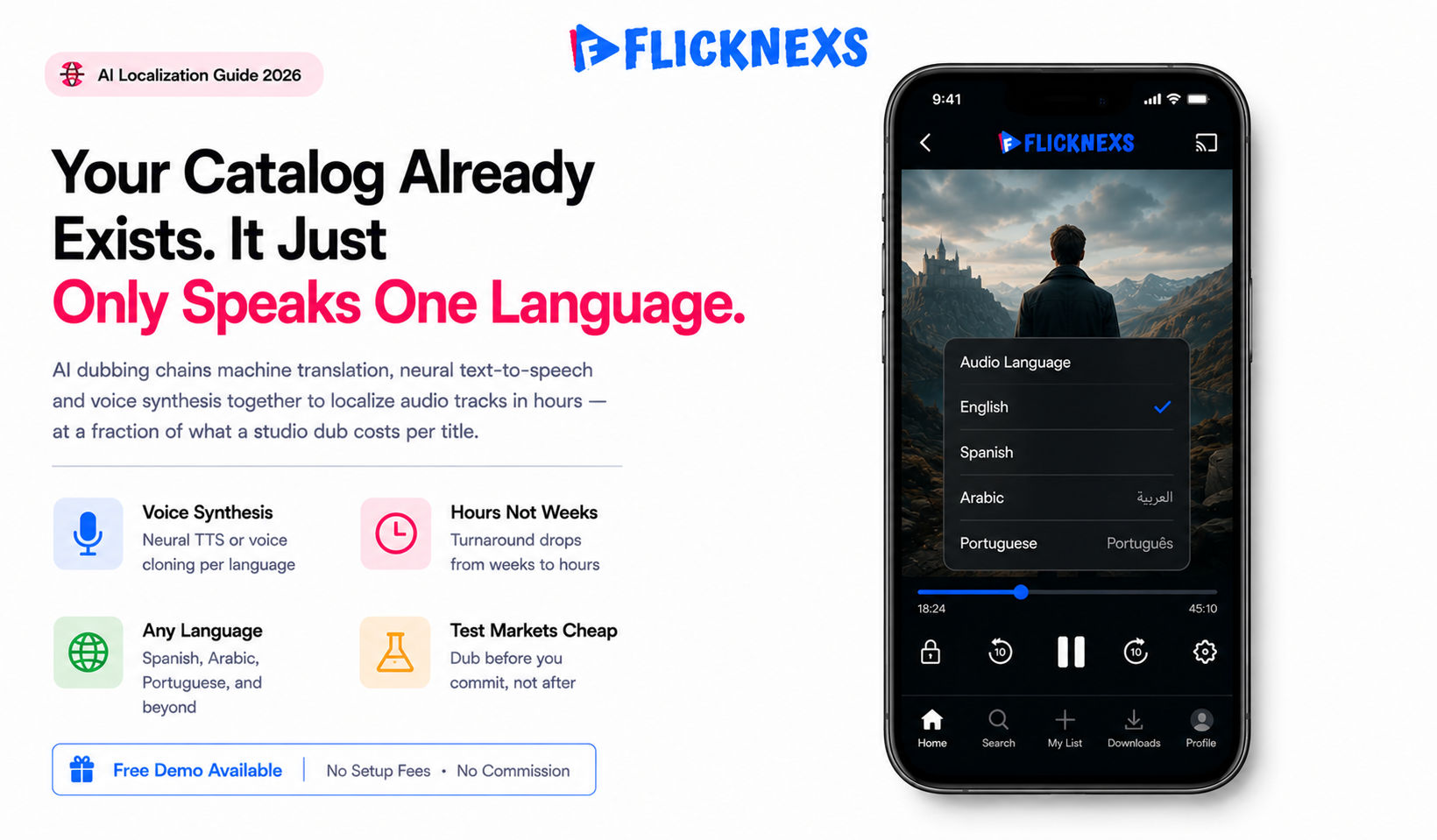
Here’s the ai dubbing for ott nobody tells you about localization it’s not a content problem, it’s a math problem. You’ve got a catalogue full of great titles sitting in one language, and dubbing every single one into Spanish, Hindi, Arabic and Portuguese would bankrupt you before launch. So most of it just sits there. Untouched. A regional film or an old back-catalogue series never clears the budget hurdle for a full studio dub, so it never travels past its home market.
AI dubbing breaks that math.
Think of it as three tools stacked on top of each other machine translation, neural text-to-speech and voice cloning that working together to spit out a localized audio track for video you’ve already shot. You’re not building a dubbing studio for every title anymore. You’re running your existing catalogue through a pipeline.
The pipeline itself isn’t complicated in concept. Transcribe the source audio.
Translate the dialogue. Generate a voice track in the target language. Time-align everything so lip-sync and pacing don’t feel obviously off that last part is where most of the real work happens, honestly, because a technically perfect translation that’s poorly timed still feels wrong to a viewer even if they can’t say why.
The honest trade-offs are emotional nuance, accuracy on anything brand-sensitive and the rights and consent questions that come with cloning someone’s voice. None of those are trivial.
Which is why the model that tends to work in practice is AI-first, with a human review pass reserved for your highest-value titles rather than the whole catalogue.For a white-label OTT platform, the payoff is straightforward. Every viewer gets a default audio track in their own language, at a scale that would’ve been financially impossible to reach any other way.
Most OTT operators are sitting on a content library that only speaks one language. That single fact quietly caps your addressable audience, your retention in non-native markets and the revenue you can pull per title, whether that’s ad or subscription. You already have the content. It just can’t reach the people who’d watch it.
Traditional dubbing means booking studios, casting voice actors, recording, mixing, waiting. Expensive and slow enough that it only pencils out for your top titles.
When it works, turnaround drops from weeks to hours per episode. And that speed does something more interesting than just saving money: it lets you test a market before you commit to it. Instead of betting six figures on whether Portuguese-speaking viewers want your documentary, you dub it cheap, put it out and watch what happens. Same way a startup ships an MVP before building the full product.
That’s the real shift here. A documentary or regional title that never justified a studio dub can now reach Spanish, English, Arabic or Portuguese audiences without a per-title cost eating your ROI before you’ve even launched.
This guide gets into how AI dubbing actually works inside an OTT workflow, what it realistically costs, where it breaks down, how to decide between going AI-only versus keeping humans in the loop and how to deliver multiple audio tracks to players at scale.
How AI dubbing works in an OTT pipeline
AI dubbing is not one model. It’s a chain of them. Understanding the stages helps you decide where to spend money on quality and where to let automation run.
1. Transcription and speaker diarization
First the source audio gets turned into text with timestamps and diarization figures out who said what line. This step sets the ceiling for everything that comes after it. Miss a word here and you don’t just get a bad transcript because you get a mistranslated line that then gets mis-spoken in the target language. The error compounds. If you’re already running automated captioning on your platform and reuse that transcript instead of starting from scratch. Our companion guide on AI subtitling and auto-captioning for streaming covers this overlap in detail.
2. Translation and adaptation
The transcript is translated into the target language. Raw machine translation is the weak point for dubbing, because spoken dialogue uses idiom, register and timing that literal translation flattens. The better systems do adaptation: shortening or lengthening lines so the translated text fits the on-screen mouth timing and adjusting tone to match the scene. This is where a human language reviewer earns their keep on premium titles.
3. Voice synthesis (TTS or voice cloning)
A neural text-to-speech model reads the translated lines out loud. You’ve got two options a generic high-quality voice or a clone of the original actor’s voice, so the dub sounds like the same person just speaking a different language. Voice cloning is the more impressive tech, but it also drags in the heaviest consent and rights baggage of the whole pipeline. More on that later.
4. Time-alignment and lip-sync
The synthesized audio is stretched, compressed and placed against the original timeline so dialogue lands when characters’ mouths move. Some tools go further with video lip-sync, regenerating mouth movements to match the new audio. Audio-only alignment is cheaper, safer and good enough for most catalog content. Visual lip-sync is for flagship titles.
5. Mixing and delivery as a separate audio track
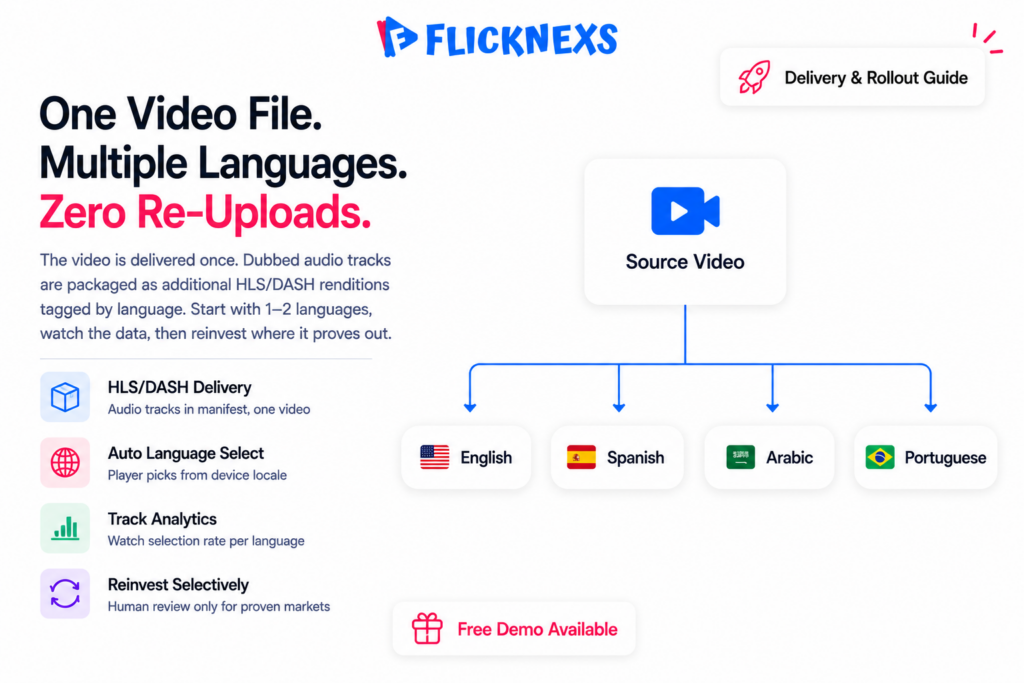
The dubbed voice is mixed back with the original music and effects (M&E stem if you have it), encoded and packaged as an additional audio track in your HLS or DASH manifest. The viewer’s player then offers a language selector. The video is delivered once, the audio per language. This is the part your streaming platform has to support natively.
AI vs hybrid vs traditional dubbing
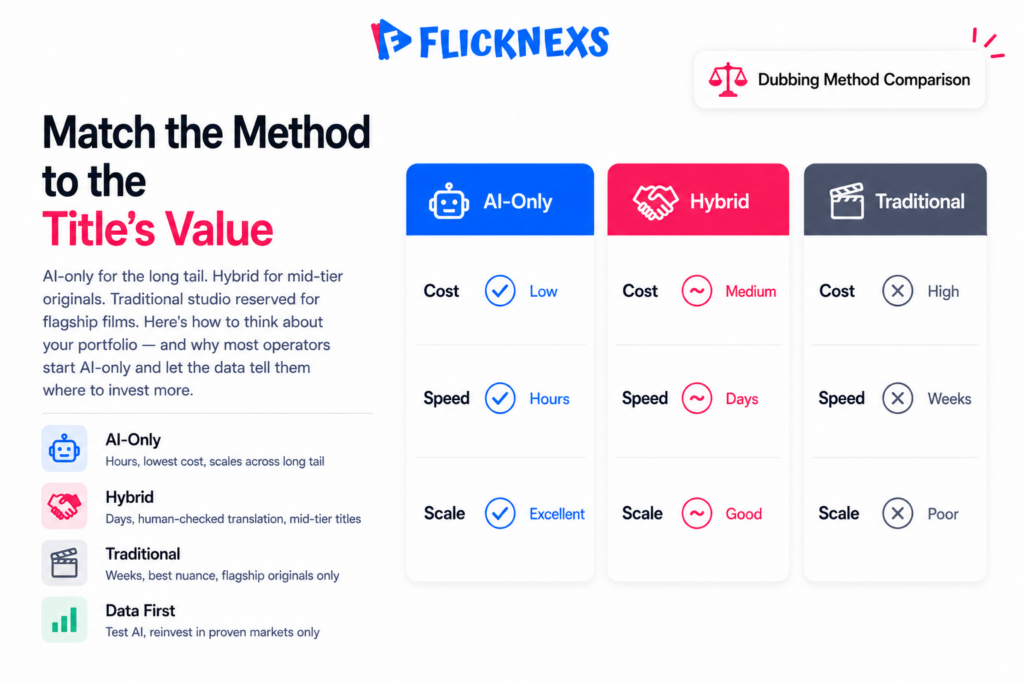
There is no single “best” approach. Match the method to the title’s value. Here is how the three options compare on the dimensions operators actually care about.
| Dimension | AI-only dubbing | Hybrid (AI + human review) | Traditional studio dubbing |
|---|---|---|---|
| Cost per title | Lowest | Moderate | Highest |
| Turnaround | Hours | Days | Weeks |
| Emotional nuance | Fair to good | Good | Best |
| Translation accuracy | Variable | High (human-checked) | High |
| Scales across long tail | Excellent | Good | Poor |
| Best for | Back catalog, docs, market testing | Mid-tier originals, brand content | Flagship films and premium originals |
Here’s how to think about your portfolio: AI-only for the long tail where you’re just testing demand, hybrid for the steady mid-tier stuff and traditional studio dubbing reserved for the handful of titles where a flat or shaky dub would actually hurt the brand.
Most operators who get this right start AI-only across the board, then watch the data. Which languages actually drive watch-time? Once you know, you reinvest in human dubs for those proven markets only.
And here’s what almost always happens when you run this experiment one or two languages you never expected end up carrying most of the watch-time, while half the languages you assumed were essential barely get a single track-selection click. You want to learn that lesson for a few dollars of synthesis, not after you’ve already paid a studio.
What AI dubbing realistically costs
pricing varies too much to quote a single rate, because it depends on the vendor, the languages, whether you use voice cloning and how much human review you add. Most AI dubbing services bill by the minute of finished audio and that per-minute rate is a small fraction of traditional studio dubbing, which is typically priced per project and runs into the hundreds or thousands per finished hour. The bigger cost lever is usually not the synthesis. It’s the human review you layer on top.
Budget against three buckets rather than chasing one number:
- Compute / vendor fees: per-minute synthesis and translation, the most predictable line.
- Human-in-the-loop review: optional but the main driver of quality and cost; scale it by title value.
- Engineering and storage: packaging extra audio tracks, manifest changes, and the storage/bandwidth of multiple tracks per title.
The economic point stands regardless of exact figures: AI dubbing makes localizing titles you would never have dubbed before financially rational. That marginal catalog, not just cheaper dubs of titles you’d already localize, is where the revenue lift comes from.
Where AI dubbing breaks
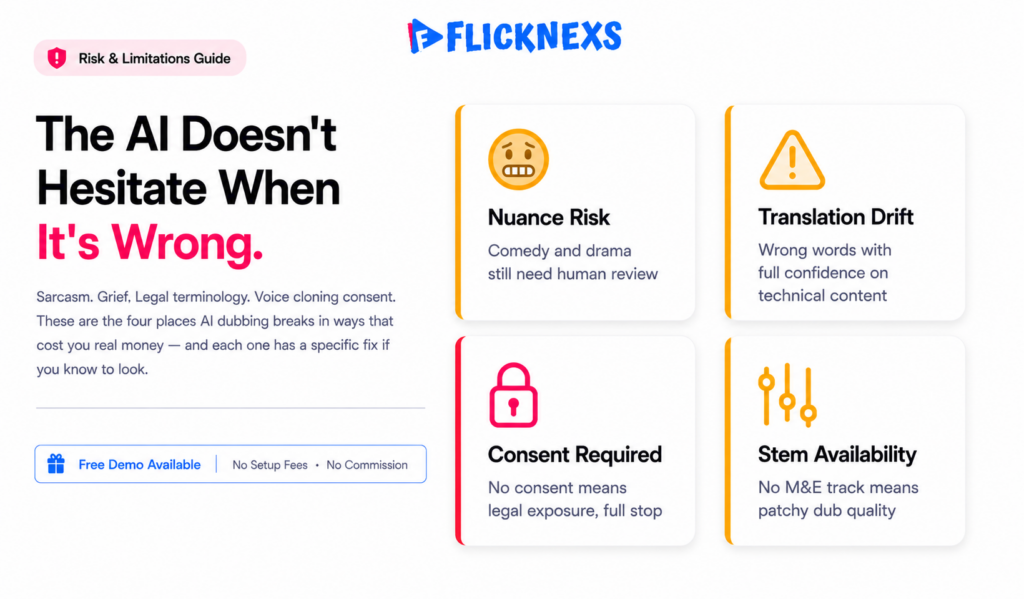
Emotional and comedic nuance
Synthetic voices have improved dramatically, but sarcasm, grief, comedic timing, and shouting still trip them up. For drama and comedy, plan on human review. For documentaries, news, education, and corporate content, AI-only is often indistinguishable to most viewers.
Translation drift on specialized content
Machine translation has a specific failure mode you need to watch for: it doesn’t hesitate when it’s wrong. It just says the wrong thing with total confidence. Fine for casual dialogue, where a slightly off line just sounds a bit stiff. Dangerous for technical, legal, medical or culturally loaded content, where the wrong word isn’t awkward, it’s a liability.
So put a native reviewer in front of anything in that category. Not as a nice-to-have, as the difference between a mistranslation you catch and one that ends up in front of a lawyer.
Voice cloning consent and rights
Voice cloning has one hard rule: you get consent, or you don’t do it. That’s not a suggestion, it’s a line, and it’s both a legal one and an ethical one.
This is a fast-moving area. Regulators and industry bodies are actively writing the rules around synthetic voice and likeness right now, which means what’s a gray area today could be flatly illegal in a year. Document every consent you get. Keep your contracts current, not just signed once and filed away.
Audio quality from a mixed master
Get the M&E stem instead whenever you can. Separate music-and-effects track, dialogue kept apart from the start. It makes the difference between a dubbed track that sounds native and one that sounds obviously patched together.The painful version of this is the back-catalog title where nobody can find the stems anymore, so you’re stuck ducking the original mix under the new voice and hoping the seams don’t show. Sort out stem availability before you commit a language to a title, not after.
Delivering multilingual audio at scale on your OTT platform
Generating dubs is half the job; serving them is the other half. The standard approach is to deliver one video rendition set plus multiple audio tracks, signalled in the streaming manifest. Adaptive streaming formats are built for exactly this. HLS and MPEG-DASH both support multiple audio renditions tagged by language, which the player exposes as a language menu. For background on how adaptive packaging carries alternate audio, the HLS reference and the broader MPEG-DASH overview are good starting points.
Operationally, you want your platform to handle:
- Per-title language management: attach, preview, enable, and disable individual language tracks without re-uploading the video.
- Default-track logic: auto-select the viewer’s language from device/locale, with manual override.
- Caption + audio parity: ship matching subtitles per language so accessibility and discovery hold up.
- Storage and CDN cost control: each language adds an audio track; only package languages with proven demand.
This is precisely the kind of localization-at-scale workflow a white-label platform should make routine. You can see how dubbing fits alongside captioning, tagging, and packaging on the Flicknexs features page.
Pair dubbing with discovery localization
A dubbed audio track only helps if viewers find the title in their language. Localized metadata, thumbnails, and trailers do the discovery half of the job. Pair dubbing with AI metadata tagging and AI-generated thumbnails and trailers so a localized title is both watchable and discoverable in each market.
A practical rollout plan
- Pick 1–2 target languages based on existing traffic, diaspora demand or a market you want to test.
- Choose 10–20 catalog titles, a mix of genres then to dub AI-only first.
- Run the pipeline and spot-check translation accuracy and timing with a native speaker.
- Publish as selectable audio tracks and watch the metrics: track-selection rate, completion rate and retention by language.
- Reinvest selectively. Add human review or full dubs only for the languages and titles that prove out.
This keeps spend tied to evidence instead of betting a localization budget on assumptions.
Frequently asked questions
Related guides
- OTT AI & localization hub
- AI Subtitling & Auto-Captioning for Streaming: Accuracy, Cost & Compliance
- AI Metadata Tagging: Auto-Organize Your Video Catalog for Discovery
- AI-Generated Thumbnails & Trailers: Lift Click-Through on Your OTT Catalog
Planning your own platform? Learn how to create your own OTT platform with Flicknexs — VOD, live, DRM, multi-device apps and hybrid monetization.
Ready to build?
If you’re planning your next OTT project, Flicknexs handles the video infrastructure end-to-end — so you can ship in weeks, not months.
- create your OTT platform
- get a quote
More OTT platform guides
Continue exploring more on this topic across the Flicknexs blog.