
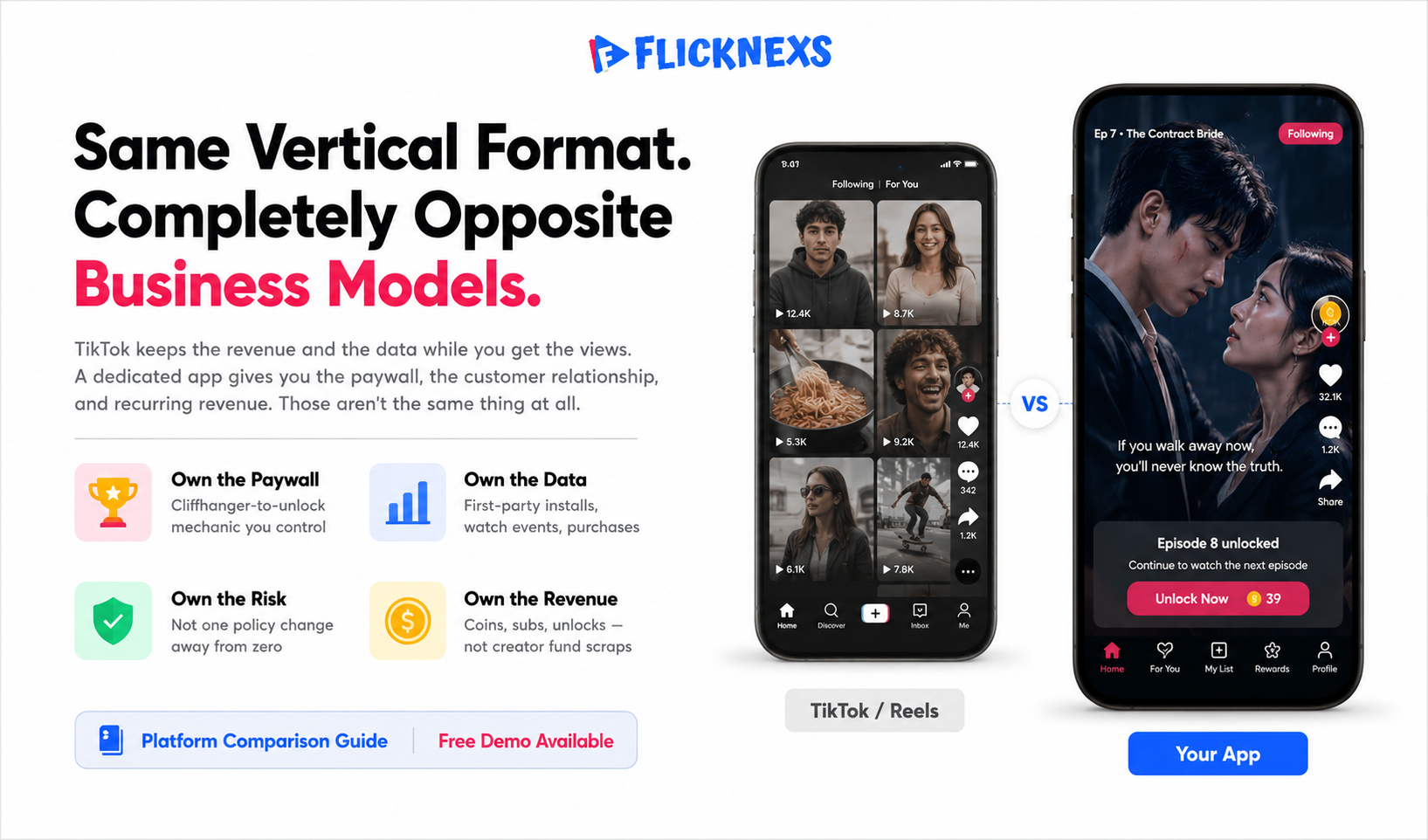
Micro-drama and TikTok or Reels both run on vertical short-form video. That’s where the similarity ends.
TikTok and Reels are social discovery feeds built to maximise ad impressions and keep creators posting. A dedicated micro-drama app exists to do exactly one thing get a viewer hooked on a scripted series and pay to finish it. Those are genuinely different jobs and the infrastructure behind each reflects that.
The dedicated app wins on monetisation because it owns everything that actually matters. The customer relationship, the billing flow, the cliffhanger-to-paywall mechanic. You’re not renting attention from a feed that keeps the revenue and the data while you get the views. You’re building something you actually control.
If recurring revenue from serialized fiction is the goal, a standalone app across web, iOS, Android and TV gives you pricing control, retention data and ownership of your IP in ways the social platforms are structurally set up to prevent. They’re not going to hand that over. That’s the whole point of their business model.
By the Flicknexs team. We build white-label OTT/VOD/IPTV streaming platforms, so this comes from hands-on streaming-platform experience.
“Micro-drama vs TikTok” is the wrong fight to think you are losing. On the surface they look identical: a phone held upright, a hook in the first three seconds, episodes measured in seconds rather than minutes. Underneath, they are built for opposite outcomes. This guide breaks down where each one wins, why creators of serialized short drama keep moving off the feeds onto their own apps and how to decide which model fits your business.
What “micro-drama” actually means (and how it differs from a TikTok clip)
A micro-drama is a scripted, serialized story told in vertical episodes of roughly 60 to 120 seconds each, with a full series often running 60 to 100+ episodes. It is produced (written, cast, shot, edited) like a soap opera compressed into your thumb. The defining trait is the cliffhanger each episode ends on a hook engineered to make you tap “next.”
A TikTok or Reels clip is usually a single and self-contained unit of content. It can be scripted, but it lives inside an infinite social feed where the next video comes from a completely different creator. The recommendation engine not the storyteller but decides what you see next.
That one structural difference drives everything else. Serialized fiction with a paywall behaves like a subscription or transactional video product. A clip in a feed behaves like advertising inventory. The business models that sit on top are nothing alike.
Same format, opposite incentives
On TikTok and Reels the platform’s incentive is to keep you scrolling across many creators so it can sell more ad impressions. On a dedicated micro-drama app your incentive is to keep the viewer inside one story until they pay to finish it. Those incentives don’t reconcile. The feed wants to pull attention sideways the drama app wants to pull it forward.
Where TikTok and Reels genuinely win
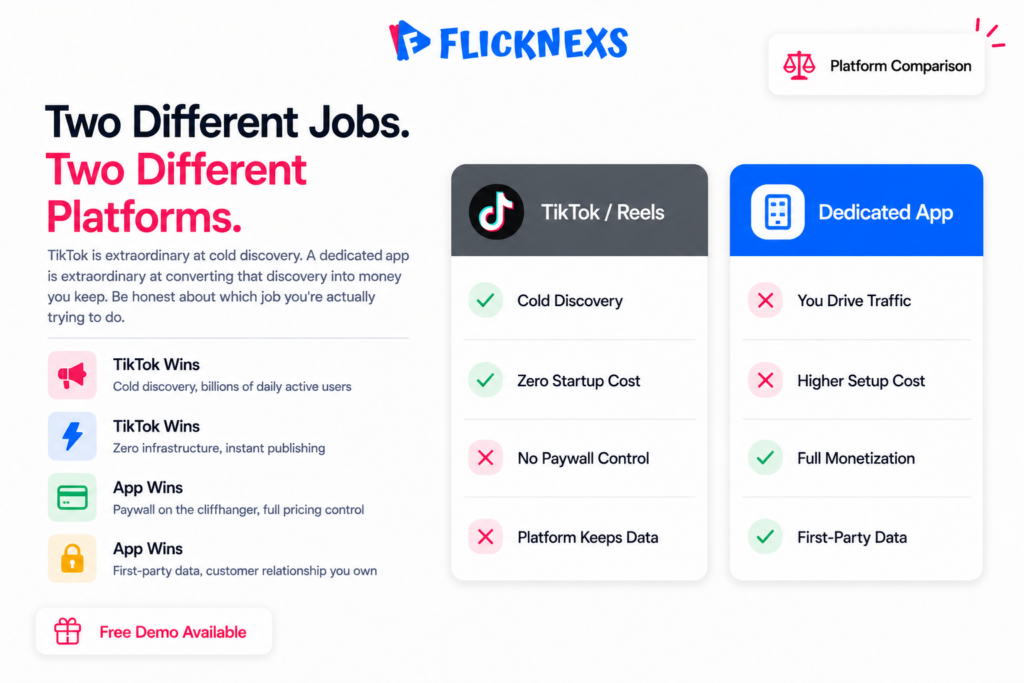
It would be dishonest to pretend the social platforms have no edge. They are extraordinary at two things and any serious micro-drama operator should use them for exactly those two things.
Discovery and top-of-funnel reach
No standalone app touches TikTok or Instagram for cold discovery. Billions of daily active users, a recommendation engine that can put your clip in front of exactly the right stranger for free. That’s not a competitor, that’s a marketing channel you’d be stupid to ignore.
The play that actually works is using it as exactly that. Post the first few hook-heavy episodes, or tight trailer cuts, on the feeds as acquisition bait. Let the algorithm do its job. Then drive whoever bites over to your app to keep watching. You’re borrowing their reach to fill your funnel, not competing with their feed for attention.
Zero upfront infrastructure
You can publish to TikTok or Reels today with a phone and an account. zero hosting,without transcoding, no billing integration, no app-store review. For testing whether your story concept hooks an audience at all, the feeds are the cheapest validation lab in the world. What actually happens, though, is that a clip popping off on a feed tells you the hook works, not that the story will convert; plenty of operators get a 2-million-view clip and then watch almost none of those viewers follow a link off-platform.
Where a dedicated micro-drama app wins
The advantages of owning the app come down to monetization, control and data, the three things the feeds keep for themselves.
1. You own the monetization mechanic
The micro-drama business model is famously aggressive give the first batch of episodes free, then gate the rest behind coins, a subscription or per-episode unlocks, with the paywall landing exactly on a cliffhanger. That mechanic is impossible to run inside someone else’s feed. On your own app you control pricing, paywall placement, coin packs and promotions down to the episode. For a deeper breakdown, see our guide on micro-drama monetization.
2. You keep the customer relationship and the data
On TikTok, the viewer is TikTok’s customer, not yours. You do not get their email, you do not control their viewing history and you cannot retarget them off-platform without paying for ads again. On your own app, every install, every watch event, and every payment is first-party data you can use to lift retention and lifetime value. As privacy rules and platform policies keep shifting, that first-party relationship is increasingly the only durable asset (see the overview of GDPR principles on why first-party consent matters).
3. You are not one policy change from zero
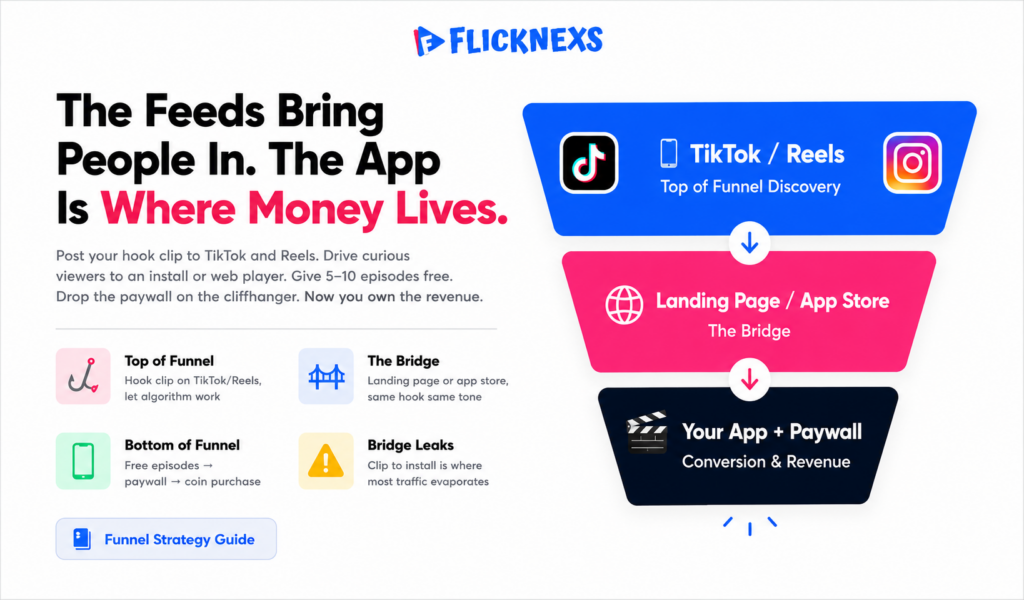
Platform risk is real. Algorithm changes, monetization-policy updates, regional bans and account suspensions can erase a feed-based audience overnight. An app you own, distributed across web, iOS, Android and connected TV, spreads that risk out. Apple’s and Google’s app stores have their own rules too, but splitting distribution across web and multiple stores is far safer than leaning on a single social algorithm.
4. Premium experience and brand
Your own app gives viewers a branded home screen, curated catalogue, continue-watching, personalised recommendations, offline downloads and a proper TV experience when they want it. The social feed gives them a thumbnail between a cooking video and a dance trend, in a scroll they’re running on autopilot
For a serialized story you’re asking someone to commit twenty episodes to, that environment difference is not a small thing.
Micro-drama app vs TikTok & Reels: side-by-side
| Dimension | TikTok / Instagram Reels | Dedicated micro-drama app |
|---|---|---|
| Primary purpose | Social discovery feed | Premium serialized-video product |
| Who owns the viewer | The platform | You (first-party) |
| Monetization control | Limited (ads / creator funds / tips) | Full (coins, subscriptions, per-episode unlock, ads) |
| Paywall on cliffhanger | Not possible | Core mechanic |
| Discovery reach | Massive, free, algorithmic | You must drive traffic (often via the feeds) |
| Customer data | Platform keeps it | Yours to keep and act on |
| Platform / policy risk | High (single algorithm) | Lower (web + iOS + Android + TV) |
| Startup cost & effort | Near zero | Higher (build or license a platform) |
| Best at | Top-of-funnel acquisition | Conversion, retention, recurring revenue |
The winning model is not “either/or”: it’s a funnel
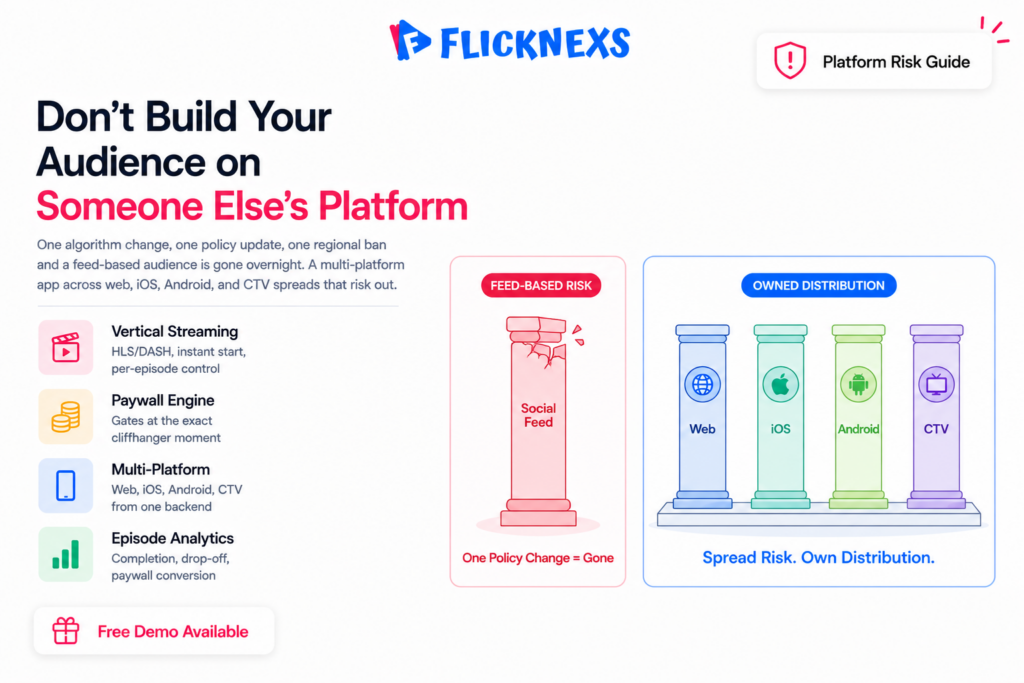
The most successful short-drama operators do not choose between the feeds and a dedicated app. They run a funnel. The social platforms feed the top, the owned app captures the value at the bottom.
How the funnel works in practice
- Top of funnel, the feeds: Cut the most hook-heavy 60 to 90 seconds of episode one into a clip. Post it to TikTok and Reels with a strong opening line and an obvious “watch the full series” call to action.
- Mid funnel, the bridge: Send curious viewers to a landing page or app-store listing. Keep the friction low; the goal is the install or the first watch.
- Bottom of funnel, the app: Give 5 to 10 episodes free to hook them, then put the paywall on the next cliffhanger. Now you own the relationship and the revenue.
One thing worth saying out loud about that bridge step: it leaks. The jump from a feed to an app install is where most of your top-of-funnel evaporates and no amount of clever editing fully fixes it. Operators who win here treat the clip and the landing page as one continuous moment, same hook, same tone, no jarring handoff, rather than a great clip dumping people onto a generic store page.
If you want the acquisition side done well, our guide to marketing and distributing a micro-drama app covers UA, hooks and retention in detail. And before any of that, the content has to land. See how to write and produce a vertical micro-drama series.
What you actually need to launch a dedicated micro-drama app
Building from scratch is expensive and slow. Most operators license a white-label OTT platform and configure it for the short-drama format. At minimum, the platform needs to handle:
Core technical requirements
- Adaptive vertical streaming with HLS/DASH so episodes start instantly on any connection (the web.dev video guidance is a good primer on delivery basics).
- Episode/series data model with seasons, ordering and per-episode access control.
- Flexible monetization: coins/wallet, subscriptions, transactional unlocks, and ad-supported tiers, ideally mixable per title.
- Paywall engine that gates at a specific episode and fires an upsell right at the cliffhanger. Not after. Not on a timer. At the exact moment the viewer can’t stand not knowing what happens next, because that’s the only moment they’re genuinely ready to pay.
- Multi-platform clients: across responsive web, iOS, Android and connected-TV apps, all running off one backend rather than four separate codebases you have to maintain in parallel.
- Analytics on completion rate, where viewers drop off per episode and exactly how many convert at the paywall, because without those three numbers you’re optimising blind.
This is exactly the kind of product a white-label platform is built to ship quickly. If you are weighing build vs. license, our team can walk you through it: build your OTT platform with Flicknexs.
Honest limitations and risks
A dedicated app is not a magic money printer. The hard parts are real. You still have to drive traffic yourself, the app doesn’t surface organically just because it exists. App-store commissions take a real cut of every in-app purchase. Content production costs stack up fast when you’re looking at 60 to 100 episodes per series. And conversion from free to paid typically sits somewhere in the low single digits percentage-wise, though that number moves around a lot depending on genre, region and how you’ve priced things. Treat any specific figure you read anywhere with healthy skepticism.
The model works on volume and retention. Not on one series going viral and carrying everything else.
Planning a micro-drama app? Launch it with Flicknexs →
Frequently asked questions
Related guides
- Micro-Drama & Short-Drama App Hub
- Micro-Drama Monetization: How Short-Drama Apps Make Money in 2026
- How to Write and Produce a Vertical Micro-Drama Series (Script to Screen)
- How to Market and Distribute a Micro-Drama App: UA, Hooks & Retention
Ready to build?
If you’re planning your next Microdrama project, Flicknexs handles the video infrastructure end-to-end — so you can ship in weeks, not months.
- get a microdrama app like DramaBox
- get a quote
More microdrama resources
Continue exploring more on this topic across the Flicknexs blog.