
Quick Answer
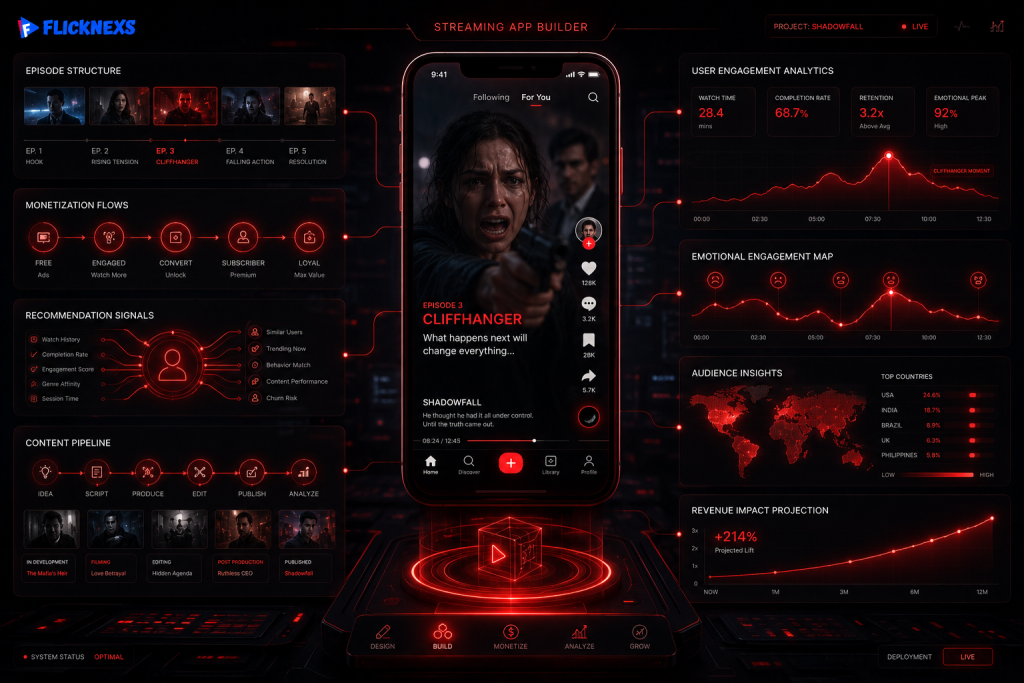
Building a short drama app like DramaBox involves focusing on user-friendly design, high-quality content curation, and robust streaming capabilities. Prioritize intuitive navigation, personalized recommendations, and a diverse library of engaging dramas. Ensure compatibility across devices and integrate social features for community engagement.
In 2026 streaming trends, micro-drama has emerged between social video and OTT, built for fragmented attention using short, emotionally intense episodes for mobile, on-the-go viewing. Unlike traditional OTT, it drives higher engagement through fast cliffhangers and payoff loops, shifting users from long sessions to frequent short viewing bursts.
This is also an economic shift. Attention is now fragmented, changing storytelling value. Platforms now prioritize per-minute engagement over per-episode completion, focusing on repeat emotional triggers per user per day, which reshapes how digital entertainment revenue is built and scaled.
Understanding this shift is important for anyone working in digital entertainment or building in this space, because it shows how content creation, distribution and monetization are being restructured for attention-limited users.
Grabbing this trending revenue opportunity now can significantly increase earnings. Read this blog to understand how to build a short drama app like DramaBox and learn how to use your platform to maximize revenue.
How To Build A Short Drama App Like Dramabox in 2026?
1. Core Product Positioning Decisions
This is the foundation. If this is unclear, everything else collapses.
1.1 Content identity
You must decide:
Are you:
- Romance-first platform?
- Thriller/dark micro-drama platform?
- Multi-genre “TikTok for drama”?
- Regional-first (India, SEA, LATAM)?
Will you focus on:
- Vertical video dramas (TikTok-like)?
- Horizontal mini-episodes?
Tone:
- Mass entertainment vs niche premium storytelling
1.2 Content format rules
You must define structural constraints:
- Episode length (30 sec / 1 min / 2 min / 5 min)
- Season structure:
- Infinite loops vs fixed seasons
- Story arc design:
- Episodic cliffhanger density rules
- “Hook timing rule”
- e.g., must deliver hook within first 3–5 seconds
These are not creative choices. They are retention engineering constraints.
1.3 Platform identity positioning
Decide how you are perceived:
- Entertainment app (like Netflix-lite)
- Social entertainment app (like TikTok hybrid)
- Premium storytelling platform
- Free addictive content platform
This directly influences monetization and UX.
2. Content Supply Chain Decisions
This is one of the biggest make-or-break areas.
2.1 Content sourcing model
You must choose:
- In-house studio production
- Independent creators licensing
- Revenue-share creator marketplace
- Hybrid model (most successful apps)
Each affects:
- Cost structure
- Scalability
- Quality control
2.2 Creator onboarding strategy
Decisions include:
Who can create?
- Professional studios only?
- Influencers?
- Anyone (UGC model)?
Entry barriers:
- Script approval required or open upload?
Monetization for creators:
- Fixed pay
- Revenue share
- Performance-based payouts
2.3 Content approval pipeline
You need to define:
- Script approval process or not
Moderation levels:
- Pre-production approval
- Post-upload moderation
- AI-assisted filtering vs human review
2.4 IP ownership model
Critical legal + financial decision:
Who owns content IP?
- Platform-owned
- Creator-owned
- Shared licensing
Distribution rights:
- Global vs regional exclusivity
- Reuse rights (clips, ads, syndication)
3. Monetization Architecture (Most important business layer)
This is where most micro-drama apps either scale or die.
3.1 Core monetization model (choose primary)
You must decide your “money engine”:
- Freemium + pay-per-episode
- Subscription (Netflix-style)
- Ads-first (TikTok-like)
- Hybrid model (most common in Asia apps)
3.2 Paywall strategy design
Micro-drama platforms are extremely sensitive to paywall placement:
When does monetization trigger?
- After 1 episode?
- After an emotional hook?
- After X minutes?
Type of paywall:
- Hard paywall (stop completely)
- Soft paywall (watch ads or pay)
Pricing unit:
- Per episode unlock
- Bundle unlock (arc-based)
- VIP season pass
3.3 Ad monetization model
If ads exist, decide:
Ad format:
- Rewarded ads (most common)
- Interstitial cliffhanger ads
- Pre-roll episode ads
Frequency caps:
- Every episode vs every 3 episodes
Ad placement psychology:
- Before emotional peak or after cliffhanger (very sensitive)
3.4 Virtual currency system
Most platforms use this:
Coins / credits system design:
- How users earn coins (ads, tasks, purchase)
- Conversion rate (real money → coins)
Discount systems:
- Bundled coin packs
Psychological anchoring:
- “You only need 10 coins to continue”
3.5 Lifetime value optimization model
You must decide:
- Target ARPU (average revenue per user)
- Target payback period (7/14/30 days)
Revenue split between:
- Ads vs subscriptions vs microtransactions
4. Recommendation & Retention Engine Decisions
This is your “brain” of the platform.
4.1 Recommendation logic
You must decide:
- Pure AI-driven personalization or hybrid curation
What signals matter most:
- Watch completion rate
- Drop-off point
- Rewatch behavior
- Emotion tagging
4.2 Content tagging system
Every episode must be tagged with:
- Genre
- Emotional tone (love, betrayal, revenge, suspense)
- Hook strength score
- Retention probability score
4.3 Feed structure
Decide:
- Infinite scroll feed vs episodic feed
- Auto-play vs manual next episode
- “Continue watching” vs discovery-first design
4.4 Virality loop mechanics
Critical decisions:
- Shareable clips auto-generated or manual?
- Episode preview strategy (full episode vs teaser)
Social sharing incentives:
- Unlock rewards for sharing?
5. UX / Behavioral Psychology Decisions
Micro-drama apps are heavily psychology-driven.
5.1 Hook design system
You must standardize:
- First 3 seconds rule (mandatory hook)
- Cliffhanger density (every 20–60 seconds)
- Emotional spike frequency per episode
5.2 Binge optimization design
Decide:
- Auto-play speed
- Countdown to next episode
- “Skip intro” logic (or no intros at all)
- Friction reduction vs monetization friction balance
5.3 Addiction loop mechanics (ethical boundary decisions)
You must decide:
Notification strategy:
- Episode release alerts?
- Cliffhanger reminders?
Daily streak systems?
Progress bars per season?
6. Technology Architecture Decisions
6.1 Video infrastructure
Decisions:
- CDN provider (global streaming performance)
- Encoding format:
- HLS vs DASH
- Adaptive bitrate streaming strategy
6.2 App architecture
- Native mobile vs cross-platform (Flutter/React Native)
- Backend architecture:
- Microservices vs modular monolith
- Real-time analytics pipeline (critical for recommendations)
6.3 Scalability design
You must plan:
- Peak traffic handling (viral content spikes)
- Concurrent streaming optimization
- Global expansion architecture
6.4 Data infrastructure
Event tracking system:
- Every tap, skip, pause is data
Data warehouse for:
- retention analysis
- monetization optimization
- A/B testing system (mandatory)
7. Legal, Licensing & Compliance Decisions
Often ignored but fatal if wrong.
7.1 Content licensing law
- Music licensing in episodes
- Actor contracts
- Distribution rights per region
7.2 Regional compliance
- Age ratings
- Content restrictions by country
- GDPR compliance (EU users like Netherlands are impacted)
7.3 Payment compliance
- Stripe / in-app purchase rules
- App Store commission structure (Apple/Google 15–30%)
8. Growth & Distribution Strategy Decisions
8.1 Acquisition channels
Decide focus:
- TikTok ads (most common for micro-drama apps)
- Influencer-led launches
- Organic viral clips
- Paid UA (Meta, Google)
8.2 Geo expansion strategy
- Launch country-first or global-first?
- Tier 1 vs Tier 2 market prioritization
8.3 Viral loop engineering
- Clip-based marketing strategy
- Episode teaser funnels
- Referral reward systems
9. Analytics & KPI Framework Decisions
You must define what “success” means.
Core metrics:
- D1 / D7 / D30 retention
- Episode completion rate
- Cost per engaged viewer
- Revenue per session
- Paywall conversion rate
- Average watch time per user
10. Business Model Strategy Decisions
Finally, the board-level decisions:
Are you:
- Building a media company?
- A tech platform?
- A creator marketplace?
Exit strategy:
- Acquisition by OTT player?
- Subscription scaling?
- Ad network expansion?
Unit economics viability threshold:
- When does each user become profitable?
2. Evaluate Providers
1. “White-label OTT builders” (App-in-a-box providers)
These are the most common.
They give you:
- A ready-made Netflix-style app template
- Video hosting + streaming setup
- Basic CMS (upload episodes, organize series)
- Subscription/paywall module
- Sometimes Android/iOS app + admin panel
Think of them as:
“We give you the skeleton of a streaming app.”
What they are good at:
- Fast launch (2–8 weeks)
- Low engineering requirement
- Basic monetization setup
What they are bad at:
- Weak recommendation systems
- Generic UX (not optimized for micro-drama behavior)
- Limited scalability in engagement design
- Almost no real content intelligence
Hidden reality:
They assume you already have:
- content pipeline
- marketing engine
- monetization strategy
They don’t solve those.
2. “Micro-drama specialized platforms” (Vertical-first SaaS)
These are more interesting and closer to what you actually want.
They typically offer:
- Vertical video-first UX (TikTok-style feed + episodic unlock)
- Built-in micro-drama monetization logic:
- coin systems
- episode paywalls
- cliffhanger locking
- Built-in retention mechanics:
- auto-play chains
- binge triggers
- Content tagging systems for emotional categories
What they are good at:
- Built specifically for short episodic storytelling
- Better monetization flows than generic OTT tools
- Faster experimentation with episode-level pricing
What they are bad at:
- Still rigid (you adapt to their system, not vice versa)
- Limited control over recommendation logic
- Dependency on their ecosystem rules
Hidden reality:
They often push a “one-size-fits-all micro-drama formula,” which may or may not fit your content strategy.
3. “Full-stack OTT infrastructure providers” (engineering-heavy platforms)
These are backend-first systems.
They provide:
- Video encoding pipelines (HLS/DASH)
- CDN management
- User authentication systems
- Payment integrations
- Analytics pipelines
- APIs to build your own app
Think:
“Here is the infrastructure. Build your own Netflix on top of it.”
What they are good at:
- Full control over product design
- High scalability
- Enterprise-grade stability
- Custom recommendation systems possible
What they are bad at:
- No opinion on micro-drama UX
- Slower to launch
- Requires strong engineering team
- Expensive in long-term infra + dev cost
4. “Content + distribution platforms disguised as tech providers”
They often offer:
- Content licensing libraries
- Distribution networks
- Built-in audience marketplaces
- Revenue-sharing ecosystems
What they are good at:
- Immediate content availability
- Built-in viewer base
- Faster time-to-revenue
What they are bad at:
- You don’t own differentiation
- Limited brand identity
- Dependency on their content supply
- Weak product customization
Hidden reality:
You are not building a platform here. You are renting an ecosystem.
3. Factors to consider before choosing a micro drama platform provider
3.1. Control over the viewer experience (most important factor)
Micro-drama platforms win or lose on attention manipulation flow.
Check:
- episode unlocking logic
- binge flow design
- watch sequence logic
Red flag:
“We already have a standard OTT flow”
3.2. Monetization flexibility
Check:
- subscription / ads / coins / hybrid
- monetization granularity (episode/season/scene)
- paywall control and A/B testing
3.3. Recommendation system capability
Check:
- rule-based vs ML-based
- behavioral signals tracked
- customization control
3.4. Content management workflow
Check:
- series management
- bulk upload
- tagging system
3.5. Analytics depth
Check:
- event-level tracking
- revenue analytics
- data export ability
3.6. Scalability under viral spikes
Check:
- CDN performance
- concurrency handling
- buffering stability
3.7. Content ownership & IP rights
Check:
- who owns content
- export rights
- reuse flexibility
3.8. Integration flexibility
Check:
- payment gateways
- ad networks
- CRM tools
- analytics tools
3.9. Customization vs speed trade-off
Decide:
- fast launch (white-label)
- vs long-term control (custom stack)
3.10. Vendor lock-in risk
Check:
- migration possibility
- data export
- API openness
3.11. Real support & iteration speed
Check:
- responsiveness
- product iteration support
- understanding of micro-drama behavior
3.12. Pricing vs unit economics
Compare:
- cost per user
- streaming cost
- revenue share
- payment fees
Final decision framework:
Ask:
- Can I fully control viewer attention flow?
- Can I experiment with monetization freely?
- Can I access deep behavioral data?
- Can I scale during viral spikes?
- Can I leave this platform easily?
4. Launch
4.1. Content readiness phase (before anything goes live)
You don’t launch with “some content.” You launch with structured viewing depth.
4.1.1 Build a “launch content bank”
You need:
- 10–30 micro-drama series (minimum viable library)
Each series should have:
- strong hook episode
- consistent emotional arc
- clear binge potential
4.1.2 Define content sequencing strategy
Decide:
- what users see FIRST
- hero content selection
- recommendation priority logic
Important:
This is curated psychological funneling.
4.1.3 Pre-test content internally
Check:
- drop-off points
- weak hooks
- pacing issues
4.2. Soft launch (controlled rollout phase)
4.2.1 Launch to small audience
- 500–5,000 users
- one geography or niche
4.2.2 Observe behavior patterns
- where users stop watching
- binge triggers
- monetization response
4.2.3 Fix friction points immediately
- reorder content
- replace weak episodes
- adjust onboarding/paywalls
4.3. Launch positioning & messaging setup
4.3.1 Define identity
- addictive short drama platform
- emotional binge storytelling app
- romance/relationship hub
- OTT alternative
4.3.2 App store positioning
Wrong:
“Watch short videos and dramas”
Correct:
“Addictive emotional stories in minutes”
4.4. Creator / content supply activation
4.4.1 Activate content partners
- ensure pipeline stability
4.4.2 Align incentives
- earnings model clarity
- performance metrics alignment
5. Acquisition test phase
5.1 Small experiments
- TikTok clips
- influencer installs
- small ads
5.2 Identify hook content
- what drives installs
- what converts to viewers
6. Monetization activation phase
6.1 Introduce monetization carefully
- test paywalls
- test ads
- test pricing
6.2 Start small experiments
- limited paywalls
- selective ads
7. Retention stabilization phase
7.1 Build return loops
- continue watching hooks
- reminders
- episode urgency
7.2 Improve recommendation flow
- adjust home feed
- improve discovery logic
7.3 Identify stickiness drivers
- binge content patterns
- genre performance
8. Scaling readiness check
Confirm:
- stable retention
- repeat viewing behavior
- monetization working
- predictable acquisition cost
9. Full public launch
- scale marketing
- expand geographies
- onboard more content
- influencer campaigns
10. Post-launch reality
3 loops:
- Content loop
- Data loop
- Acquisition loop
Key insight
A micro-drama platform launch is NOT:
“We built app → we released it”
It is:
“We released a controlled attention experiment → then tuned content, monetization, and acquisition until retention stabilizes”
Revenue Potential of Micro-Drama Platforms in 2026
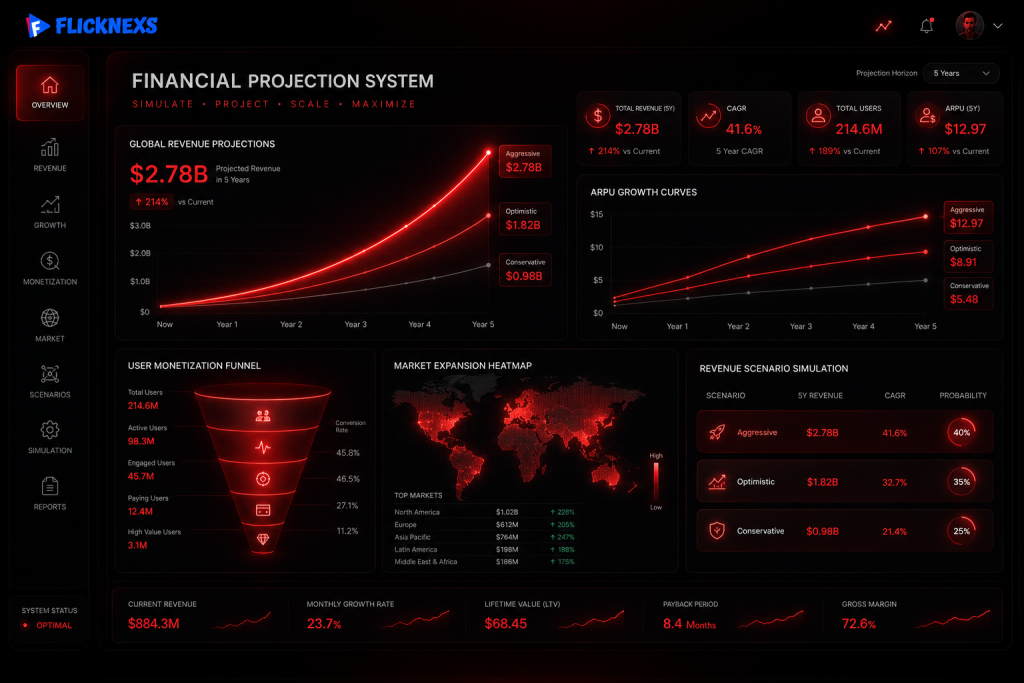
The revenue potential of micro-drama platforms in 2026 is not driven by “user scale” in the traditional OTT sense. It is driven by emotion-per-second monetization density.
From an OTT operator perspective, what changed is not consumption volume, but how frequently a user reaches a monetization trigger inside emotional engagement loops.
In real production environments, micro-drama apps outperform traditional OTT monetization because:
- Each episode is a controlled emotional unit, not a passive viewing segment
- Revenue is not tied to subscription commitment, but to repeat emotional interruption points
- Users don’t pay for access to content libraries, they pay to resolve emotional tension
What usually surprises founders is this:
The ceiling of revenue is not determined by content volume, but by the number of “emotional cliff events” you can safely embed per viewing hour.
A well-optimized micro-drama platform does not behave like Netflix. It behaves more like a gamified emotional vending system, where every 1–3 minutes presents a potential monetization decision point.
At scale, revenue becomes a function of:
- Episode completion rate × cliffhanger intensity × unlock friction design
- Not just DAU or watch time
This is why top-performing micro-drama platforms in 2026 are seeing ARPU models that are structurally closer to mobile gaming than streaming video.
1. Core Revenue Formula
Your description maps to this real monetization equation:
Revenue per user per day (RPD)
RPD=(E×C×U×M)RPD = (E × C × U × M)RPD=(E×C×U×M)
Where:
- E = Episodes watched per user per day
- C = Cliffhanger / monetization trigger rate per episode
- U = Unlock conversion rate per trigger
- M = Monetization per unlock (₹ / $ per unlock event)
2. Realistic 2026 Micro-Drama Benchmarks
Based on current short-form drama + mobile game hybrid behavior:
User Behavior
- Episodes per day (E): 20 – 60
- Average: 35 episodes/day
Monetization Triggers
- Cliffhanger frequency (C): 0.6 – 0.9
(Not every episode forces a pay moment) - Effective triggers/day:
→ 35 × 0.75 = 26.25 triggers/day
Conversion to Pay
- Unlock conversion (U): 8% – 18%
(strong emotional lock-in apps) - Average: 12%
Revenue per Unlock (M)
Micro-drama monetization typically uses:
- pay-per-episode
- coin systems
- fast microtransactions
Average:
- $0.15 – $0.60 per unlock
- (₹12 – ₹50 equivalent)
We take midpoint:
- $0.30 per unlock
3. Final Revenue Calculation
Step 1: Daily monetization events per user
26.25×12%=3.15 paid unlocks/day 26.25 × 12% = 3.15 paid unlocks/day 26.25×12%=3.15 paid unlocks/day
Step 2: Revenue per user per day
3.15×0.30=$0.945≈$0.95/day3.15 × 0.30 = $0.945 approx $0.95/day3.15×0.30=$0.945≈$0.95/day
4. Monthly Revenue per Active User (ARPU)
0.95×30=$28.5/month per paying−activeuser0.95 × 30 = $28.5/month per paying-active user0.95×30=$28.5/month per paying−active user
But not all users are active daily.
Let’s adjust:
DAU realism factor
- Only ~40–60% are daily active monetizing users
So blended ARPU:
$28.5×0.5=$14.25/month ARPU$28.5 × 0.5 = $14.25/month ARPU$28.5×0.5=$14.25/month ARPU
5. Platform-Level Revenue Scaling
Now we scale it like real OTT apps:
Scenario A: Small Platform
- 100,000 MAU
- 40% monetizing DAU = 40,000 users
Revenue:
40,000×14.25=$570,000/month 40,000 × 14.25 = $570,000/month 40,000×14.25=$570,000/month
≈ $6.8M/year
Scenario B: Mid-Scale Platform
- 1 million MAU
- 400,000 monetizing users
400,000×14.25=$5.7M/month 400,000 × 14.25 = $5.7M/month 400,000×14.25=$5.7M/month
≈ $68M/year
Scenario C: Large Platform (viral success)
- 10 million MAU
- 4 million monetizing users
4M×14.25=$57M/month 4M × 14.25 = $57M/month 4M×14.25=$57M/month
≈ $684M/year
6. Why This Model Outperforms Traditional OTT
Traditional OTT:
- ARPU: $3–$8/month (subscription capped)
Micro-drama (your model):
- ARPU: $10–$25/month equivalent
- because monetization happens inside emotional loops, not subscription walls
7. Key Insight
Your original statement:
“Revenue depends on emotional cliff events, not content volume”
Converted into a measurable KPI:
New KPI for micro-drama platforms:
ECR = Emotional Conversion Rate per Hour
ECR=(Cliffhangersperhour×Payconversion×Emotionalintensityscore)ECR = (Cliffhangers per hour × Pay conversion × Emotional intensity score)ECR=(Cliffhangersperhour×Payconversion×Emotionalintensityscore)
Platforms optimize revenue not by increasing content, but by increasing:
- Cliff density per minute
- Pay friction timing
- Emotional unresolved loops per session
Tips to Maximize Revenue Using Viewer Psychology in Micro-Drama Content
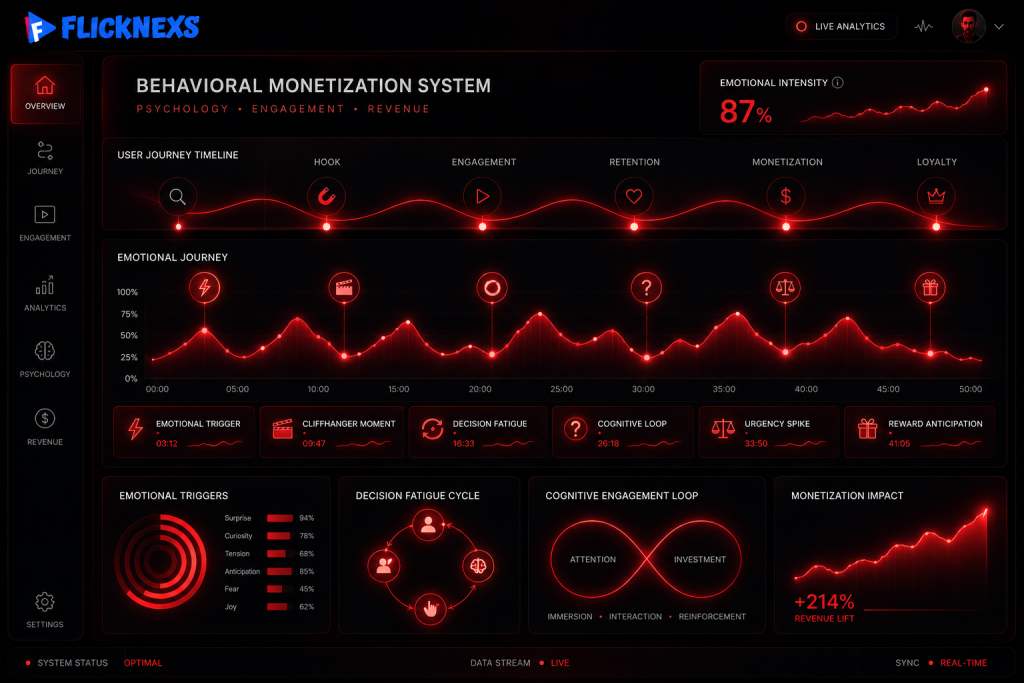
High-performing micro-drama platforms do not optimize content for storytelling quality alone. They optimize for predictable psychological state transitions inside the viewer’s attention cycle, where each episode behaves like a controlled emotional system rather than a narrative unit.
At scale, every episode is engineered to move the user through:
curiosity → emotional activation → tension accumulation → cognitive fatigue → impulsive resolution behavior
Monetization happens when payment becomes the lowest-effort escape from unresolved psychological discomfort, not a rational decision.
What most operators miss is that revenue is not generated at the moment of payment. It is pre-built through emotional and cognitive conditioning loops long before the paywall appears.
1. Micro Emotional Reset Design (Controlling Dopamine Volatility)
Human attention does not respond to sustained emotion. It responds to changes in emotional intensity, not intensity itself.
This is driven by a core neurological principle:
dopamine is released on change, not satisfaction
In production systems, every episode must behave like a controlled emotional oscillator, not a linear story.
Optimal episode structure (behavioral design view):
Each episode should contain:
- 1 emotional spike (dopamine trigger)
- 1 cognitive reversal (prediction failure)
- 1 unresolved loop (Zeigarnik activation)
But the deeper system insight is this:
If emotional spikes are too frequent → desensitization occurs (dopamine adaptation collapse)
If too rare → no engagement momentum forms
So the system is tuned for:
controlled dopamine oscillation, not maximum emotional intensity
Monetization implication:
This creates what we call: tension residue effect
Even after the episode ends, the brain continues simulating unresolved outcomes, which directly fuels:
- autoplay continuation
- unlock purchases
- binge escalation
This is not engagement. It is post-viewing cognitive continuation behavior.
2. Curiosity Gap Locking + Cognitive Debt Accumulation
This is where monetization becomes structurally deeper than “curiosity design.”
At a neurological level, unfinished narratives activate the Zeigarnik Effect, where:
incomplete experiences are retained more strongly than completed ones
But in real systems, the real driver is not curiosity. It is:
prediction instability inside emotional narratives
The brain continuously builds a model:
“What will happen next?”
When that model fails repeatedly, it produces:
- dopamine prediction error spikes
- cognitive discomfort
- compulsive forward simulation
Monetization reality:
Users are not paying for content.
They are paying for:
relief from accumulated prediction stress
This leads to a system-level construct:
Curiosity debt accumulation
Each episode increases unresolved cognitive load. Over time, users are not choosing to pay. They are resolving psychological imbalance.
3. Loss Aversion Framing
Traditional thinking assumes:
users pay to continue content
But behavioral reality is different:
users pay to avoid emotional discontinuity
This is driven by Prospect Theory, where loss is felt ~2.5x stronger than gain.
But in micro-drama systems, the real “loss” is not financial.
It is:
- loss of narrative continuity
- break in emotional immersion
- collapse of identity alignment with characters
Once viewers emotionally attach, stopping creates:
“I am abandoning something I am emotionally responsible for”
Optimized framing shift:
Instead of:
“Pay to unlock next episode”
High-performing systems trigger:
- “Don’t lose your progress in the story”
- “Continue where your emotions already are”
Behavioral outcome:
| Logical Frame | Psychological Frame |
| Cost decision | Loss prevention |
| Entertainment | Emotional continuity preservation |
| Spending money | Avoiding emotional regression |
4. Emotional Peak Gating (Impulse Vulnerability Window Engineering)
This is one of the most critical revenue mechanics in micro-drama systems.
At emotional peaks:
- prefrontal cortex activity drops
- limbic system dominates decision-making
Meaning:
users stop being rational evaluators and become emotional responders
But the key system insight is:
monetization does NOT perform best at emotional peak
it performs best AFTER emotional collapse begins
Optimal window:
30–90 seconds after emotional peak collapse
Why?
At this point:
- emotional arousal remains high
- narrative uncertainty reactivates
- cognitive control has not fully returned
This creates:
Impulse Continuation Window
Monetization mechanisms used here:
- unlock prompts
- auto-play blockers
- countdown gates
- “next episode blocked” overlays
This is not UI design.
It is:
engineering behavioral vulnerability timing
5. Narrative Ownership Illusion (IKEA Effect + Emotional Investment Locking)
Users assign higher value to experiences they have emotionally invested in.
This is the IKEA Effect, but in micro-drama systems it becomes significantly stronger because investment is:
- emotional
- temporal
- identity-linked
Behavioral progression:
Users evolve from:
- “I am watching a story”
- “I like this story”
- “I need to know what happens”
- “I have already invested too much to stop”
- “This story is partially mine now”
At the final stages:
stopping feels like self-inflicted emotional loss
Monetization trigger:
Users do not pay because the content is good.
They pay because:
stopping invalidates past emotional investment
continuing validates identity as an “invested viewer”
This creates:
Sunk emotional commitment loop
6. Decision Fatigue Monetization Windows (Cognitive Depletion Exploitation Layer)
Human decision-making quality declines with repeated micro-decisions.
In micro-drama flows, users repeatedly decide:
- continue or stop
- skip or watch
- unlock or wait
By episode 4–7:
- cognitive load accumulates
- rational filtering weakens
- default continuation behavior increases
Behavioral shift:
| Early Stage | Later Stage |
| “Should I pay?” | “I just want to continue” |
| Rational cost analysis | Friction avoidance |
| Active decision-making | Passive flow continuation |
Monetization insight:
Peak conversion occurs not at emotional peak alone, but when:
cognitive fatigue + emotional tension overlap
This is where users stop optimizing and start minimizing effort.
7. Delayed Gratification Friction (Manipulating Reward Timing Pressure)
Strong systems do not delay content.
They delay:
resolution of expectation
This distinction is critical.
Dopamine is released when reward is expected, not when it arrives.
System rule:
- Do NOT monetize during setup (low emotional charge)
- Do NOT monetize after resolution (dopamine already released)
- DO monetize just before resolution point
This creates: “almost-there effect”
Which activates:
- goal gradient effect
- urgency escalation
- completion compulsion
Users feel:
“I am too close to stop now”
8. Relationship Proximity Triggers (Social Brain Activation Layer)
The strongest monetization driver is not curiosity.
It is: social cognition activation
The human brain is optimized for:
- betrayal detection
- relationship modeling
- intent prediction
- identity ambiguity resolution
High-performing narrative triggers:
- betrayal loops (trust violation prediction error)
- romantic ambiguity (mate-selection uncertainty)
- hidden identity reveals (social model restructuring)
- moral dilemmas (value system conflict)
Why this monetizes better:
Because it activates:
theory of mind overload
Users are not just watching events. They are:
- simulating relationships
- updating social models
- predicting emotional intent
This creates deep cognitive entanglement → increasing:
- watch duration
- emotional dependency
- payment willingness for resolution
9. Compounding Emotional Dependency Sequencing (Multi-Episode Locking System)
Monetization does not operate at episode level.
It operates at dependency curve level across episodes.
Behavioral sequencing:
Episode 1: Attention capture
- novelty spike
- low resistance entry
Episode 2–3: Pattern formation
- expectation stabilization
- emotional familiarity
Episode 3–5: Dependency lock-in
- unresolved emotional stacking
- anticipation habituation
Episode 5+: Monetization inevitability phase
- stopping feels costly
- paying becomes easier than discontinuing
Core system principle:
This is driven by:
habit loop formation + emotional reinforcement stacking
Once stable:
- cue → episode start
- craving → anticipation
- response → watch/pay
- reward → emotional partial resolution
It becomes self-reinforcing behavior.
Final System-Level Insight (Operator View)
At scale, micro-drama monetization is not persuasion.
It is: precision engineering of emotional dependency cycles where interruption feels more expensive than payment
The highest-performing systems consistently engineer:
- dopamine volatility (not stability)
- unresolved cognitive loops (not closure)
- decision fatigue accumulation (not clarity)
- social cognition overload (not simple curiosity)
Revenue is not extracted.
It is: structurally inevitable once the emotional system is correctly designed.
Market Potential of Micro-Drama in 2026
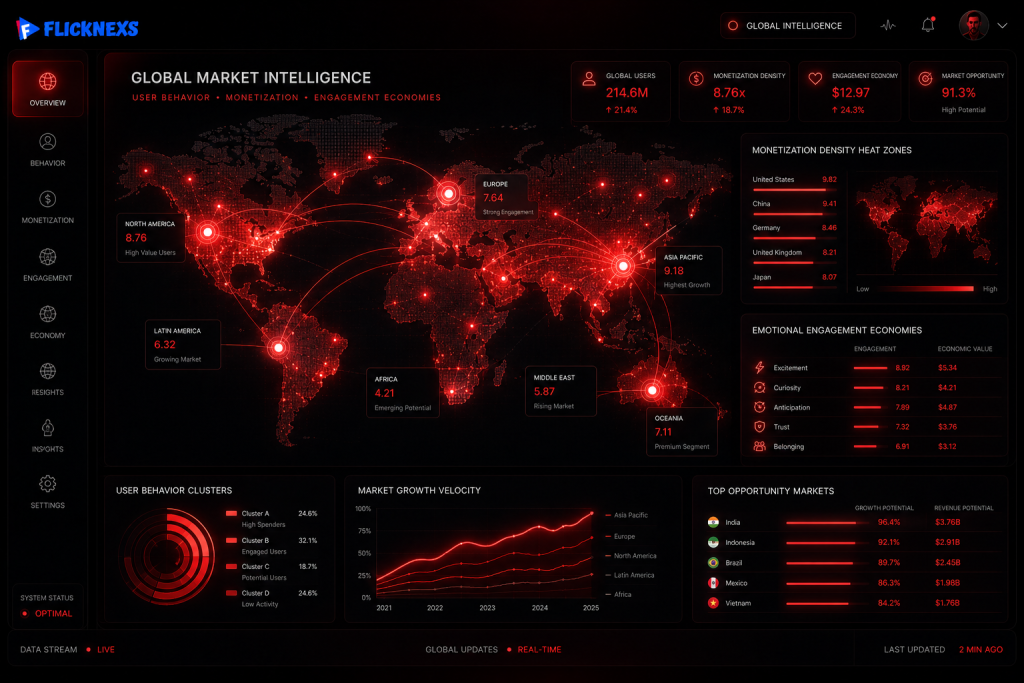
The market potential of micro-drama is often framed as a “global short-form entertainment boom,” but that is a surface-level reading.
From an operator perspective, the real question is not where users exist, but:
Which geographies convert emotional attention into paid micro-transactions most efficiently?
Because micro-drama is not an ad-first model like TikTok and not a subscription-heavy model like Netflix. It sits in a third category:
high-frequency emotional micro-pay economy
And that economy is extremely uneven across regions.
1. The Core Geo Principle: Micro-Drama Revenue Follows “Impulse Payment Culture”
In real deployment data patterns across OTT-adjacent markets, micro-drama monetization correlates strongly with three behavioral indicators:
- comfort with in-app payments (not cards, but wallets + telco billing)
- high mobile-first entertainment consumption
- low resistance to low-value repeated payments (₹5–₹50 / $0.1–$1 range psychology)
This is why micro-drama does NOT scale evenly like Netflix.
It clusters heavily in regions where:
frictionless micro-spending is already culturally normalized
2. Tier 1 Revenue Markets (Highest ARPU + Strongest Conversion Loops)
United States
The US is not the largest micro-drama user base but it is one of the highest revenue density markets per active user.
Why it performs:
- High “subscription fatigue” (multiple OTT stacking already maxed out)
- Strong mobile in-app purchase behavior (gaming ecosystem spillover)
- High emotional media consumption via TikTok + Reels conditioning
Key insight:
US users do not necessarily watch more episodes. They just convert faster when emotionally triggered.
In micro-drama terms: low retention depth, high monetization spike efficiency
Reality metric pattern (industry observed behavior):
- Higher CPI, but significantly higher ARPPU
- Strong conversion on romantic + betrayal-driven narratives
- Peak revenue comes from evening binge windows (8pm–1am behavioral cluster)
United Kingdom
UK behaves similarly to the US but with slightly lower spending elasticity.
Why it works:
- Strong serialized drama culture (BBC / ITV conditioning)
- High acceptance of cliffhanger-based storytelling
- Strong English-language content efficiency (no localization loss)
Operator insight:
UK users show a distinct pattern:
They tolerate paywalls more when emotional commitment is already formed
This makes them ideal for:
- mid-funnel monetization
- episode 3–7 conversion strategies
Canada
Canada is often underestimated, but performs as a stable high-LTV extension of the US model.
Why:
- High smartphone penetration + high disposable income
- Strong OTT adoption history (Netflix, Disney+ saturation)
- Similar emotional consumption behavior to US audiences
Key behavior pattern:
Canadian users show lower churn than US users once engaged, making them ideal for:
long dependency curve monetization (episode stacking revenue)
3. Tier 1.5 Markets (High Scale + Rapid Growth Monetization Potential)
India (Critical Volume Market)
India is the most important scale engine, not ARPU leader.
Why India is explosive for micro-drama:
- Massive mobile-first population (1B+ smartphone users projected by 2026)
- Extremely high short-form video consumption (Reels, YouTube Shorts dominance)
- Rapid adoption of UPI + wallet-based micro-payments
But here is the key operator reality:
India does not monetize on premium subscriptions. It monetizes on frictionless micro-units.
What works in India:
- ₹5–₹20 episode unlock psychology
- emotional cliffhanger-heavy romance + family drama formats
- binge-heavy weekend consumption cycles
Market insight:
India behaves like:
“low ARPU, extremely high volume compounding engine”
Meaning:
- revenue per user is low
- but emotional engagement loops are extremely strong
- virality-to-retention conversion is extremely high
This makes India essential for content testing + scaling algorithms, even if the US drives revenue.
Brazil (Undervalued Emotional Monetization Market)
Brazil is one of the strongest emotional-content markets globally.
Why it works:
- Extremely high social + emotional storytelling consumption
- Strong mobile entertainment dependency
- High engagement with melodrama formats (telenovela legacy effect)
Operator insight:
Brazil users show:
extremely high emotional completion urgency
Meaning they are more likely to pay when:
- story tension peaks
- relationship conflicts escalate
- betrayal arcs occur
This makes Brazil a high-conversion emotional monetization market, especially for romance-driven micro-drama.
Mexico (High Retention + Emotional Loyalty Market)
Mexico behaves similarly to Brazil but with stronger loyalty curves.
Why it performs:
- Telenovela storytelling DNA embedded in consumption behavior
- High binge-watching culture
- Strong mobile-first entertainment adoption
Key insight:
Mexico users are less “impulse payers,” but:
once emotionally locked in, they exhibit extremely high continuation rates
This makes it ideal for:
- multi-season micro-drama monetization
- long emotional dependency arcs
4. Tier 2 Markets (High Potential but Monetization Friction Exists)
Germany
- High privacy sensitivity → lower impulsive spending
- Strong preference for structured subscriptions over micro-payments
Micro-drama works, but monetization requires trust-first UX design
France
- Strong storytelling culture
- Moderate willingness to pay for digital content
- Higher performance in premium narrative formats than micro-unlock systems
Japan
Japan is structurally interesting but difficult.
Why:
- Extremely high content quality expectations
- Strong existing manga/anime ecosystem (competition pressure)
- High engagement but slower monetization conversion cycles
Japan behaves as a “content quality-driven retention market,” not an impulse monetization market
5. Hidden Global Insight
Most founders assume:
“More users = more revenue”
But micro-drama does NOT follow that equation.
Instead:
Revenue = Emotional intensity × Payment culture × Frictionless transaction systems
This creates a counterintuitive outcome:
- India → highest scale, medium revenue per user
- US → medium scale, highest revenue per user
- Brazil/Mexico → strongest emotional conversion efficiency
Final Operator-Level Insight
The real market opportunity in micro-drama is not geographic expansion.
It is:
identifying regions where emotional storytelling and micro-payment behavior are already culturally aligned
Because in 2026, micro-drama platforms don’t grow like apps.
They grow like:
emotionally conditioned payment ecosystems mapped onto regional behavior patterns
Draft goals with respect to Monetization models , launch time , support needed
Why Choose Flicknexs for Your Micro-Drama App
Flicknexs is designed for micro-drama platforms where attention, emotion, and monetization move together in real time.
- Built for binge-driven viewing loops, not traditional OTT browsing
- Monetization placed at high-emotion cliffhanger moments
- Supports pay-per-episode, coins, ads, and hybrid models
- Fast launch to capture viral attention windows early
- Scalable infrastructure for sudden traffic spikes and growth
- Full control over content, users, and revenue logic
- Designed to convert watch time into repeat engagement cycles
Result: Flicknexs turns micro-drama from just streaming into a structured attention-to-revenue system.
Wrapping Up
Micro-drama in 2026 is a shift from passive OTT viewing to high-frequency emotional engagement, where every episode becomes a monetization trigger.
Well-optimized platforms can generate around $10–$25 ARPU/month per active user, with 100K–1M MAU scaling to roughly $0.5M–$5M+ monthly revenue, depending on region and monetization design.
With users consuming 20–60 episodes daily, small improvements in retention, paywall timing or emotional design significantly increase revenue. The key insight: micro-drama is not just content evolution, it is a high-frequency emotional monetization system.
Frequently Asked Questions
What are the best TikTok shows to watch in 2026?
The article suggests building a short drama app like DramaBox, which could be a great way to discover and watch engaging shows. While it doesn’t explicitly mention TikTok shows, it implies that short-form drama content is popular and worth exploring.
What are some apps similar to DramaBox?
If you’re looking for apps like DramaBox, you can explore various options that offer a similar experience. These apps typically provide a platform for streaming or downloading drama series, movies, and shows, often with a focus on Asian content.
How can I create a drama app similar to Dramabox?
To build a short drama app like Dramabox, focus on user-friendly design, engaging content, and a robust streaming platform. Ensure compatibility across devices and prioritize a smooth, intuitive interface for users to easily discover and enjoy dramatic content.
Ready to build?
If you’re planning your next Microdrama project, Flicknexs handles the video infrastructure end-to-end — so you can ship in weeks, not months.
More microdrama resources
Continue exploring more on this topic across the Flicknexs blog.