
Quick answer: A micro-drama streaming app is designed to deliver short, episodic stories in mobile-friendly formats, particularly vertical video. A complete platform can include content management, episode scheduling, personalized recommendations, subscriptions, advertising, in-app purchases, analytics, and multi-device streaming. Flicknexs helps businesses build customizable micro-drama platforms with scalable OTT infrastructure, secure video delivery, and monetization features.
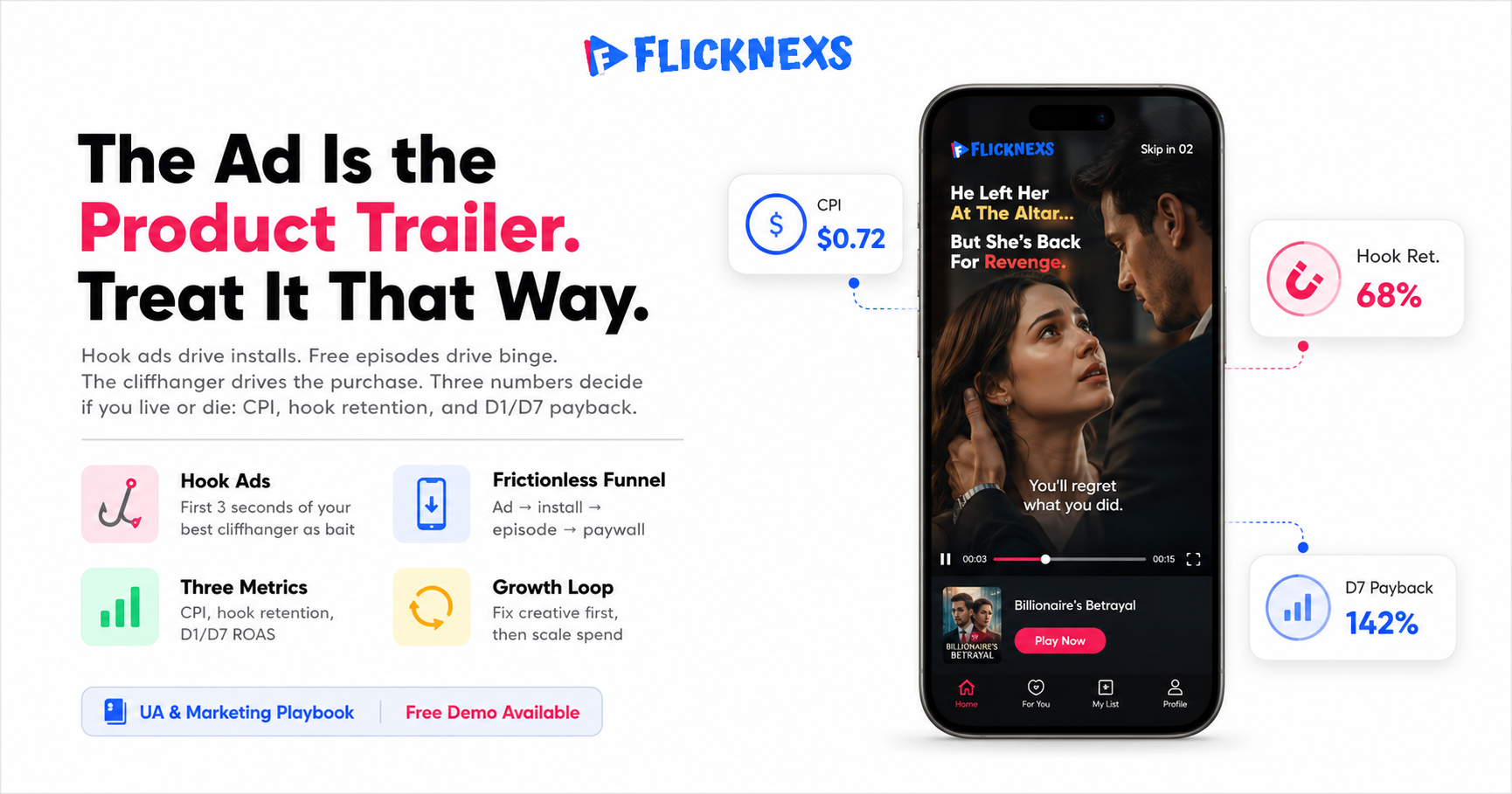
Micro-drama app marketing isn’t a slower version of film marketing, it’s a completely different sport running on a tight, repeatable loop.
You buy traffic with vertical hook-ads, the first three seconds of your most addictive episode, ripped out and used as bait. Send that traffic to a frictionless install or web player. Then hit them with an episode-gated paywall right at the cliffhanger, exactly when they can’t stand not knowing what happens next.
Distribution runs across your own iOS and Android apps, a mobile web player for paid social traffic, plus connected-TV and short-video syndication for discovery. Three numbers decide whether you live or die here: CPI (cost per install), hook retention (how many viewers actually survive episode one) and D1/D7 retention feeding into your paid funnel.
Here’s what most people get wrong: they treat creative as an afterthought, something the marketing team bolts on after the product’s built. Wrong move. In short-drama, the ad is the product trailer. A weak hook doesn’t just hurt your CTR, it drags down every single number downstream of it.
Written by the Flicknexs team. We build white-label OTT/VOD/IPTV streaming platforms, so this comes from actually building this stuff, not just researching it.
Marketing a micro-drama app has nothing in common with marketing a film festival or a classic SVOD service.The content is built for impulse viewing. Sixty-to-120-second vertical episodes, dozens per series, engineered top to bottom around cliffhangers. That format changes how you acquire users then how you hook them and how you keep them paying.
This guide walks through user acquisition, hook creative, retention and the distribution surfaces that actually move the needle for a short-drama app.
Understand the micro-drama growth loop before you spend a rupee
Most micro-drama apps aren’t running an organic content business, they’re running a paid-acquisition business that happens to have episodes attached. You’re essentially performance-marketing a serialized story.
The healthy loop looks like this a scroll-stopping vertical ad drives an install or a web-player session,viewer burns through a few free episodes after hits a paywall, then either buys coins or a subscription or churns out. Your job as a marketer is to make every single handoff in that loop cheaper and stickier than it was last week.
Here’s the part that trips people up. Because the whole economics depend on a small slice of viewers spending meaningfully, you cannot throw more budget at a broken funnel and expect it to heal. If hook retention is weak, every paid install you buy is money burned. If your paywall lands in the wrong spot, even viewers who love the show will walk. Fix the creative and the funnel first. Scale spend only after that’s solid.
The three numbers that govern everything
| Metric | What it measures | Why it decides scale |
|---|---|---|
| CPI / CPM | Cost to acquire an install or a thousand impressions | Sets your ceiling on spend; driven mostly by creative quality and bid strategy |
| Hook retention | % of viewers who finish episode 1 (or the first 30–60s) | A weak hook poisons every downstream number, so fix this first |
| D1 / D7 retention | % returning the next day / after a week | Predicts whether paid users ever reach a paywall and pay back CPI |
| Payback / ROAS | Revenue recovered vs. acquisition cost over a window | The only metric that says “scale” or “stop” |
We deliberately avoid quoting precise industry benchmarks here. They swing wildly by country, genre and platform and stale numbers do more harm than good. Instead, instrument your own funnel and treat your first 30 days of spend as paid research. Your benchmarks are the only ones that matter.
User acquisition: where micro-drama apps actually buy growth
Short-drama UA lives and dies on paid social and short-video platforms, because that’s exactly where vertical, swipe-native attention already exists. You’re not fighting for a new kind of attention here. The audience they’ll happily sit through a 90-second cliffhanger ad is the same audience already scrolling reels at 11pm.
Channel mix
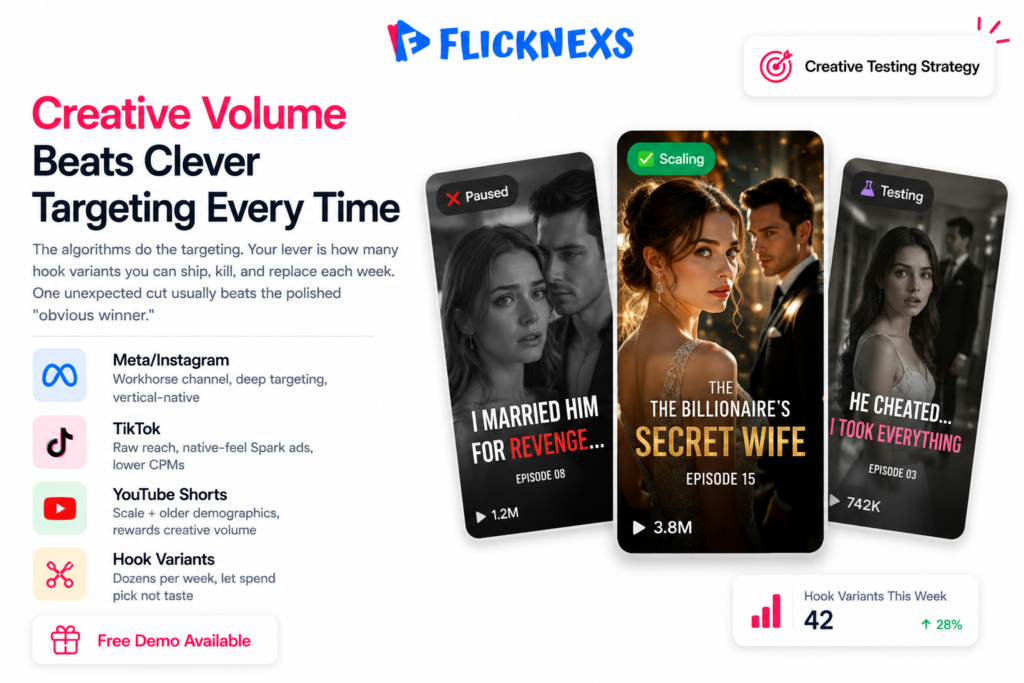
- Meta (Facebook/Instagram Reels): The workhorse for most short-drama UA. Deep targeting, mature optimization and a vertical-video surface that matches your creative natively.
- TikTok: Strong for raw reach and for creative that feels organic. Spark-style ads and creator collaborations can lower CPMs when the hook is genuinely native.
- YouTube Shorts & Google App campaigns: Useful for scale and for reaching slightly older demographics automated bidding rewards strong creative volume.
- Programmatic / DSPs & in-app networks: A secondary lever once you have proven creative and reliable measurement.
Whatever the channel, the durable advice is the same: optimize toward a downstream event (a purchase or a meaningful viewing milestone), not just installs. Optimizing to installs alone fills your app with people who never reach a paywall. Meta’s own guidance on app event optimization explains why deeper events produce higher-value users. See Meta’s Marketing API documentation.
Creative volume beats clever targeting
In a privacy-constrained, signal-limited ad world, the algorithms do most of the targeting. Your real lever is creative throughput. Successful short-drama teams ship dozens of hook variants per week kill losers fast and double down on winners. Each “ad” is essentially a re-cut of your best cliffhanger moment with a different opening line, thumbnail or caption. One thing that catches teams off guard the variant that wins is rarely the one the room loved in review. The polished, “obviously best” cut underperforms a rough re-edit roughly as often as not, which is exactly why you let spend pick instead of taste.
Hooks: the single highest-leverage thing you control
The hook is the first one to three seconds of your ad and the first episode of your series. Nothing else in short-drama carries this much weight, because the format gives viewers zero patience to earn their attention slowly.
A strong hook does three things, instantly. It plants a question the viewer needs answered. It signals the genre and the emotional stakes without wasting a beat. And it implies the payoff isn’t far off, so sticking around feels worth it.
Patterns that reliably work
- In-media-res conflict: Open on the slap, the betrayal, the reveal, not the setup.
- Status-reversal premise: “The CEO’s secret wife,” “the disrespected heir.” Clear, archetypal, instantly legible.
- Curiosity gap in the caption: Pair the visual with a line that names the stakes (“She didn’t know he owned the company”).
- Native framing: The ad should feel like content the user chose to watch, not an interruption.
For the production side of building hooks that hold (scripting beats, shot framing, and episode pacing), see our companion guide on writing and producing a vertical micro-drama series. Marketing and production are not separate disciplines here; the hook is written on the page and bought in the ad account.
Test hooks the way performance teams test landing pages
Treat every hook as a hypothesis. Hold the rest of the ad constant, vary only the opening, and let spend decide. Web performance teams have long known that the first moments determine whether a user stays. The same loss-aversion logic that drives web performance best practices on web.dev applies to your first three seconds of video: every fraction of a second of confusion costs you a viewer.
Retention: turning a curious installer into a paying viewer
Acquisition gets people in the door; retention pays the bills. For micro-drama, retention is mostly about momentum: keeping the viewer in the binge state long enough to reach a purchase decision, then giving them reasons to come back for the next series.
Onboarding and the first session
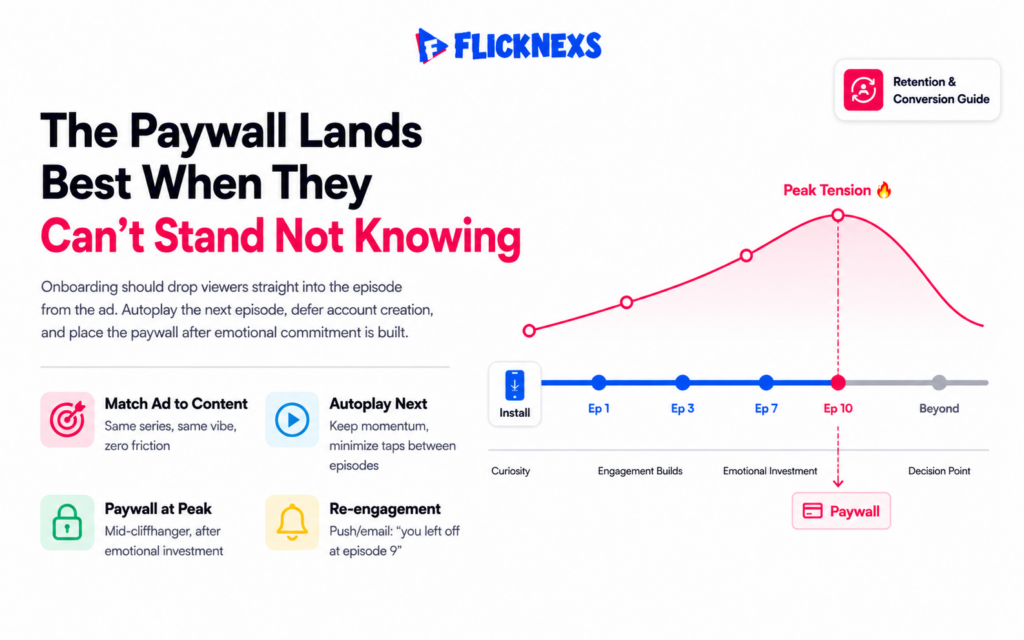
The first session should drop the viewer straight into the episode they were promised in the ad. Same series, same vibe, no friction. Mismatched ad-to-content handoffs are a top reason for D0 churn. Autoplay the next episode, minimize taps, and defer account creation until the viewer is already invested.
Paywall placement and pricing psychology
Where you place the paywall matters as much as the price. The strongest position is mid-cliffhanger, after the viewer has consumed enough free episodes to be emotionally committed. Common monetization models include coin/unlock economies, episode passes, and subscriptions; many apps blend them. We cover the full revenue side in depth in micro-drama monetization for 2026.
Re-engagement
- Push and email: “New episodes dropped” and “you left off at episode 9” notifications recover lapsing viewers.
- Series-to-series merchandising: Recommend the next binge while the dopamine is fresh.
- Win-back offers: Discounted unlock bundles for users who churned mid-paywall. These people already showed intent. They hit the wall and stopped, they didn’t just wander off. A small discount right there often closes the gap between “maybe later” and “let me just finish this.
Distribution: every surface where your drama can be found
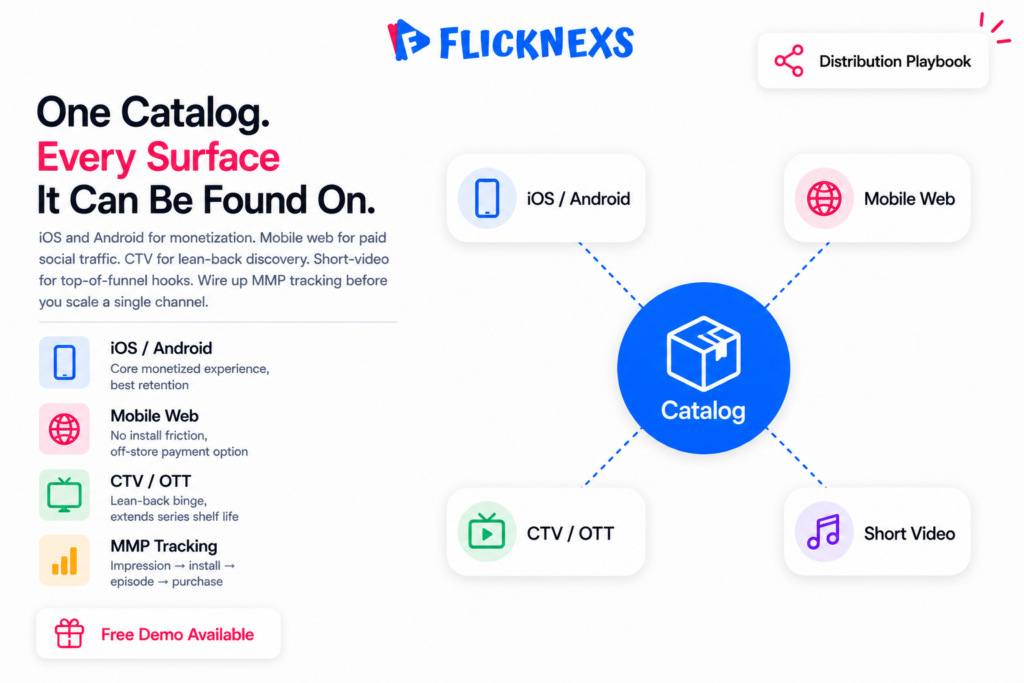
App-store installs are only one distribution channel. A serious short-drama operation treats discovery as multi-surface and uses cheaper surfaces to feed the paid app.
| Surface | Primary role | Notes |
|---|---|---|
| iOS / Android apps | Core monetized experience | Best retention and payment UX; subject to store fees and review |
| Mobile web player | Frictionless landing for paid social | Skips install friction; can route payments off-store |
| Connected TV (CTV) / OTT apps | Lean-back discovery & second screen | Growing surface for binge audiences; extends a series’ shelf life |
| Short-video syndication | Top-of-funnel discovery | Post hook clips on TikTok/Reels/Shorts that drive to the app |
The mobile web player deserves special attention. Sending paid traffic to a web player rather than an app install removes a major drop-off step and can improve the economics of off-store payments. A white-label platform that can publish the same catalog to native apps, a web player and CTV from one backend, which is exactly what we build at Flicknexs, lets you test surfaces without rebuilding your content pipeline each time. A word of caution from doing this in practice: routing payments off-store through a web player saves you the store cut, but it also moves you onto your own checkout and chargeback liability. Plenty of teams find the headline savings smaller than expected once failed payments and support load show up. Run the numbers on net revenue, not gross.
Measurement: instrument before you scale
You cannot optimize what you cannot see. Before scaling spend, wire up a mobile measurement partner (MMP) or first-party analytics that tracks the whole loop: impression to install to first episode to paywall to purchase. Pass purchase and milestone events back to your ad platforms so their algorithms optimize toward payers, not just installers. Respect platform privacy frameworks (Apple’s ATT and aggregated measurement, Android Privacy Sandbox) and lean on modeled conversions where deterministic signal is unavailable.
Explore Flicknexs micro-drama streaming app solution to launch and scale your own vertical short-drama streaming service.
A practical launch sequence
- Cut 10–20 hook variants from your strongest series before spending a cent.
- Stand up the funnel: web player + app, paywall at the cliffhanger, payment and analytics wired.
- Run a creative-testing budget on one or two channels, optimizing to a downstream event.
- Read hook retention and D1 daily; kill losers, scale winners.
- Layer in re-engagement (push/email) once you have a paying cohort to win back.
- Expand surfaces (CTV, more channels) only after one channel pays back.
Frequently asked questions
Related guides
- Micro-Drama & Short-Form Streaming Hub (Flicknexs blog)
- Micro-Drama Monetization: How Short-Drama Apps Make Money in 2026
- How to Write and Produce a Vertical Micro-Drama Series (Script to Screen)
- Micro-Drama vs TikTok & Reels: Why a Dedicated Short-Drama App Wins
Ready to build?
If you’re planning your next Microdrama project, Flicknexs handles the video infrastructure end-to-end — so you can ship in weeks, not months.
More microdrama resources
Continue exploring more on this topic across the Flicknexs blog.