
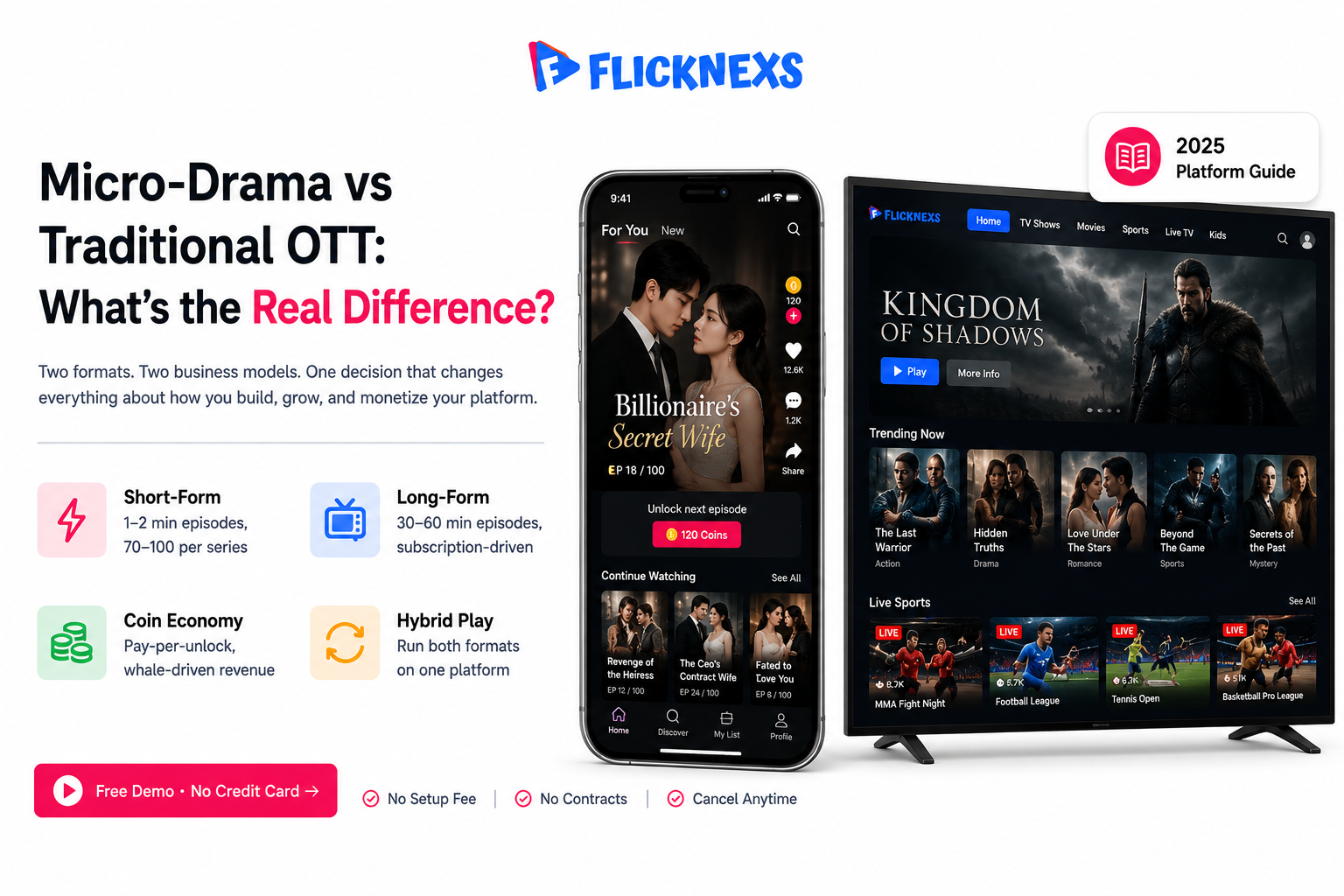
Micro-Drama vs Traditional OTT: What’s Different and Why It’s Exploding

By Sharon Hepzibah | Last Updated on July 29, 2026

Micro-drama vs traditional OTT streaming — complete comparison guide by Flicknexs

Let’s get something straight before we go any further. Micro-drama and traditional OTT get lumped together because they both involve video and a screen. That’s where the similarity ends.
Micro-drama was built for people who scroll. One to two minutes per episode, seventy to a hundred episodes per series and every single episode ends right before the moment you actually wanted to see. That’s not an accident. The cliffhanger isn’t a storytelling choice, it’s the product. You’re engineering compulsion. Viewers pay to unlock the next episode with coins or a direct purchase and the whole thing is fuelled by paid ads driving installs at scale. You’re not building an audience the way Netflix does. You’re running a performance marketing operation that happens to have a story attached to it.
Traditional OTT works nothing like that. Your viewer chose a subscription, sits down intentionally and watches thirty to sixty minutes on a proper screen. Growth comes from reputation catalogue depth and the occasional show that everyone seems to be talking about at the same time. Nobody rage-unlocks a prestige drama at midnight on the bus.
Where founders go badly wrong is assuming the infrastructure the team or the economics of one can stretch to cover the other. They can’t, the technology stacks are different. The content pipelines are different. The way you acquire and monetise users is completely different. Trying to run both from the same playbook is like using a food truck operation to cater a sit-down wedding. Same ingredients, totally wrong setup.
Micro-drama is essentially mobile gaming with a plot. Traditional OTT is closer to cable TV with better UX. Know which one you’re actually building  because the moment you blur that line, every decision downstream gets harder to make.Short-form is exploding because it married telenovela storytelling to the performance-marketing playbook of mobile gaming. And here’s the part most operators miss: both can run on the same white-label infrastructure, so you no longer have to choose.

By the Flicknexs team we build white-label OTT/VOD/IPTV streaming platforms, so this is written from hands-on streaming-platform experience.

Two formats, two different businesses wearing the same word

We call both “streaming,” but micro-drama and traditional OTT are almost different industries. One is a content business that happens to use ads to acquire customers. The other is a performance-marketing business that happens to produce content. Understand that inversion and the rest of this falls into place.

What is a micro-drama (short-drama)?

Nobody invented micro-drama in a boardroom.It was built around one ruthlessly simple insight people don’t put their phones down, so give them something that works in the cracks of their day.
Episodes are 60 to 120 seconds. Not short episodes of a normal show. Genuinely one to two minutes, end to end. And the series doesn’t wrap up in eight episodes like a prestige limited run. You’re looking at 70 to 100 episodes minimum. Sometimes more. The format is vertical, 9:16, shot to fill your phone screen the way TikTok does. Nobody’s squinting at black bars on the side.
The whole thing runs on one storytelling mechanic: the cliffhanger. Not occasionally. Every single episode. A slap. A secret blown open. The broke girl turns out to be the heiress. The husband’s affair partner walks into the office. The moment you’ve been waiting for gets yanked away and you staring at an unlock screen.

At genres don’t pretend to be anything other than what they are secret-CEO romance, werewolf fantasy, revenge arcs, rags-to-riches, second-chance marriages. Pure pulp and completely unashamed of it.
The first ten to fifteen episodes are free. That’s the hook. After that you pay, either per episode, through a coin wallet or a pass. The pricing is deliberately granular because the decision to unlock needs to feel small and impulsive, not like a considered purchase.


What is traditional OTT?

Traditional OTT is what most people picture when they hear “streaming platform.” Netflix, Disney+, Prime Video and underneath those, thousands of niche white-label services running the same basic model for specific audiences, languages or genres.
The content is long-form. Thirty to sixty minute episodes, two-hour films, prestige limited series with the kind of production budget that gets written about in trades. You watch it leaned back. On the TV in the living room, a tablet in bed, a laptop on a flight.

The whole experience assumes you have time, you’re in the mood and you’re going to actually browse before you commit to something.
Money comes in three flavours. Subscriptions, where viewers pay monthly or annually for access to everything. Ad-supported tiers, where access is free or cheaper but you sit through commercials. And transactional rentals, where you pay per title. Most serious platforms run at least two of these at once.
Here’s the part worth paying attention to if you’re building one: growth in traditional OTT has never been built primarily on paid ads. It runs on catalogue depth, brand reputation, a marquee title that gets everyone talking and the kind of slow organic compounding that comes from SEO, press coverage and word of mouth. You’re not buying every viewer through an ad auction. You’re building something people come looking for.
That’s a fundamentally different muscle than micro-drama. Patient, brand-led, catalogue-driven. The economics reward you later and longer, but they punish you early if you don’t have the content to back it up.

Format and production telenovela speed vs prestige craft

Micro-drama production speed vs traditional OTT craft  format and budget comparison

The production gap is enormous, and it’s the source of micro-drama’s velocity. A full micro-drama series (80-plus episodes totaling 90–120 minutes of finished runtime) is often shot in 7 to 14 days on a single location or two with budgets that frequently land between roughly $150,000 and $400,000 for a localized English-language title and far less in some markets. The math is closer to soap-opera and short-form influencer production than to scripted television.

Traditional OTT sits at the other extreme. A single prestige episode can cost more than an entire micro-drama series, shoot over weeks and demand months of post. The craft is the moat: cinematography, score, performances and arcs that pay off over hours.

The writing itself diverges. Micro-drama scripts are engineered, almost mechanically, around a hook every 60–90 seconds and a paywall-friendly cliffhanger at the unlock boundary. The writer’s job is to make stopping feel unbearable. Long-form writers build slow-burn character and theme across a season trusting the viewer to stay for the payoff. Vertical framing also changes the grammar: tight singles, faces filling the frame, minimal wide shots, text and reaction beats that read on a 6-inch screen. In practice this trips up teams coming from TV. Shoot a beautiful wide establishing shot and it just reads as a tiny, busy rectangle on a phone, so you end up recutting for closeups you didn’t plan for.

Business model: coins and UA vs subscription and brand

Micro-drama coin economy vs OTT subscription model  monetization comparison for platform operators

This is where the two models stop just looking different and start being genuinely incompatible in how you run the business.
Micro-drama monetisation is a coin economy. Viewers buy a bundle of coins, top up a wallet and spend episode by episode. Most platforms layer in ad-unlocks too, where you watch a rewarded ad to open the next episode instead of paying. The mental model isn’t streaming. It’s mobile gaming. A small slice of heavy spenders and the whales that drive a disproportionate share of total revenue. Everyone else either churns or converts slowly. The whole thing lives or dies on one ratio: what you paid to acquire a viewer versus what that viewer actually spends before they leave.
And acquiring viewers is not a side activity in micro-drama. It’s the business. Operators spend heavily on TikTok, Meta and YouTube, running clipped cliffhangers as ads and driving people straight to an install or a web sign-up. When it works, you recoup the ad spend through in-app unlocks within days. The content is almost the cost of goods. The real engine is advertising arbitrage.
That framing matters because of what it means when things go wrong. The day your ad creatives stop converting, revenue doesn’t taper off gradually. It drops within hours. There’s no organic base underneath you, no catalogue quietly pulling in subscribers, no brand equity softening the fall. You’re only ever as healthy as this week’s numbers.
Traditional OTT doesn’t work like that at all. Revenue comes from subscriptions people renew monthly or yearly, or from ad inventory against viewers who keep showing up. The unit you’re optimising for is retention, not conversion. Paid acquisition exists but it’s a supplement, not the engine. Growth comes from brand, word of mouth, content marketing and the compounding effect of a catalogue that keeps getting more valuable over time. Lifetime value is measured in years of subscription, not a burst of coin purchases in the first week.
One model is a sprint you repeat every week. The other is a slow build you have to be patient enough to wait for.


Audience and consumption: the commute vs. the couch

Micro-drama is consumed in the cracks of the day: the commute, the lunch line, the bedtime scroll. It’s a phone-first, one-handed, sound-optional (heavy captions) experience that slots into the same moments people give to TikTok and Reels. The audience skews toward women 25–55 in many Western markets and toward mass-market, mobile-only viewers in emerging ones, though the demographic is broadening fast.

Traditional OTT owns the living room and the intentional viewing session. The viewer sits down, often with others, picks something and commits 30 minutes to three hours. It’s a lean-back, multi-device, big-screen experience where audio and picture quality matter.

The strategic insight: micro-drama’s competitor is not Netflix. It’s TikTok. It fights for fragmented attention against free, infinite, algorithmic short video. That reframes everything, from creative to pricing to the speed at which the feed must hook a new viewer.

Technology and platform needs