
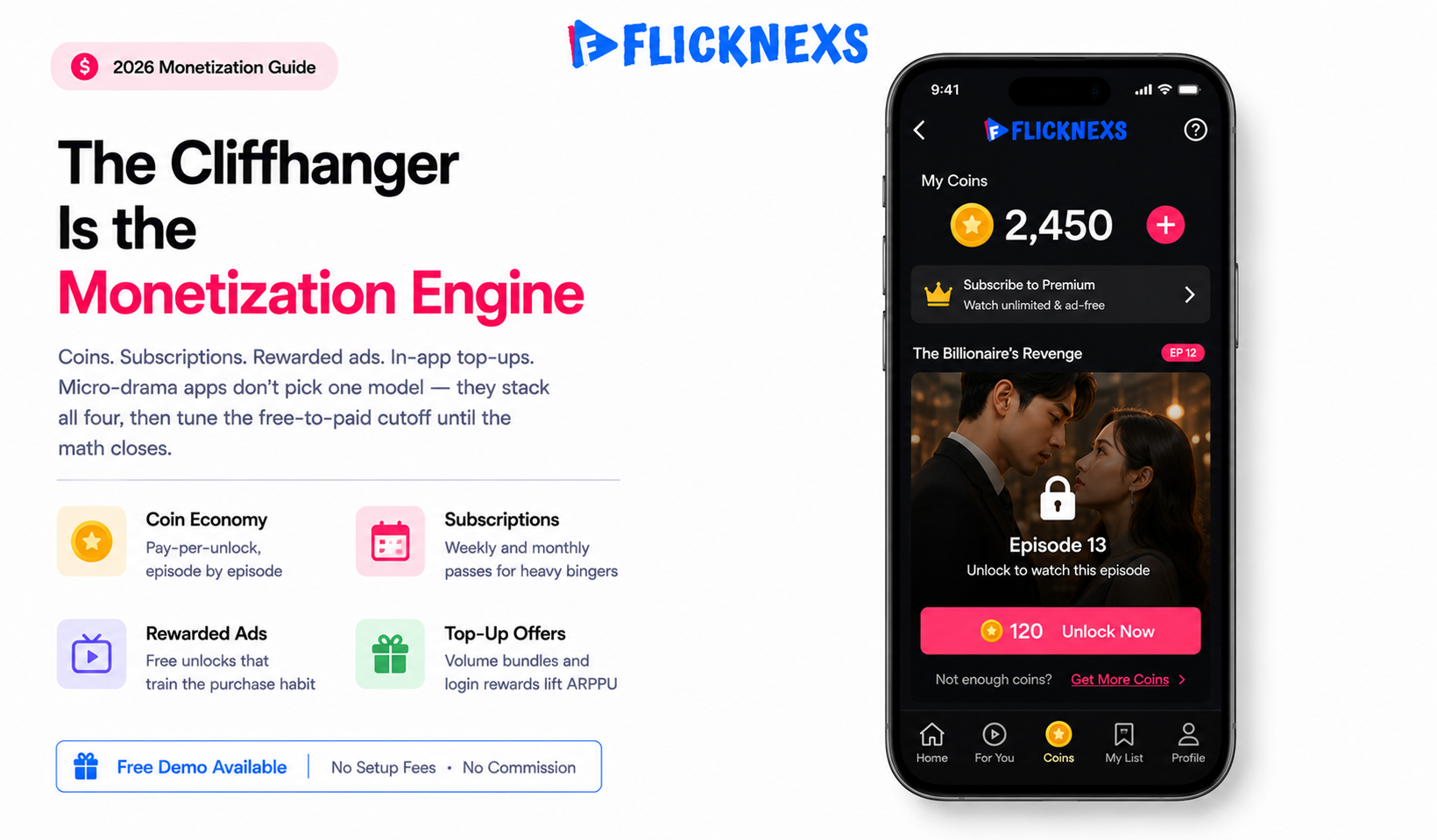
Micro-drama monetization apps don’t make their money one way. They stack three or four revenue streams on top of each other, because betting everything on a single model is how you go broke in this business.
The backbone is a coin economy. Viewers watch a few episodes free, hit a wall right at the cliffhanger and buy virtual coins to unlock what’s next. That alone wouldn’t be enough, so operators layer weekly and monthly subscriptions on top, plus rewarded ads and coin top-ups for whenever someone’s balance runs dry. Think of it less like a Netflix subscription and more like a mobile game’s in-app purchase system, wearing a drama costume.
The economics only work because the content is cheap to make. A vertical short-drama series runs 60 to 100 micro-episodes and shot fast that built entirely around the cliffhanger. That cliffhanger isn’t a storytelling flourish the monetization engine. It’s what turns “I want to keep watching” into an actual purchase, one tiny transaction at a time.
The operators winning in 2026 aren’t picking one model and sticking with it. They blend pay-per-unlock with subscriptions and ad tiers, then tune the free-to-paid episode cutoff constantly (move it one episode too early and you kill binge momentum, too late and you leave money on the table) and they pour acquisition spend into whatever channel gets lifetime value past payback fastest.
By the Flicknexs team. We build white-label OTT/VOD/IPTV streaming platforms, so this comes from actually running these systems, not just reading about them.
Micro-dramas, vertical phone-shot fiction told in one-to-two-minute episodes, are one of the fastest-growing formats in streaming right now. The format started in China, often labeled microdramas or short dramas and spread outward from there. Every operator eyeing this space is asking the same question: how do you actually turn a cliffhanger into cash? This guide walks through the monetization models that work, the real unit economics behind them and the platform mechanics you need to run this business in 2026.
The core micro-drama monetization models
No single model wins in every market. What actually works, if you look at the apps making real money, is running a hybrid of all of them at once. Once you understand each building block on its own, you can figure out which mix fits your catalogue, your audience and how much you’ve got to spend on acquisition.
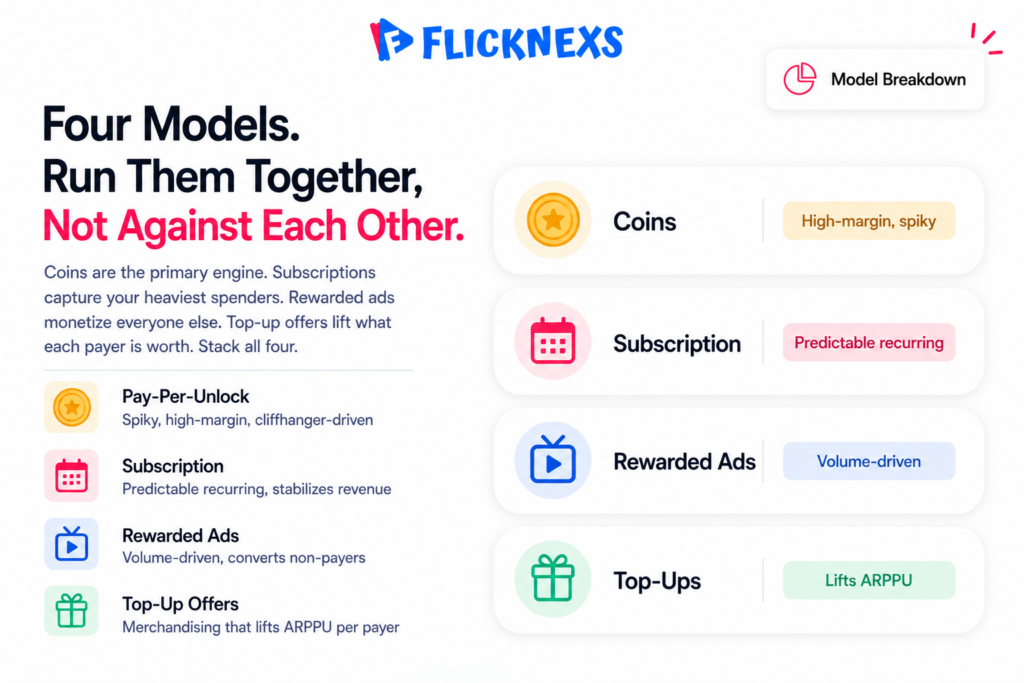
1. Pay-per-unlock (The coin economy)
This is the signature model of the category. A series gives away the first batch of episodes for free, often 5 to 15, to hook the viewer, then locks every episode after that behind a small payment. Viewers buy a bundle of coins (a virtual currency) up front, then spend a few coins to unlock each new episode as they binge.
The clever part of the coin layer isn’t the coins themselves, it’s the psychological distance they put between the viewer and their actual money. Once someone’s topped up, every unlock feels close to free. Casino chips work the same way and that’s not a coincidence. The “should I really pay for this?” hesitation just evaporates, right at the exact moment the cliffhanger hits and binge intent is highest.
The free-to-paid cutoff is the one lever that matters more than anything else here. Set it too early and you scare off casual viewers before the story’s had a chance to hook them. Set it too late and you’re handing away your most monetizable episodes for free.
2. Subscriptions (weekly, monthly and all-access)
Subscriptions sit alongside coins for heavy viewers. A weekly or monthly pass that unlocks everything (or hands out a daily coin allowance) appeals to bingers who would otherwise spend more buying unlocks à la carte. Many apps deliberately price the subscription so the heaviest 10 to 20% of users find it cheaper than paying per episode, which converts your best customers into predictable recurring revenue. Short, low-commitment weekly passes tend to convert better than annual plans here, because the content is impulsive and trend-driven and nobody wants to commit a year to a genre fad.
3. Advertising and rewarded video
Ads serve the large free tier that will never pay. Two formats dominate. Standard pre-roll and mid-roll for ad-supported (AVOD) viewing and rewarded video, where a viewer watches a 15 to 30 second ad to earn a free unlock. Rewarded ads pull real weight because they monetize non-payers and quietly train them on the coin economy. The viewer goes through the unlock mechanic without spending a cent, which lowers the barrier to that first real purchase later.
4. In-app purchases and top-ups
Beyond episode unlocks, apps sell coin bundles at tiered price points with volume bonuses (buy more, get a better per-coin rate), first-purchase discounts, daily login rewards and limited-time top-up offers. These merchandising tactics, borrowed straight from mobile gaming, lift average revenue per paying user in a way that surprises operators coming from traditional VOD.
Comparing the models at a glance
| Model | Who it monetizes | Revenue pattern | Best for |
|---|---|---|---|
| Pay-per-unlock (coins) | Engaged bingers past the free hook | High-margin, spiky, content-dependent | Cliffhanger-driven serialized catalogs |
| Subscription | Heavy repeat viewers | Predictable recurring | Stabilizing revenue, retaining whales |
| Rewarded / AVOD ads | Free, non-paying majority | Volume-driven, lower per-user | Large top-of-funnel audiences |
| Coin top-ups & offers | Existing payers | Lifts ARPPU via merchandising | Maximizing value per paying user |
The practical takeaway: run coins as your primary engine, layer a subscription to capture and keep your heaviest spenders and use rewarded ads to monetize and convert the free tier. Treat these as competing instead of complementary and you leave money on the table.
The unit economics that make or break a micro-drama app
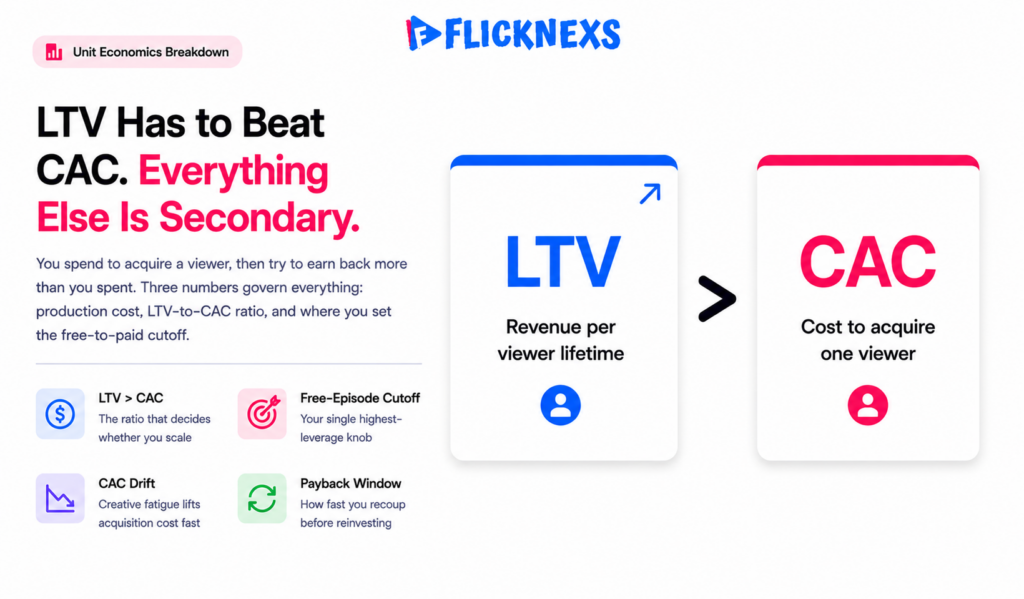
Monetization models only matter if the math closes. Micro-drama is, at heart, a performance-marketing business. You spend to acquire a viewer, then try to earn back more than you spent. Three numbers govern everything.
Production cost per series
Vertical micro-dramas are cheap relative to traditional film because they shoot fast, use compact crews and lean on a handful of tight locations. Budgets swing enormously by market and ambition. A lean production can come in low, while polished originals cost a lot more. The point is that a series is amortized across dozens of monetizable episodes so even modest per-series revenue can clear cost if conversion and retention hold. We won’t quote a single “industry average” figure because real budgets range widely by country and quality tier. Treat any specific number you see as a starting hypothesis to validate against your own first titles.
User acquisition cost vs. lifetime value
Most micro-drama apps acquire users through paid social and short-video ad networks, using the most gripping 15-second clip from a series as the ad creative itself. The make-or-break ratio is LTV-to-CAC the average revenue you eventually earn from a user against what you paid to acquire them. If LTV comfortably beats CAC inside an acceptable payback window, you scale spend. If it doesn’t, no amount of monetization cleverness will save the business. That’s why creative testing and the free-episode cutoff get obsessive attention. Small lifts in conversion compound directly into how much you can afford to spend on growth. (What actually happens at scale is messier than the spreadsheet a creative that crushes for two weeks fatigues fast, your CAC drifts up and you’re back in the editing bay cutting new hooks before the old cohort has even finished paying back.)
The free-to-paid cutoff is your highest-leverage knob
Where you drop the paywall inside a series shapes conversion more than almost anything else. Standard practice is to A/B test the cutoff per title, because the optimal point depends on how quickly that specific story hooks viewers. Strong openings can paywall earlier. Slow-burn stories need more free runway. Instrument drop-off per episode, watch where binge velocity peaks and place the first lock just after the moment viewers are most committed.
How to instrument micro-drama monetization on your platform
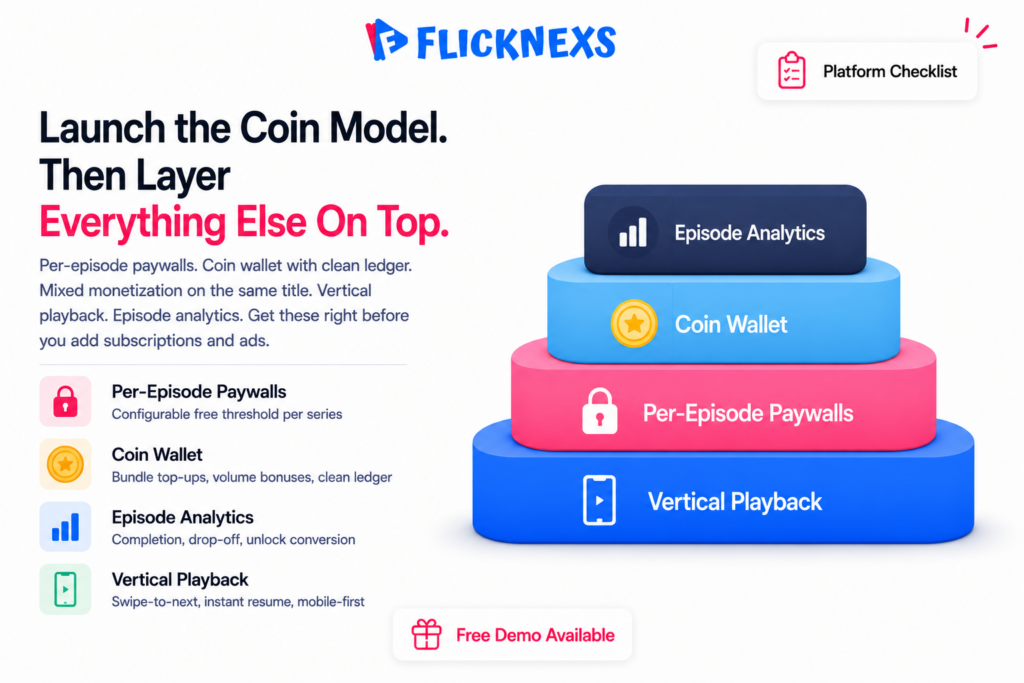
To run any of this you need a platform that supports granular, per-episode entitlements rather than the coarse “whole show or nothing” model of traditional VOD. Concretely, your stack needs:
- Per-episode paywalls with a configurable free-episode threshold per series.
- A virtual currency / coin wallet where viewers top up in bundles, get volume bonuses for buying bigger packs and can see a clean transaction ledger for every coin spent.
- Mixed monetization that isn’t locked to one mode. The same catalogue should be able to sit behind a paywall, come bundled in a subscription, run with ads or unlock through a rewarded ad, sometimes all four on the same title depending on the viewer.
- Vertical, mobile-first playback built for swiping straight into the next episode, with instant resume so nobody loses their place.
- Analytics down to the episode: completion, drop-off, unlock conversion and ARPPU.
- App-store billing plus card/wallet payment rails, since iOS and Android take a cut of in-app purchases that your web checkout can avoid.
This is the difference between bolting a paywall onto a generic player and running a purpose-built short-drama economy. One thing teams underestimate: that “clean ledger” line item is doing more work than it looks. The moment a refund, a chargeback or a duplicate-purchase bug hits a coin wallet, you’re reconciling virtual currency against real money and a sloppy ledger turns into support tickets and angry one-star reviews. A flexible video monetization platform should let you combine AVOD, SVOD and transactional (coin/unlock) models in one catalog without re-platforming. See how we approach this at Flicknexs.
Don’t ignore app-store economics
Apple and Google take a meaningful percentage of in-app purchases, which directly compresses margin on coin sales made inside the apps. Many operators steer users to a web-based top-up flow where policy and regulation allow, recovering that margin.Build your pricing and checkout around platform fees from day one. Don’t find out about the haircut after you’ve already launched, that’s a painful and entirely avoidable mistake. Always check the current App Store Review Guidelines and Google Play policies before you design your payment flow, since these terms shift and you want to be building against what’s actually in force, not what was true last year.
Putting the mix together: a practical sequence
If you’re launching, sequence your monetization instead of switching everything on at once. Start with the coin/unlock model and a generous free hook to learn your conversion curve. Add rewarded ads early to monetize and convert non-payers. Introduce a subscription once you can actually see who your heavy spenders are, and price it to keep them. Finally, layer in top-up merchandising (bundles, offers, login rewards) to lift revenue per payer. Throughout, let LTV-to-CAC, not vanity install counts, decide how hard you scale acquisition.
For the upstream and downstream of this, see our companion guides on writing and producing a vertical micro-drama series and marketing and distributing a micro-drama app, and on why a dedicated app beats relying on TikTok and Reels for ownership of the customer and the revenue.



Leave a Reply