
Pricing a video membership well comes down to one thing most creators get backwards: perceived value has to lead and operational costs follow from there. Start with what a paying member should feel they’re getting, then work out what you need to charge to make the economics work. To create a successful video membership model, consider integrating your content with a robust video CMS platform solution.
Most creators do sensibly start with a single entry-level tier and a free trial. Lower friction at the door means more people come in and more people in means more data on what actually converts. As the content library grows, a mid-tier and a premium option give members a natural upgrade path and push average revenue per user up without requiring a single new acquisition.
Retention is where pricing strategy lives long-term though. The initial price point gets someone in. Consistent content delivery, a community worth staying for and billing cycles that flex around real life, annual plans, pause options, are what keep them there month after month.
Key Takeaways
- Tiered structures let you pull value from casual viewers and power users at the same time, without pushing either group away. The trick is making each tier feel like a genuine step up not just the same product with a higher price tag slapped on it.
- Free trials and money-back guarantees lower the barrier to entry significantly, but only if you’re upfront about what happens when the trial actually ends. Vague communication here is exactly where post-trial churn comes from. People don’t cancel because the price hurt, they cancel because they got surprised.
- Retention comes from content cadence and community, not price. Members getting consistent value and feeling connected to something don’t leave over a modest price bump. Members who aren’t getting that will leave regardless of what you charge them.
- Your platform choice determines how much flexibility you actually have over billing logic. White-label solutions give you full control here. Third-party marketplaces often restrict which pricing models you can even run and that constraint bites sooner than most people expect.
- And pricing at launch is a starting point, not a final answer carved in stone. What converts well with an early audience often needs adjusting as the library grows, the community matures and you understand what your members actually value, versus what you originally guessed they would.
What Is the Real Problem Creators Face When Pricing Video Content?
The moment a creator decides to launch a membership site, the biggest hurdle is not recording the video or editing the footage. It is the paralysis of setting a price. You have spent months building a library, perhaps filming hundreds of hours of content and now you must assign a dollar value to it. Many founders freeze here. They worry that pricing too high will leave them with zero subscribers, while pricing too low will make the business unsustainable or devalue their work in the eyes of the audience.
The anxiety most creators feel about pricing comes from misreading what the customer is actually buying. They’re not buying a video file. They’re buying an outcome, a status, access to a community or a shortcut to a result they care about. The price on a course about selling online reflects the transformation the student expects to achieve. The price on a membership reflects ongoing access to that transformation and the people pursuing it alongside them. Get that framing right and pricing becomes a different kind of conversation.
The options don’t help. One-time fee, monthly subscription, annual plan, hybrid model, free tier, freemium, content locked behind a paywall, content released on a drip schedule. Every combination is technically viable and none of them is obviously correct without a strategy underneath it. Without that strategy you’re guessing. Guessing produces revenue gaps. Revenue gaps lead to content droughts because the money isn’t there to keep producing. Content droughts trigger cancellations. The whole thing unravels from a pricing decision that felt fine at the time.
Many creators look at competitors and copy their prices. This is a dangerous strategy. A competitor might have a massive existing audience that subsidizes a low price point. They might have different cost structures. They might be in a different stage of business growth. What works for a giant in the fitness industry might fail for a niche expert in sustainable gardening.
The core issue is that pricing is not a math problem; it is a psychology problem. It is about how your audience perceives value relative to the cost. When someone is deciding whether to pay a substantial monthly fee, they’re not thinking about your server costs or how long the editing took. The only question running in their head is whether this will help them solve their problem faster than they could on their own. If the answer is yes, the price is secondary. If the answer is no, even a low price feels like too much.
The technical implementation creates its own set of problems on top of that. Plenty of creators end up on platforms that lock them into rigid billing structures that don’t match how they actually want to run the business. You want a seven-day trial followed by a monthly charge but the platform only does annual billing. You want a VIP tier with live Q&A access but tiered access logic isn’t supported. So you compromise on your business model to fit the tool instead of finding a tool that fits the model. That compromise tends to cost more in lost revenue over time than the platform ever saved you upfront.This is where the distinction between a simple video host and a dedicated membership platform becomes critical. Generic video hosting services are designed to store files, not manage complex billing relationships. They lack the logic to handle prorated upgrades, downgrades or trial conversions. When you try to build a sophisticated membership on a basic host, you end up with a patchwork of spreadsheets, manual email reminders and frustrated customers.
The solution requires a shift in mindset. You must stop thinking about the price as a static number and start thinking about it as a dynamic relationship. The price is the entry point to a journey. The structure of that journey—how long it takes, how much support they get, how exclusive the content is—determines the price they are willing to pay.
How Do You Structure Pricing Tiers to Maximize Revenue Without Confusing Customers?
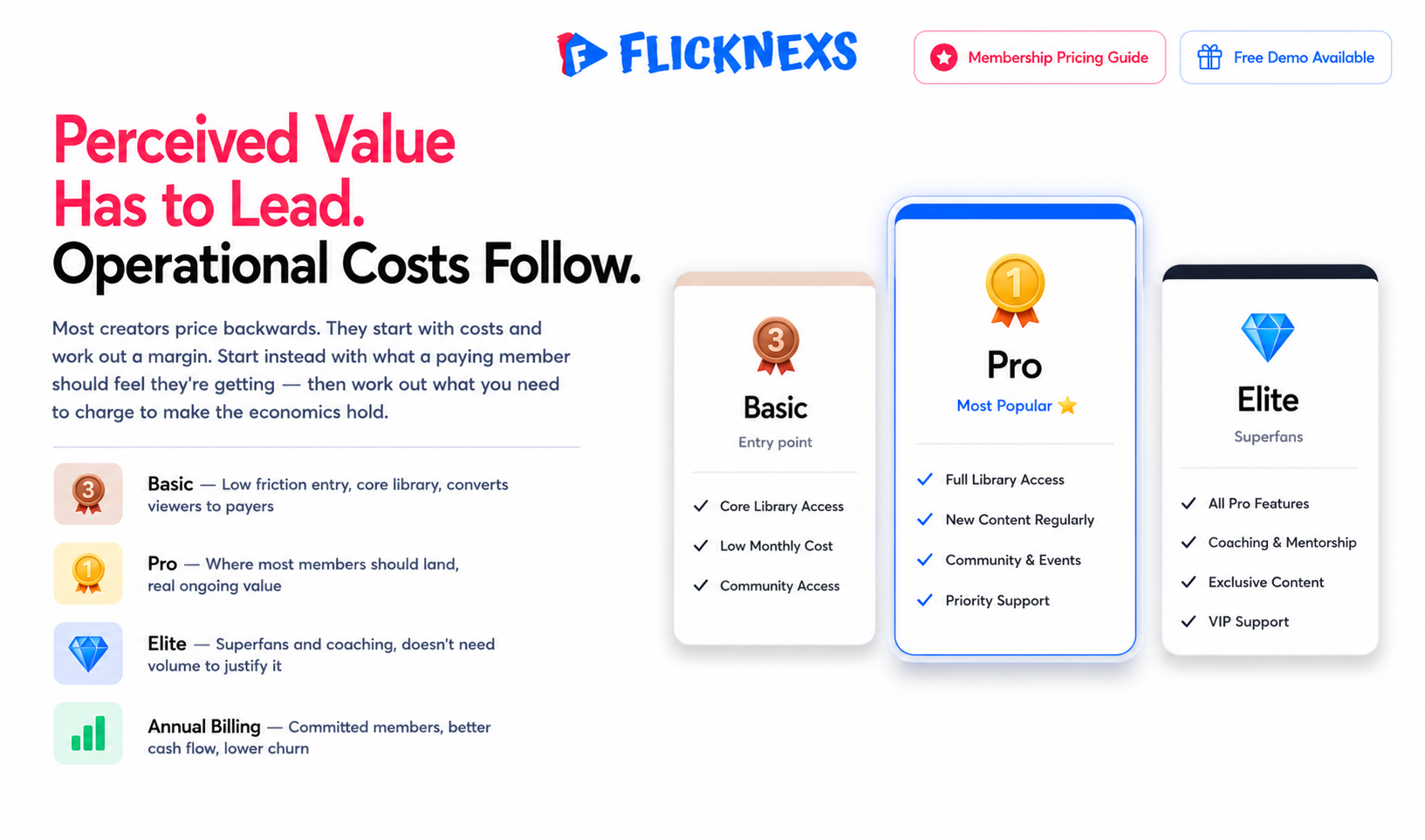
Three tiers is the number that works. One forces everyone into the same box and leaves money on the table from power users. Four or more creates choice overload and people close the tab rather than decide. The structure that converts consistently is Basic, Pro and Elite and the psychology behind it is straightforward: the Elite tier makes Pro look like the smart, reasonable choice. Not the cheapest, not the most expensive. The one a sensible person picks.
Here’s how to think about each tier:
- Basic is your entry point, priced low enough to feel like an impulse buy. Core video library access, nothing more. Its job is to convert viewers into paying members so you can upsell them later, not to give away everything you’ve built.
- Pro is where you want most members to land. Everything in Basic plus the features that create real ongoing value: live Q&As, a private community, downloadable resources, behind-the-scenes content. The price gap between Basic and Pro should feel like a genuine upgrade, not a rounding error.
- Elite is for superfans and it doesn’t need to sell in volume to justify its existence. One-on-one coaching, early access, personalised elements. A handful of Elite subscribers can generate revenue that rivals a much larger Basic cohort.
One thing most creators get wrong: they put their best feature in the lowest tier because they want to impress new members. Don’t. If weekly live calls are your strongest offering, they belong in Pro or Elite. Giving them away in Basic collapses the value case for everything above it.
Upgrades and downgrades need to be frictionless. A member who hits a wall trying to change their plan doesn’t downgrade. They cancel. Handle prorated billing automatically, make tier changes instant and keep the process out of their way entirely.
When Should You Use Free Trials, Money-Back Guarantees or Freemium Models?
The debate over free trials versus paid trials is one of the most common in the space and the logic sounds simple: let people try before they buy and they’ll see the value and convert. The execution is where it gets complicated.
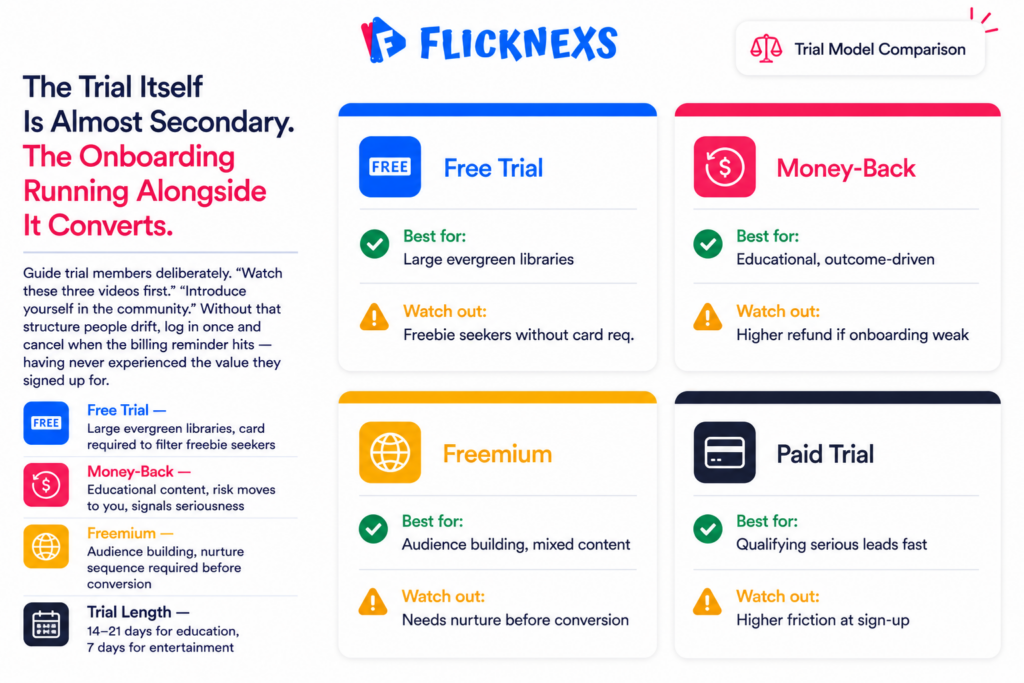
A free trial gives access for a set period without charging. For a large evergreen library this works well, seven or fourteen days gives someone enough time to binge enough content to understand the quality. The problem is free trials attract freebie seekers, users who consume everything they can before the billing date and cancel without paying. The fix is requiring a credit card upfront. It filters out the non-serious users before they cost you bandwidth and support time.
A money-back guarantee flips the dynamic entirely. You charge immediately but promise a full refund within 30 days if they’re not satisfied. The risk moves from the user to you, which is exactly the signal a serious buyer needs. People who are genuinely committed to getting a result tend to prefer this model because the safety net is there if they need it, even though most of them never will.
Freemium is a different animal. A permanent free tier with limited access, a few videos, a weekly newsletter with a link to free content, while the full library sits behind a paywall. It’s not really a trial. It’s an audience-building tool that captures people who aren’t ready to pay yet and gives you the email relationship to stay in front of them until they are.
| Model | Best for |
Watch out for |
| Free trial (card required) | Large evergreen libraries | Freebie seekers if no card required |
| Money-back guarantee | Educational, outcome-driven content | Higher refund rate if onboarding is weak |
| Freemium | Mixed free/paid content, audience building |
Lead nurturing required before conversion |
| Paid trial | Qualifying serious leads quickly | Higher friction at sign-up |
Trial length matters more than most creators think about. Seven days is too short for educational content where someone might need two weeks just to get through the first module and understand what they’re actually getting. Thirty days swings too far the other way and gives users enough time to feel they’ve already consumed what they came for. For educational content, fourteen to twenty-one days is usually the right window. For entertainment, seven days is enough.
Whichever model you pick, guide the user through it deliberately. “Watch these three videos first.” “Introduce yourself in the community.” “Join the live Q&A on Tuesday.” Without that structure, people drift. They log in once, poke around, forget about it and cancel when the billing reminder hits, having never actually experienced the value they signed up for. The trial itself is almost secondary. The onboarding running alongside it is what converts.
Which Billing Cycles and Payment Methods Drive the Highest Retention Rates?
Your billing cycle shapes both revenue stability and how likely members are to stick around. Monthly billing lowers the barrier to entry and makes acquisition easier, but churn is higher because the commitment is lower. Someone who misses a week of content or hits a tight month will cancel without much hesitation. Annual billing flips that dynamic. A member who’s paid upfront for the year is committed, less likely to cancel and better for cash flow. The trade-off is the higher upfront cost, which is why a meaningful discount, two months free, something that actually feels like a deal, is usually necessary to make the annual option convert.
| Cycle | Barrier to entry |
Retention | Cash flow | Best for |
| Monthly | Low | Lower | Steady but fragmented | New audiences, lower price points |
| Quarterly | Medium |
Moderate |
More predictable | Seasonal or project-based content |
| Annual | Higher | Strongest | Immediate lump sum |
Established libraries, loyal audiences |
Beyond the cycle itself, three operational details quietly determine how much revenue you actually keep. Payment methods matter more than most creators expect: credit cards dominate in the US, direct debit and SEPA are standard across much of Europe and digital wallets like Alipay are essential in parts of Asia. Limit yourself to one gateway and you’re turning away buyers who would have paid if you’d made it easy. Dunning, the automated process that retries failed payments and emails members to update expired cards before cancelling their access, can recover a meaningful percentage of revenue that would otherwise just disappear. And the billing portal itself needs to be clean and self-service. A member who can’t easily update their card or pause their subscription doesn’t downgrade. They cancel, because cancelling is easier than dealing with a clunky interface
How Do You Keep Members From Churning When Content Demand Fluctuates?
Churn is the number that determines whether your membership business is actually building toward something or just running to stand still. High churn means you’re replacing departing members faster than you’re growing. Low churn means the base compounds and the business gets easier over time, not harder.
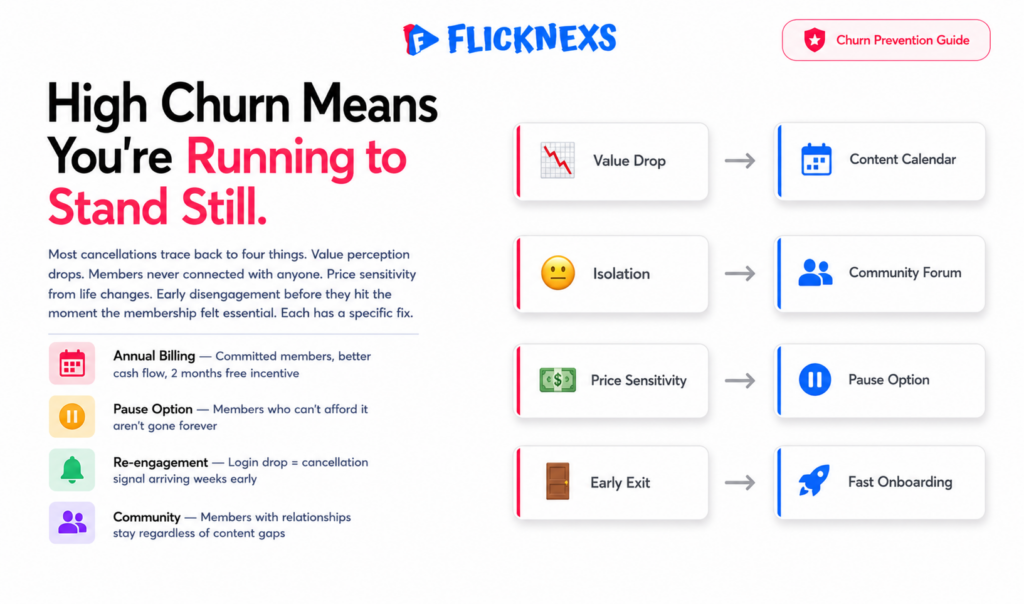
Most cancellations trace back to one of four things. Perceived value drops, usually because content frequency slips or quality drifts. Isolation, the member never connected with anyone and realises they’re just watching videos alone, which they could do anywhere. Price sensitivity, not a reflection of your value but of their circumstances changing. And early disengagement, the member never reached the moment where the membership felt essential because nobody guided them there fast enough.
The fixes map directly to the causes:
- Content calendar discipline: If you promise a new video every week, that video has to exist every week. Members don’t cancel the day you miss a post. They cancel when missing posts becomes the pattern they expect.
- Community infrastructure: A private forum, a Discord server, live Q&As, any structure that gets members talking to each other. Members who’ve formed relationships inside your platform have a reason to stay that has nothing to do with your next piece of content.
- Pause option: A member who can’t afford the subscription right now isn’t necessarily gone forever. Give them a way to pause for a month or two without losing their history and access. Most of them come back. Almost none of them do if you force a full cancellation.
- Re-engagement automation: A drop in login frequency or video views is a cancellation signal that arrives weeks before the actual cancellation. Catch it with an automated sequence. A personal-feeling email pointing them toward something specific they haven’t seen yet costs almost nothing and recovers a meaningful percentage of members who were drifting.
- Fast onboarding to value: The more content a member has consumed, the less likely they are to cancel. Getting them to the moment where the membership feels indispensable as quickly as possible is the single most underrated retention lever. Guide them to your best content first. Don’t make them discover it on their own.
Retention isn’t a campaign you run once. It’s the ongoing work of delivering on the promise someone made to themselves when they signed up. Get that right consistently and the churn rate takes care of itself.
How Does Your Platform Choice Impact Your Ability to Scale Pricing and Features?
The platform you build on determines what your membership business can become. Not just today, but eighteen months from now when you want to add a tier, run a trial, integrate a new payment gateway or launch on TV. The wrong platform doesn’t just slow you down. It actively prevents you from doing things your business needs to do.
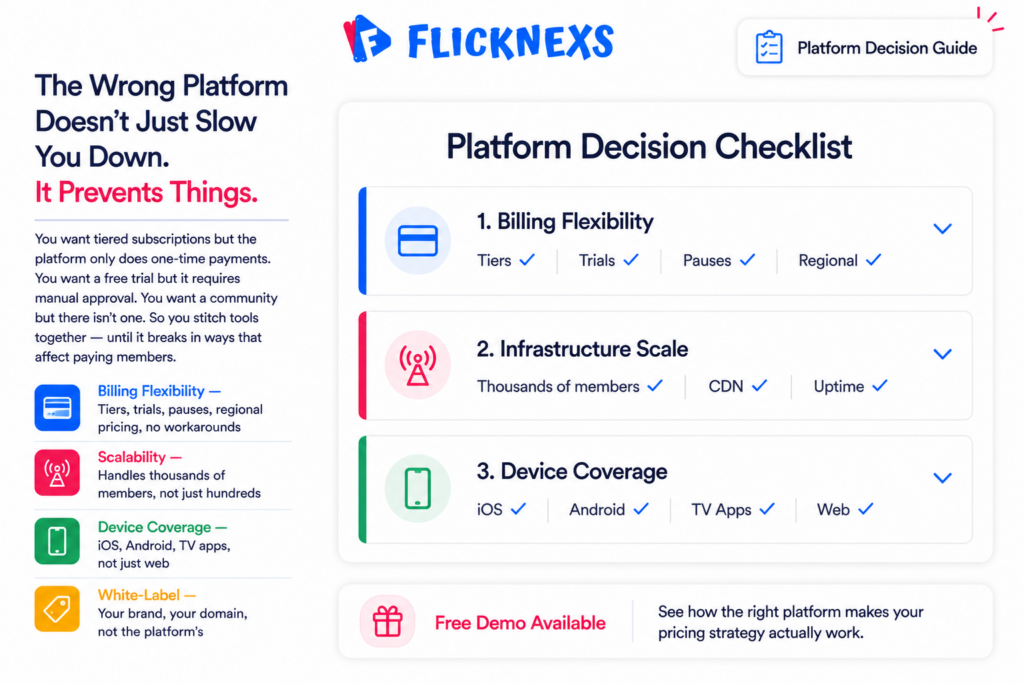
Most creators start with a simple video host or a course platform and hit the same wall at roughly the same point. You want tiered subscriptions but the platform only does one-time payments. You want a free trial but it requires manual approval. You want a community but there isn’t one. So you start stitching tools together, a video host here, a membership plugin there, a third-party forum bolted on the side. It works until it doesn’t and when it breaks it breaks in ways that affect paying members.
A white-label OTT platform is built to avoid that specific problem. Full control over billing logic, complex pricing models, tiers, trials, annual discounts, multiple payment gateways, community features, all in one place. No patches, no workarounds, no explaining to a member why their access didn’t update when their payment went through.
The white-label piece matters more than people initially realise. Your logo, your colours, your domain, a professional branded experience rather than a generic platform your members can immediately identify as someone else’s product. For high-ticket memberships especially, the environment you present is part of what justifies the price. A generic interface makes a premium membership feel like anything but.
Three factors should drive your platform decision:
- Billing flexibility: Can you set up tiers, trials, pauses, annual discounts and regional pricing without waiting for a platform update? If the answer involves a workaround, that’s a ceiling you’ll hit.
- Scalability: A platform that handles a few hundred members smoothly can fall apart at a few thousand. Infrastructure matters and it’s invisible until it isn’t.
- Device coverage: Web-only is a meaningful limitation. Members watch on phones, tablets and TVs. A platform that delivers native iOS, Android and TV apps keeps you in front of them wherever they actually watch.
The upfront cost of a white-label solution is higher than a basic SaaS platform. The economics over time usually aren’t. You’re not paying per user. You’re not giving up a percentage of revenue. You’re paying for the platform itself and as your member count grows, your cost per member drops rather than rising alongside it.
Frequently Asked Questions
Ready to build?
If you’re planning your next OVP project, Flicknexs handles the video infrastructure end-to-end — so you can ship in weeks, not months.
- explore online video platform
- see Flicknexs pricing
More video platform guides
Continue exploring more on this topic across the Flicknexs blog.