
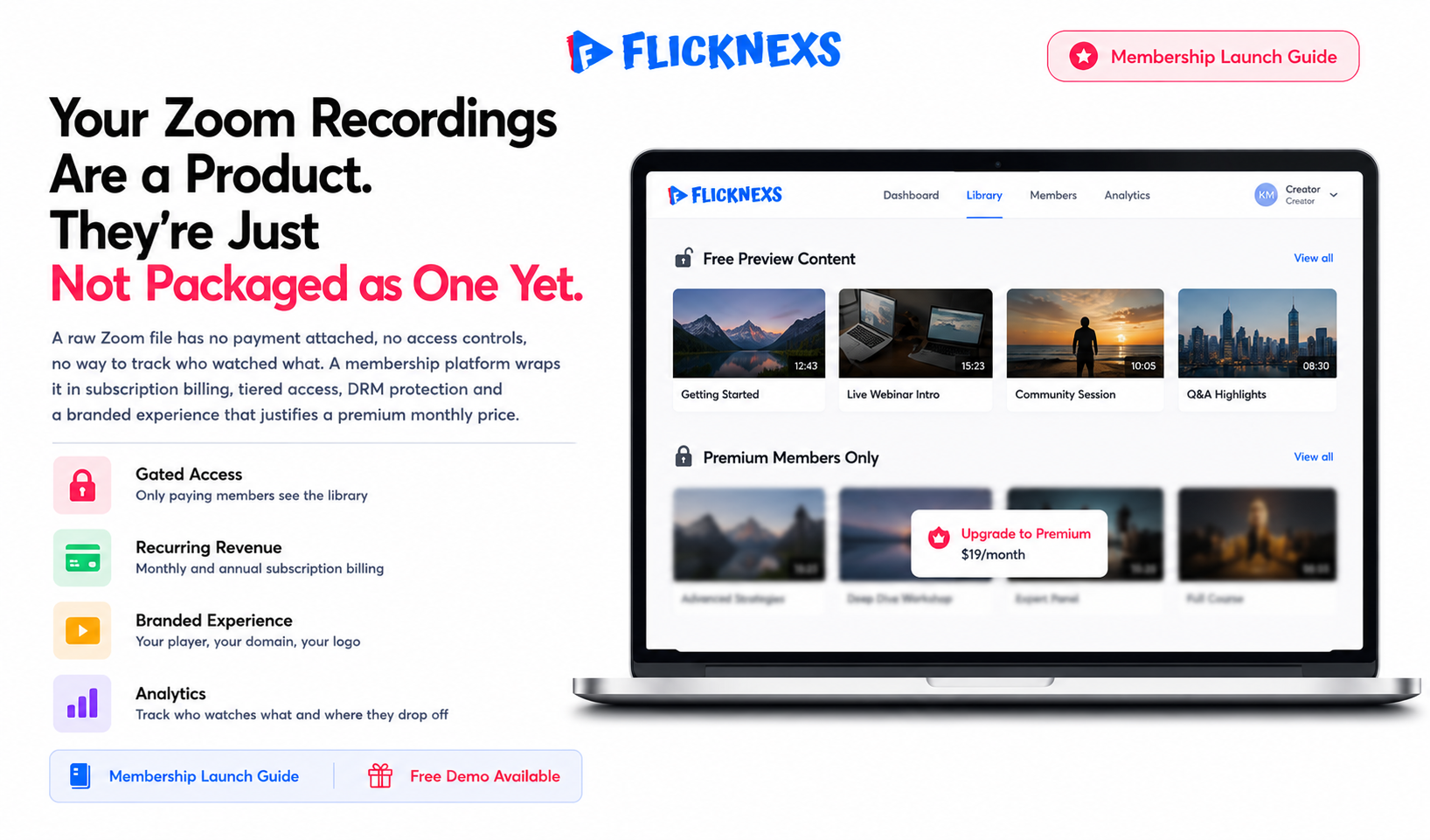
Transform Zoom recordings into a recurring video membership by uploading content to a dedicated streaming platform, establishing a membership structure with tiered access, and enforcing strict viewing permissions. This approach converts one-time event archives into a sustainable revenue stream while providing a professional viewing experience for your audience.
Key Takeaways
- Centralize Content: Move Zoom files from cloud storage to a dedicated video hosting platform optimized for streaming and security.
- Monetize Access: Set up subscription models that gate your content properly, so only paying members can get in. Free previews are fine, but the library itself should sit behind a paywall that actually holds.
- Control Distribution: Role-based access controls and DRM keep your content from walking out the door. Unauthorized sharing and IP leakage are quiet revenue killers, and neither problem fixes itself without the right controls underneath.
- Scale Operations: White-label technology lets you put branded apps on mobile and TV without building the underlying software yourself. You get to market faster and spend the engineering budget on things it actually differentiate your product.
- Engage Audiences: Analytics tell you where members are dropping off and why. Community features give them a reason to stay. Used together, they’re your best tools for keeping churn low enough that the subscription business actually compounds over time.
What Is the Core Problem Creators Face With Raw Zoom Recordings?
Most educators, coaches and consultants end up in the same frustrating position. They run a valuable webinar or training session on Zoom, save the recording and then… nothing. It sits in a cloud folder, a generic YouTube playlist or on a hard drive somewhere. The knowledge exists. The business model doesn’t.
The immediate problem is structure, or the lack of it. A raw Zoom file is just a video file. No payment attached, no way to track who watched what, no access controls. Send a Dropbox link and anyone who gets it can share it with anyone else. You have no idea if the person watching paid for it or got it forwarded by someone who did. Your work is being consumed and you’re seeing none of the revenue it should be generating.
The viewing experience usually makes things worse. Zoom recordings are compressed for speed, not quality. No chapter markers, no variable playback speed, without adaptive streaming that adjusts to a slow connection. Stick it on a free host and your audience watches in a generic player full of ads and unrelated recommendations. Your brand, your message and your authority all take a hit from an experience you didn’t design and can’t control.
The shift from “recording meetings” to running a media business requires different infrastructure entirely. Your video content needs to be treated as a product, not a file. That means moving away from ad-hoc sharing and toward a proper membership ecosystem where access is tied to subscription status, not a link someone can forward.
General-purpose website builders and basic video hosts seem like the obvious fix, but they struggle with the specific demands of a video-first business. Large files handled poorly mean slow load times. Most can’t manage tiered access logic cleanly, where one subscriber sees a different library than another based on what they’re paying for. The workarounds get complicated fast and the experience still feels like a workaround.
Consider the user journey. A potential member lands on your site. They see a list of videos. They click play, but the video buffers, or the player looks unprofessional. They leave. Even if they stay, if they can share the link freely, your potential paying customers become pirates. The raw Zoom recording, without the proper wrapper of a membership platform, is a liability rather than an asset.
The problem is not the content itself. The content is valuable. The problem is the delivery mechanism. You need a system that enforces value. This system must handle the authentication of users, the processing of payments, and the secure delivery of the media file. Without this, you are essentially giving away your product for free, hoping that some people will pay you out of goodwill. That is not a business model; it is a hobby.
Why Should You Convert Passive Recordings Into an Active Membership Model?
Turning a static library of Zoom recordings into a recurring membership changes the fundamental economics of your business. Instead of chasing one-off payments for individual courses or events, you build revenue that shows up every month without you having to sell something new each time.
The practical benefit is predictability. When you know roughly what’s coming in, you can plan content production, hire help and invest in better equipment without gambling on whether the next launch will hit. Monthly or annual subscribers aren’t buying a single piece of information. They’re buying ongoing access to you, which shifts the whole dynamic from a transaction to a relationship.
That relationship changes how you create too. When a loyal paying audience is waiting for your next piece, you produce differently. You think in terms of curriculum, not individual videos. You organise recordings into structured learning paths, add transcripts or supplementary materials, build something with depth. That depth justifies higher prices than anything you’d charge for a standalone download.
Community compounds this further. A membership site isn’t just a video library. It’s a place where members interact with each other and with you. Forums, live Q&As, member-only chat. People cancel subscriptions when they’ve consumed the content. They stay when they feel connected to a group. The community is often the stickier product than the videos themselves.
From a pure business standpoint, a membership site is a growing asset. A single webinar is a moment. A membership library gains value every time you add something to it. Each new piece of content makes the offering more attractive to the next prospective member and the cost of adding one more viewer is essentially zero once the content exists.
Compare that to the traditional workshop model. Weeks of preparation, one event, revenue stops. The recording sits somewhere doing nothing. In a membership, that same recording becomes a permanent part of a library that keeps generating revenue for every new subscriber who joins six months or two years later.
The shift also changes how you think about your audience. In a one-off model they’re a crowd you sell to. In a membership they’re a community you’re accountable to. They tell you what they need, what’s missing, what’s landing. That feedback loop is genuinely hard to replicate when you’re only ever talking to people right before they buy something.
How Do You Select the Right Video Streaming Infrastructure?
Infrastructure is the most consequential technical decision you’ll make and getting it wrong costs more than money. It costs the trust of members who hit a broken experience at the worst possible moment.
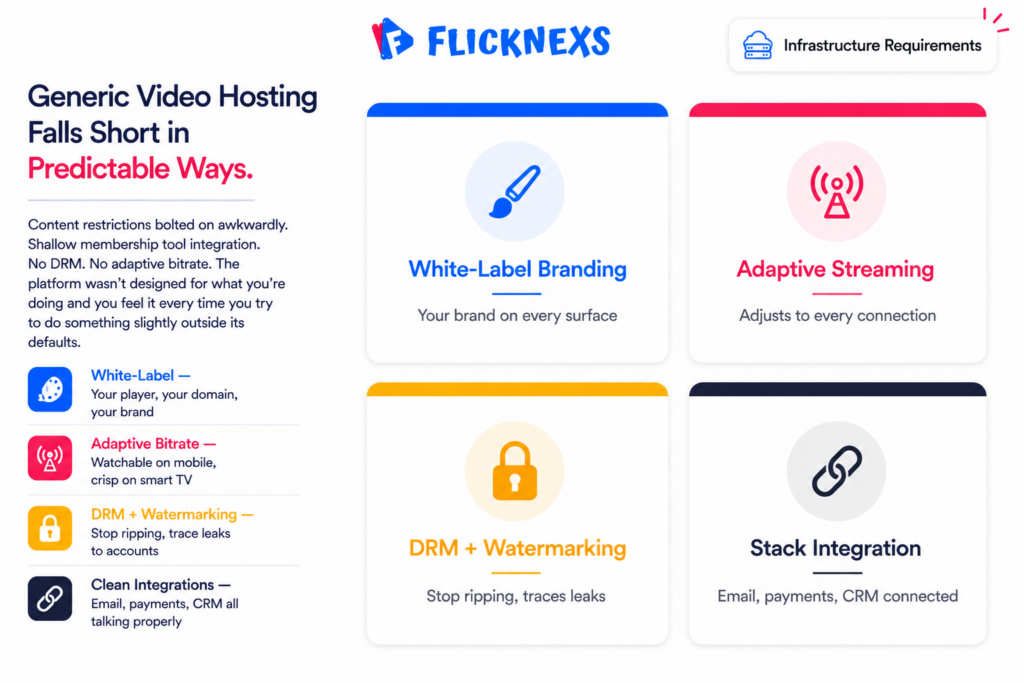
Generic video hosting falls short for membership sites in predictable ways. Content restrictions based on user roles are either missing or bolted on awkwardly. Integration with membership management tools is shallow. The platform wasn’t designed for what you’re trying to do and you feel that every time you try to do something slightly outside its defaults.
What you actually need is a platform built for OTT delivery and where the whole point is a branded, secure but monetised viewing experience rather than just somewhere to park video files.
Start with white-label capability. Your player, your interface, your domain, your logo. A generic player with another company’s branding sitting inside your membership site undermines the authority you’ve spent time building. Members should feel like they’re in a dedicated space built for your content, not a third-party video tool you happen to be renting.
Delivery quality matters more than most creators expect until they have a member complaining about buffering. Adaptive bitrate streaming adjusts video quality automatically based on the viewer’s connection, so someone on a weak mobile signal gets a watchable experience instead of a spinning loader. It needs to work across desktops, phones and smart TVs consistently, because your members are watching on all three.
Security isn’t optional if you’re charging for access. Domain locking stops your videos from being embedded on unauthorised sites. DRM makes downloading and ripping genuinely difficult. Dynamic watermarking, which displays the viewer’s email or IP address on the video itself is a strong deterrent against screen recording and sharing. Used together these controls close most of the gaps that let paid content leak.
The platform also needs to connect cleanly with the tools you’re already running. Email marketing, payment gateways, CRM. A disjointed stack creates friction for you every time you need to do something routine, and it creates friction for members when something breaks at the seam between two systems that don’t talk to each other properly.
When you’re comparing options Muvi and VPlayed offer solid white-label solutions with different pricing structures. Uscreen is popular for its simplicity and low barrier to entry. Dacast leans heavily toward live streaming. Brightcove and Kaltura are enterprise-grade and priced accordingly, which makes them overkill for most independent creators. Vimeo OTT and JW Player have strong players with monetisation features. Kajabi is widely used for courses and memberships but its video infrastructure is secondary to its course builder, which shows when you push it.
The right choice depends on what you’re actually building. Simple start with managed complexity, Uscreen or Vimeo OTT. Fully branded app experience across mobile and TV with serious security controls, a dedicated OTT platform is worth the extra investment. Find the balance between features, usability and cost that fits where your business actually is right now, not where you hope it’ll be in three years.
What Features Must Your Membership Software Include?
The software running your membership is the engine the whole business runs on. It handles the money, the user accounts and the rules of access. Get this wrong and you’ll spend more time managing the system than creating the content it’s supposed to deliver.
Access control is the most important feature, full stop. You need to define who can see what, cleanly and reliably. Different tiers, a basic level for introductory content and a premium level for advanced workshops, with the system automatically granting or cutting access based on subscription status. When someone cancels, their access goes with it. Immediately not after a grace period nobody agreed to.
Subscription management needs to handle the unglamorous stuff without breaking. Recurring billing, proration when someone upgrades mid-cycle, multiple payment gateways so you can accept credit cards, PayPal and local payment methods depending on where your audience is. Free trials and discount codes matter too, not as nice-to-haves but as real marketing levers you’ll use regularly.
Retention depends on engagement and engagement needs tools. Automated emails for new member welcome sequences, reminders for upcoming live events, re-engagement for members who’ve gone quiet. A built-in community forum or comment section removes the need to bolt in a third-party tool and gives members somewhere to interact that feels like part of your platform rather than something stapled to the side of it.
Analytics tell you what’s actually working. Which videos get watched, where people drop off, how many new sign-ups came in this month, which content drives upgrades. Without this data you’re guessing at your content strategy and hoping the guesses are right.
The interface matters on both sides. A complicated backend means you’re spending time fighting the system instead of running the business. A confusing frontend frustrates members into cancelling. Mobile responsiveness isn’t optional when a significant portion of your audience is watching on a phone or tablet.
Most platforms claim all of this. The implementation is where they diverge. Before you commit to anything, run a basic test. Can you upload a video and set a price in under five minutes? Can you create a new user tier with a few clicks? If either answer is no, the platform will slow you down at exactly the moments when you need to move fast.
Integration is where quietly a lot of platforms fall apart. Your membership software has to talk to your payment processor, your email service and your video host. When those systems don’t communicate properly you end up with data silos and access control failures. Someone cancels in the payment gateway but your membership software never gets the signal, so they keep watching content they’re no longer paying for. That’s not just a revenue leak. It’s a security failure that’s hard to catch until it’s already cost you something.
The best platforms centralise everything into one dashboard. Revenue, members, content, analytics, all visible in one place. That centralisation isn’t just convenient. It removes the category of errors that only happens when information lives in two places at once and the two places disagree.
How Do You Configure Access Controls to Protect Your Content?
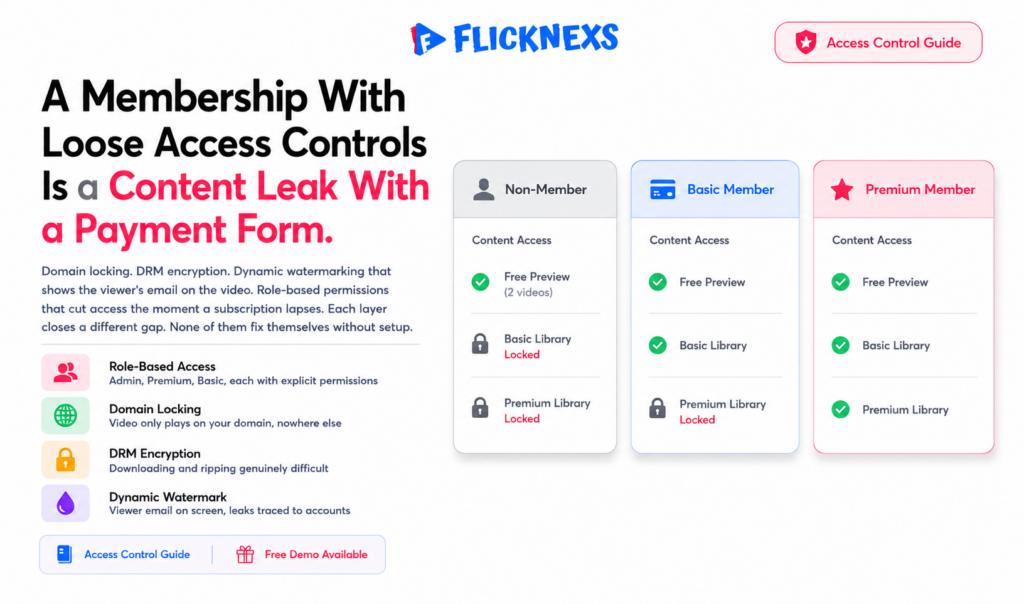
Access control configuration is where you move from an open library to a private club. The rules you set here determine who sees what, and getting them right is the difference between a membership business and a content leak with a payment form attached.
Start by defining your user roles clearly. Admin, Instructor, Premium Member, Basic Member. Each role carries specific permissions and nothing more. An Admin can upload and manage users. A Basic Member can view a defined subset of content and that’s it. The permissions should be explicit, not inherited by accident from a misconfigured default somewhere in the settings.
Then organise your content to match those roles. Group your Zoom recordings into categories that correspond to your membership tiers. A free intro category for everyone. A Silver tier for monthly subscribers. A Gold tier for annual subscribers. When a member tries to play something, the system checks their role against the content category before anything loads. No match, no access.
Domain locking is worth setting up early. It restricts video playback to specific websites so if someone tries to embed your content on an unauthorised site it simply won’t play. If your membership lives on yourbrand.com, the player only works on yourbrand.com. That one configuration closes a surprisingly common leak.
DRM is the strongest protection available for high-value content. It encrypts the video stream and makes downloading or recording genuinely difficult rather than just inconvenient. It’s more complex to set up than domain locking but if you’re selling premium content at a serious price point it’s not optional. Most white-label platforms offer it as either a built-in feature or an add-on worth paying for.
Dynamic watermarking works differently but complements DRM well. Displaying the viewer’s email address or IP on the video screen doesn’t stop a determined pirate, but it makes sharing feel risky for ordinary members. If a video does leak, you can trace it back to the specific account it came from and act on it.
Test everything before you go live, and test it properly. Log in as a non-member, a basic member and a premium member on different devices and browsers. Try the edge cases that seem unlikely but happen constantly. What happens when a subscription expires mid-video? What happens when someone accesses content from a different IP address than usual? What happens when someone tries to share a direct link? A single loophole, once discovered, spreads fast.
Balance security with usability throughout. If legitimate paying members hit friction every time they try to watch something, you’ll see it in your churn rate before you ever connect the cause. The goal is invisible security that stops the wrong people while staying completely out of the way of the right ones.
Access control isn’t a one-time setup either. As the business grows, tiers change, pricing evolves, new content types get added. Build on a system flexible enough to adapt to those changes without requiring you to rebuild the rules from scratch every time something shifts.
What Strategies Work Best for Promoting and Growing Your Membership?
Getting the platform live is the easy part. Getting paying members through the door is the ongoing work, and it starts before you spend a dollar on advertising.
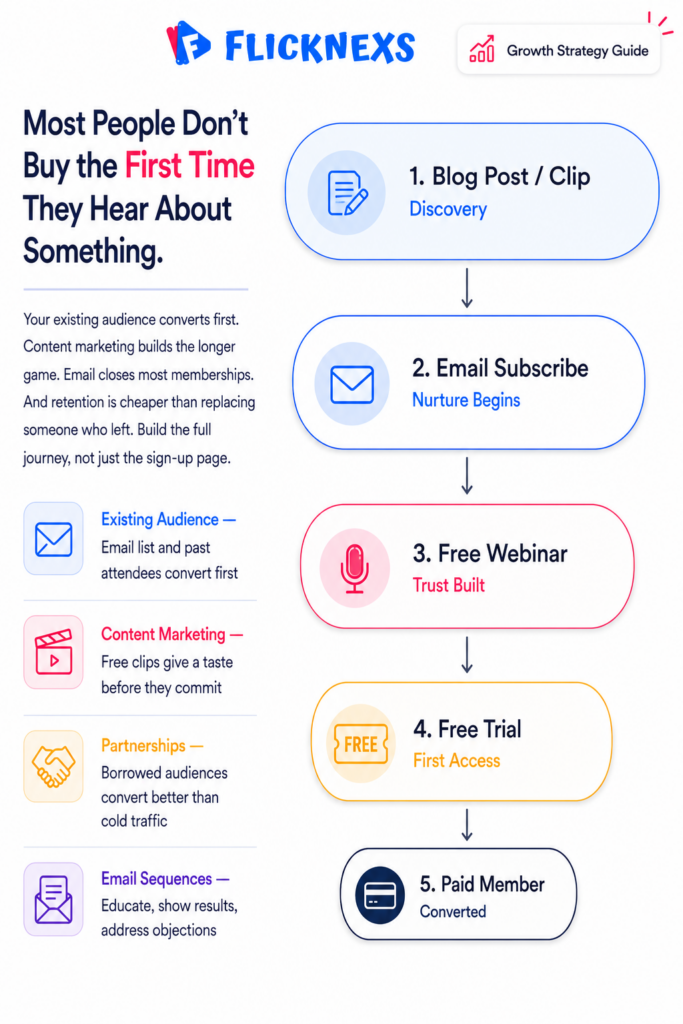
Your existing audience is the most valuable asset you have at launch. Email list, social media following, past webinar attendees, start there. Announce the membership to people who already know you and offer an early-bird discount with a genuine deadline. People who’ve already shown up for your free content are the most likely to pay for structured access to more of it.
Content marketing builds the longer game. Blog posts, short video clips, podcast appearances, social snippets from your Zoom recordings, all of it gives potential members a taste of what they’d be paying for. The freemium logic works here: let people see the quality before they commit, and the conversion rate on your paid offer goes up because they’re not buying blind.
Partnerships can compress the timeline significantly. Find other creators or educators in your niche and look for cross-promotions, guest appearances or bundle deals that put your membership in front of an audience that already cares about your topic. Borrowed audiences convert better than cold traffic almost every time.
Paid advertising works when the creative is right. Facebook, Instagram and LinkedIn all let you target by demographics and interest, but the ad that performs is the one that leads with a specific benefit, exclusive access to something, a community, a shortcut to a result, not a generic “join my membership” message. Retargeting people who visited your site and didn’t sign up is often where the real return lives.
Email remains the channel that closes most memberships. Build a sequence that educates rather than sells, shares real results from current members, addresses the objections people actually have and lets the value case build over several touchpoints. Most people don’t buy the first time, but they hear about something. A good email sequence bridges that gap.
Retention matters as much as acquisition, usually more. Keeping an existing member is cheaper than replacing one who left. Engage with your community regularly, ask what they need, keep adding content that earns the monthly fee. A loyal member who recommends you to three colleagues is worth more than any paid ad you’ll ever run.
Think in terms of the full customer journey rather than isolated tactics. Someone might find you through a blog post after subscribe to a newsletter then attend a free webinar and then join the membership three months later. Each step needs to be good enough to earn the next one. Understand that journey and you stop treating promotion as a single moment and start treating it as a system.
How Can You Retain Members and Minimize Churn Rates?
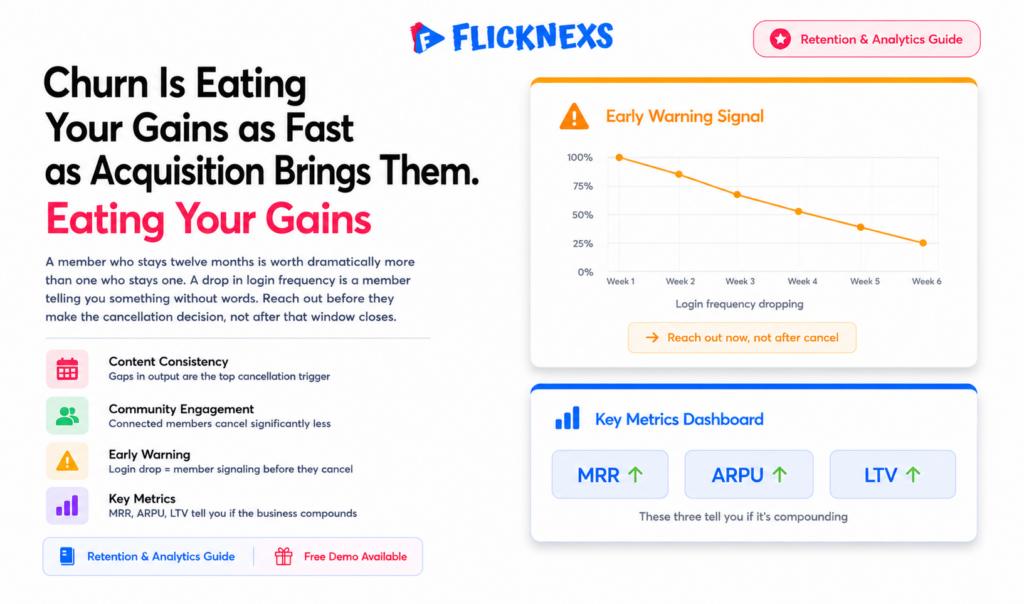
Churn is the quiet killer of recurring revenue. You can keep signing up new members every single month and still watch the total number go nowhere, because cancellations are eating the gains as fast as they come in. Most operators focus obsessively on acquisition and treat retention as an afterthought. That’s backwards. Retention isn’t a feature of a membership business. It’s the foundation.
The levers that actually move it:
- Consistency: Members paying monthly expect new content on a predictable schedule. A content calendar isn’t busywork, it’s infrastructure. Gaps in output are the most common cancellation trigger and members almost never tell you that’s why they left.
- Engagement: Members who feel genuinely connected to a community cancel less, often significantly less. Comments, forums, live Q&As, actually responding to questions in reasonable time. When people feel heard they stick around longer than any feature or discount could keep them.
- Personalisation: Viewing data tells you what each member actually watches. Use it to surface relevant content and send recommendations that feel considered rather than automated. A member who keeps discovering things they didn’t know they needed never goes looking for a reason to leave.
- Pricing flexibility: Give someone a pause option before they reach the cancel button. An annual plan at a discount locks in commitment and removes the monthly moment of “do I still need this?” that quietly costs you subscriptions you didn’t see coming.
- Feedback loops: Ask members what they want next and then actually do some of it. When people see their suggestions show up in the content calendar they develop an investment in the platform that runs deeper than the content itself.
- Early warning signals: A drop in login frequency or video views is a member telling you something without using words. Reach out before they make the cancellation decision, not after. That window closes faster than most people realise.
A member who stays twelve months is worth dramatically more than one who stays one, and keeping them costs a fraction of what you’d spend replacing them. The operators who build retention systems with the same seriousness they bring to acquisition are the ones whose subscriber numbers actually compound over time rather than treading water.
How Do You Use Analytics to Drive Business Decisions?
Without analytics you’re making decisions based on gut feel and hoping the gut is right. Sometimes it is. More often you’re leaving money on the table or fixing the wrong problems while the real ones compound quietly in the background.
Start with acquisition metrics. How many visitors are hitting your site, where they’re coming from and which channels are actually converting to paid memberships. If email is driving three times the sign-ups that social media is, that’s where your next hour of marketing effort should go. The data makes the allocation obvious in ways that instinct rarely does.
Engagement metrics tell you how your content is actually landing, not how you think it’s landing. Which videos get watched all the way through. Where people drop off. If a significant chunk of viewers stop at the same point in a video, something’s wrong there, pacing, content, relevance, and you now know exactly where to fix it instead of guessing.
The revenue numbers worth watching closely are monthly recurring revenue, average revenue per user and lifetime value. Those three together tell you whether the business is healthy, whether it’s growing and whether the economics of acquiring a new member actually make sense given what they tend to spend over time.
Churn analysis is where most operators don’t dig deep enough. It’s not enough to know that people are leaving. You need to know when they’re leaving and what was happening just before they did. After a specific time period? After a gap in content? After a price increase? The root cause changes the response entirely.
Behavioural data rounds out the picture. If members are consistently watching everything you produce on a specific topic, that’s demand telling you something directly. More content there, a specialised course, a dedicated tier, the data is pointing at the opportunity and you just have to follow it.
The operators who build sustainable membership businesses aren’t necessarily the ones with the best content. They’re the ones who measure what matters, act on what they find and keep adjusting. You can’t improve what you don’t track and the gap between a membership site that grows and one that treads water is usually found somewhere in that discipline.
What Are the Best Practices for Content Production and Delivery?
No platform zero marketing strategy and no pricing structure rescues bad content. Quality is the foundation everything else sits on and your audience calibrates their expectations against what you produce in the first few minutes of the first video they watch.
Start with audio. Bad audio kills videos faster than anything else, including shaky camera work or poor lighting. A decent microphone and a quiet recording environment are non-negotiable investments. Everything else can be improved in post. Audio recorded in a reverby room with background noise cannot.
Video quality matters but the bar is lower than most people assume. A decent camera and proper lighting get you most of the way there without a significant equipment budget. The image needs to be clear and well-lit. It doesn’t need to look like a broadcast production.
Structure your content deliberately. A 60-minute Zoom recording is not a piece of content, it’s raw material. Break it into 10 to 15 minute segments, each focused on a single topic. Members looking for something specific will find it faster, watch more of it and come back for more. Long unedited recordings feel like homework, not a premium membership experience.
Add value beyond the footage itself. Intros and outros that reinforce your brand, chapter markers so people can jump to what they need and downloadable PDFs or checklists that complement the video. These additions lift the perceived value of the content without requiring significant extra production time.
Think about format too. Audio-only versions serve members who prefer listening while commuting or working. Transcripts widen accessibility and quietly improve your SEO at the same time. Neither takes long to produce once the video exists.
Keep the visual style consistent across everything. Same intro music, same lower thirds, same overall look. A library that feels cohesive feels professional. A library that looks like it was assembled from different projects over three years feels like exactly that.
Organise the library properly. Clear titles, logical categories, relevant tags. Members who can’t find what they’re looking for don’t stay members for long and a disorganised library signals that the operator isn’t really thinking about the experience from the viewer’s side.
If you’re charging a premium price, the content has to be worth a premium price. That’s not a complicated principle but it’s the one most membership sites that fail manage to overlook.
Frequently Asked Questions
Ready to build?
If you’re planning your next Membership project, Flicknexs handles the video infrastructure end-to-end — so you can ship in weeks, not months.
- launch your membership site
- see pricing and plans
More on membership video
Continue exploring more on this topic across the Flicknexs blog.