
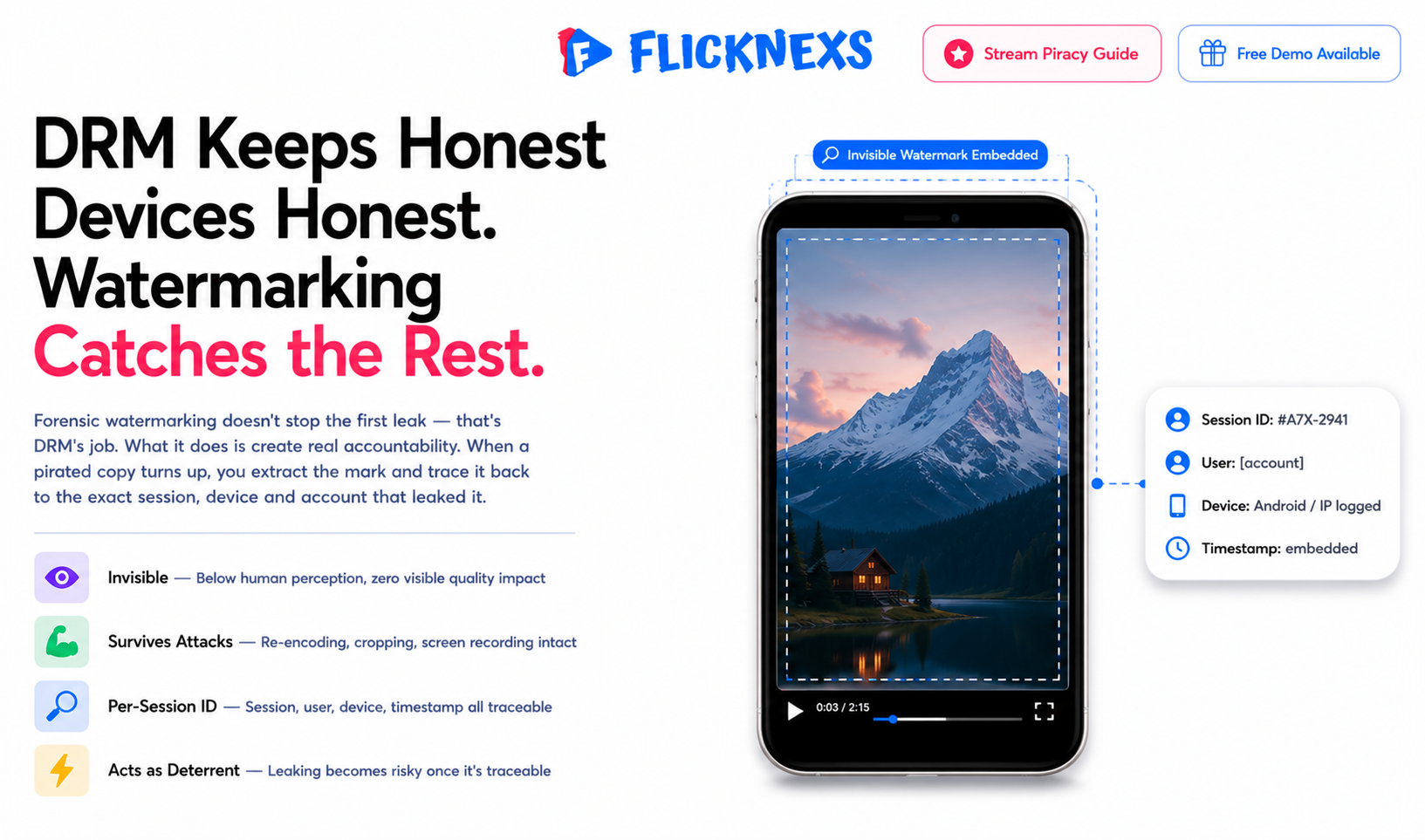
Forensic video watermarking embeds a hidden, per-session identifier into a video stream. If that content leaks, you pull the watermark out of the pirate copy and trace it back to the exact account, device or session that captured it. A visible logo sits in the corner where anyone can crop it out. A forensic watermark doesn’t work that way. It’s invisible to viewers and it survives re-encoding, screen-recording, cropping, all of it. Short of destroying the video entirely, nothing removes it.
Worth being clear about what this doesn’t do. Watermarking doesn’t stop the first leak on its own. That’s DRM and encryption’s job, not this one. What it does instead is create real accountability. Credential-sharing suddenly carries a consequence, because you can trace exactly who leaked what. And when something does get out, you’ve got actual evidence to revoke access and pursue takedowns, rather than just guessing at the source and hoping you’re right.
The workflow itself isn’t complicated. Every playback gets a unique payload embedded into it. You keep an eye on known piracy sources for your content. When a leaked copy turns up, you extract the watermark from it. Then you act on whatever source it points back to.
By the Flicknexs team. We build white-label OTT/VOD/IPTV streaming platforms, so this is written from hands-on streaming-platform experience.
If you sell premium video, whether that’s live sports, first-run films, paid courses, or subscription series, your biggest revenue threat usually isn’t the person who never pays. It’s the paying subscriber (or a compromised account) who re-streams or records your content and redistributes it. DRM keeps honest devices honest, but determined pirates capture the decrypted pixels anyway. Forensic video watermarking is the layer that answers the question DRM cannot: who leaked it?
What forensic video watermarking actually is
A forensic watermark doesn’t sit on top of the video like a logo. It’s woven directly into the signal itself, down in the luminance, color or transform-domain data of the frames. The payload usually carries a session ID, user ID or device token, something your platform can look up later and trace back to a real account. And because the mark lives inside the picture rather than layered over it, it survives the things that would normally erase evidence. Strip the metadata, transcode to a new codec, even film the screen with a phone, the mark is still there.
Two things make a watermark actually good at its job. First, nobody should be able to see it. A normal viewer watching the video notices zero difference in quality, the mark sits well below what the human eye can pick up. Second, it needs to survive getting roughed up. Compression, resizing, frame-rate changes, cropping, color shifts, even someone re-capturing the screen with a camcorder, none of that should be enough to kill the mark.
Here’s the tension though: these two goals actually fight each other. Push for a stronger, more robust mark and it gets easier to detect, which risks it becoming visible. Go subtler instead and it stays invisible, but now it’s easier for an attacker to strip out. Mature implementations split the difference and embed the mark redundantly across many frames, so no single point of failure kills the whole thing.
Forensic watermarking vs a visible logo (bug)
A station “bug,” the small logo in the corner, is a visible, deterrent-only mark. It identifies the brand, not the leaker and a pirate can crop or blur it. Forensic watermarking is invisible and identity-specific. Both have a place; they solve different problems.
| Attribute | Visible logo / bug | Forensic watermark |
|---|---|---|
| Visible to viewer | Yes | No |
| Identifies the leaker | No | Yes (per session/user) |
| Survives cropping | Often no | Designed to, when embedded across the frame |
| Survives re-encoding | Yes (it’s burned in) | Yes (good implementations) |
| Primary purpose | Branding / mild deterrent | Traceability & accountability |
How it fits with DRM and encryption
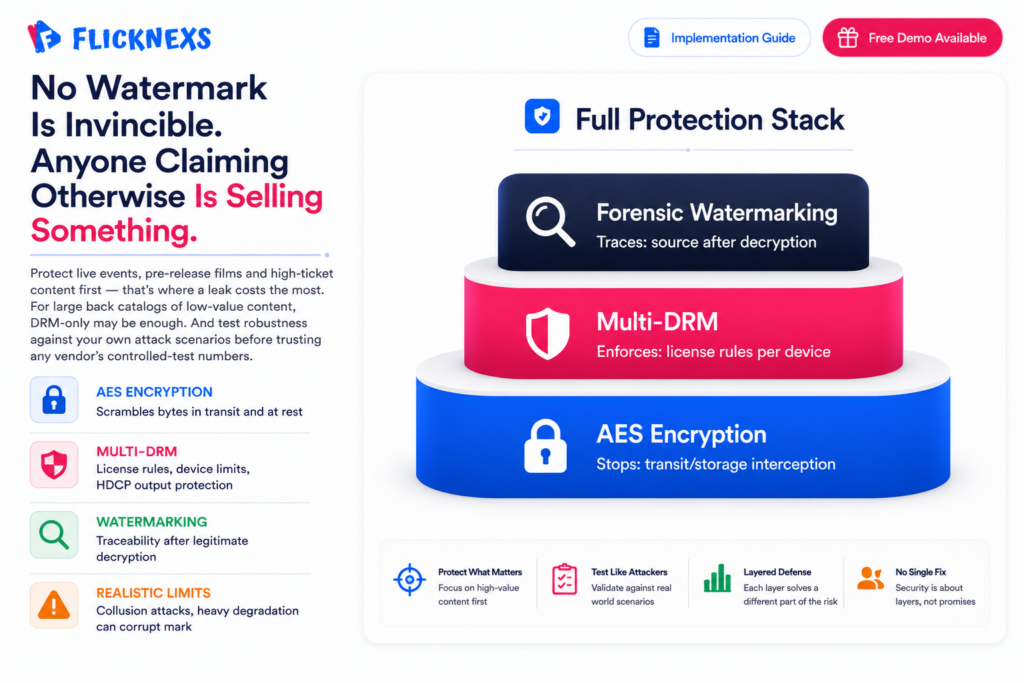
Here’s the part people get wrong: watermarking doesn’t replace DRM or encryption. It sits alongside them, doing a completely different job. Encryption and DRM control access. They’re the layer stopping unauthorized devices from decrypting and playing the stream in the first place. Watermarking picks up where that leaves off. It provides traceability after the content has already been legitimately decrypted and displayed on someone’s screen. Put both together and you’ve got a real layered defense.
- AES encryption scrambles the bytes in transit and at rest.
- Multi-DRM enforces license rules: which device, how long, output protection (HDCP), offline limits.
- Forensic watermarking identifies the source when a decrypted copy escapes anyway.
For the foundations of the access layer, see our deep dives on Multi-DRM (Widevine, FairPlay & PlayReady) and AES encryption vs DRM for video. Watermarking is the accountability layer that sits on top of both.
Server-side vs client-side watermarking
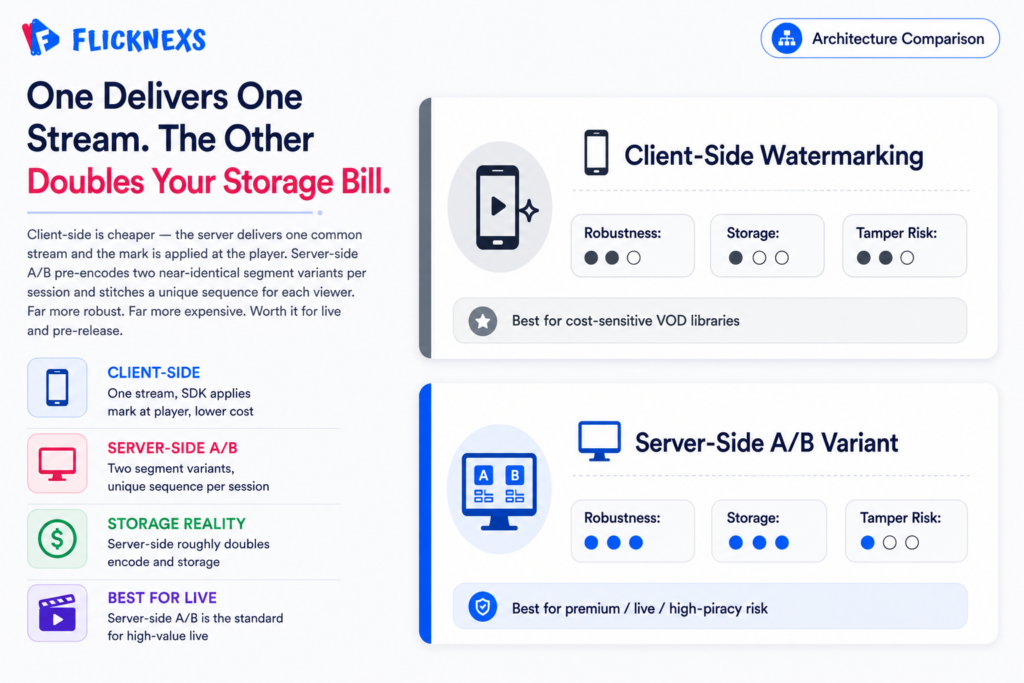
There are two main architectures for inserting the per-user payload and the difference matters enormously for cost and scale.
Client-side (player-side) watermarking
The unique payload is applied in or near the player, for example by an SDK that subtly modulates frames at playback time, or by selecting a per-session pattern on the device. It’s comparatively cheap because the server delivers one common stream, but it’s generally considered less robust and more tamperable, since the marking logic runs in an environment the pirate may control.
Server-side A/B variant watermarking
The server pre-encodes two (or more) near-identical variants of each segment, call them A and B, that differ only in their embedded mark. For each session, the manifest stitches a unique sequence of A/B segments (A-B-B-A-B-A and so on). That binary sequence is the per-session identifier. It’s far more robust and harder to defeat, but it roughly doubles storage and adds packaging complexity. This A/B approach is the dominant technique for high-value live and premium VOD.
One thing that bites teams the first time they turn this on: your encode farm and storage bill don’t just nudge up, they basically double for every protected title, because you’re carrying two versions of every segment. We usually tell people to switch it on for the live and pre-release catalog first and watch the storage line for a billing cycle before flipping it across the whole library.
| Factor | Client-side | Server-side A/B |
|---|---|---|
| Robustness | Moderate | High |
| Storage/encode cost | Low | Higher (~2x variants) |
| Tamper resistance | Lower (runs on device) | Higher (logic stays server-side) |
| Live-stream fit | Possible | Strong, widely used for live |
| Best for | Cost-sensitive VOD libraries | Premium / live / high-piracy-risk |
How to trace a leak: the extraction workflow
Embedding is only half the system. The value comes from being able to read the mark back from a pirated copy. Here is the operator-grade workflow.
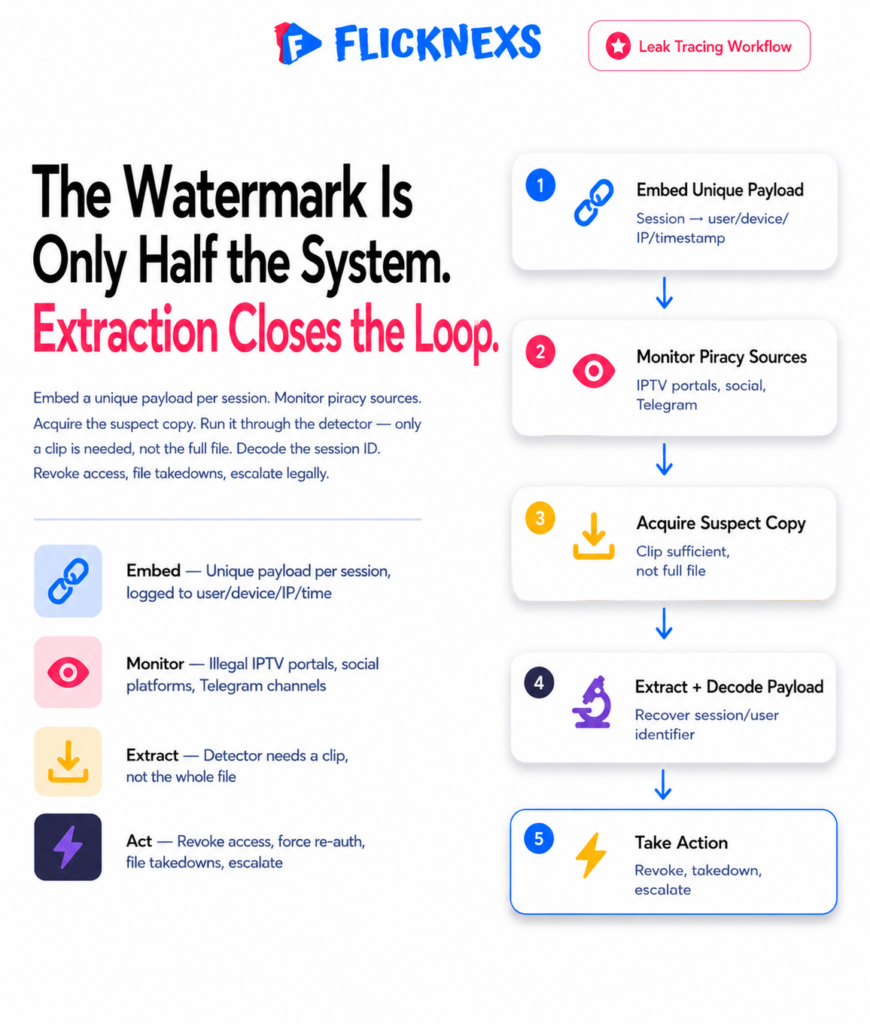
- Embed a unique payload per playback. Bind it to a session token that maps to user, device, IP and timestamp in your logs.
- Monitor for leaks. Use anti-piracy monitoring, either manual takedown teams or automated services, to find your content on illegal IPTV portals, social platforms, file lockers, and Telegram channels.
- Acquire the suspect copy and run it through your watermark detector. Detection generally needs only a clip, not the whole file, because the payload is repeated across frames.
- Decode the payload to recover the session/user identifier, even from a re-encoded, cropped, or camcorded copy if the mark was robust enough.
- Act: revoke the offending session/account, force re-authentication, file takedowns, and (for organized redistribution) escalate legally.
The deterrent effect is real. Once subscribers know a leak is traceable to their account, casual credential-sharing and re-streaming drop off. The mark doesn’t need to be unbeatable. It needs to make leaking risky enough to change behavior.
Realistic limits: set expectations honestly
No watermark is invincible and anyone claiming otherwise is selling something. A badly enough degraded copy, very low bitrate, heavy cropping, a phone filming a shaky screen, can sometimes destroy or corrupt the payload entirely. And collusion attacks are a real, documented threat: multiple pirates average their differently-marked copies together and wash the mark out completely. Resisting that specific attack requires anti-collusion coding, Tardos-style fingerprint codes being the usual approach.
Vendors will quote robustness numbers, but those numbers come from qualitative claims and controlled-test conditions, not the messy real world. Treat any “survives everything” claim with real skepticism, and test it against your own actual attack scenarios before you trust it.
Here’s what we actually see most often in practice, and it’s rarely anything clever. It’s usually just one account streaming to a packed room of viewers. The mark traces back exactly where it should, the account is right there. The “leaker” just turns out to be a single credential shared twenty ways.
Choosing and implementing watermarking on your platform
Decide what to protect first
Watermark the content where a leak costs the most: live sports and events, pre-release or windowed films, and high-ticket courses. For a large back catalog of low-value content, the storage cost of server-side A/B may not pay off, and client-side or DRM-only may be enough.
Key implementation considerations
- Latency: for live, the per-session stitching must not add meaningful delay. Server-side A/B is built for this when packaged correctly.
- Payload mapping: keep a secure, queryable map from watermark payload to session to identity. The watermark is only as useful as the lookup behind it.
- Standards alignment: if you license premium studio content, expect contractual requirements for forensic watermarking and output protection; align your approach with industry content-protection guidance.
- Privacy & compliance: you are binding playback to identity. Document retention, disclose it in your terms, and handle personal data per your jurisdiction’s rules.
On a managed white-label platform, these layers are configured rather than coded from scratch. Explore how the access and protection layers come together on the Flicknexs features page, and read the full strategy in our OTT Content Security guide.
Authoritative background reading
For the conceptual underpinnings, the Wikipedia overview of digital watermarking covers spatial- and transform-domain techniques and robustness trade-offs. For the broader media-distribution and content-protection context, the DRM overview explains how access control and traceability fit together, and developer-facing guidance on encrypted media in browsers is documented at web.dev’s Encrypted Media Extensions primer.
Frequently asked questions
Related guides
- OTT Content Security: The Complete Guide to Protecting Your Video Revenue (hub)
- Multi-DRM Explained: Widevine, FairPlay & PlayReady for OTT Platforms
- AES Encryption vs DRM for Video: What Actually Protects Your Content
- Flicknexs platform features
Planning your own platform? Learn how to create your own OTT platform with Flicknexs — VOD, live, DRM, multi-device apps and hybrid monetization.


Leave a Reply