
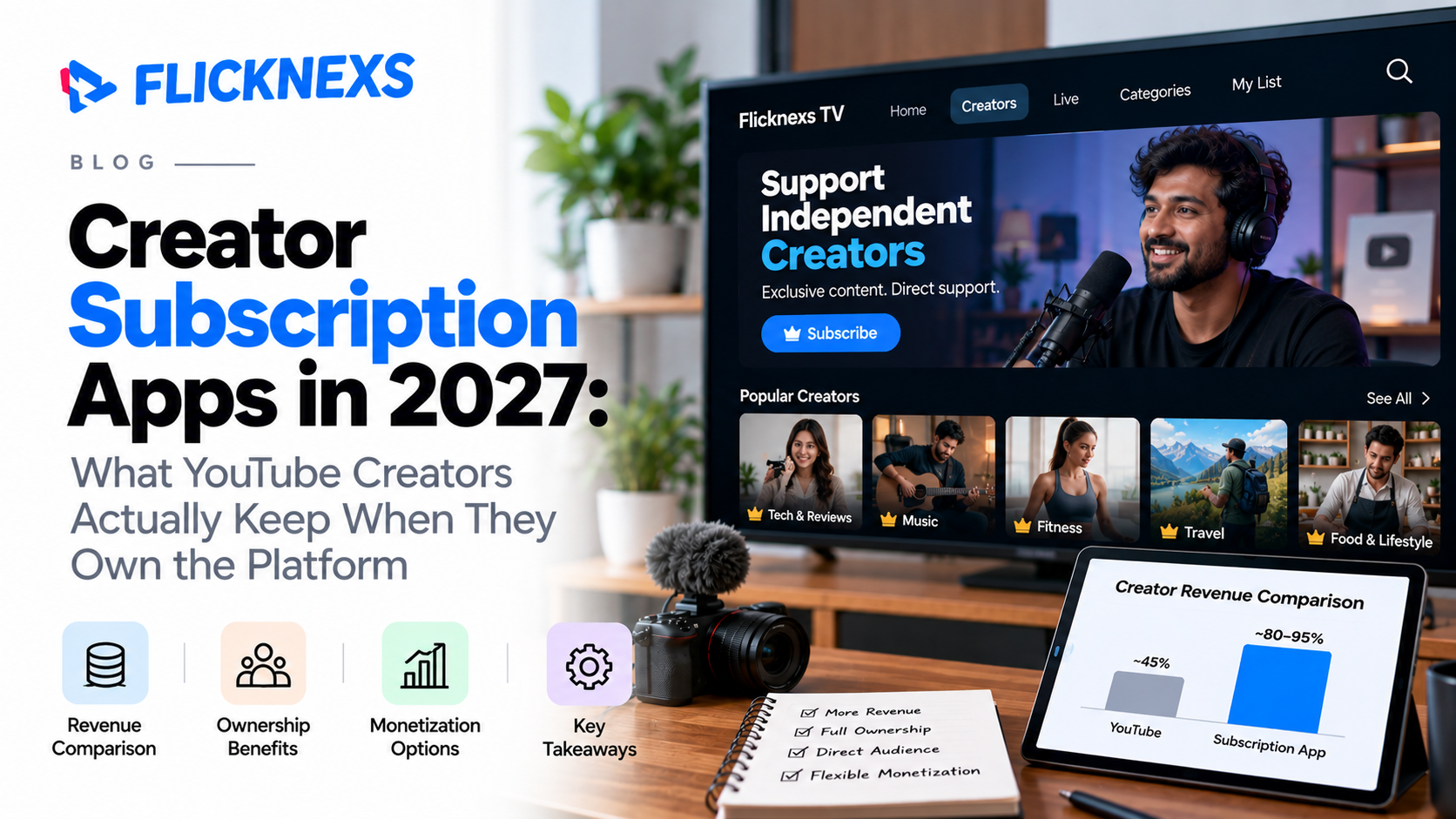
Quick answer: A creator subscription app is a branded video service where fans pay the creator directly for premium videos, early access or a full library. In 2026 a creator with a loyal audience has three routes to recurring video income: license shows to a streamer such as Netflix, Disney+ or Tubi, sell YouTube channel memberships, or run their own subscription app. Streamer deals mostly go to a small group of top creators. YouTube memberships pay 70% but keep the customer inside YouTube. Your own app keeps the most from each subscriber and gives you the customer relationship, but it only pays off if you can keep subscribers: at the 4.6% monthly churn that premium streaming services average, you would lose about 43% of your subscribers in a year.
This guide is for creators and creator-led media businesses deciding whether a creator subscription app is worth building. It skips the generic “own your audience” pitch and works through the numbers that decide the answer: what you keep per subscriber on each route, how churn changes lifetime value, and how many new subscribers you need every month just to stand still.
It does not repeat the break-even calculation for replacing YouTube income with app revenue. For that, see our YouTube vs own OTT platform break-even math, which works through replacement and hybrid scenarios. This post picks up after that decision: what each subscriber is actually worth once fees and churn are counted.
If you are a media business rather than a creator, our guide to creating a movie streaming website covers the build side in more depth.
Key takeaways
- The streamer bidding war is real but narrow. Netflix, Disney+ and Tubi are signing creators, and YouTube is pushing back hard. Analysts say the fight is about the top 20 to 50 creators. Everyone else needs a different route to recurring revenue.
- Your own app keeps the most per subscriber, if you sell on the web. From a $10 monthly subscription, a web checkout leaves about $9.41 before platform fees. A YouTube membership leaves $7.00, and less when the member pays inside the iPhone app.
- Churn sets the real price. At 2% monthly churn a $10 subscriber is worth about $500 over their lifetime. At 8% they are worth about $125. Retention matters more than the price tag.
- Every subscriber base leaks. With 1,500 subscribers and 4.6% monthly churn, you need about 69 new subscribers a month just to stay level.
- The creator-owned services that worked kept YouTube as their trailer. Dropout and Nebula both use free YouTube content to sell a paid library rather than replacing YouTube.
Why this question matters this month
In short: Big streamers are paying top creators for shows, YouTube is using incentives and pressure to keep them, and that contest leaves most creators to build recurring revenue themselves.
On 21 October 2026, The Hollywood Reporter reported that Netflix and Disney are actively courting YouTube creators with original-show funding and help in areas such as consumer products, and that creators have been surprised by how hard YouTube is fighting back (The Hollywood Reporter). Disney’s signings reportedly include Dude Perfect, Dhar Mann and Like Nastya for Disney+ (Main Street Mouse, citing THR).
Tubi has moved fastest on volume. It added more than 16,000 episodes from over 200 creators in ten months, then launched a Creatorverse Incubator with TikTok on 19 March 2026 to develop original long-form shows (Broadcast; Fox Corporation).
YouTube’s response matters for any creator weighing a move. MediaPost reported that YouTube executives warned some creators who took non-exclusive deals with Netflix that they could get less promotion or lose brand deals, including placement in YouTube’s premium ad programs (MediaPost). LightShed analyst Rich Greenfield’s read, quoted by THR, is that YouTube cares because the top 20 to 50 creators carry outsized weight in its brand advertising commitments (THR via Yahoo).
That is the useful insight for most creators. If you are not one of those few dozen names, no streamer is going to write you a cheque, and YouTube is not going to bid to keep you. The decision in front of you is whether to sell memberships inside YouTube or run your own subscription product.
The three routes, compared
In short: Streamer deals trade control for funding, YouTube memberships trade margin for convenience, and your own app trades effort for margin and ownership.
| License to a streamer | YouTube channel memberships | Your own subscription app | |
|---|---|---|---|
| Who pays you | The streamer, per deal | Members, through YouTube | + |
| Your share | Negotiated fee or license | 70% after taxes and fees | Price minus payment, store and platform fees |
| Who owns the subscriber | The streamer | YouTube | You |
| Can you email or export members | No | No | Yes, subject to consent and privacy law |
| Main risk | Exclusivity terms and YouTube pushback | Tied to one channel’s health and policies | You must acquire, bill and retain subscribers yourself |
| Best fit | Top creators with mass reach | Creators testing paid demand | Creators with a clear premium offer and a growing library |
Sources: YouTube membership share from YouTube Help; streamer and YouTube dynamics from the reports cited above.
These routes are not exclusive. Many creators should start with memberships to prove that fans will pay, then move their premium library to an owned app once the numbers justify it. If you are weighing course and membership tools rather than a full video app, our comparison of Kajabi, Patreon and self-hosted membership platforms covers that choice.
What you keep from a $10 subscriber
In short: Selling through a web checkout keeps the most per subscriber; selling inside iPhone apps keeps the least, though US rules on linking out to the web have shifted in creators’ favor.
Here is what reaches the creator from one $10 monthly subscription in the first year, in the US, before your own platform or software fees, taxes and refunds.
| Where the fan pays | Who takes a cut | Creator keeps (approx.) |
|---|---|---|
| YouTube membership, bought on desktop or Android | YouTube 30% | $7.00 |
| YouTube membership, bought in the YouTube iPhone app | App store fee, then YouTube 30% | About $4.90 |
| Your app, web checkout with a card processor | Card fees (2.9% + $0.30) | $9.41 |
| Your app, Apple in-app purchase, standard rate | Apple 30% in year one | $7.00 |
| Your app, Apple in-app purchase, Small Business Program | Apple 15% | $8.50 |
| Your iPhone app links to your web checkout (US) | Currently no Apple commission; card fees only | $9.41 today |
How the figures were worked out:
- YouTube memberships: creators get 70% of membership revenue after applicable taxes and fees, and YouTube covers card processing (YouTube Help). For purchases made through app stores, the app store fee comes off as well (PPC Land’s summary of YouTube’s terms), so a $10 iPhone purchase works out to roughly 70% of 70%.
- Card processing: Stripe’s standard US domestic-card price of 2.9% plus 30 cents (eWeek). Your processor and region may differ.
- Apple in-app purchase: 30% standard, or 15% for Small Business Program developers and for subscriptions after the first paid year (eWeek).
- US link-outs: after the Epic v. Apple contempt ruling, US apps can link to an outside checkout with no Apple commission until a court approves one. In August 2026 Apple asked the court to allow 15% on linked-out subscriptions in year one and 10% after (Subscription Insider). If that were approved, the last row would drop to about $7.91.
What this means in practice: make your website the main place people buy, and use mobile and TV apps mainly as the place people watch. Most creators already send viewers to links from YouTube descriptions and community posts, and those clicks land on a browser, where the web checkout is the cheapest route. Rules differ outside the US, and Google’s Play Store terms changed in 2026 too, so check current store rules for each country you sell in.
Churn is the real price of a subscription
In short: A low price with low churn beats a high price with high churn. Model lifetime value before you set a price.
Antenna puts the weighted average monthly churn for premium US streaming services at 4.6%, with Netflix lowest at about 2% (MediaPost on Antenna data; Webtonic summary of Antenna’s 2026 report). A creator app will not automatically match either figure, so treat them as reference points, not targets.
Here is what different churn rates do to a $10 monthly subscriber, using a simple constant-churn model:
| Monthly churn | Subscribers left after 12 months | Average subscriber lifetime | Lifetime revenue at $10/month (gross) |
|---|---|---|---|
| 2% (Netflix-level) | 78% | 50 months | $500 |
| 4.6% (premium SVOD average) | 57% | about 22 months | about $217 |
| 8% | 37% | 12.5 months | $125 |
| 12% | 22% | about 8 months | about $83 |
Illustrative arithmetic. Average lifetime is 1 divided by monthly churn. Real churn is usually higher in the first months after sign-up and lower after that.
The gap between the 2% and 8% rows is four times the lifetime revenue from the same price. That is why a creator who publishes something new for members every week often earns more than one who charges twice as much and publishes occasionally. For how tier structure and annual plans affect retention, see our guide to membership pricing models for video streaming.
The stand-still number
Churn also sets how many new subscribers you need just to stay where you are:
New subscribers needed each month to stay level = active subscribers × monthly churn
| Active subscribers | At 4.6% churn | At 8% churn |
|---|---|---|
| 500 | 23 per month | 40 per month |
| 1,500 | 69 per month | 120 per month |
| 5,000 | 230 per month | 400 per month |
Growth only starts once your monthly sign-ups exceed this number. Before you launch, ask whether your YouTube channel can reliably send that many paying sign-ups every month, not only in launch week. The stand-still number tells you how many sign-ups keep a subscriber base level; the replacement and hybrid break-even formulas tell you how large that base has to be in the first place.
What Dropout and Nebula show
In short: The two best-known creator-owned services grew by using free YouTube content as a trailer for a paid library and by favoring formats that were cheap to make and kept people subscribed.
Dropout, run by former CollegeHumor creative chief Sam Reich, passed 1 million paid subscribers in early 2026 while its YouTube channel drew roughly 10 million views a month (Tubefilter). Two lessons stand out:
- Format beat budget. After launch, Dropout found that its cheaper unscripted shows both attracted and kept subscribers, while its more expensive scripted shows did neither, and it shifted almost entirely to unscripted programming (Dropout’s history on Wikipedia).
- Free seasons work as trailers. Dropout has made full seasons of its flagship show free to watch to draw in potential subscribers (Flow Journal).
Nebula was launched in 2019 by a group of education-focused YouTubers as a complement to their YouTube channels, not a replacement (Nebula on Wikipedia)). It was set up so that creators and the operating company, Standard, each take 50% of the profits, and by 2021 it reported more than 350,000 paying subscribers with retention above 80% (Business Wire).
What both teach a solo creator:
- Do not move your audience. Extend it. Both kept publishing on YouTube and used it to find new viewers.
- Sell a library, not a single show. Subscribers stay when there is always something else to watch.
- Pick formats you can sustain. If a format costs too much to make weekly, it will not keep churn low.
- Pooling can beat going alone. Nebula is many creators under one subscription. A small group of creators in the same niche can share one app and one price, which gives subscribers more reasons to stay.
Six numbers to check before you build
In short: You are ready for your own app when you have returning viewers, an owned contact list, a content runway, clean rights, a priced offer and someone to handle support.
Run this before you spend money on apps or production. These are our working rules, not industry standards; adjust them to your niche.
| Check | What to measure | Ready signal |
|---|---|---|
| 1. Returning viewers | Monthly returning viewers in YouTube Analytics, not total subscribers | Enough that 1–2% of them covers your stand-still number |
| 2. Owned contact list | Email or SMS subscribers you can reach without an algorithm | A list you can launch to directly, not only via YouTube |
| 3. Content runway | Planned paid releases and existing library hours | At least three months of member releases planned before launch |
| 4. Rights | Music licenses, sponsor clauses, collaborator and guest permissions | Every title you plan to put behind the paywall is cleared for paid use |
| 5. Paid proof | YouTube memberships, a founding-member pre-sale or a paid pilot | People have already paid, not just said they would |
| 6. Support capacity | Who handles login, billing and refund questions | A named person and a response time |
Check 4 is the one creators most often miss. Licensed music that was fine in a monetized YouTube video may not be licensed for a paid subscription service, and some sponsor contracts restrict where an integration can appear. Clear these before you move a back catalogue behind a paywall.
What stays free and what goes behind the paywall
In short: Keep the content that finds new fans on YouTube; charge for depth, early access and the full library.
| Content | Keep free on YouTube | Put on your app |
|---|---|---|
| Regular episodes | Yes. This is your discovery engine. | Ad-free versions, optionally |
| New series | Episode 1, or a season you use as a trailer | The rest of the season |
| Early access | Public release after a delay | Same-day or early release for members |
| Extended cuts and outtakes | Short clips | Full versions |
| Courses and deep dives | A sample lesson | The structured course |
| Live sessions | Occasional public streams | Member-only Q&As and workshops |
| Back catalogue | Popular videos that still attract search traffic | Archived or removed series, organized as a library |
The rule behind the table: a fan should never feel that something they used to get free has been taken away. Paid content should be more, not the same thing moved behind a wall.
Keep the YouTube relationship healthy
In short: Owning a subscription app is not the same as licensing your shows to a rival streamer, but read your contracts before you make content exclusive anywhere.
The pushback reported in October 2026 concerned top creators licensing shows to rival streamers such as Netflix. A creator selling their own extended episodes to their own fans is a different situation. Still, three precautions are sensible:
- Read your existing deals. Brand contracts, multi-channel network agreements and any streamer license may limit exclusivity or where content can appear.
- Check YouTube’s current policies on promoting off-platform paid content before you add calls to action in videos and descriptions.
- Do not starve the channel. If your free uploads slow down because effort has moved to paid content, the funnel that feeds your app shrinks with it.
Platform checklist for a creator subscription app
In short: Beyond hosting and playback, a creator app needs web checkout, app-store billing that stays in sync, subscriber data you can export and churn reporting you can act on.
Use this when you compare providers:
- Web checkout as the main purchase path, with your own payment gateway and support for the currencies you sell in.
- App store billing that syncs with web subscriptions, so a fan who pays on the web can watch in the iPhone or TV app and vice versa.
- Free and paid tiers in one catalogue, so you can offer teaser episodes and a free account that converts later.
- Subscriber data export, including emails (with consent) and subscription status, so you can change providers without losing your customers.
- Churn and cohort reporting, showing retention by sign-up month, plan and acquisition source.
- Win-back tools, such as discount offers for lapsed subscribers and pause options instead of cancellation.
- Scheduled and early-access publishing, so members get releases before the public YouTube upload.
- Web, mobile and TV apps under your brand, added in that order as demand grows.
- Clear pricing, including setup fees, monthly fees, transaction or revenue-share fees and app-store publishing costs.
Where Flicknexs fits
In short: Flicknexs provides the white-label OTT platform layer for a branded subscription video service; it does not supply an audience or guarantee subscribers.
Flicknexs is a white-label OTT platform for launching a branded streaming service across web, mobile and TV, with subscription, pay-per-view and ad-supported monetization options. For a creator, the parts that matter most are the ones in the checklist above: selling through your own web checkout, keeping subscriber data you can use, and publishing a premium library under your own brand.
No platform can supply the returning viewers, content runway or retention that decide whether a creator subscription app works. Run the six checks above first, then test any provider, including Flicknexs, against the platform checklist in a live demo.
See how Flicknexs helps you launch a branded subscription streaming service
Already have paying members on YouTube or Patreon? Start a free trial or book a demo and map your existing membership tiers onto your own platform.
Frequently asked questions
What is a creator subscription app?
A creator subscription app is a branded video service, on the web, mobile or TV, where fans pay a creator directly for premium content such as full episodes, early access, courses or a complete library. Unlike YouTube memberships, the creator controls the pricing, the content packaging and the subscriber relationship.
How much do YouTube creators keep from channel memberships?
Creators keep 70% of membership revenue after applicable taxes and fees, and YouTube covers card processing. When a member pays inside an app store, the store’s fee is also deducted, so the creator’s share of that payment is lower.
Is it cheaper to sell subscriptions on my own website than in an app?
Usually, yes. A web checkout typically costs card processing of around 3% plus a small fixed fee. Apple’s standard in-app purchase commission is 30% in the first year, or 15% for Small Business Program developers. In the US, apps can currently link to an outside checkout without paying Apple a commission while the court decides what Apple may charge.
How many new subscribers does a creator app need each month?
Multiply your active subscribers by your monthly churn rate. That is the number of new sign-ups you need just to stay level, before any growth. At 4.6% monthly churn, 1,500 subscribers need about 69 new sign-ups a month.
Can several creators share one subscription app?
Yes. Nebula is the best-known example: many education-focused creators sell one subscription and split profits with the operating company. A small group of creators in the same niche can do the same, which gives subscribers a bigger library and more reasons to stay.
Can YouTube penalize creators who launch their own subscription service?
Reported pressure in October 2026 involved top creators licensing shows to rival streamers such as Netflix, with warnings about promotion and brand programs. Selling your own premium content to your own fans is a different case, but read your brand, network and licensing contracts and check YouTube’s current policies before making content exclusive.
What content should I put behind a paywall?
Keep regular episodes and discovery content free. Charge for full seasons after a free first episode, early access, extended cuts, structured courses, member-only live sessions and an organized back catalogue. Paid content should add to what fans already get, not remove it.
What is a good churn rate for a creator subscription app?
Premium US streaming services averaged about 4.6% monthly churn in Antenna’s data, with Netflix near 2%. A creator app’s churn depends on publishing frequency and library depth. Track churn by sign-up month, since early-month churn is usually the highest.
Ready to build?
If you’re planning your next Monetization project, Flicknexs handles the video infrastructure end-to-end — so you can ship in weeks, not months.
- get a subscription video platform
- check plan pricing