
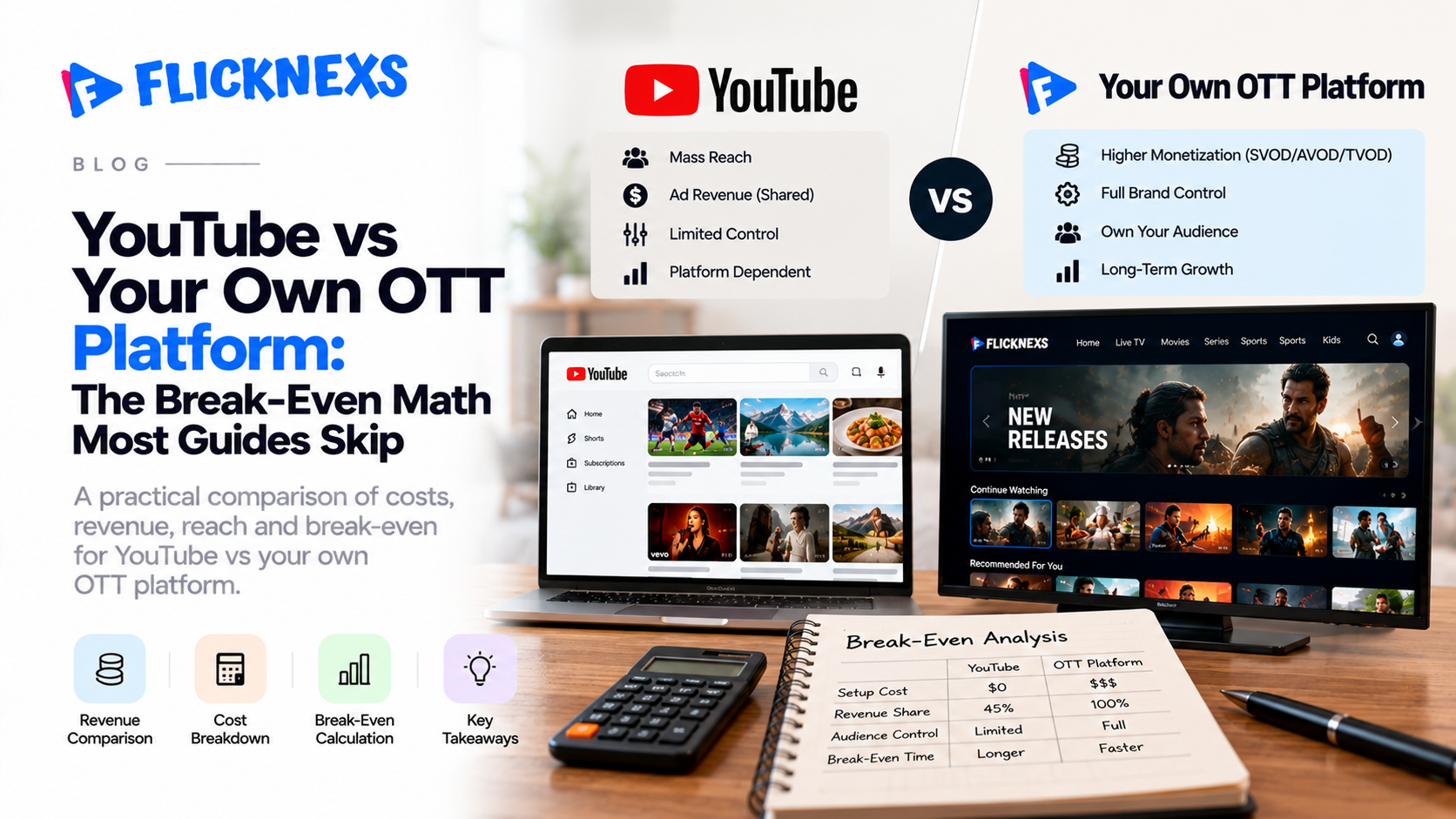
Quick answer: Build on YouTube until you can prove people will pay. Launch your own OTT platform when your paying audience covers the platform’s monthly running cost. For most creators, sports bodies and media brands, the sensible order is YouTube for reach, then YouTube channel memberships to test payment, then your own OTT app for the premium tier. In a hybrid model your OTT app only has to pay for itself, not replace your YouTube income, which cut the break-even point by more than half in our worked example below.
The YouTube vs own OTT platform question usually gets answered with a pros-and-cons list. That doesn’t help you decide. This guide gives you three things you can use: a break-even formula you can fill in with your own numbers, a lesson from how the Indian Super League split its free and paid streams this season, and a six-question scorecard.
Key takeaways
- YouTube took a record 14.2% of US TV viewing in July 2026, which works out to roughly 29% of all streaming time on US TV sets.
- Being on the TV screen is no longer an advantage of owning an app. YouTube is already there. Your app has to win on what sits behind the paywall.
- The ISL’s free YouTube stream carries English and Hindi commentary only. Tamil, Malayalam and Bengali commentary stays with Sony’s TV channels and SonyLIV. Free feed for reach, paid feed for the audience that wants something specific.
- Calculate two break-even points: replacement (OTT replaces YouTube income) and hybrid (OTT only covers its own costs). Most businesses should aim for the hybrid one.
- Test willingness to pay with YouTube channel memberships before you build. YouTube pays creators 70% of net membership revenue.
What does YouTube’s 14.2% share of TV actually measure?
Nielsen’s July 2026 Gauge, covering June 29 to July 26 and published on September 10, put YouTube at a record 14.2% of total US television viewing time. Streaming as a whole reached 49.0%. YouTube’s viewing rose 6% month over month, and it led Nielsen’s Media Distributor Gauge by 5.0 share points.
The figure is a share of viewing time on TV sets. It is not the share of Americans who use YouTube, and it is not a subscription market share.
Divide one number by the other and you get a figure Nielsen doesn’t headline: 14.2 ÷ 49.0 ≈ 29%. Roughly three of every ten minutes spent streaming on US TV sets went to YouTube. YouTube itself says its platform now sees over a billion hours of watch time on TV every day.
What this means for you: a few years ago, a branded OTT app was one of the few ways to put your content on a living-room TV. That reason has largely gone. If your only argument for building an app is “we want to be on TV,” YouTube already solves that for free. The case for your own platform now rests on what you can sell that the free version doesn’t include.
The ISL detail most coverage missed: free feed vs paid feed
For the 2026–27 season, the Indian Super League made all 163 matches available live and free on YouTube. SonyLIV streams all 163 matches as part of its subscription, and Sony Sports Network shows more than 80 on TV.
Most coverage stopped at “ISL is free on YouTube.” The more useful detail is the language split. According to Khel Now, YouTube streams the matches in English and Hindi only, while Sony’s TV channels and SonyLIV carry five languages: English, Hindi, Malayalam, Tamil and Bengali.
So the free stream reaches the widest possible audience, and the paid and TV feeds keep something a specific audience values. A fan in Chennai who wants Tamil commentary doesn’t treat the free YouTube stream as a substitute.
You don’t need ISL-sized rights to use the same structure. Ask what you can keep back from the free tier that a defined group of viewers will pay for:
| What you hold back | Who pays for it | Example |
| Regional-language version | Viewers who prefer their own language | Tamil or Telugu dubs of a course or show that runs in English on YouTube |
| Full archive and replays | Fans who missed it live | Highlights free on YouTube, full matches on your app |
| Ad-free viewing | Heavy viewers | Same content, no ad breaks, on a monthly plan |
| Live access | Fans who care about timing | Events live on your app, edited version on YouTube later |
| Structured programmes | Learners | Free lessons on YouTube, a sequenced certificate course on your app |
| Extra angles | Enthusiasts | Main camera free, multi-camera or analyst feed paid |
The ISL arrangement applies to this season and shouldn’t be read as a permanent rights template. For the rights side, see what the ISL’s free YouTube deal means for sports streaming rights.
Platform risk is a cost: the February 2027 Shorts change
YouTube has announced that from February 1, 2027, creators will need 10 million qualified Shorts views in the previous 90 days to be eligible for ad and subscription revenue sharing on Shorts. Channels below that level stay in the YouTube Partner Program and keep earning on long-form videos, and Shorts revenue sharing resumes automatically if they cross the threshold again.
This isn’t a criticism of YouTube. It’s YouTube’s platform and it sets the rules. But if a large share of your income comes from Shorts, a rule change you didn’t vote on can reduce it from one quarter to the next. When you compare YouTube with your own platform, count that dependency as a risk line in the plan, not as a footnote.
The break-even formula: replacement vs hybrid
Here are the two numbers to calculate. Use your own figures from YouTube Analytics and your OTT vendor’s quote.
YouTube monthly income ≈ (monthly monetised views ÷ 1,000) × your RPM
Net revenue per OTT subscriber = monthly price × (1 − payment fee %)
Replacement break-even (OTT fully replaces YouTube income) = (YouTube monthly income + OTT monthly running cost) ÷ net revenue per subscriber
Hybrid break-even (you keep YouTube; OTT only has to pay for itself) = OTT monthly running cost ÷ net revenue per subscriber
RPM in YouTube Analytics is already your share after YouTube’s cut. For context, YouTube pays creators 55% of ad revenue on long-form videos and 45% of their allocated share on Shorts.
Worked example: a regional fitness channel
The inputs below are illustrative assumptions, not benchmarks. Replace every one with your own.
| Input (assumption) | Value |
| Monthly long-form views | 20,00,000 |
| RPM (your share) | ₹40 |
| YouTube monthly income | ₹80,000 |
| Monthly unique viewers | 3,00,000 |
| OTT plan price | ₹149 / month |
| Payment fee | 2% |
| Net revenue per subscriber | ₹146 |
| OTT running cost (platform + delivery + support) | ₹60,000 / month |
| Result | Subscribers needed | Share of monthly unique viewers |
| Replacement break-even | (₹80,000 + ₹60,000) ÷ ₹146 ≈ 959 | 0.32% |
| Hybrid break-even | ₹60,000 ÷ ₹146 ≈ 411 | 0.14% |
In this example, the hybrid target is 57% lower than the replacement target. That is the main argument for running both: you don’t have to win back everything YouTube pays you before your own platform is viable.
One adjustment people forget: if you move content off YouTube to make it paid-only, your YouTube views may fall. Add any YouTube income you expect to lose to the OTT running cost before you calculate the hybrid figure.
The step most guides skip: test payment on YouTube first
Views tell you people will watch. They don’t tell you anyone will pay. YouTube channel memberships give you a cheap way to find out before you commit to a platform: YouTube pays creators 70% of net revenue from memberships, Super Chat, Super Stickers and Super Thanks.
Use membership numbers as evidence. If your paying members are approaching your hybrid break-even number, you have a real signal that an owned subscription tier can cover its costs. If you can’t get a few hundred people to pay for perks inside YouTube, a separate app is unlikely to fix that.
Moving from memberships to your own platform makes sense when you need things memberships don’t give you: your own pricing and bundles, your own billing, full control of the app experience, regional-language packs, and a direct relationship with subscribers based on data they’ve agreed to share.
| Stage | Where | What to measure | Move on when |
| 1. Reach | Free YouTube channel | Views, unique viewers, watch time | You have a steady audience in a defined niche |
| 2. Prove | YouTube channel memberships | Paying members, monthly churn | Members approach your hybrid break-even |
| 3. Own | Your OTT platform | Paid subscribers, churn, cost per subscriber | Run both; keep YouTube as the top of the funnel |
For Indian OTT launches: price below the UPI AutoPay limit
Under RBI’s e-mandate rules, recurring payments up to ₹15,000 per transaction can be processed without an additional authentication step. Above that, the customer has to authenticate each payment (a few categories such as insurance premiums and mutual fund SIPs have a ₹1 lakh limit, but OTT subscriptions are not among them).
For a subscription business this matters more than it looks. A monthly or annual plan priced under ₹15,000 can renew automatically through UPI AutoPay without the customer having to approve each renewal. Most consumer OTT plans sit well under that limit, but premium annual B2B or education plans can cross it. Check your payment gateway’s support for recurring UPI mandates before launch. Our guide to Razorpay payment methods covers the options.
Six-question scorecard: YouTube, hybrid or own OTT?
Answer yes or no to each question.
- Do you hold the rights to distribute your premium content on your own platform, in the territories you want?
- Can you keep something back from the free tier that a defined audience values (language, archive, ad-free, live, structured courses)?
- Have at least as many people as your hybrid break-even number already paid you for something (memberships, events, courses)?
- Is your audience concentrated in a segment YouTube serves poorly, such as a regional language or a professional niche?
- Can you fund the platform’s running cost for six months or more before it breaks even?
- Do you have a plan to move viewers from YouTube to your app within YouTube’s rules (descriptions, pinned comments, mentions in live streams)?
| Yes answers | What to do |
| 0–2 | Stay on YouTube and grow reach. Revisit in six months. |
| 3–4 | Turn on channel memberships and measure paying members against your hybrid break-even. |
| 5–6 | Evaluate your own OTT platform and run it alongside YouTube. |
What about FAST channels?
If your content suits continuous, TV-style viewing and you’d rather earn from ads than subscriptions, a free ad-supported streaming TV (FAST) channel is a third route. It sits on platforms like Roku and Samsung TV Plus rather than on YouTube, and it has its own acceptance criteria and technical requirements. See how to get your FAST channel on Roku, Samsung TV Plus, Tubi and Prime Video.
Where Flicknexs fits
Flicknexs provides a white-label OTT platform for businesses that want to launch their own branded streaming service with subscription, rental or ad-supported models. It is built for stage 3 of the ladder above: once you have proof that people will pay, it gives you the app, billing and content management to sell your premium tier under your own brand.
[EDITOR — REQUIRED FOR EEAT GATE] Insert one anonymised Flicknexs client example: content type, starting YouTube audience, plan price, months to cover running cost, and one dashboard screenshot (with alt text). Do not publish without it.
If you’re comparing vendors, our list of white-label OTT platform providers sets out the options.
Run the numbers with the Flicknexs team — bring your YouTube Analytics figures and we’ll work through your hybrid break-even with you.
Frequently asked questions
Is YouTube better than having your own OTT platform?
Neither is better in every case. YouTube is the better choice for reach and discovery. Your own OTT platform is the better choice when you have premium content a defined audience will pay for and you want control over pricing, billing and the viewing experience. Many businesses run both.
How many subscribers do I need before launching an OTT app?
Divide your platform’s monthly running cost by the net revenue per subscriber (price minus payment fees). That’s your hybrid break-even. In our illustrative example, a ₹60,000 monthly cost and a ₹149 plan needs about 411 subscribers.
Can I keep publishing on YouTube after launching my own OTT app?
Yes, as long as your content rights allow it. Most businesses keep YouTube as the place new viewers find them and reserve a distinct premium tier, such as full archives, regional-language versions or ad-free viewing, for their own app.
What does YouTube’s 14.2% figure measure?
It is YouTube’s share of total US television viewing time in Nielsen’s July 2026 Gauge (June 29 to July 26, 2026). It is not the share of Americans who use YouTube, and it does not count phone or computer viewing.
How much does YouTube pay creators?
Under the YouTube Partner Program, creators receive 55% of ad revenue on long-form videos, 45% of their allocated share of Shorts ad revenue, and 70% of net revenue from channel memberships and Super Chat. From February 1, 2027, Shorts revenue sharing requires 10 million qualified Shorts views in the previous 90 days.
Do I need my own OTT app to reach viewers on TV?
No. YouTube is already watched on TV at scale. The reason to build your own app is to sell something the free version doesn’t offer, not to get onto TV screens.
Can Indian OTT subscriptions renew automatically through UPI?
Yes. UPI AutoPay supports recurring payments, and under RBI’s e-mandate rules renewals up to ₹15,000 per transaction can go through without an extra authentication step. Your payment gateway needs to support recurring UPI mandates.
Ready to build?
If you’re planning your next OTT project, Flicknexs handles the video infrastructure end-to-end — so you can ship in weeks, not months.