
Quick answer: AI-generated microdramas went from 3% of new vertical-drama releases outside China in Q1 2026 to roughly two-thirds in Q3, according to Owl & Co data reported by The Hollywood Reporter, and the first data on paying viewers shows they convert at almost the same rate as live-action shows (TheWrap on Holywater’s AI vs live-action conversion data). That changes where a microdrama business wins. When a series can be produced in weeks for a fraction of a live-action budget, production stops being the moat. The platform becomes the moat: how fast you can test genres, how well you surface the right series to the right viewer, how you label AI content where the law requires it, and how you prove which titles actually make money.
This post is for people who run or plan to run a vertical streaming app. It does not repeat the basics of building one; for that, see our guide to building a short-drama app like DramaBox. For the format itself, start with what a micro drama is, and for how it differs from long-form streaming, see micro-drama vs traditional OTT. For writing and shooting a series, see how to write and produce a vertical micro-drama series. This post covers one question: what should an operator change now that most new releases are made with AI?
Key takeaways
- The shift is fast and recent. AI-generated titles rose from 3% of non-China microdrama releases in Q1 2026 to 28% in Q2 and about two-thirds in Q3, across 20 top platforms tracked by Owl & Co (summary of the Owl & Co vertical release data).
- Viewers are paying for AI series. On Holywater’s apps, the AI series app converted users to paying subscribers at 23.6%, against 23.9% for the live-action app (State of Microdrama findings reported by TheWrap).
- Cheaper production moves the bottleneck to the platform. If you can afford five times as many pilots, your analytics, discovery and publishing workflow decide whether that extra volume turns into revenue or into catalog clutter.
- AI fits some genres better than others. Industry producers say AI does best in effects-heavy genres such as fantasy and sci-fi, while live-action still holds an edge in emotionally complex drama (VML’s analysis of AI micro-dramas) and in markets where fans follow real actors.
- Disclosure is now a platform feature. Since 2 August 2026, the EU AI Act requires deployers to disclose deepfakes (CEPIC’s guide to the AI Act transparency rules). Your CMS and player need a way to carry and show that label.
What actually happened in 2026
In short: AI-generated microdramas took most new release slots outside China within two quarters, and early subscriber data shows viewers pay for them at nearly the same rate as for live-action series.
The release share flipped in two quarters
In October 2026, The Hollywood Reporter covered Owl & Co’s quarterly “What We Watched on Vertical” report. Across 20 top platforms outside China, AI-generated titles made up 3% of vertical-drama releases in Q1 2026, 28% in Q2 and roughly two-thirds in Q3 (report summary via The Hollywood Reporter).
Two details in that report matter more than the headline number:
- AI titles also led on minutes watched. On apps where viewers pay, AI-generated titles dominated the top of the minutes-watched ranking. The top title was ReelShort’s AI-generated The Great and Powerful Genie.
- The number measures releases, not revenue. Two-thirds of new titles does not mean two-thirds of viewing or two-thirds of income. Keep that distinction when you plan budgets.
The market around it is large, but most of it is not microdrama apps
Owl & Co and Holywater Tech estimate the vertical video economy outside China at $150 billion in 2026, up 41% in a year. Dedicated vertical-series apps account for about $4 billion of that total (Señal News on The State of Microdrama 2026). Research firm Omdia puts US microdrama revenue at $1.5 billion this year, and counts 66 million US monthly viewers in 2025, up from 26 million in 2024 (Reuters report on the US microdrama boom). Globally, Omdia projects roughly $14 billion in microdrama revenue for 2026, up from about $11 billion in 2025 (Omdia’s global forecast as cited by Morphic).
The useful figure for an operator outside China is the $4 billion, not the $150 billion. That is the pool dedicated apps compete for, and it is shared with ReelShort, DramaBox, MyDrama and a growing list of studio-backed entrants. Fox, for example, agreed to produce more than 200 vertical titles with Holywater in exchange for an equity stake (Reuters on the Fox and Holywater deal).
Paying viewers are not rejecting AI series
The most important data point for operators came from Holywater’s July report. Its AI series app, MyMuse, converted users into paying subscribers at 23.6%. Its live-action app, MyDrama, converted at 23.9% (TheWrap’s coverage of the microseries economy report). In the same study, 89% of surveyed MyMuse users said they wanted more AI-generated stories (Holywater’s announcement of the audience report).
This is one company’s data from its own apps, so treat it as a strong signal rather than a law. But it removes the main argument operators used to hold back: that viewers would not pay for AI-made drama.
What China already shows about the next 12 months
In short: China went through this shift first, and its pattern (huge release volume, a rising but not total share of hit titles) is the best preview of what Western apps will face in 2027.
The Hollywood Reporter noted that the Western shift echoes how the format evolved in China, where microdramas were first popularized (the Hollywood Reporter story on Owl & Co’s Q3 report). The Chinese numbers show what happens next. According to industry data cited by VML, more than 10,000 AI-generated microdrama titles were being released every month in China alone by early 2026, and AI titles rose from 7% to nearly 40% of top-chart titles within a year (industry figures compiled by VML).
Read those two figures together. AI won the release count long before it won the charts. Even after a year of growth, most top-chart slots in China still went to titles that were not fully AI-generated. For an operator, that means two things:
- Volume will outrun quality. When release counts climb into the thousands, most new titles will be average or worse. The apps that win are the ones that find the few strong titles quickly and keep weak ones off the home screen.
- Production speed keeps compressing. Vigloo’s AI-generated series Met a Savior in Hell was completed in six weeks with costs cut by 90% (VML’s report on Vigloo’s AI pipeline). Directors are changing how they work too: one US-trained microdrama director told the South China Morning Post that a live-action vertical shoot in the US typically needed 20 to 30 people, including actors (SCMP on how AI is reshaping microdrama production). The same report describes content farms now turning out productions with the latest AI tools, which is exactly the crew that AI pipelines are designed to shrink.
If the Western market follows China’s path, release volume in 2027 will rise faster than audience time. Every operator will be choosing from more titles than viewers can watch.
Why cheaper production moves the bottleneck to the platform
In short: When production gets cheap, the scarce resources become viewer attention, discovery and measurement, and those are platform problems, not studio problems.
When a scarce input becomes cheap, the advantage moves to whatever is still scarce. In microdrama, that is now attention, discovery and measurement.
The slate math
Two reference points from 2026 show the gap:
- AI productions can be completed in three to four weeks for $60,000 or less, according to Reuters reporting on the US vertical market (Reuters on AI production timelines and costs).
- SAG-AFTRA’s Verticals Agreement covers live-action vertical productions with budgets under $300,000 (Variety on the SAG-AFTRA Verticals Agreement).
Neither number is a quote for your project. Use them as bounds to see what a fixed budget buys:
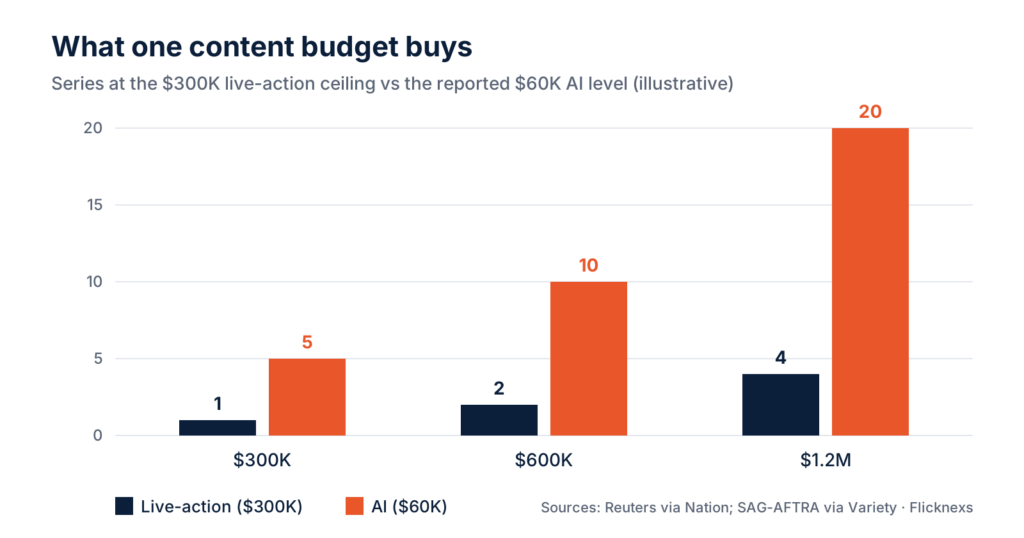
Series per budget at the $300K union ceiling versus the reported $60K AI level. Illustrative arithmetic, not a price quote.
| Content budget | Live-action series at the $300K union ceiling | AI series at the reported $60K level | Extra pilots AI makes possible |
|---|---|---|---|
| $300,000 | 1 | 5 | 4 |
| $600,000 | 2 | 10 | 8 |
| $1,200,000 | 4 | 20 | 16 |
Illustrative arithmetic only. Real costs vary by length, quality, localization and talent.
Holywater’s co-CEO described the same effect from the inside: testing a new genre used to take months, and on its AI app it takes weeks (comments from Holywater’s co-CEO).
What breaks when you have five times the pilots
More pilots only help if the platform handles three jobs quickly:
- Spotting the working pilot. You need episode-level continuation data, split by series, by acquisition source and by production method.
- Matching series to viewers. A larger catalog makes the home screen and recommendations more important, not less. Ten weak series in a carousel bury the one strong one.
- Knowing what to stop. Without a clear kill rule, cheap pilots pile up as clutter, and every title still costs storage, encoding, delivery, subtitles and moderation.
An app built for a slow live-action slate, with a handful of new series a month published by hand, will struggle at AI release volume. That is the operator problem this shift creates.
The hidden cost of every extra title
In short: A cheap series is not a free series. Every title you publish carries platform costs that do not shrink when production gets cheaper, so judge each title on contribution after those costs.
Production budgets get the headlines, but a microdrama app pays for each title again after it is made. These costs are easy to miss because they sit in infrastructure and operations lines rather than in the content budget:
- Encoding and storage. Every episode is transcoded into several bitrates and stored as a master plus renditions. Every extra series, with dozens of episodes each, multiplies that work.
- Delivery. Each view is streamed through a CDN. A title nobody finishes still costs the bandwidth of every first episode it was promoted into.
- Localization. The practical way to budget is per episode, then per language, since each market is its own dubbing pass (Morphic‘s guide to microdrama production costs). A weak title localized into five languages is five weak titles.
- Metadata and artwork. Each series needs a title, synopsis, genre tags, thumbnails and a trailer clip for social acquisition.
- Moderation and compliance. Someone has to check each title for rights, likeness and disclosure issues before it goes live in each market.
- Store fees. In-app purchases on iOS and Android go through the app stores’ billing systems and their commission, which applies to every coin pack regardless of how the series was made.
None of these costs care whether a series was made by a camera crew or a model. That is why “AI is cheaper” only becomes “AI is more profitable” when the platform can find and stop weak titles early. The test loop later in this post is built around that.
Where AI series fit, and where live-action still wins
In short: AI is strongest in effects-heavy fantasy, sci-fi and animation; live-action still wins where viewers follow real actors and in emotionally complex drama, and hybrid production covers the middle.
Release share is not the same as fit. Producers and analysts quoted in 2026 point to a split by genre and market:
- A Chinese producer quoted by VML said AI-generated dramas suit effects-heavy genres best, while live-action remains stronger for emotional storytelling (producer comments quoted by VML).
- The Hollywood Reporter noted that live-action AI microdramas have generally not worked in the US, where fans form around real actors (The Hollywood Reporter on AI microdramas in the US).
Now set that next to who is joining the audience. On MyDrama, men went from 1.1% to 30.3% of monthly active users over seven quarters. Male viewers watch 1.4 times more sci-fi and fantasy than female viewers, and are more likely to find series through YouTube and app-store search (audience findings summarized by TheWrap).
Put together, the genre where AI is strongest (effects-heavy fantasy and sci-fi) is the genre the fastest-growing audience segment watches most. That is the clearest opening for an AI-first slate. Here is how we would map it:
| Genre or format | Best fit | Why |
|---|---|---|
| Fantasy, supernatural, sci-fi | AI-first | Sets, creatures and effects are expensive to shoot and cheap to generate |
| Animated series | AI-first | No live-actor fandom to lose |
| Romance with a known lead | Live-action | Fans follow the actor, especially in the US |
| Emotionally complex family drama | Live-action or hybrid | Producers still rate live performance higher here |
| Thriller and mystery | Hybrid | Shoot leads live; use AI for locations, coverage and pick-ups |
| Localized versions of a hit | AI-assisted | Dubbing and subtitles for new markets, with human review |
Hybrid production is already common. Some teams shoot leads live and use AI for coverage, localization or costly scenes (Morphic’s overview of hybrid microdrama production). One US studio, Ironblood, has humans write its AI shows and brings in real actors to help the models portray expressions (Reuters on Ironblood’s hybrid workflow).
Localization: the growth lever AI makes cheap
In short: The biggest operator win from AI may not be new series at all, but taking proven series into new languages and markets quickly, provided the platform can manage each language as its own release.
Most of the discussion about AI microdramas is about making new series. For a platform operator, the more reliable win is often taking a series that already works and releasing it in more markets. A proven title has known continuation and conversion data; a new pilot does not.
Latin America shows how fast this is moving. Argentine AI studio Gennial reported producing 20 vertical series in August 2026 for specialized microdrama platforms, all generated with AI. One of them, a vampire romance, premiered on Idilio, a Colombian Spanish-language microdrama platform available in more than 50 countries (Ecosistema Startup on Gennial’s AI series). The same report notes that platforms in the region typically let viewers watch 10 to 30 episodes free before asking them to subscribe.
That free window matters for localization. However long your free window is, every new language version has to carry those free episodes well enough to convert. A poor dub in an early episode loses the viewer before the paywall ever appears.
What the platform needs to make localization work:
- One series, many language versions. Each language should be a track or version of the same series, not a separate title, so continuation and conversion data roll up to one place.
- Per-market release status. You should be able to launch the Spanish version in Mexico this week and hold it in Spain until rights or review are done.
- Per-market free windows and pricing. Coin prices and the free-to-paid point that work in the US will not automatically work in Brazil or India.
- Human review before launch. AI dubbing and translation are fast but still need a native reviewer for slang, names and cultural references, especially in romance and family drama.
- Per-language analytics. If the Portuguese version drops off early and the English one does not, the problem is the localization, not the story.
The order we would follow: localize your best-converting series first, test them in one new market each, and only then localize new pilots. Proven stories in new languages carry less risk than new stories in any language.
Disclosure is now a product requirement in Europe
In short: Since 2 August 2026, EU rules require deployers to disclose deepfakes; deciding which titles need a label is a legal call, but carrying and showing the label is a platform feature.
If your app reaches viewers in the EU, AI content is no longer only a creative choice. Article 50 of the EU AI Act has applied since 2 August 2026. Deployers who publish AI-generated or manipulated video, image or audio that counts as a deepfake must clearly disclose that it is artificial. Fines for breaching Article 50 can reach €15 million or 3% of worldwide annual turnover (summary of the Article 50 rules).
Three points matter for a drama app:
- Fiction gets a lighter version, not an exemption. For evidently artistic or fictional works, the disclosure can be made in a way that does not spoil the viewing (Eden AI’s explainer on the Article 50 rules).
- Not every AI image is a deepfake. Draft Commission guidance suggests content that depicts neither real people nor real places may fall outside the deepfake definition, and the answer depends on the facts of each case (SRD Rechtsanwälte on the draft deepfake guidance). An AI series that recreates a real celebrity or a real city is the risky case.
- Old content is not retroactive. Content created before 2 August 2026 does not need to be labeled after the fact (Commission guidance as explained by CEPIC).
This is general information, not legal advice. The practical point is that the decision about whether a title needs a label is made by your legal or editorial team, but carrying and showing that label is a platform job. If your CMS has no field for it, every series becomes a manual exception.
The AI-ready microdrama platform: a 10-point spec
In short: An AI-ready microdrama platform needs to tag production method, carry disclosure labels, publish in bulk, manage languages per market, and report results per episode.
Use this when you evaluate a platform or audit your own. Each item exists because one of the shifts above creates a need for it.
- Production-method field per series and per episode. Values such as live-action, AI-generated, hybrid. Without it you cannot compare conversion between production methods, which is the most useful analysis you can run in 2026.
- Disclosure field and player label. A flag that controls an on-screen notice, plus where it appears (series page, episode start or both), so labeled titles do not need a manual workaround.
- Provenance storage. Keep the source files and any embedded provenance metadata (such as C2PA content credentials) with the master, so you can answer questions about a title later.
- Consent and likeness records. For each series, store which performers’ likenesses or voices were used, the consent document and its territory and expiry. This matters more as voices and faces become easy to generate.
- Bulk publishing and scheduling. AI volume means many series at once. Upload, metadata, artwork and release dates should be batch operations, not one form per episode.
- Per-language audio and subtitle tracks. One master, many languages, each with its own publish status, so a localized version can go live market by market.
- Episode-level continuation analytics. Starts, completions and episode-to-episode drop-off for every episode, filterable by production method, genre, language and acquisition source.
- Paywall position testing. The ability to move the free-to-paid point per series and compare results, because an AI pilot may need a different hook point than a live-action one.
- Editorial controls over discovery. Pin, demote or hide series by market. As release volume climbs, curation protects the home screen from weak titles.
- Fast takedown and version replacement. AI episodes get regenerated. You need to swap an episode file without breaking watch history or entitlements, and remove a title quickly if a rights or likeness issue appears.
A 4-week genre test loop for AI pilots
In short: Publish a small batch of AI pilots in one genre, send each the same traffic, compare them with your own live-action baseline, and keep only the ones that land near or above it.
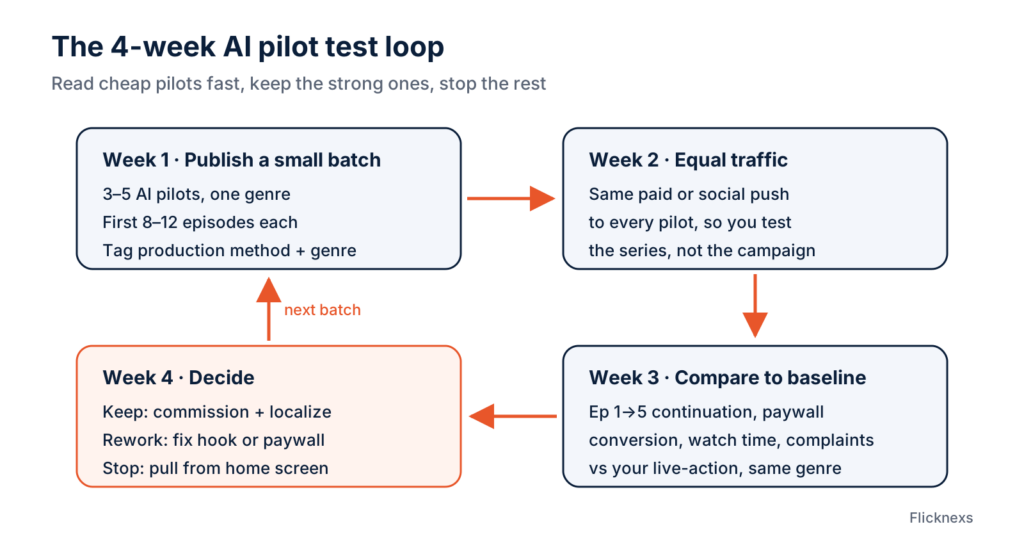
The 4-week pilot test loop. Results from week 4 shape the next batch.
Cheap pilots are only valuable if you can read them quickly and stop the weak ones. Here is a simple loop we would use.
Week 1: Publish a small batch. Release three to five AI pilots in one genre, each with its first 8–12 episodes. Tag every title with production method and genre.
Week 2: Drive the same traffic to each. Send comparable paid or social traffic to every pilot, so the comparison is about the series and not the campaign.
Week 3: Compare against your own baseline. For each pilot, check episode 1 to episode 5 continuation, free-to-paid conversion and average watch time per viewer. Compare these to your live-action average in the same genre, not to industry figures. Holywater’s near-identical conversion rates suggest a good AI series should land close to your live-action baseline.
Week 4: Decide. Keep producing the pilots that land near or above your baseline. Stop or rework the ones that fall well below it, and remove them from prominent placements so they do not dilute discovery. Feed what you learned into the next batch.
Two cautions. First, a few hundred viewers per pilot will not give stable numbers, so set a minimum audience before you judge. Second, watch refund and complaint rates as well as conversion. A title that converts well but generates complaints about quality is a trust problem, not a win.
Worked example: reading a four-pilot test
Here is how the week 3 and week 4 decisions look in practice. The figures below are a hypothetical example, not results from a real app. Assume a fantasy-genre test, and compare each pilot with your own live-action fantasy averages for continuation and paywall conversion.
| Pilot (hypothetical) | Ep 1 → Ep 5 continuation vs baseline | Paywall conversion vs baseline | Complaints | Decision |
|---|---|---|---|---|
| A: Dragon heir revenge | Above | Above | Normal | Keep. Commission the full season and localize first. |
| B: Space station romance | Near | Below | Normal | Rework. Story holds viewers; test an earlier or later paywall. |
| C: Haunted academy | Below | Near | High (visual quality) | Stop. Pull from the home screen. |
| D: Time-loop thriller | Well below | Well below | Normal | Stop. Note the hook problem for the next batch. |
Three lessons come out of a table like this:
- Continuation and conversion fail for different reasons. Pilot B keeps viewers but does not convert them, which usually points to paywall timing or price. Pilot D loses viewers early, which points to the story hook. They need different fixes.
- Complaints can override good numbers. Pilot C converts close to baseline, but quality complaints damage trust in the whole app. In an AI slate, visual consistency problems are the most common complaint source.
- The winner gets more than a season. Pilot A is the title to localize first, because it is now a proven story. That links the test loop to the localization plan above.
Run the same loop on a live-action pilot occasionally as a control. If your live-action baseline drifts, your comparisons drift with it.
Mistakes operators are making in the AI shift
In short: The common mistakes are measuring releases instead of revenue, mixing AI and live-action data, treating disclosure as a one-off task, and imitating real people.
- Counting releases instead of revenue. Publishing more titles is easy now. Measure contribution per title after delivery, localization and acquisition costs.
- Mixing production methods in reports. If AI and live-action series sit in the same analytics bucket, you cannot tell which approach is paying.
- Treating disclosure as a one-off legal task. In the EU it is an ongoing workflow that touches the CMS, the player and the publishing checklist.
- Copying real people. An AI series that imitates a real actor or public figure is the case most likely to trigger deepfake rules and consent claims.
- Ignoring the live-action fan effect. In markets where viewers follow actors, an AI-only slate may struggle in romance, even when it works in fantasy.
- Localizing everything at once. Translating every new pilot into every language multiplies the cost of weak titles. Localize proven series first.
Where Flicknexs fits
In short: Flicknexs provides the platform layer for microdrama apps; it does not produce series, and the 10-point spec above is the checklist to test any provider against.
Flicknexs provides the platform layer for branded streaming and microdrama apps: series and episode management, vertical playback, monetization models including subscriptions and pay-per-episode, multi-language delivery and viewer analytics. It does not produce your series, and no platform can promise that an AI slate will convert.
What a platform can do is make the operator jobs in this post repeatable: tagging titles by production method, publishing in batches, testing paywall positions and reading episode-level results. Before you commit to any provider, check each of the ten items in the spec above against a live demo, and ask which ones are built in and which need custom work.
See how Flicknexs supports microdrama app development
Already running a streaming service and adding a vertical slate? Read how the Flicknexs OTT platform handles branded streaming apps, then start a free trial or book a demo and walk through the 10-point spec on a live account.
Frequently asked questions
What percentage of microdramas are AI-generated in 2026?
According to Owl & Co’s report covered by The Hollywood Reporter, roughly two-thirds of vertical-drama releases outside China in Q3 2026 were AI-generated, across 20 top platforms. The share was 3% in Q1 and 28% in Q2. The figure counts releases, not viewing time or revenue (source: Owl & Co via The Hollywood Reporter).
Do viewers pay for AI-generated microdramas?
Early data says yes. Holywater reported that its AI series app MyMuse converted users to paying subscribers at 23.6%, compared with 23.9% for its live-action app MyDrama. This is one company’s data, so test against your own audience before you rely on it (source: Holywater data via TheWrap).
Which genres work best for AI microdramas?
Producers point to effects-heavy genres such as fantasy, supernatural and sci-fi, plus animation. Live-action still tends to do better in emotionally complex drama and in romance where fans follow real actors, especially in the US.
Do I have to label AI-generated microdramas in Europe?
Under Article 50 of the EU AI Act, in force since 2 August 2026, deployers must disclose deepfakes. Fictional works get a lighter obligation that can be met without spoiling the viewing, and content that depicts no real people or places may not count as a deepfake. Get legal advice for your specific titles (Article 50 overview).
How much does it cost to produce an AI microdrama?
Reuters reported that AI productions in the US vertical market can be completed in three to four weeks for $60,000 or less. Costs depend on episode count, quality, voice work and how many languages you localize into (source: Reuters report on AI production costs).
Will AI replace live-action microdramas?
Current evidence points to coexistence. AI is taking most new release slots, but live-action keeps an advantage where viewers follow real actors and in emotionally complex stories. Many studios now use hybrid production, shooting leads live and using AI for other scenes.
What should a microdrama platform track to compare AI and live-action series?
Tag every title with its production method, then compare episode-to-episode continuation, free-to-paid conversion, watch time per viewer, refunds and complaints between the two groups, within the same genre and market.
Is the $150 billion vertical video figure the microdrama market size?
No. The $150 billion estimate from Owl & Co covers the whole vertical video economy outside China, including platforms such as TikTok. Dedicated vertical-series apps account for about $4 billion of it (source: The State of Microdrama 2026).
Should I localize AI microdramas into other languages?
Yes, but start with series that already convert well. AI makes dubbing and subtitles fast, yet each language still needs a native reviewer and its own analytics. Localizing proven series into one new market at a time carries less risk than localizing every new pilot.