
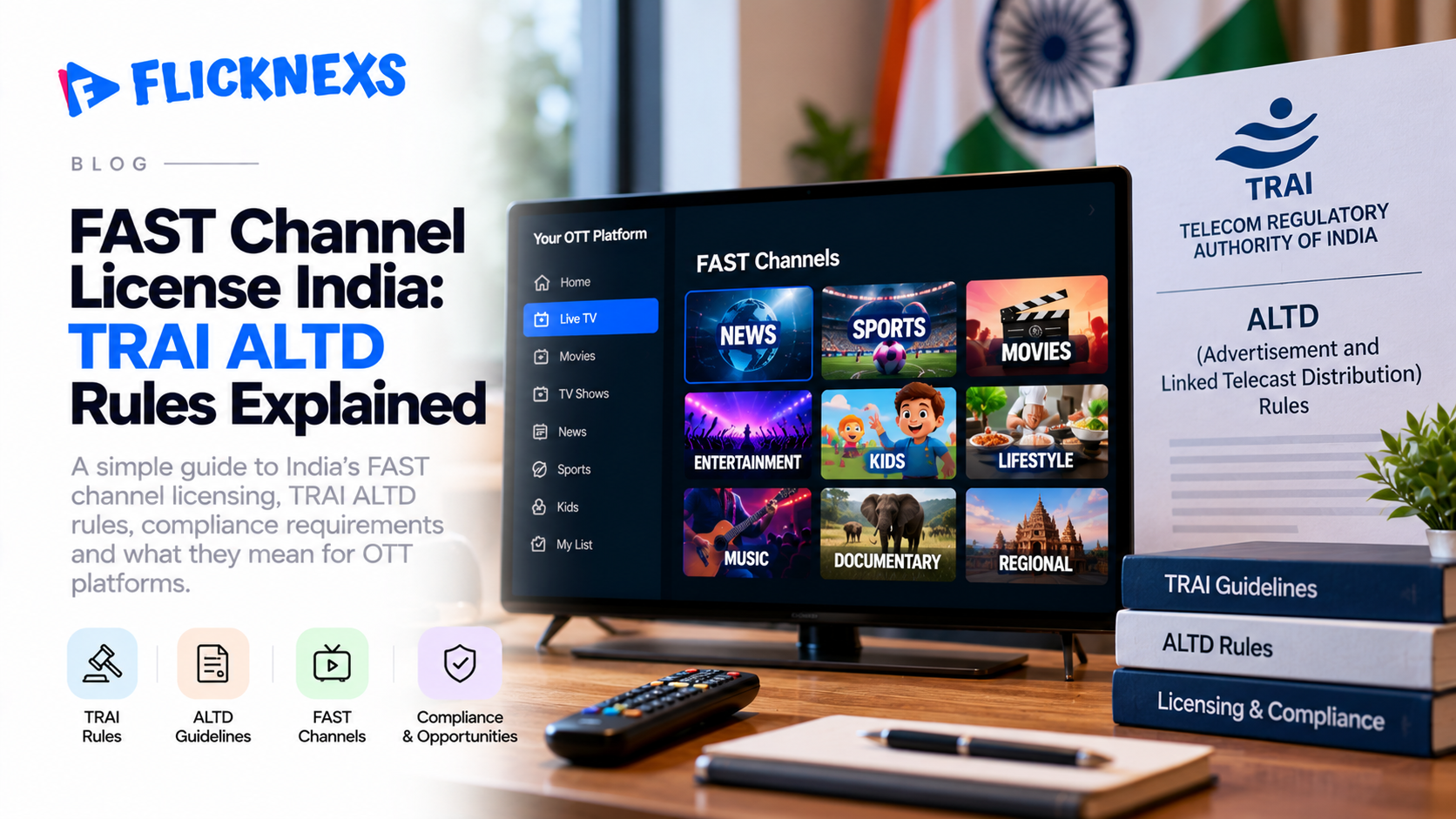
Quick answer: No. As of 12 October 2026, India has no FAST channel license in force. TRAI has finished consulting on rules for app-based linear TV, including FAST, but the Ministry of Information and Broadcasting has not notified any rules. Until it does, FAST and OTT apps fall under the IT Rules, 2021.
Source: TRAI ALTD consultation page. Trade press reported on 25 September 2026 that TRAI is likely to recommend a formal framework (exchange4media), so prepare now without treating any license as mandatory yet.
If you are launching a FAST channel in India now, build it so it survives any of the three outcomes below. Then you will not rebuild when the rules land.
Key takeaways
- The ALTD paper is a proposal. Nothing in it binds an operator yet.
- 46 public submissions (TRAI) split three ways: full licensing, light-touch registration, or no new regime.
- TRAI separates a “FAST TV” platform from a “FAST channel” inside a larger OTT app. Your obligations will likely follow that line.
- The app provider is the most likely primary regulated entity, not the TV maker or the software vendor.
- Rights paperwork, a grievance desk and a channel log are useful under every outcome. Start there.
India’s FAST market is no longer a side bet. Industry estimates cited by Swift TV put connected-TV homes at about 20 million today, rising past 40 million by 2028, with FAST ad revenue near $600 million in that period (exchange4media, 25 Sep 2026). That growth is why cable operators, broadcasters and regulators are now arguing over who sets the rules. New to the format? Start with our practical guide to FAST channels, then come back here for the India rules.
Where the ALTD process stands (October 2026)
The process has passed consultation and is waiting on TRAI’s final recommendations. Here is the dated record, newest first.
| Date | What happened | Source |
| 12 Oct 2026 | MIB tells TDSAT that OTT platforms (Prasar Bharati’s Waves) are governed by the IT Rules, 2021, not the 2022 uplinking and downlinking guidelines | exchange4media |
| 25 Sep 2026 | Report: TRAI likely to recommend a formal framework for ALTD and FAST | exchange4media source |
| 26 May 2026 | 11 counter-comments published | TRAI source |
| 11 May 2026 | Extended closing date; 35 comments published the next day | TRAI report |
| 6 Apr 2026 | TRAI releases the ALTD consultation paper | TRAI paper (PDF) |
| 15 Dec 2025 | MIB asks TRAI to recommend a FAST framework on parity, content accountability and consumer protection | Communications Today |
What happens next. TRAI sends recommendations to the MIB. The MIB can then use Section 56 of the Telecommunications Act, 2023 to make rules requiring a service authorization under Section 3(1)(a), according to law firm JSA. Recommendations are advice, not law. Watch for a gazetted rule with an effective date and a transition window.
The tension to watch. The MIB’s 12 October filing argues OTT delivery over IP is distinct from satellite broadcasting. Its own reference to TRAI, meanwhile, asks how to regulate FAST. Both can be true: a new ALTD category would sit between the IT Rules and the cable and DTH regime, rather than inside either.
Bottom line: the next document that matters is TRAI’s recommendation to the MIB. Until then, the rules have not changed.
What TRAI actually asked
TRAI’s paper did not propose final rules. It asked stakeholders a set of questions, and those questions show where obligations are most likely to land. Based on the consultation paper and TRAI’s own quarterly newsletter, the main themes were:
- Definition. How ALTD should be defined in India, covering pre-installed apps, downloadable apps and web-based players.
- The primary entity. Whether the application provider should be the entity that holds the authorization.
- Terms of authorization. The conditions for granting it and for service provisioning.
- Duties further up the chain. What broadcasters, content providers and aggregators must do before placing a linear channel on an ALTD platform.
- Pay channels shown free. How to treat pay TV channels that appear free on FAST apps, a concern raised by cable operator associations.
- Audience measurement. Whether and how ALTD viewing should feed into India’s TV ratings system.
Each theme maps to something you can prepare. Definitions decide whether you are in scope. The primary-entity question decides who signs. Upstream duties decide what your channel partners must hand you. Pay-channel rules decide which channels are risky to carry. Measurement decides what data you may later need to report.
Bottom line: if you can answer these six questions about your own service today, you are ahead of most operators.
Who argued what: the stakeholder map
The 46 public submissions on TRAI’s consultation page fall into three camps, and the final rules will land somewhere along that line. We read the submissions list on TRAI’s site and the published summaries of each position; the map below is our own analysis.
| Camp | Who (examples) | Core argument | What they asked for |
| 1. Full parity licensing | Zee Entertainment; Times Network | FAST replicates TV distribution without licensing, tariff, quality or content duties | Zee: pan-India authorization for 10 years, app provider as the regulated entity, Rs 10 crore net-worth floor, must-carry and must-provide duties (exchange4media report) |
| 2. Light-touch, accountable | ABP Network; Eenadu TV; CloudTV; RunnTV | Some rules are needed, but legacy TV rules do not fit apps | ABP: “light-touch but proactive” rules, broadcaster control of ad inventory. Eenadu: non-discrimination duties to protect regional channels. CloudTV and RunnTV: registration with the MIB instead of a license |
| 3. No new regime | Jio Platforms; JioStar; Culver Max; Network18; TV Today; LG; MAIT | FAST runs at the application layer, not the network layer, so it is not a telecom service | Stay under the IT Rules, 2021; do not classify TV makers as broadcasters or distributors |
Sources: exchange4media on all named positions, exchange4media on Eenadu, TRAI submissions list.
What the map tells an operator. Camp 1’s sharpest complaint is pay channels showing up free on FAST apps. If you carry any channel that is also sold on cable or DTH, your rights paperwork is the first thing a regulator or a cable operator will ask for. Camp 2’s issues, ad-inventory control and non-discrimination, will likely shape your carriage contracts even if no license arrives.
One gap stood out in the commenter list: no white-label OTT platform builder filed. A Rs 10 crore net-worth floor, as Zee proposed (Zee proposal, per exchange4media), would hit small brands launching on rented technology hardest, and that cost deserves its own look before any rule is final.
Bottom line: the debate is not license versus no license. It is how much of the cable rulebook moves onto apps.
ALTD vs cable, DTH and OTT: where FAST sits today
FAST borrows from both worlds. It looks like TV to the viewer and works like an app underneath. That is why it fits neither existing rulebook cleanly.
| Feature | Cable, DTH, IPTV (DPOs) | On-demand OTT | FAST / ALTD app |
| What the viewer gets | Scheduled channels | A library to pick from | Scheduled channels, often beside a library |
| Delivery | Managed network, set-top box | Open internet | Open internet, smart-TV or mobile app |
| Who regulates today | MIB permissions, TRAI tariff and interconnection rules | IT Rules, 2021 | IT Rules, 2021; ALTD framework under consultation |
| How it earns | Subscriptions, carriage fees, ads | Subscriptions, rentals, ads | Mostly ads |
| Gatekeeper | The DPO | The app store and the app | The app, the TV maker’s home screen and the OS |
Two points from this table matter for operators. First, the MIB already ensures compliance by cable, DTH, IPTV and HITS operators, and told TDSAT that OTT platforms fall in none of these categories (exchange4media, 12 Oct 2026). Second, Times Network warned that smart-TV makers and OS providers could start charging channels for placement, rebuilding the carriage-fee model on connected TVs. If that happens, home-screen placement becomes a cost line in your FAST budget.
Bottom line: FAST sits in a gap between two rulebooks, and the ALTD framework is the attempt to close it.
FAST TV, FAST channel or VOD? Classify your service in five questions
TRAI draws a line most guides miss. A FAST TV platform streams only free, ad-supported linear channels. A FAST channel is a single free linear channel inside a larger OTT app (Fox Mandal). The paper also names the layers in the chain: TV makers, operating-system providers, app providers and content or solution partners.
Answer these five questions about your service, in order:
- Does anything play on a fixed schedule that the viewer cannot pick or pause? No: you run VOD. The ALTD paper is about linear distribution, so it likely does not reach you; the IT Rules, 2021 still do.
- Is every item in your app a scheduled, ad-funded channel? Yes: you look like a FAST TV platform, the core ALTD case.
- Do you run a few linear channels beside a VOD library? Yes: you host FAST channels inside an OTT app. Map the linear part separately from the library.
- Do you carry channels you do not own? Yes: you are acting as an aggregator or app provider. Rights and carriage terms become your first risk.
- Is any channel you carry also sold on cable, DTH or IPTV? Yes: expect scrutiny first. Free carriage of pay channels is the main complaint from cable operators and broadcasters.
A technology vendor that only licenses software and hosting sits at a different layer from the app provider that picks channels and owns the viewer. Contracts help show who does what, but a regulator will look at who actually controls the lineup.
Bottom line: classify each part of your service separately. The answer for your linear channels may differ from the answer for your library.
Four operator scenarios, worked through
Abstract rules are hard to apply. Here is how the classifier and the three outcomes play out for four common Indian setups. These are illustrative models, not legal opinions.
Scenario 1: a regional FAST TV startup
A Tamil-language startup licenses a dozen linear channels from independent producers and runs them free with ads on smart TVs and Android.
- Classifier result: FAST TV platform and aggregator. It is the core ALTD case.
- Biggest risk: rights. Every channel needs a written grant for free internet distribution in India on each device type.
- Under outcome A: it would likely need an authorization in the app provider’s name. A high net-worth floor could be hard to meet for an early-stage company.
- Act now: build the rights register first, then the grievance desk. Budget legal review per channel added.
Scenario 2: a broadcaster adding FAST channels to its own app
A news broadcaster already holds MIB permissions for its satellite channels. It wants to stream two of them free inside its own app.
- Classifier result: FAST channels inside an OTT app, owned content.
- Biggest risk: inconsistency between the satellite channel’s obligations and the app version. Ad breaks and content may differ between the two feeds.
- Under outcome A or B: the program and advertising codes it already follows may extend to the app feed.
- Act now: keep one compliance owner for both feeds and log any differences between them.
Scenario 3: a brand OTT with one linear channel
A fitness brand runs a subscription video library and adds one 24/7 free channel looping its own classes to attract new viewers.
- Classifier result: a FAST channel inside an OTT app, all owned content, no third-party channels.
- Biggest risk: low. Its exposure is mainly the IT Rules it already follows.
- Under any outcome: it may still need a grievance contact and clear ad labeling for the linear part.
- Act now: keep the linear channel’s schedule, ad log and complaints separate from the library so it can be reported on its own.
Scenario 4: an aggregator placing channels on smart-TV home screens
A company packages third-party channels and supplies them to several smart-TV makers’ built-in FAST apps.
- Classifier result: aggregator and possibly app provider, depending on who runs the app.
- Biggest risk: upstream duties. TRAI asked what aggregators must check before a channel goes onto an ALTD platform.
- Under outcome A or B: expect diligence duties on every channel it supplies, plus questions on revenue-sharing.
- Act now: document what checks you run per channel and what warranties you give the TV maker.
Bottom line: the more third-party linear channels you carry, the more any new rule will cost you.
Three likely outcomes and what each means for you
The September report points toward some form of framework, so outcome A or B is more likely than C. These are our planning scenarios, not predictions of the final text.
| Outcome | What it would look like | Who carries most of the cost | What you would need | Signal it is coming |
| A. ALTD authorization | Telecom Act authorization for app providers, close to Zee’s proposal | FAST TV platforms and channel aggregators | Indian entity, entry fee or net-worth floor, program and ad code compliance, grievance officer, possible must-carry | TRAI recommendation names the app provider as licensee; MIB notifies Section 56 rules |
| B. Registration plus duties | MIB registration, no license fee, conduct rules on content, ads and complaints | Apps carrying third-party linear channels | Registration filing, channel rights register, grievance process, non-discrimination terms in carriage deals | Recommendation uses “registration” or “light-touch” language |
| C. Status quo | ALTD stays under the IT Rules, 2021 and self-regulation | Nobody new | Digital Media Ethics Code duties you already have | MIB adopts the reasoning it used in the Waves filing |
Our read. Even outcome C does not mean zero work. The IT Rules already expect grievance handling for digital publishers, and cable operators are testing disputes at TDSAT. Pick the controls that pay off under all three outcomes, which is the next section.
Bottom line: plan for outcome B as your base case and keep a path to A.
The no-regret checklist: what to do before the rules land
Every item below pays off under outcomes A, B and C. Ordered by risk, highest first.
Priority 1: rights (weeks 1–2)
- List every channel with its rights holder, territory, devices and expiry date.
- Flag any channel that is also sold on cable, DTH or IPTV. Get written confirmation it can run free on your app.
- Confirm each carriage deal allows internet, FAST and the device types you ship on.
- Write a takedown rule: who pulls a channel within how many hours when rights lapse or are disputed.
Priority 2: who controls what (weeks 2–3)
- Draw your chain: TV maker, OS, app provider, aggregator, channel owner, ad partner. Name the legal entity at each layer.
- Record who picks the lineup, who sets the schedule and who sells the ads.
- Check your contracts match that map. If your vendor only supplies software, the contract should say so.
Priority 3: viewers and advertisers (weeks 3–4)
- Name a grievance officer and publish a complaint route inside the app.
- Log every complaint with date, response and outcome.
- Label sponsored content and keep ad approvals on record.
- Keep a dated log of channel launches, suspensions and removals.
Priority 4: stay current (ongoing)
- Check TRAI’s ALTD page and MIB notices monthly. Note the date and document checked.
- When final rules appear, re-map your service against their scope, effective date and transition window.
- Get a written legal opinion on your specific model before launch or any major change.
This guide is not legal advice. Have a lawyer qualified in Indian media and telecom law review your service model.
Bottom line: rights first, control map second, viewer processes third. That order holds whatever TRAI decides.
A 30-day readiness plan
The checklist above is the what. This is the when. Use it as an internal plan, not a legal deadline.
| Days | Focus | Output you should have at the end |
| 1–7 | Classify the service with the five questions; list every channel and partner | A one-page service map and a channel inventory |
| 8–14 | Collect rights grants, carriage contracts and ad-sales agreements | A rights register with gaps flagged in red |
| 15–21 | Set up the grievance route, complaint log and channel change log | Working processes, tested with one dummy complaint |
| 22–30 | Legal review, owner for each item, monitoring routine | A signed-off action list and a monthly review date |
Most small operators can finish days 1 to 21 without outside help. The legal review in the last week is where money is best spent, because the lawyer will be working from organized records instead of a pile of emails.
Bottom line: in 30 days you can move from “we think we are fine” to a file you could hand a regulator.
Questions to ask your channel partners
Your exposure under any outcome depends heavily on what your channel partners can prove. Before you add or renew a channel, ask the partner these questions in writing:
- Who owns the rights to this channel’s content, and can you show the chain of grants? You need to know if the partner is the owner or a licensee.
- Does your grant cover free, ad-supported internet distribution in India? Many older deals cover only cable, DTH or subscription streaming.
- Which devices and app stores does the grant cover? Smart TV, mobile, web and pre-installed apps can be licensed separately.
- Is this channel also sold on cable, DTH or IPTV? If yes, ask for written consent to carry it free.
- Who sells the ads inside the channel, and who keeps what share? Camp 2 broadcasters want control of ad inventory; your contract should settle it now.
- How fast will you tell us if rights end or are disputed? Agree a notice period and a takedown time.
- Will you warrant that the content follows Indian program and advertising codes? If rules extend those codes to apps, this warranty becomes valuable.
A partner that cannot answer the first four questions is a risk under every outcome. A partner that answers all seven in writing makes your own compliance file much easier.
Bottom line: your compliance is only as good as your weakest channel partner’s paperwork.
How the rules could change FAST distribution on smart TVs
Most FAST viewing in India happens on connected TVs, where the TV maker and the operating system control the home screen. The ALTD debate could change how that works in three ways.
First, who counts as the distributor. LG and MAIT argued TV makers are technology enablers, not distributors (exchange4media details). If TRAI agrees, the app provider carries the duties, even when its app is pre-installed by the TV maker.
Second, placement fees. Times Network warned that TV makers and OS providers could charge channels for discoverability, much as cable operators charge carriage fees. A non-discrimination rule, as Eenadu asked for, would limit how those fees can be set.
Third, must-carry. Zee proposed must-carry and must-provide duties for ALTD apps. If adopted, a FAST app could be required to carry certain channels, which affects both lineup control and bandwidth costs.
For an independent channel owner, the practical effect is that the smart-TV platform deal becomes a regulated relationship, not just a commercial one. See how FAST channel deals with Roku and Samsung TV Plus work today.
Bottom line: watch the final text for the words “app provider”, “non-discrimination” and “must-carry”. Each one shifts cost between channels and platforms.
What a license regime could cost a small operator
No final fee or net-worth figure exists yet, so any number here would be a guess. What we can do is list the cost drivers that appeared in the proposals, so you can budget for them in ranges once rules are out.
- Entity and capital requirements. Zee’s proposal ties eligibility to an Indian company and a net-worth floor of Rs 10 crore (exchange4media coverage). For a startup, this could mean restructuring or raising capital before applying.
- Compliance staff. A grievance officer and a content compliance owner are likely under outcomes A and B. In a small team, these can be part-time roles.
- Legal and filing work. Expect one-time legal review at launch and per new channel, plus annual filings if registration is required.
- Technical records. Channel logs, complaint logs and ad logs need a system. Many OTT platforms already keep these; check before you build.
- Must-carry and bandwidth. If must-carry is adopted, carrying extra channels raises delivery costs.
Outcome C adds almost none of these. Outcome B adds the middle three. Outcome A adds all five.
Bottom line: budget for people and records now; budget for capital only if outcome A arrives.
Questions to take to your lawyer
A short, specific brief saves legal fees. Bring these questions, with your service map and rights register attached:
- Based on our service map, which parts are linear and which are on-demand?
- Under today’s rules, which duties already apply to us under the IT Rules, 2021?
- If TRAI recommends app-provider authorization, which of our entities would apply?
- Are any of our channel grants weak for free internet distribution in India?
- What should our carriage contracts say about ad inventory and takedowns?
- What would we need to change if must-carry duties were introduced?
Bottom line: a lawyer working from your records answers in days; a lawyer working from scratch takes weeks.
Final verdict
For FAST TV platforms and aggregators: treat outcome A as a real possibility and fix rights paperwork first. For broadcasters adding app feeds: align the app feed with the codes your satellite channel already follows. For brand OTTs with one linear channel: your risk is low; keep the linear channel’s records separate. In short, nobody needs a FAST license in India today, but every operator should have a compliance file ready for when TRAI reports.
Ready to build? See how Flicknexs runs FAST channels with linear and VOD in one place.
Four mistakes we see operators make
- Quoting the consultation as law. “TRAI mandates FAST licenses” is wrong today. Say “TRAI has consulted on” until rules are notified.
- Reading the Waves filing as an all-clear. The MIB was answering a satellite-guidelines dispute. It did not rule out a new ALTD framework.
- Trusting an aggregator’s rights promise. Ask for the chain of rights in writing, per channel, per territory.
- Mixing linear and VOD in one compliance file. If outcome A or B lands, only the linear part may be in scope. Keep them separable.
Glossary
- ALTD: Application-based Linear Television Distribution. Apps that deliver scheduled TV channels.
- FAST: Free Ad-Supported Streaming Television. Free linear channels funded by ads.
- DPO: Distribution Platform Operator. Cable, DTH, HITS and IPTV operators licensed under MIB permissions.
- MIB: Ministry of Information and Broadcasting, which licenses TV channels and distributors.
- TRAI: Telecom Regulatory Authority of India, which recommends rules to the government.
- TDSAT: Telecom Disputes Settlement and Appellate Tribunal, where telecom and broadcasting disputes are heard.
- Must-carry: a duty to carry certain channels on a platform.
- IT Rules, 2021: the Information Technology (Intermediary Guidelines and Digital Media Ethics Code) Rules, which govern OTT content today.
Building a FAST or OTT service on Flicknexs
Software does not make a service compliant; your rights, contracts and processes do. What a platform can do is make the records in the checklist easy to keep.
Flicknexs builds white-label OTT platforms with automated 24/7 playout, drag-and-drop scheduling, server-side ad insertion, geo-fencing and a content partner portal (Flicknexs). For the checklist above, that means you can run linear channels on their own schedules, keep them apart from the VOD library, restrict a channel by territory and let partners manage their own content.
When you assess any OTT platform, including ours, ask: can linear channels and VOD be managed and reported separately? Can staff roles limit who edits the lineup? Is there a log of channel changes? Ask any vendor to show you these in a demo, not a slide.
Talk to us about launching a FAST channel or build your own branded OTT platform. You can also start a free 14-day trial or compare plans and pricing.
Related reading: how to launch a FAST channel in 2026, how FAST channels make money through ads, getting a FAST channel onto Roku, Samsung TV Plus, Tubi and Prime Video, and OTT app requirements for CTV in India.
FAQ
Is a FAST channel license mandatory in India in 2026?
No. As of 12 October 2026, TRAI has consulted and is expected to recommend a framework, but the MIB must still make rules before any license applies. In short, there is no FAST license to apply for yet.
What is ALTD?
ALTD is Application-based Linear Television Distribution: apps that deliver scheduled TV channels on smart TVs, phones, pre-installed apps or browsers. In short, FAST is one kind of ALTD service.
What is the difference between a FAST TV platform and a FAST channel?
A FAST TV platform streams only free, ad-supported linear channels. A FAST channel is one such channel inside a larger OTT app. In short, TRAI treats them separately, and obligations may differ.
Does the ALTD framework apply to Netflix-style VOD apps?
Probably not. The consultation targets linear, scheduled channels. In short, a pure VOD app stays under the IT Rules, 2021.
Who would hold the license: the TV maker, the app or the vendor?
Most proposals name the app provider that aggregates channels and controls access. TV makers such as LG argued they should not be classed as distributors. In short, plan as if the app provider signs.
When will the final FAST rules come out?
No date is public. TRAI’s recommendations come first, then MIB rules under the Telecommunications Act, 2023, usually with a transition period. In short, expect months, not weeks, after TRAI reports.
Can I carry a pay TV channel free on my FAST app?
Only if your agreement with the rights holder clearly allows free internet distribution in India on your devices. In short, get it in writing; this is the most contested issue in the consultation.
Does the MIB’s Waves filing mean OTT is exempt?
No. The MIB argued that satellite uplinking guidelines do not apply to OTT. In short, it did not rule out a separate ALTD framework.
Will FAST viewing count in TV ratings?
Not yet. TRAI asked whether ALTD viewing should feed into ratings, and Eenadu TV argued it should not be merged for now. In short, keep your own viewing data clean in case it is requested later.
Do I need an Indian company to run a FAST app in India?
Not under today’s rules. Zee’s proposal would limit authorization to Indian companies with a commercial presence. In short, foreign operators should watch outcome A closely.
What should a small FAST operator do right now?
Build the rights register, ownership map and grievance desk in the checklist above. In short, these are needed under every likely outcome.
Where can I track official updates?
TRAI’s ALTD page and the MIB notices page. In short, check monthly and note the date you checked.
Ready to build?
If you’re planning your next Playout / FAST project, Flicknexs handles the video infrastructure end-to-end — so you can ship in weeks, not months.