
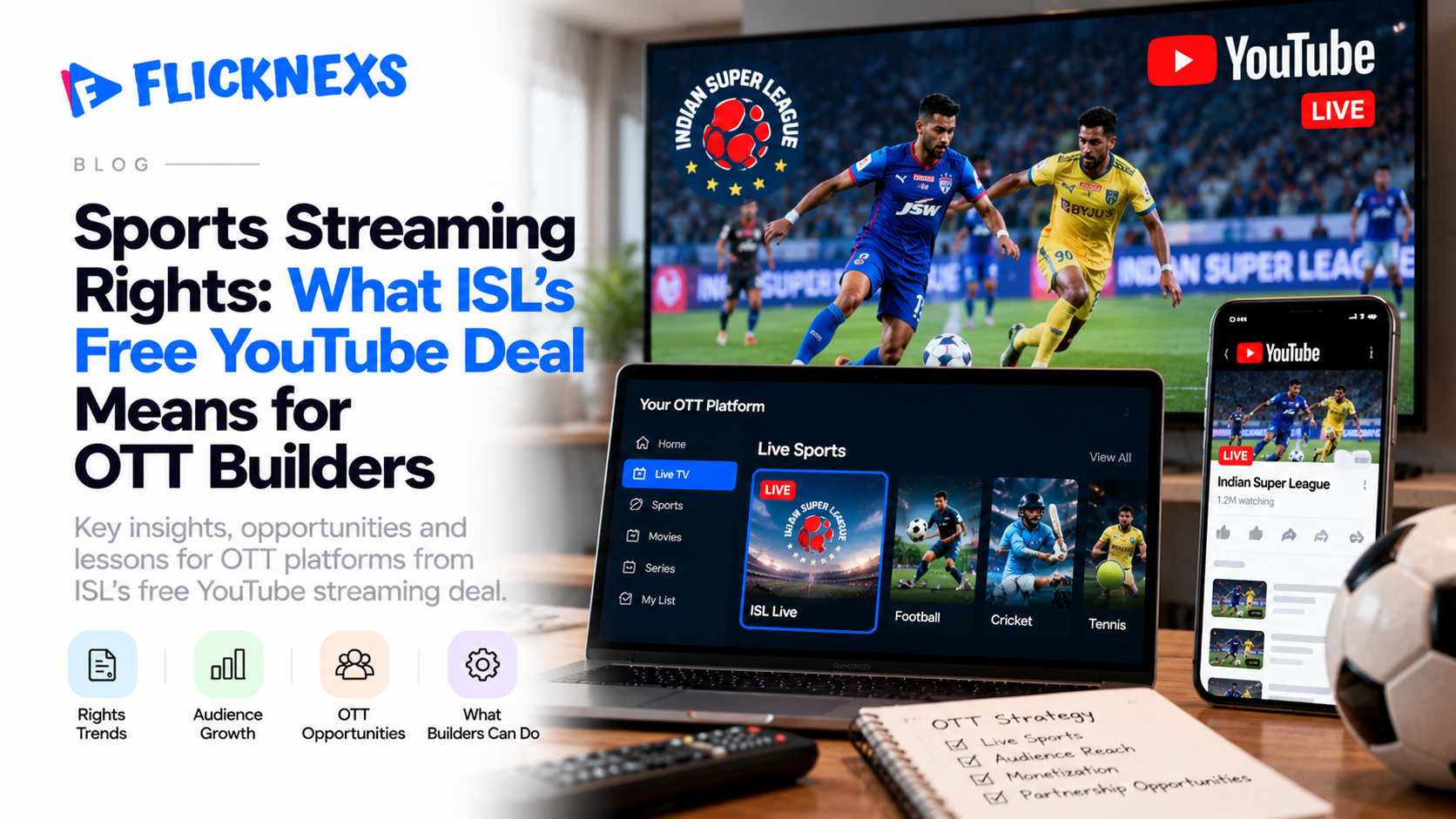
On 7 October 2026, the Indian Super League confirmed that every one of its 163 matches this season will stream live and free on YouTube. For fans, that is simple good news. For anyone building a sports OTT app, it raises a harder question about sports streaming rights: if the league is giving matches away, what is left to sell, and what are you actually allowed to show?
This guide is for clubs, regional media startups, academies and anyone weighing a sports streaming product in India. We break down who got what in the ISL deal, the gaps it leaves open, a simple framework for checking any piece of footage, and what a rights-safe sports app costs to run.
Quick answer: The ISL 2026–27 deal makes every match free to watch on YouTube, but it does not make the footage free to use. Without a license, you cannot rebroadcast or monetize ISL matches in your own OTT app. You can still build a paid or ad-supported sports app around owned, licensed and original content.
Key takeaways
- Free to watch and free to reuse are different things. Sports streaming rights sit with the league and its licensed partners, not with whoever can see the stream.
- The deal splits the ISL by platform, language and territory. Those splits are where smaller builders find room.
- YouTube carries English and Hindi only. Regional-language audiences are served by Sony, which leaves space for original regional programming around the league.
- Clubs are reportedly getting reach data for the first time, which strengthens the case for club-owned fan apps.
- Owning an OTT platform gives you the pipes and the billing. It does not give you the content.
What did each ISL partner get?
Most coverage stops at “ISL is free on YouTube.” The detail underneath is what matters to builders, because every split in a rights deal tells you where an exclusive line has been drawn.
| Partner | What they carry | Languages | Territory |
| YouTube | All 163 matches, live and free, plus highlights, Shorts, interviews and analysis | English, Hindi | India and worldwide |
| SonyLIV | All 163 matches, inside its paid streaming service | English, Hindi, Malayalam, Tamil, Bengali | India |
| Sony Sports Network (TV) | More than 80 matches on linear TV | Same five languages | India |
Sources: the league and Sony’s announcement as reported by Medianews4u; the language and territory split as reported by Khel Now; YouTube’s ancillary content as reported by MyKhel.
A few other details shape the season. There are 13 teams, and Phase 1 runs 78 matches from 10 October 2026 to 17 January 2027, with 53 of those on Fridays, Saturdays or Sundays, according to DT Next. Khel Now has also reported that the agreement covers two seasons and that clubs will get access to broadcast and streaming data, including state-wise reach, for the first time. Treat the two-season term and the data clause as reported rather than confirmed until the league publishes them.
Show Image
Bottom line: free and paid distribution are running side by side, on purpose. YouTube buys reach. Sony buys regional commentary and the TV audience. Nobody in that table is giving up control of the footage.
Why “free to watch” is not “free to stream”
Here is the mistake that sinks small sports apps. A founder sees a public YouTube stream, assumes the content is now “open,” and embeds or restreams it inside a branded app with ads or a paywall around it.
Three separate things are at play, and they are often confused:
| Concept | What it answers | Who decides |
| Viewer access | Does the fan pay to watch? | The rights holder and its partners |
| Sports streaming rights | Who may distribute this footage, where, when and how? | The league or event owner, through contracts |
| Platform ownership | Who runs the app, player, billing and data? | You, if you build or license your own OTT platform |
The ISL chose to make viewer access free on YouTube. That decision does not change the second row. The league still decides who may carry the footage, and it has already decided: YouTube and Sony.
So if you have no ISL license, the honest answer is that live matches, full replays and match clips are off the table for your app, however you plan to monetize them. Embedding someone else’s stream inside a paid product, re-encoding it, or cutting clips from it all depend on permission you do not have. Platform terms (including YouTube’s own) add their own limits on top.
This is general business information, not legal advice. Sports media rights are contract-specific, so speak to a media-rights lawyer before you distribute or monetize any third-party sports footage.
The Rights Stack: six layers of sports content
When we talk to sports clients, the most useful habit is to stop asking “do we have rights to the ISL?” and start asking “which layer of the content are we talking about?” Each layer is licensed, owned or produced differently.
| Layer | Examples | Who usually controls it | What a non-rights-holder can build |
| 1. Live match feed | The live broadcast of a fixture | League and its licensed broadcasters | Nothing without a license |
| 2. Replays and delayed | Full-match replay, condensed match | Same as above, often with time windows | Only under a replay or delayed-rights deal |
| 3. Highlights and clips | Goals, key moments, Shorts | League or highlights licensee | Only licensed clips, within the license’s limits |
| 4. Ancillary club content | Training, interviews, behind the scenes | Often the club, subject to league rules | Partnerships with clubs and players |
| 5. Data and stats | Scores, live stats, reach data | League, data providers, clubs | Licensed data feeds; original analysis of public facts |
| 6. Owned originals | Your tactics show, podcast, coaching series, local league coverage | You | Everything, as long as you don’t use others’ footage, music or marks |
The pattern is clear. The higher layers (1–3) are where the money changes hands at league level, and where the ISL deal has already been done. The lower layers (4–6) are where clubs, regional media and startups can build something they control.
Check each layer separately. A deal for clips (layer 3) does not cover full replays (layer 2), and a partnership with a club (layer 4) does not cover match footage, even of that club’s own games.
Bottom line: if you don’t hold a league license, build on layers 4 to 6. That is where a club, regional channel or startup can own the product outright.
Five gaps the ISL deal leaves open
This is where the deal gets interesting for builders. Each of these is a real opening, and none of them requires you to touch ISL match footage.
1. The regional-language gap
YouTube’s free stream is in English and Hindi only, while Tamil, Malayalam and Bengali commentary sits with Sony, per Khel Now. That means a Kerala, Tamil Nadu or Bengal football fan watching free gets the match but not their own language.
You cannot add your own commentary over the match feed without rights. But you can own the conversation around the match in that language: a Malayalam pre-match show, a Tamil tactical breakdown on Monday, a Bengali fan phone-in. Original talk formats that use no match footage, and that use stills or graphics you have rights to, are yours to make and monetize. If you want to run regional programming on your own app, a regional OTT platform lets you publish each language as its own title with its own subtitle tracks.
2. The club data gap
If the reported clause holds, ISL clubs will now see how many people watch them and in which states. That is the first thing a club needs to justify its own fan app or membership product. A club that knows it has a large following outside its home state can sell a membership with training sessions, player interviews, academy matches and archive content to fans who will never get to the stadium.
3. The “other football” gap
The ISL is one competition. State leagues, women’s football, youth leagues, school and university tournaments, futsal and corporate leagues mostly sit outside any national streaming deal. Their rights are often held by a state association, an organizer or the venue, and they are frequently unsold. If you can agree terms with those owners, you can carry live matches legally, which is exactly what you can’t do with the ISL.
4. The calendar gap
Phase 1 packs 53 of its 78 matches into Fridays to Sundays. Khel Now reports the season runs until May 2027. That leaves midweek evenings, and later the off-season, with no ISL to watch. A sports channel that fills those slots with its own programming (preview shows, archive matches you own, grassroots fixtures) gives fans a reason to open the app when the big league is quiet. A 24×7 FAST-style linear channel is built for this kind of schedule.
5. The direct relationship gap
YouTube gives the ISL reach. It does not give a club, academy or local broadcaster an email list, a paying member or first-party viewing data on its own fans. Any business that wants to sell memberships, match passes or coaching programs needs its own app, its own checkout and its own audience data.
The 6-question test before you put footage in your app
Use this before any video goes live in your app. If you hit a “no” or “not sure,” stop and fix it before publishing.
- Who owns this footage? Name the person or organization. “It’s on YouTube” is not an answer.
- What do I hold in writing? A license, a partnership agreement or a production contract. Verbal is not enough.
- Which layer does it cover? Live, replay, highlights, ancillary, data or originals (see the Rights Stack).
- Where may I show it? Which territories, which devices, which apps. Is it exclusive to someone else in any of them?
- How may I earn from it? Free, ads, subscription, pay-per-view, sponsorship. A license for free viewing may not cover a paywall.
- For how long, and what else is inside the frame? End date of the license, plus music, sponsor boards, logos and people on screen who may need separate clearance.
If all six answers are clear and written down, the footage is ready to ingest. Record them against each title in your content library so anyone on the team can check later.
Bottom line: six written answers per title, or the title doesn’t go live.
Three sports OTT models that work without major league rights
Here are three ways sports businesses are building around the ISL rather than against it. The platform setup differs for each.
Model A: The club fan app
Who it suits: an ISL, I-League or state-league club with a loyal following.
What goes in it: training sessions, player interviews, behind-the-scenes, academy and reserve matches (where the club holds those rights), press conferences and archive content the club owns.
How it earns: annual membership as the base, a free ad-supported layer for casual fans, and pay-per-view for one-off events like an academy final or a pre-season friendly the club organizes.
What to check: the league’s rules on club media, and whether any of your club’s matches are covered by the league’s broadcast contracts. Your own league fixtures will usually be.
Model B: The regional-language sports channel
Who it suits: a regional media house, YouTube creator team or sports journalism startup.
What goes in it: original pre- and post-match shows in Tamil, Malayalam or Bengali, tactics explainers, fan shows, interviews, and live coverage of local tournaments where you have agreed rights with the organizer.
How it earns: advertising and local sponsors on a free tier, plus a subscription for ad-free viewing and archives.
What to check: any graphics, photos or clips you use inside your shows. Original commentary is yours; the pictures behind it may not be.
Model C: The grassroots league network
Who it suits: a tournament organizer, state association or sports-tech startup.
What goes in it: live coverage of school, college, youth and amateur competitions, full-match replays, condensed matches and player profiles.
How it earns: match passes for families and alumni, season subscriptions for scouts and coaches, and sponsor ad breaks during half-time.
What to check: consent for filming minors and amateurs, venue permissions, and who actually holds the rights (organizer, association or school).
| Club fan app | Regional-language channel | Grassroots network | |
| Main content | Ancillary club content | Original programming | Live local matches |
| Rights source | Club, players, league rules | You (originals) | Organisers, associations |
| Lead revenue | Membership | Ads + sponsors | Match passes + subscriptions |
| Biggest risk | Overlap with league broadcast rights | Using unlicensed match clips | Consent and venue permissions |
What a rights-safe sports app costs to run
Free distribution of the ISL does not change your cost base. You still pay for production, delivery, apps and any rights you buy. A simple monthly check keeps the numbers honest:
Monthly cost = rights fees + production + platform and delivery + payment fees + marketing
Break-even paying members = monthly cost ÷ average monthly revenue per paying member
As a worked example, take Flicknexs’ published plan prices: F1 Standard is listed at $349/month and F2 Super, which adds Android and iOS apps, at $599/month. Samsung, LG, Roku and Apple TV apps are add-ons at $200/month per app.
Suppose a regional channel picks F2 Super ($599/month) and assumes each paying member brings in $3/month. The assumption here is yours to replace with real pricing. Platform cost alone then needs about 200 paying members to cover it ($599 ÷ $3). Add production, rights, marketing and payment fees to the top line and the number moves. The point of the exercise is to know that number before you launch, not after.
Two questions are worth asking any platform you consider:
- Is the fee flat, or a share of every sale? Sports revenue spikes around finals and drops in the off-season. A revenue share takes most when you earn most. Flicknexs states 0% commission on sales on its sports channel page.
- What happens to delivery costs in a big week? Bandwidth tracks viewing. Check what’s included in your plan and what a finals-week spike would add.
Building it step by step
Step 1: List your content by layer
Make a spreadsheet of every title or feed you plan to carry. For each one, record the Rights Stack layer, the owner, the license, territories, permitted earning models and end date. This is your rights register, and it should exist before you write a line of app copy.
Step 2: Pick the earning model for each layer
Free and ad-supported for originals and highlights you are licensed to show. Subscription for archives and members’ content. Pay-per-view or match passes for one-off events you have the live rights to. Many sports apps run all three. If you are weighing transactional pricing, our guide to TVOD platforms covers how pay-per-view and rentals are set up.
Step 3: Lock access per title
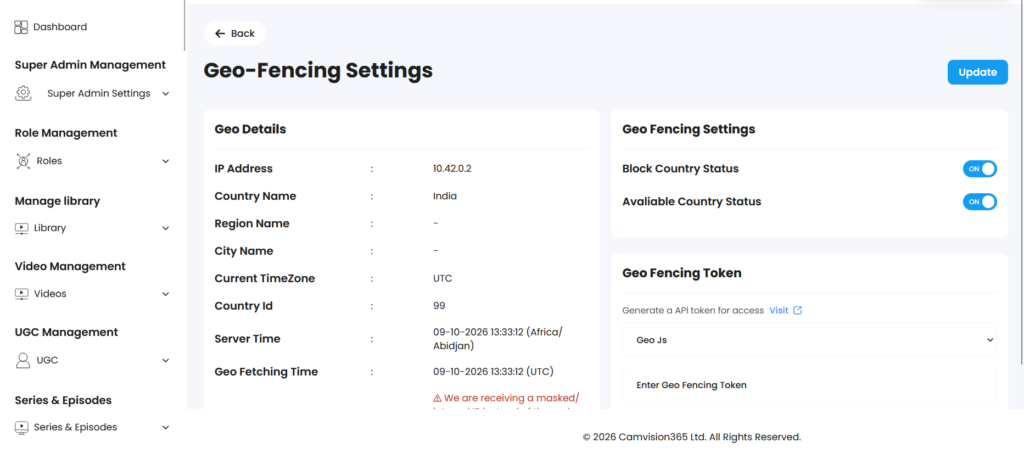
Every title needs its own access rule: who can watch, from which countries, for how long, and on which tier. This is how you stay inside a license that only covers India, or a replay right that only opens after a delay. On Flicknexs, geo-restriction and per-title access are set on the title itself.
Step 4: Plan the channel and the schedule
Live events need real start times in the guide. Between them, a 24×7 channel built from your archive and originals keeps the app alive on midweek nights and in the off-season. Flicknexs’ cloud playout lets you build a drag-and-drop schedule and cut to a live feed when a fixture starts, then return to the schedule automatically.
Step 5: Set up ads and sponsor breaks
If your free tier carries ads, test pre-, mid- and post-roll placements and half-time sponsor breaks on each device your audience uses. Local sport often has local sponsors already on the boards at the ground; offer them the stream too.
Step 6: Build the path from free to paid
A fan who watches your free Tamil preview show should see a relevant next step: a membership with the full archive, or a pass for a live local final. Keep the offer specific and say exactly what they get.
Step 7: Measure what matters
Track unique viewers, watch time, repeat visits, free-to-paid conversion, churn after the season ends, revenue by content layer, and cost per paying member. Those numbers tell you whether your free content is building an audience that will pay.
Where Flicknexs fits
Flicknexs is an OTT and live streaming platform for businesses that want their own branded sports app or channel. On its 24×7 sports TV channel solution, the listed capabilities include live match broadcasting, multiple-language commentary published as separate titles, VOD replays and highlights, cloud playout for a 24×7 channel, sponsor ad insertion, and pay-per-view and match-pass subscriptions. Apps run on web, phones and TVs, depending on plan.
One thing a platform cannot do is hand you rights. Flicknexs gives you the app, the player, delivery and billing. The footage you put through it has to be yours or licensed to you. For the full feature list, see the Flicknexs sports OTT platform.
Start your sports channel free · Compare plans and pricing
If you plan to push your channel beyond your own app, read our guide to getting a FAST channel onto Roku, Samsung TV Plus, Tubi and Prime Video. And if you are still comparing vendors, see our roundup of white-label OTT platform providers.
Mistakes we see sports OTT builders make
- Treating a public stream as permission. Visible is not licensed. This is the single most common way small sports apps get takedown notices.
- Licensing one layer and using another. A clips deal used for full replays, or a club partnership used for league match footage.
- Forgetting what’s inside the frame. Background music, sponsor boards from expired deals and competition logos can each need their own clearance.
- Ignoring territory. An India-only license on an app available worldwide breaks the license the day you launch.
- Building the paywall before the rights register. Pricing and packaging should follow what you’re allowed to sell, not the other way round.
- Going quiet in the off-season. A subscription bought for a cup run has nothing holding it in June unless something is running in June.
FAQs
Can I stream ISL 2026–27 matches in my own app if they are free on YouTube?
No, not without a license. The ISL has licensed its matches to YouTube and Sony. A free public stream gives fans access; it does not give other platforms the right to carry, embed for profit or re-encode the footage.
Who holds the ISL 2026–27 streaming rights?
YouTube streams all 163 matches live and free in English and Hindi, in India and worldwide. SonyLIV streams all 163 matches in India in five languages, and Sony Sports Network shows more than 80 on TV, according to reports from Khel Now and Medianews4u.
Can I make ISL commentary or analysis shows in Tamil, Malayalam or Bengali?
Original talk, analysis and fan shows in any language are yours to make, as long as you don’t use match footage, broadcast graphics or clips you aren’t licensed for. Adding your own commentary over the live feed needs rights you won’t have.
What are sports streaming rights?
Sports streaming rights are the contractual permissions to distribute a sporting event or its footage online. They are usually split by layer (live, replay, highlights), territory, language, device, earning model and time period.
Can a club build its own OTT app while the league has a broadcast deal?
Yes. A club can build an app around content it controls, such as training, interviews, academy matches and archives, subject to the league’s media rules. League match footage will usually stay with the league’s broadcast partners.
Can I monetize a sports app without buying major league rights?
Yes. Original programming, coaching content, licensed highlights and grassroots competitions can all support ads, subscriptions or pay-per-view. Grassroots and state-level events are often the most accessible live rights.
Does an OTT platform provider give me the rights to stream sports?
No. A provider like Flicknexs supplies the app, player, delivery and billing. Rights come from the owner of the content, through a separate agreement.
What should I check before signing a sports content license?
Check the layers covered, territories, devices, languages, permitted earning models, exclusivity, sublicensing, any delay windows, the end date and what third-party material sits inside the footage.
Can I embed the official ISL YouTube stream on my own website?
Embedding is governed by YouTube’s terms and by whether the uploader allows embeds. Putting that embed inside a paid product, or wrapping it in your own ads, is a separate commercial use that needs the rights holder’s permission. If you want to show it, ask the league or its partner first.
How do I find out who owns the rights to a local tournament?
Ask the organizer directly, then confirm with the state association and the venue. Get the answer in writing, including whether any sponsor, school or broadcaster has a prior claim. For school and youth events, also confirm who gives consent for filming players.
The short version
- Can you stream ISL matches in your app? Only with a license from the league or its partners.
- Can you build a sports app anyway? Yes, on club content, original programming, licensed highlights and grassroots events.
- Where’s the opening? Regional languages, club fan relationships, local competitions and the midweek and off-season calendar.
- What comes first? The rights register, then the earning model, then the platform.
Final verdict
The ISL’s YouTube deal is a reminder that sports streaming rights, not viewer access, decide who can build a business on a match. For most clubs, regional media houses and sports startups, the ISL’s live feed was never on the table. What the deal does is make the gaps easier to see: regional languages, club-owned fan relationships, grassroots competitions and the long stretches of the calendar with no big match on.
Start with a rights register. Pick the layers you control. Choose the earning model for each. Then pick the platform that runs it.