
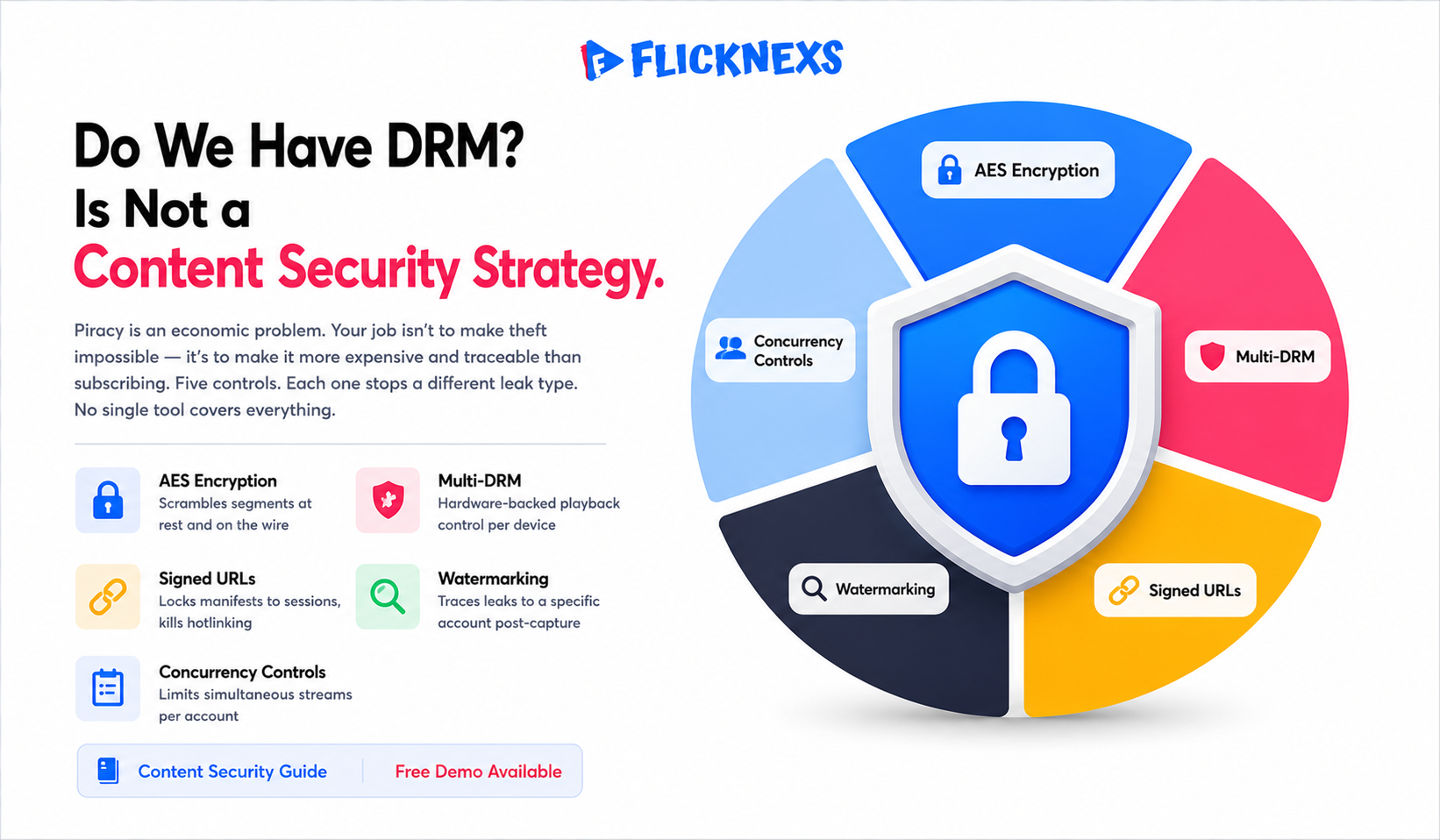
OTT content security is the layered set of technologies and policies that stop your video from being stolen, redistributed or watched without paying. The core stack is encryption in AES-128 or SAMPLE-AES plus multi-DRM across Widevine, FairPlay and PlayReady to control playback, secure token-based delivery to lock down streaming URLs, forensic watermarking to trace leaks back to a specific account and concurrency and device controls to stop credential sharing. To protect your content and users, consider implementing robust security measures by create your own OTT platform today with our expert guidance.
By the Flicknexs team. We build white-label OTT/VOD/IPTV streaming platforms, so this is written from hands-on streaming-platform experience.
If your video is your product, content security is your revenue protection layer. Every unprotected stream is a potential leak somewhere: a re-streamed live event, a ripped premium film, a shared login quietly serving five households on one subscription fee.
Most operators know they need security but struggle with calibration. Too little and you’re haemorrhaging revenue in ways that don’t show up cleanly in any dashboard. Too much and you’re spending on controls that make no difference for your actual threat level while making life harder for legitimate paying viewers.
This guide breaks down what actually protects OTT content, where each control fits in the stack and how to build a defence that matches the real value of your catalogue without overspending on the parts that don’t move the needle.
Why OTT content security is a revenue problem, not just a tech problem
It is tempting to treat security as a checkbox: “Do we have DRM? Yes.” But piracy is fundamentally economic. Pirates and casual sharers weigh effort against reward. Your job is not to make theft impossible (that is unachievable for anything that ultimately decrypts to pixels on a screen) but to raise the cost, friction and traceability high enough that legitimate subscription becomes the path of least resistance.
The leaks that hurt OTT operators fall into a few buckets:
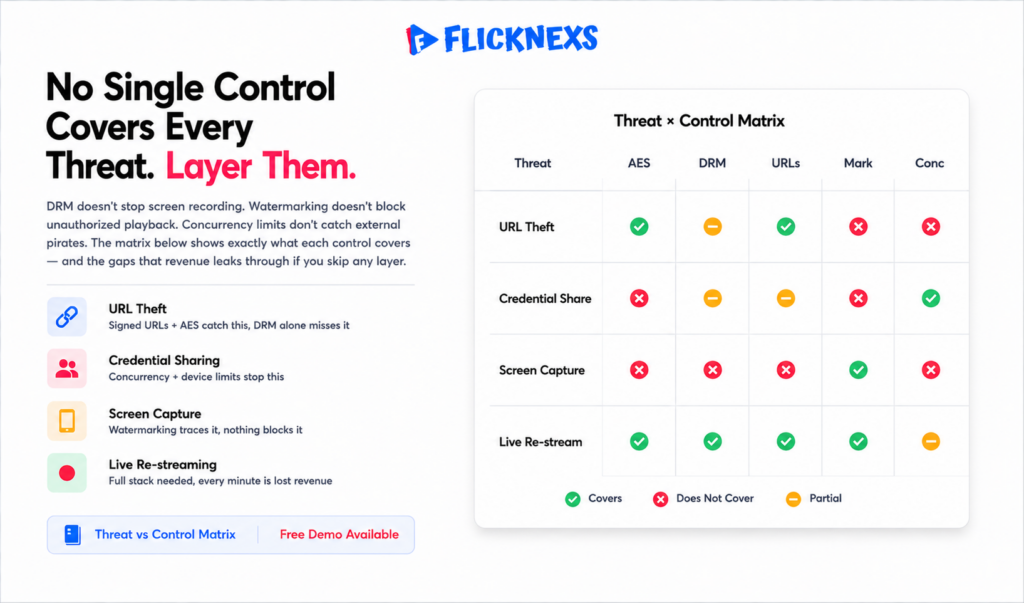
- Direct URL theft: someone grabs the manifest or segment URLs and embeds your stream on their own site or app.
- Credential sharing: one paid account serving many households, which quietly caps your conversion and ARPU.
- Screen and capture ripping: premium VOD captured and uploaded to piracy sites, often during the lucrative early release window.
- Live re-streaming: sports and events rebroadcast in near real time, where every minute of unprotected stream is lost pay-per-view revenue.
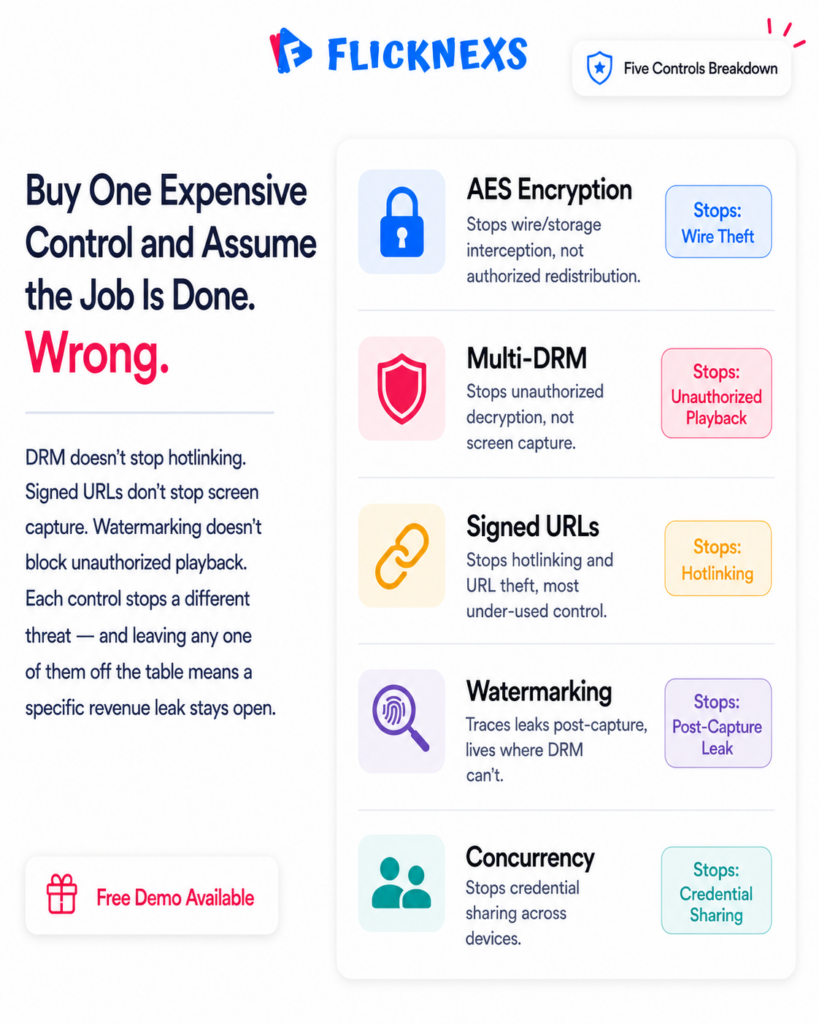
Each leak type has a matching control. The mistake operators make is buying one expensive control (usually DRM) and assuming the job is done, while leaving signed URLs, concurrency limits and watermarking on the table.
The core layers of OTT content security
1. Encryption: the baseline lock
Encryption scrambles your video segments so that intercepted files are useless without the key. The two common approaches in HLS and DASH are AES-128 (full-segment encryption) and SAMPLE-AES. Encryption alone does not control who gets the key. It just ensures the bytes on the wire and at rest are not plaintext. It is cheap, broadly compatible and the right floor for any catalog. The weakness if the key-delivery endpoint is loosely protected, the key can leak alongside the content. That is why encryption should always pair with secure key delivery (token-gated, HTTPS, short-lived).
2. Multi-DRM: hardware-backed playback control
DRM goes beyond encryption by enforcing a license. It controls decryption inside a secure environment, ties playback to approved devices and can enforce rules like output protection via HDCP, offline expiry and playback windows. Because Apple, Google and Microsoft each ship their own DRM system, premium catalogues need all three:
- Widevine: Chrome, Android and most smart TVs.
- FairPlay: Safari, iOS, tvOS and macOS.
- PlayReady: Windows, Edge, Xbox and many connected-TV and STB ecosystems.
The Common Encryption standard, CENC, lets one packaged asset serve all three license systems, so you encode once and deliver to everyone. DRM is the strongest practical control available for premium content, but it adds real cost in license-server fees and packaging complexity and it doesn’t stop screen recording or analog capture. That’s where watermarking picks up.
One thing worth flagging from experience: FairPlay is usually the integration that eats your week. Widevine and PlayReady behave fairly predictably once you know what you’re doing. Apple’s certificate and key-server requirements have a habit of surfacing edge cases the night before a launch, not during the comfortable part of the build. Budget time for it accordingly.
3. Secure token-based delivery (signed URLs)
Even encrypted, DRM-protected streams need their delivery URLs locked down. Signed (tokenized) URLs make each manifest and segment request valid only for a short window, often bound to the viewer’s IP, session, or geography. This is the single most under-used control: many operators run DRM but leave their CDN origin reachable with predictable URLs. Token authentication shuts down hotlinking, deep-linking and most casual URL theft and it is usually included or cheaply available at the CDN layer.
4. Forensic watermarking
Watermarking embeds an invisible per-session or per-user identifier directly into the video. If a stream leaks, you extract the mark from the pirated copy and trace it back to the specific account or session it came from, which enables targeted takedowns and account termination rather than just filing a generic DMCA notice into the void.
Unlike DRM, watermarking survives screen capture and re-encoding. That’s exactly the gap DRM leaves open and exactly why watermarking exists. The two controls aren’t competing, they’re complementary. Watermarking is the tool of choice for high-value live events and early-window premium VOD where a leak has real financial consequences within hours of it happening.
5. Concurrency, device and geo controls
These are the business-rule layer sitting on top of the technical controls. Concurrent-stream limits cap how many simultaneous plays one account can run. Device registration limits how many devices a login can bind to. Geo-blocking enforces licensing territories. Together they directly attack credential sharing, which for subscription OTT quietly costs more cumulative revenue than outright piracy does for most operators.
One thing worth knowing from the field: set concurrency too tight and you’ll spend support hours apologising to legitimate paying families who hit the cap because a kid left something paused on a tablet in another room. Two to three concurrent streams is usually where the math balances out before complaints start outweighing the protection you’re getting from the limit.
How the controls compare
No single control covers every threat. This is why a real OTT content security strategy layers them. Here is how the main controls map to what they actually stop and roughly where the cost lands.
| Control | Stops | Does NOT stop | Relative cost | Best for |
|---|---|---|---|---|
| AES encryption | Wire/storage interception | Authorized-user redistribution | Low | All catalogs (baseline) |
| Multi-DRM | Unauthorized decryption, device/output abuse | Screen capture, analog rip | Medium–high | Premium VOD, studio content |
| Signed URLs | Hotlinking, URL theft | Playback by a valid session | Low | Every stream |
| Forensic watermarking | Tracing leaks post-capture | The leak itself (it traces, not blocks) | Medium–high | Live events, early-window VOD |
| Concurrency/device limits | Credential sharing | External piracy | Low | Subscription OTT |
For an honest comparison of where plain encryption is enough versus where you genuinely need DRM, read AES encryption vs DRM for video.
A practical, budget-aware security blueprint
You should not protect a free promotional clip the same way you protect a championship final. Match the control to the content’s value and exposure window.
Free / promotional content
HTTPS delivery plus signed URLs is usually sufficient. The content is meant to spread; over-securing it adds cost and friction for no revenue benefit.
Standard subscription catalog
AES encryption, signed URLs, plus concurrency and device limits. This stops casual theft and the bulk of credential sharing at low cost. Add DRM selectively as your catalog or licensing demands grow.
Premium VOD and licensed studio content
Multi-DRM (Widevine, FairPlay, PlayReady via CENC) is typically a licensing requirement, not a choice. Many studios contractually mandate DRM plus output protection. Layer forensic watermarking for early-window titles.
Live sports and high-value events
The full stack DRM, signed URLs, low-latency packaging, forensic watermarking and active re-stream monitoring. Here, every minute of unprotected delivery is direct lost revenue, so investment in watermarking and takedown workflows pays for itself.
Flicknexs ships these controls (multi-DRM, AES, tokenized delivery, concurrency limits and watermarking integrations) as configurable features rather than custom builds, which is the fastest way to get to a defensible posture. You can see the full set on our platform features page.
Common mistakes that quietly leak revenue
- DRM without signed URLs. You paid for licenses but left the CDN origin guessable. Token everything.
- Treating watermarking as optional for live. DRM does not stop a phone pointed at a screen; watermarking is how you trace and terminate the re-streamer.
- No concurrency limits. For subscription OTT this is often the single largest invisible revenue leak.
- Over-securing free content. Spending DRM budget on clips meant to go viral is wasted money and added friction.
- No takedown workflow. Detection without a fast DMCA/takedown and account-termination process means you find leaks but never close them.
For the underlying standards, the W3C Encrypted Media Extensions specification defines how browsers handle DRM-protected playback and the Wikipedia overview of DRM is a solid neutral primer on the trade-offs involved.
Ready to build your own OTT platform? Get started with Flicknexs →
Frequently asked questions
Related guides
- OTT Content Security: The Complete Guide (hub)
- Multi-DRM Explained: Widevine, FairPlay & PlayReady for OTT Platforms
- Forensic Video Watermarking: How to Trace and Stop Stream Piracy
- AES Encryption vs DRM for Video: What Actually Protects Your Content
Ready to build?
If you’re planning your next OTT project, Flicknexs handles the video infrastructure end-to-end — so you can ship in weeks, not months.
- start streaming with Flicknexs
- see pricing and plans
More OTT platform guides
Continue exploring more on this topic across the Flicknexs blog.