
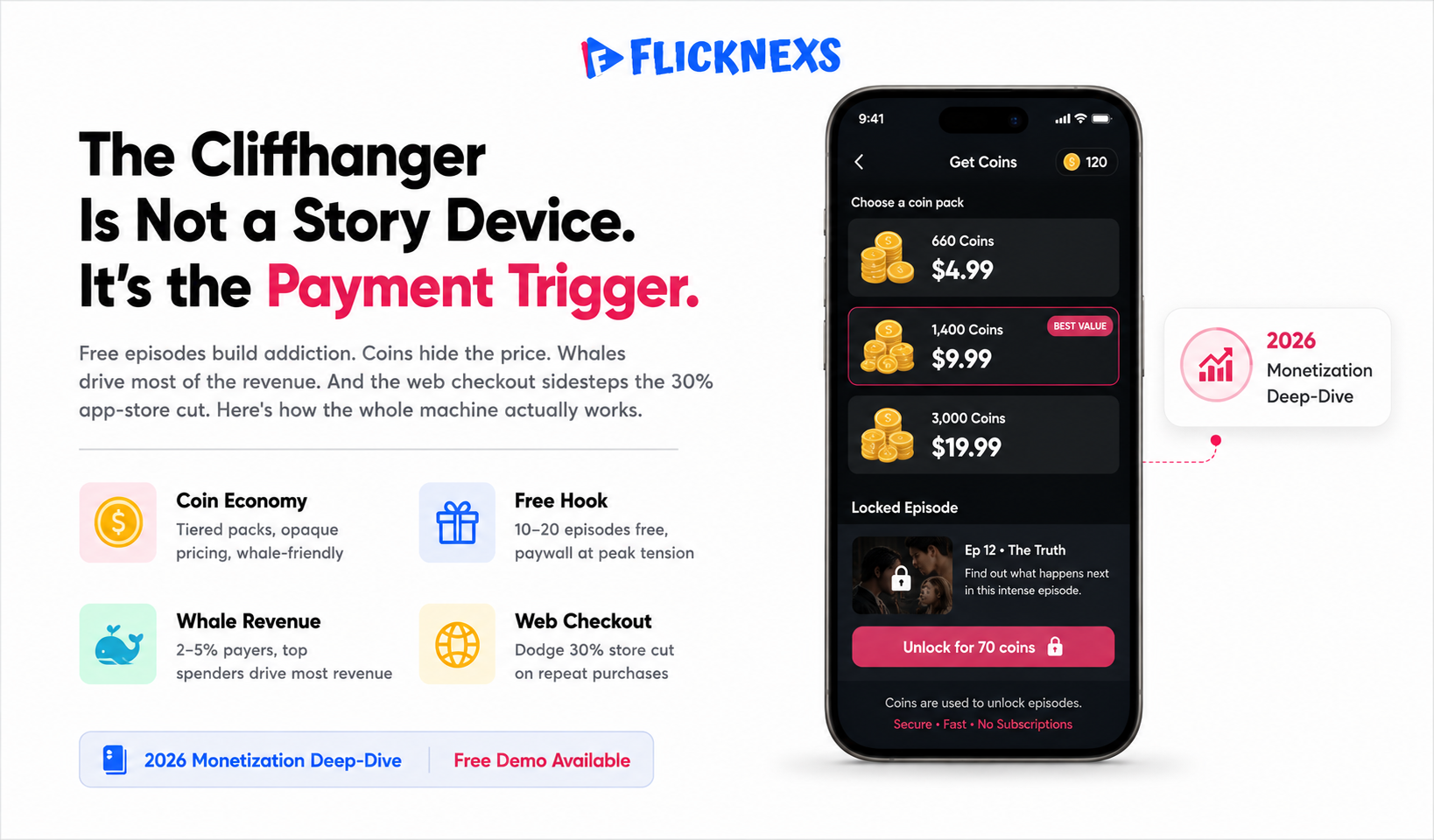
Micro-drama apps make money by giving away the first 10–20 episodes of a roughly 70–100 episode vertical series for free, then locking the rest behind in-app “coins” users buy in tiered packs. A small fraction of viewers, often 2–5%, convert to payers and a tiny sliver of those (whales) drive most of the revenue by spending heavily to binge-unlock one cliffhanger after another. The economic engine is paid user acquisition on TikTok, Meta and YouTube, using the most addictive cliffhanger as the ad creative, then recouping that CAC through coin spend and an optional all-access VIP subscription. The whole business lives or dies on episode pacing. The cliffhanger is not a storytelling device; it’s the payment trigger. Smart operators also push users to web-based checkout to dodge the 30% app-store cut, which materially improves margins.
By the Flicknexs team — we build white-label OTT/VOD/IPTV streaming platforms, so this is written from hands-on streaming-platform experience.
Three years ago micro-drama was a niche Chinese format most Western media executives had never heard of. Now it’s a multi-billion-dollar global category and apps like ReelShort and DramaBox are routinely topping entertainment charts and out-earning established streamers on a per-install basis. One to two minute vertical episodes, shot fast and cheap, built entirely around cliffhangers that make stopping feel physically uncomfortable. That’s the whole format and it turns out that’s enough.But the content is only half the story. The reason these apps print money is a monetization architecture borrowed more from mobile gaming than from Netflix. This guide breaks down exactly how that machine works, with the numbers and trade-offs operators actually face. If you want the build-side companion, see our guide to build a DramaBox-style micro-drama app.
The core model: free hooks, then pay-to-unlock
Every successful micro-drama app runs the same funnel.The first ten episodes, sometimes up to twenty are completely free. By the time the paywall shows up, the viewer is already emotionally committed. The protagonist just got publicly humiliated. The secret billionaire identity is one episode away from being revealed. The cheating spouse just walked through the door. Stopping now feels genuinely awful.
This is deliberate. The free episodes are not generosity. They’re a demo of the addiction. Operators tune the free cutoff to the point of maximum narrative tension and minimum viewer fatigue: far enough in that the viewer is hooked, early enough that the production cost of the free portion stays low relative to lifetime revenue. The free episodes also do double duty as the top of the paid-acquisition funnel and as organic share bait.
Once past the wall, the user pays per episode in coins. They never see a dollar price at the moment of unlocking a single episode. They see “Unlock for 70 coins,” which psychologically decouples the spend from real money. That decoupling is the entire point of the coin layer.
The coin economy
Coins are the abstraction that makes micro-payments feel painless. A user buys a pack of coins once, then spends them episode by episode without re-confronting their wallet each time. This is a textbook example of in-app purchase design borrowed from mobile gaming.
How coin packs and episode pricing are designed
A typical episode costs somewhere between 30 and 100 coins to unlock. Coin packs follow the standard in-app purchase ladder, $0.99, $4.99, $9.99, $19.99, $49.99, $99.99 with bonus coins thrown in at the higher tiers so the more you spend the cheaper each coin actually works out.The structure intentionally mirrors mobile-game gem economies: the smallest pack rarely covers a full series, which nudges users toward the mid- and high-tier packs.
The denominations are engineered. A single episode priced at “70 coins” against a “660-coin pack for $4.99” is opaque on purpose. The user can’t easily compute that they’re paying roughly $0.50 to $0.75 per episode, which would feel expensive shown as a line item. Small coin denominations also create frequent “almost enough” moments a user with 40 coins left who needs 70 is one tap from buying another pack. That gap, by the way, isn’t an accident of rounding. The whole point is to leave you short right when the next hook lands.
Daily bonuses, ad-for-coins, and free-coin loops
Coin economies are kept warm with free-coin mechanics:
- Daily check-in bonuses: small coin grants for opening the app each day, which build habit and keep non-payers in the funnel.
- Rewarded video ads: watch a 15–30 second ad to earn enough coins for one or two episodes. This monetizes non-payers via AVOD while keeping them engaged toward an eventual purchase.
- First-purchase boosters: a heavily discounted “starter pack” (e.g. 2x coins on first buy) to convert a free user into a payer, after which normal pricing resumes.
The goal of every free-coin loop is to stop the user from quitting at the paywall while gently showing that the fastest, friction-free path is simply buying coins.
Hybrid monetization stacks
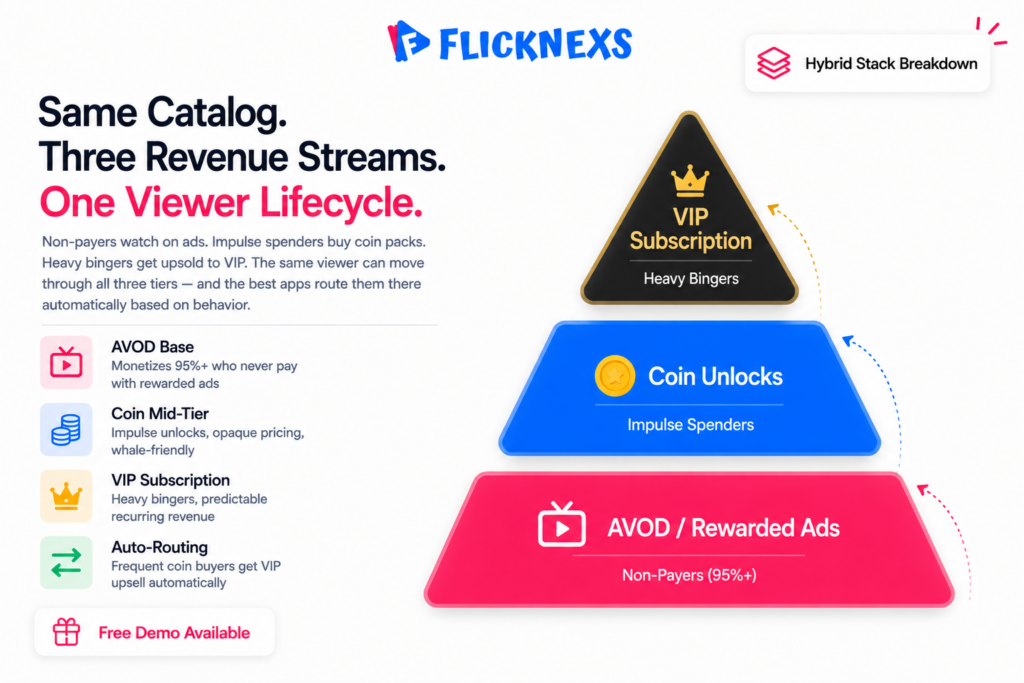
Mature operators rarely run pure coins. They layer three models and route users to whichever extracts the most value:
- Coins / pay-to-unlock: the default. Best for impulse spenders and casual viewers who only want to finish one series.
- All-access VIP subscription: a weekly or monthly plan, usually somewhere in the $9.99 to $19.99 per month range, often with an aggressively priced weekly trial to get people in the door, that unlocks everything at once. It’s built for the heavy binger who’d otherwise spend more than that on coins anyway. For the platform it trades the unpredictable spike of a whale going deep on unlocks for something more useful: predictable recurring revenue and a smoother LTV curve.
- AVOD / rewarded ads: monetizes the 95%+ who never pay, and provides the ad-for-coins on-ramp.
The art is in sequencing. A new user gets coins and rewarded ads. A user who has bought three coin packs in a week gets a VIP upsell, because at that spend rate a subscription is both better for them and more valuable to you. A user who refuses to pay still generates ad revenue. The same viewer can move between all three tiers over their lifecycle.
This blend is what most distinguishes the format from subscription-first streaming. For a fuller contrast of the two business shapes, see micro-drama vs traditional OTT.
Acquisition economics: the cliffhanger is the ad
Micro-drama is a paid-UA business. Organic discovery exists, but scale comes from buying installs on TikTok, Meta (Instagram/Facebook Reels) and YouTube Shorts. The ad creative is almost always a 15–40 second clip of the single most dramatic cliffhanger in a series (the slap, the reveal, the betrayal) cut to end on maximum tension and a “watch the rest in the app” call to action.
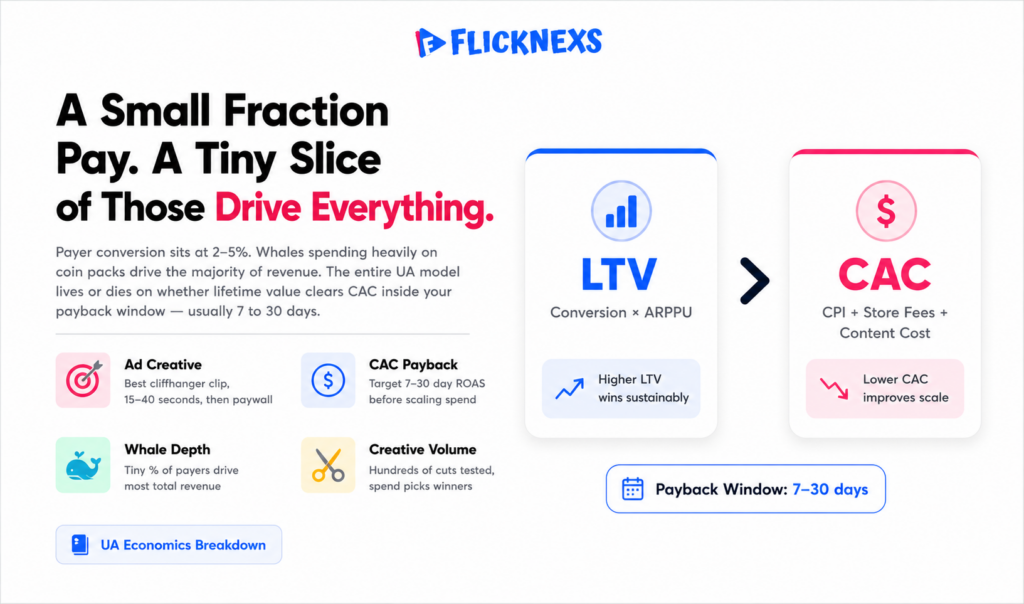
The economics are brutal but legible. Cost per install runs from well under $1 in low-cost markets to several dollars in the US. Against that, you need lifetime value high enough to recoup CAC plus blended ad-platform fees plus production. The first-episodes-free funnel is the entire conversion mechanism the ad sells the cliffhanger, the free episodes confirm the addiction, the paywall closes the sale. Operators live and die by ROAS (return on ad spend), typically targeting payback inside a defined window (recoup CAC within 7 to 30 days, say) before scaling spend.
Creative volume is a moat. Top operators test hundreds of cliffhanger cuts per week, kill the losers fast and pour budget into the few that hook. Here’s what actually happens day to day: a clip you were sure would win flatlines, and some throwaway cut of a slap in a parking lot is suddenly carrying half your spend. The series that produces the best-converting ad gets the most UA budget, so content and acquisition end up tightly coupled.
Whales, retention and why pacing is monetization
Like mobile gaming, micro-drama revenue is extremely top-heavy. Of the small share of users who pay at all, a minority (the whales) drive most of the revenue, sometimes spending the equivalent of tens or hundreds of dollars to binge-unlock multiple full series in a sitting. Your monetization model has to be built so a highly engaged user can spend effectively without limit deep coin packs, big-bonus tiers and a frictionless one-tap unlock flow all exist for exactly this person.
This is why episode pacing is the monetization strategy. Every micro-episode is engineered to end on a hook, so the marginal cost of stopping feels higher than the marginal cost of one more unlock. Retention loops (daily bonuses, “continue watching,” new-episode notifications and a deep catalog so a finished bingewatcher immediately starts another series) keep the whale spending across titles. A series that pays off its cliffhangers too slowly, or resolves tension too early, leaks revenue at every episode boundary.
Payment rails and the 30% app-store problem
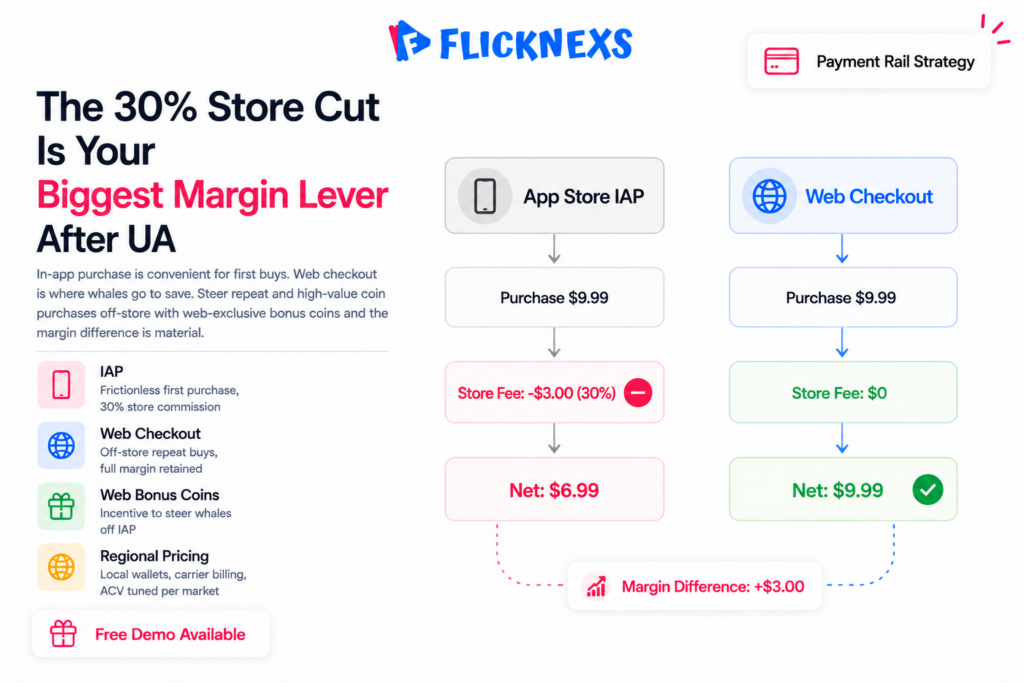
The single biggest margin lever after UA is payment routing. In-app purchases through Apple’s App Store and Google Play carry up to a 30% commission, per Apple’s published App Store Review Guidelines. On a business running thin per-install margins, that cut is enormous.
The widespread workaround is to push users to a web-based checkout: buying coins or a subscription through a mobile web page or companion site, then having the balance reflected in the app. This sidesteps the store commission and can lift net revenue per payer by double-digit percentages. Operators commonly combine both rails: IAP for frictionless first purchases (where the convenience justifies the fee) and web checkout for repeat buyers and high-value packs , often with web-exclusive bonus-coin incentives to steer whales there.
Regional pricing
Coin and subscription prices are localized aggressively. The same series might be priced for a US payer at one tier and far lower in price-sensitive markets, with payment methods (local wallets, carrier billing) and pack sizes adjusted per region. Because CPI and ARPPU both swing dramatically by geography, the profitable strategy in one market can be a money-loser in another. Many operators win on volume in low-ACV markets and on depth in high-ACV ones.
The metrics that actually matter
| Metric | What it tells you | Why it matters |
|---|---|---|
| Payer conversion rate | % of users who ever buy coins/VIP (often 2–5%) | The top-of-funnel money gate; small moves here swing total revenue. |
| ARPPU | Average revenue per paying user | Captures whale depth, the number that pays back CAC. |
| Unlock rate per episode | % of viewers who pay to continue at each paywall | Tells you if the cliffhanger and free-cutoff are tuned right. |
| Episode drop-off curve | Where viewers abandon a series | Pinpoints weak episodes leaking revenue; guides re-edits. |
| ROAS / CAC payback | Ad spend returned within a payback window | Decides whether you can scale UA profitably. |
| D1/D7 retention | Users returning after 1 and 7 days | Predicts catalog cross-binge and lifetime spend. |
The two ratios that govern the whole business are payer conversion × ARPPU (revenue per acquired user) versus CAC. If lifetime revenue per install clears CAC plus store fees plus content cost with margin to spare, you scale UA. If not, you fix the funnel (usually the free-cutoff point, the cliffhanger quality or the coin-pack pricing) before spending another dollar on ads.
Comparison of monetization models
| Model | Best fit | Pros | Cons |
|---|---|---|---|
| Coins / pay-to-unlock | Impulse spenders; single-series viewers; whales | Highest revenue ceiling; price hidden behind coins; captures whales with no spend cap; flexible per-episode pricing | Friction at every paywall; low payer conversion; can feel nickel-and-dime; revenue is lumpy |
| All-access VIP subscription | Heavy bingers; loyal multi-series fans | Predictable recurring revenue; smooths LTV; rewards loyalty; reduces per-unlock friction | Caps whale spend; high churn on weekly plans; needs a deep catalog to justify; lower ceiling per heavy user |
| AVOD / rewarded ads | Non-payers; price-sensitive markets; acquisition on-ramp | Monetizes the 95%+ who never pay; keeps users in funnel; powers ad-for-coins loop | Low revenue per user; ad fatigue can hurt retention; depends on ad-fill and CPMs by region |
None of these are either/or choices. The most profitable apps run all three simultaneously and route each viewer toward whichever model fits how they actually behave. A casual viewer watches on the ad tier. A binger converts to subscription. A whale buys coin packs at 2am because they cannot stop mid-series. Same platform, three different revenue streams, one catalogue serving all of them.
Frequently asked questions
Related guides
- Build a DramaBox-style micro-drama app (hub)
- Micro-drama vs traditional OTT (related spoke)



Leave a Reply