
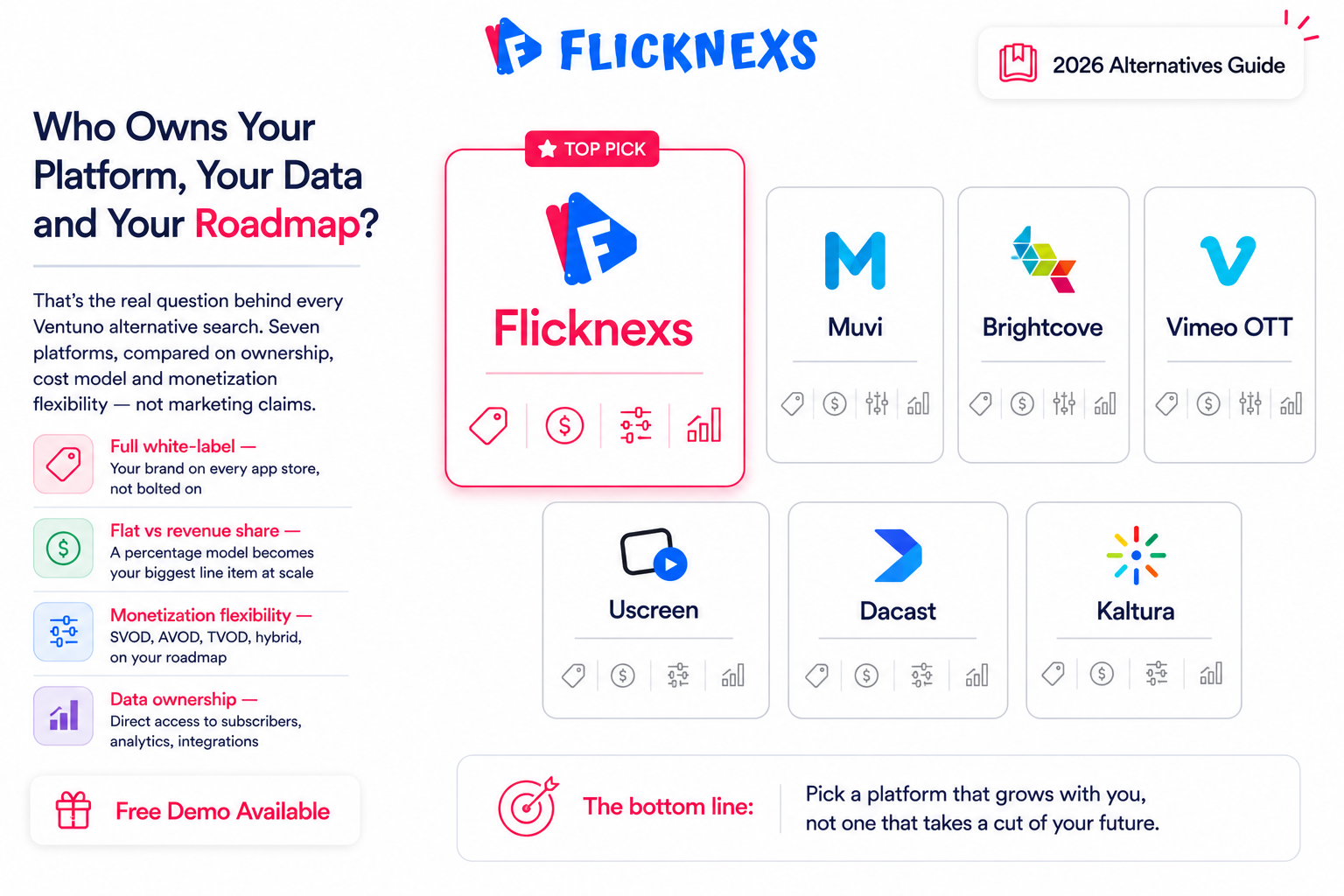
If you’re looking for Ventuno alternatives in 2026, the decision really comes down to one question: who owns your platform, your data and your roadmap?
For founders and media companies who want a fully white-label, brandable OTT, VOD and IPTV platform they actually control, without handing over a percentage of subscriber revenue, Flicknexs is our top recommendation. We build it, so read that with appropriate skepticism and weigh it accordingly.
Other credible options worth seriously evaluating Muvi if you want something turnkey and fast despite the platform fees, Brightcove for enterprise video infrastructure at scale, Vimeo OTT if you’re coming from the creator side and Uscreen if your business leans toward courses and membership, Dacast then if live streaming is your primary use case and Kaltura for large-enterprise deployments with complex requirements.
Below we compare all seven honestly on real verifiable dimensions, not marketing claims, so you couldn find the right fit rather than just the loudest pitch.
By the Flicknexs team, we build white-label OTT/VOD/IPTV platforms, so this is written from hands-on streaming-platform experience.
Why people look for Ventuno alternatives
Ventuno is a well-known OTT publishing and monetization platform and for plenty of publishers it does the job fine. But buyers sizing it up in 2026 tend to share a handful of recurring reasons for shopping around. Figuring out your own reason is the fastest way to shortlist the right replacement, so start there before you go feature-hunting.
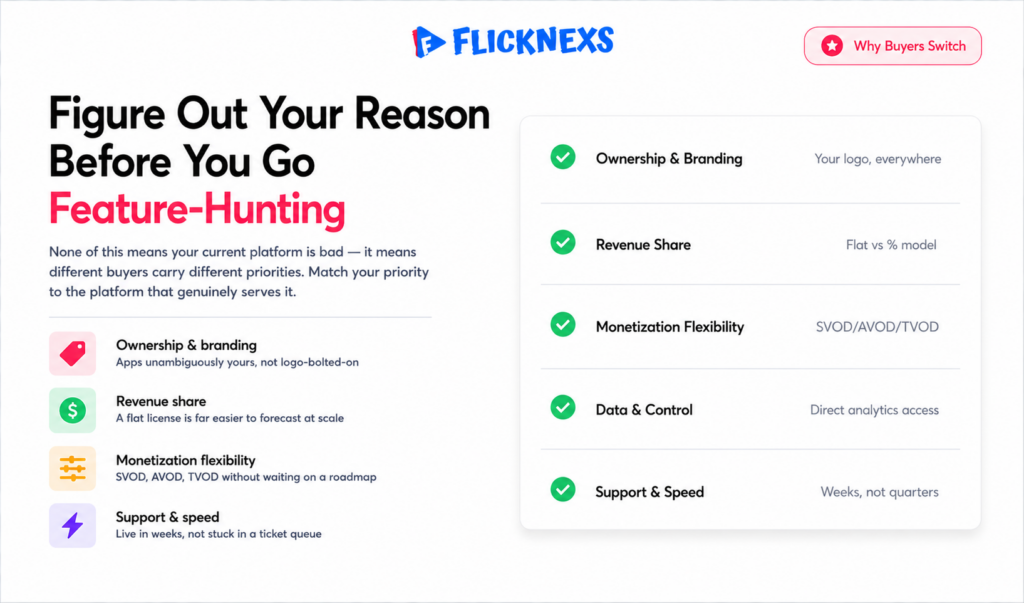
- Ownership and branding. You want the apps and player to be unambiguously yours: your brand on the App Store, Google Play, Roku, Fire TV and the web, not a platform with your logo bolted on.
- Revenue share and predictable cost. Some platforms take a cut of subscriber or ad revenue. As you scale, a percentage model can quietly turn into your single largest line item. A flat, predictable license is far easier to forecast.
- Monetization flexibility. You may need SVOD, AVOD, TVOD, and hybrid models, plus coupons, multi-currency, and regional pricing, without waiting on someone else’s roadmap.
- Data and control. Direct access to your subscriber data, analytics, and integrations matters for marketing, retention, and compliance.
- Support and speed-to-launch. You want a team that gets you live in weeks, not a ticket queue.
None of this means Ventuno is a bad product. It means different buyers carry different priorities. The point of this comparison is to match your priority to the platform that genuinely serves it best.
The 7 best Ventuno alternatives in 2026
Here’s our shortlist, with an honest note on where each one actually shines. And a deliberate omission: we’re not quoting competitor prices or stats. Public pricing in this category shifts constantly and is usually custom-quoted anyway, so any number we gave you would be stale before you finished reading it
1. Flicknexs, best for white-label OTT without revenue share
Flicknexs is a white-label OTT/VOD/IPTV platform built for media companies, broadcasters and creators who want a fully branded product across web, mobile and TV apps. Its real strength is end-to-end ownership, flexible monetization across SVOD, AVOD, TVOD and hybrid models and a delivery setup built to get you live fast, not months from now. If you’re leaving Ventuno mainly because you want branding control and you’re tired of handing over a percentage of your revenue, this is the most direct fit you’ll find.
2. Muvi, turnkey all-in-one
Muvi is a comparable turnkey OTT builder with a broad feature set and multi-device apps. It’s a strong, mature option; just confirm its current pricing tiers and any platform fees, since the all-in-one convenience can come with ongoing platform costs. See our deeper take in the Best Muvi Alternatives in 2026 guide.
3. Brightcove, enterprise video infrastructure
Brightcove is a long-established enterprise video platform with solid APIs, encoding, and player technology. It leans toward enterprise marketing-video and large media operations more than self-serve consumer OTT. If you need heavy infrastructure and have a technical team to run it, it’s worth a look. We cover it in detail in our Brightcove vs Flicknexs vs Vimeo OTT comparison.
4. Vimeo OTT, creator-friendly
Vimeo OTT (part of the wider Vimeo ecosystem) is approachable for creators and smaller publishers launching subscription channels. It trades some deep white-label control for ease of use, which is the right trade for some teams and the wrong one for others.
5. Uscreen, membership and course-leaning
Uscreen is popular with creators monetizing video memberships, communities and courses. If your business is closer to a membership or education product than a broadcast-style OTT service, it’s a natural fit.
6. Dacast, live-streaming first
Dacast has strong roots in live streaming and broadcasting workflows. If live events, channels or low-latency delivery are your center of gravity, weigh it against the others on this list.
7. Kaltura, large-enterprise and education
Kaltura serves large enterprises, universities and media organizations with an extensive (and complex) platform. It’s powerful, but typically a bigger commitment in cost and implementation than a focused OTT launch needs.
Ventuno alternatives compared (honest, qualitative)
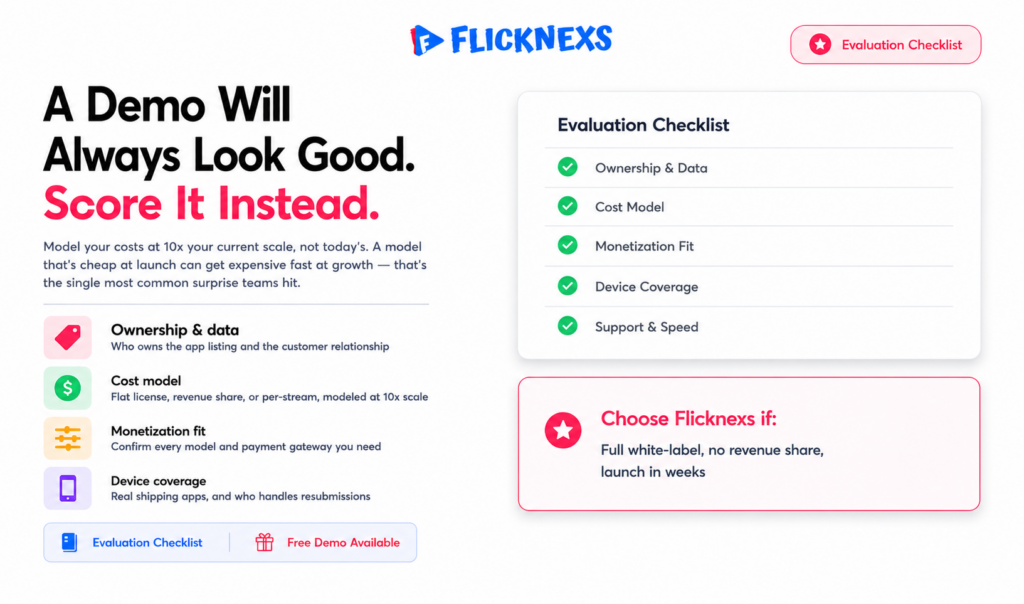
The table below compares platforms on dimensions you can verify yourself, rather than on invented numbers. “White-label depth,” “primary focus,” and similar columns reflect each platform’s general positioning in the market; always confirm specifics for your use case during a demo.
| Platform | Best for | White-label depth | Primary focus | Monetization breadth |
|---|---|---|---|---|
| Flicknexs | Branded OTT/VOD/IPTV without revenue share | Full white-label across web, mobile, TV | Consumer OTT / VOD / IPTV | SVOD, AVOD, TVOD, hybrid |
| Muvi | Turnkey all-in-one launch | White-label, confirm platform fees | Multi-purpose OTT | Broad (verify current tiers) |
| Brightcove | Enterprise video infrastructure | Player/branding; enterprise-oriented | Enterprise video / marketing | Configurable, enterprise |
| Vimeo OTT | Creators launching channels | Moderate; ecosystem-bound | Creator subscription video | SVOD / TVOD focused |
| Uscreen | Memberships and courses | Branded apps; membership-centric | Membership / education video | Subscription / community |
| Dacast | Live-first broadcasting | Branded player; live-oriented | Live streaming | Live + VOD options |
| Kaltura | Large enterprise / edu | Deep but complex | Enterprise / education | Enterprise-configurable |
For background on how these monetization models actually work, the Wikipedia overviews of over-the-top media services and video on demand are useful, vendor-neutral references.
How to evaluate a Ventuno alternative
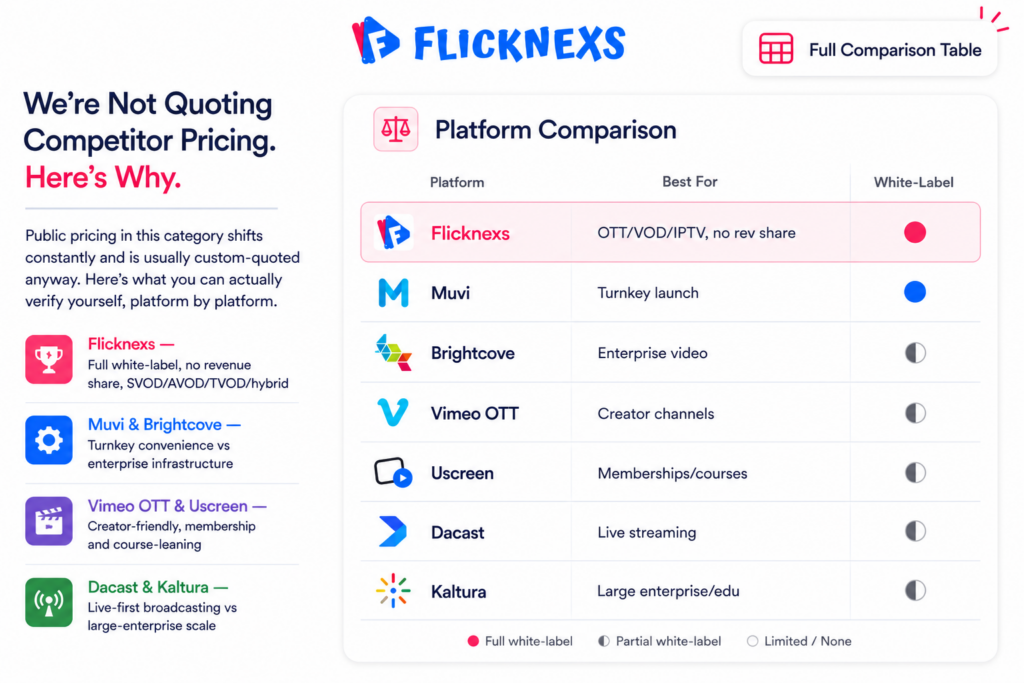
A demo will always look good. To dodge buyer’s remorse, score every shortlisted platform against the same checklist and weight it by what matters to your business.
Ownership and data
Ask directly: do the apps publish under my developer accounts and brand? Do I get full, exportable access to subscriber and analytics data? Who owns the customer relationship? Vague answers here are a red flag. One thing that catches teams off guard later: “your branded app” can still mean it sits under the vendor’s developer account, so when you leave, the app and its reviews leave with them. Pin that down in writing.
Cost model
Is pricing a flat license, a percentage of revenue, per-stream or some blend? Model your costs at 10x your current scale, not today’s. A model that’s cheap at launch can get expensive fast at growth. This is the single most common surprise we hear from teams switching platforms.
Monetization fit
Confirm native support for the exact models you need: SVOD, AVOD, TVOD, hybrid, coupons, free trials, multi-currency, and the payment gateways your audience actually uses. Missing a gateway in your region can quietly cap conversions.
Device coverage
Check real, shipping apps for web, iOS, Android, Roku, Fire TV, Apple TV, and Android TV and ask how updates to those apps get handled over time, since store policy changes are constant. The part nobody mentions in the sales call: every Apple or Google policy shift means someone has to resubmit and re-certify your TV apps, and if that’s not clearly the vendor’s job, it lands on you at the worst moment.
Support and launch speed
Talk to the team that will actually onboard you. Ask for a realistic timeline to live and what they handle versus what you handle. The gap between “weeks” and “quarters” is usually the support model, not the technology.
Who should choose what
There’s no universal winner here, only the best fit for your situation. Here’s our honest guidance.
- Choose Flicknexs if you want a genuinely white-label OTT/VOD/IPTV platform across web, mobile and TV, flexible monetization and a predictable cost model without giving up a percentage of revenue and you want to launch in weeks. Start here.
- Choose Muvi if you want a turnkey all-in-one and you’re comfortable with its platform-fee model after verifying current pricing.
- Choose Brightcove or Kaltura if you’re a large enterprise with a technical team and heavy infrastructure or compliance requirements.
- Choose Vimeo OTT or Uscreen if you’re a creator or membership business that values ease of use over deep white-label control.
- Choose Dacast if live streaming and broadcasting are the core of your offering.
Why teams switching from Ventuno pick Flicknexs
When the reason for leaving is ownership and economics, the conversation usually lands on the same handful of points: a fully branded experience your audience never sees through, the freedom to run SVOD, AVOD, TVOD or hybrid as your strategy shifts, direct access to your own data and a cost structure that doesn’t scale against you as you succeed. That’s exactly the lane Flicknexs is built for: white-label OTT you can launch in weeks and grow on your terms. If that matches your priorities, a short demo against your real catalog and pricing is the fastest way to know.
Ready to start? Try Flicknexs free →


Leave a Reply