
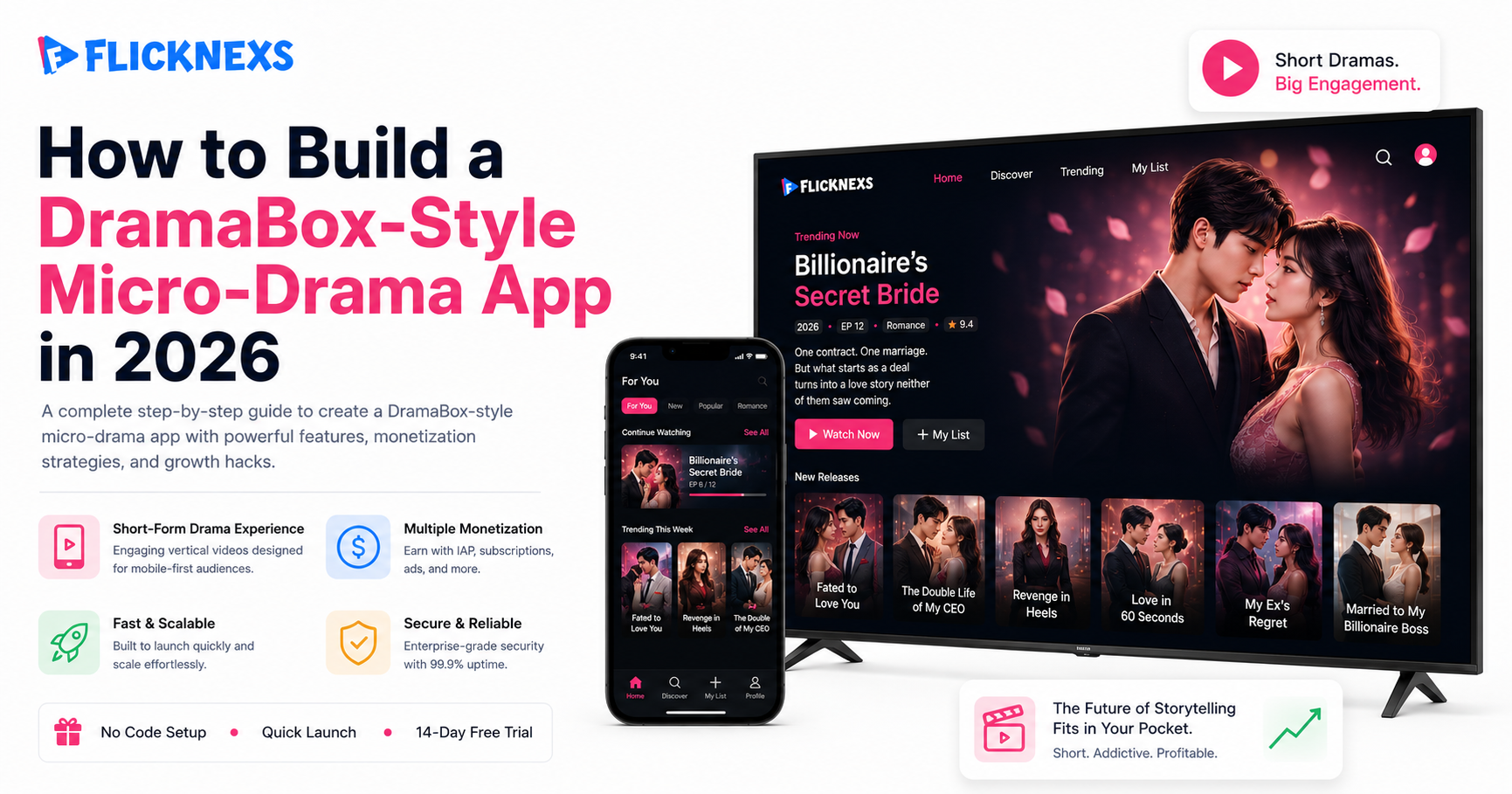
DramaBox didn’t accidentally become one of the most downloaded entertainment apps in the world. It was engineered that way and the blueprint is replicable if you understand what you’re actually building.
At its core, a micro-drama app delivers 60 to 120 second vertical episodes and every one ending on a cliffhanger with the first five to fifteen free and everything after locked behind coins or a subscription. Simple premise. The execution is where most people underestimate the work.
To build one properly in 2026 you need four things in place before you launch anything. A deep library of short serialized vertical content, because without volume the swipe feed has nowhere to go and retention collapses fast. A mobile-first app across iOS, Android and web with an infinite swipe feed that keeps people moving forward without thinking. A coin and unlock engine that layers subscriptions and rewarded ads on top, so you’re capturing revenue from every type of viewer, the ones who pay per episode, the ones who’ll watch an ad instead and the ones who eventually subscribe. And a paid acquisition setup that can actually measure what’s working, because without proper attribution you’re spending blind.
Get all four working together and the model is genuinely powerful. Miss one and the others can’t compensate. And streaming infrastructure (adaptive HLS over a CDN, plus DRM) to deliver thousands of short clips cheaply. Building all of this from scratch takes 6–12 months and a sizeable engineering team, which is why most operators launch on a white-label OTT platform like Flicknexs and go live in weeks. The hard part is never the tech. It’s the content engine and the paid-acquisition math that make the coin economy profitable.
By the Flicknexs team — we build white-label OTT/VOD/IPTV streaming platforms, so this is written from hands-on streaming-platform experience.
What Micro-Dramas Actually Are
Micro-drama came out of China, where it’s called “duanju,” and the Western entertainment industry spent a few years not taking it seriously. Some still don’t. They’re wrong.
Episodes are 60 to 120 seconds. A full season runs 60 to 100 of them so you’re watching a film’s worth of story in vertical clips you swipe through on your phone between meetings, on the bus, waiting for coffee. The genres are unapologetically pulpy. Secret billionaires. Revenge arcs. Contract marriages. Werewolf romance. Amnesia twists at episode 47. Every single episode ends before the moment you actually wanted to see. A slap. A confession interrupted. An identity blown open. Stopping feels wrong, and that’s exactly the point.
The first chunk of episodes costs nothing. Around episode eight to fifteen, depending on the app, a paywall shows up. You buy coins. Each locked episode costs a few. Feels like pocket change. Multiplied across millions of viewers who are genuinely mid-series and emotionally invested, it becomes a number that serious money pays attention to.
DramaBox, run by Storm X under COL Group, and ReelShort from Crazy Maple Studio are the names that come up first. ShortMax, GoodShort and Netshort are right behind them. App intelligence firms have tracked annual in-app revenue for the category climbing into the billions across 2024 and into 2026. Nobody agrees on the exact figures, but nobody’s seriously arguing about the direction either.
TikTok was the last format that grew this fast. That’s not hyperbole, that’s just what the numbers show.
Why the Format Works (The Psychology)
Micro-dramas are not “TV, but shorter.” They are a different product that happens to use video. Four psychological levers do the work.
Cliffhanger-per-episode
Traditional TV puts one cliffhanger at the end of a 45-minute episode. Micro-dramas put one every 90 seconds. Each open loop the brain wants closed is a fresh decision point, and you’ve engineered it to land exactly when the viewer is most invested. This is the Zeigarnik effect weaponized at industrial scale.
Micro-payments below the pain threshold
Unlocking one episode might cost the equivalent of a few cents. No single decision feels expensive, so the rational “is this worth it?” brake never fully engages. By the time a binger has unlocked 50 episodes in a sitting, they may have spent $10–$30, but they got there one painless tap at a time. This is the same architecture that makes mobile games profitable, ported to fiction.
Mobile-first vertical
Shot 9:16, full-screen, no pinch-to-rotate, no lean-back. It lives in the exact same posture and swipe muscle-memory as TikTok and Reels, so there’s zero behavioral friction to adoption and zero competition for a second screen.
The binge loop
Autoplay-next plus an infinite feed plus short runtime means the default state is “still watching.” Friction is added only at the paywall, and only after the story has its hooks in. The product is designed so the easiest thing to do at any moment is keep going.
The Full Build: What a Micro-Drama App Requires
Whether you build it yourself or configure it on a platform, a credible micro-drama app has the same component list. Here’s what each piece actually entails.
Content and episode structure
This is the real product. You need a series → season → episode hierarchy where episodes are ordered, individually lockable, and tagged for the feed (genre, mood, language). Plan for vertical (9:16) masters, burned-in or sidecar subtitles for every target market (dubbing and localization are how DramaBox and ReelShort cracked the West), and thumbnail/hook-clip assets per episode. A launch library is rarely one title. You want 10–30 complete series so a paying viewer who finishes one has somewhere to go.
Vertical video delivery
Each episode is transcoded into an adaptive bitrate ladder (typically HLS, several renditions from ~360p to 1080p) so playback is instant on a train and crisp on Wi-Fi. The feed pre-fetches the next episode while the current one plays. Sub-second start time is the single most important performance metric in this category. Stutter at the cliffhanger is a churned viewer.
The apps (iOS, Android, web)
Native iOS and Android are non-negotiable because in-app purchase of coins runs through the App Store and Google Play billing for most flows, and because push notifications drive re-engagement. A responsive web app captures desktop discovery and ad-traffic landing (often with cheaper payment rails). The core UI is deceptively simple: a vertical swipe player, an unlock sheet, a coin wallet, and a “continue watching” rail.
The monetization engine
This is where the money is made, and it’s worth its own deep dive: see micro-drama monetization. At minimum you need a coin wallet and ledger; coin packs at multiple price points (with the classic “best value” anchor); per-episode unlock pricing (often cheaper deeper into a series to reduce drop-off); an optional all-access subscription (VIP) that removes unlock friction entirely; and rewarded video ads that grant coins, monetizing non-payers and acting as a soft on-ramp to first purchase. The best apps run all three (coins, subscription, and ads) simultaneously, segmenting users by willingness to pay.
Recommendation feed and analytics
The feed decides what a new user sees first, and first-episode completion rate is the leading indicator of everything downstream. You need event-level analytics: per-episode completion, the exact episode where the paywall converts (or loses) people, coin balance over time, ad fill and reward rates, and cohort retention (D1/D7/D30). This data closes the loop with your ad spend. You cannot run profitable acquisition without it.
CDN, streaming infrastructure, and DRM
A global CDN is mandatory. You’re serving thousands of small files to a mobile-heavy, geographically spread audience, and origin egress without a CDN will eat your margin. Layer in DRM (Widevine on Android, FairPlay on iOS) plus signed/expiring URLs so paid episodes can’t be ripped and re-uploaded. Content theft is a genuine threat in a category this lucrative. One thing operators learn the hard way: the moment a title starts converting well, ripped copies of the full season show up on free aggregator sites within days, so the expiring-URL plumbing earns its keep on your best performers, not your average ones.
Build vs. Buy: The Honest Comparison
You can absolutely build all of this in-house. The question is whether you should, given that the thing that actually determines success (content and acquisition economics) is entirely separate from the plumbing.
Building from scratch means assembling a transcoding pipeline, a billing and coin ledger that survives audits and refund disputes, native apps that pass App Store and Play review (in-app purchase and subscription review is its own gauntlet), DRM integration, a CDN setup, and an analytics stack. Then maintaining all of it. Realistically that’s 6–12 months and a meaningful engineering payroll before you sell a single coin. Every one of those months is content and marketing budget not spent.
A white-label OTT platform inverts the order. Flicknexs ships the transcoding, ABR delivery, CDN, DRM, native iOS/Android/web apps, the coin/subscription/ads monetization engine, and the analytics as configurable product, so you spend your weeks loading content, tuning prices, and pointing ad spend at it, not building infrastructure. The trade-off is real and worth stating: you adopt a platform’s architecture and roadmap rather than owning every line of code. For a few operators with deep engineering benches and a need for a truly bespoke mechanic, in-house wins. For the overwhelming majority racing a fast-moving content trend, time-to-market is the whole game, and buy beats build.
| Capability | Build from scratch | White-label (Flicknexs) |
|---|---|---|
| Time to first launch | 6–12 months | Weeks |
| Upfront engineering cost | High (full team) | Low (configuration) |
| Coin / unlock / subscription engine | Build & maintain yourself | Built-in, configurable |
| Native iOS / Android / web apps | Build + pass store review solo | Provided, store-ready |
| Transcoding, ABR, CDN, DRM | Assemble & operate | Included |
| Analytics & retention reporting | Build your own stack | Built-in dashboards |
| Customization ceiling | Unlimited | High, within platform |
| Where your time goes | Infrastructure | Content & acquisition |
For a deeper look at how the short-drama model diverges from a Netflix-style service, see micro-drama vs traditional OTT. The monetization, content cadence, and unit economics are genuinely different businesses wearing similar UIs.
Go-to-Market: The Real Engine
Here is the uncomfortable truth that separates operators who profit from those who burn cash: a micro-drama app is a performance-marketing business with a content product attached. The growth motion is highly standardized.
Acquisition: the first two episodes are the ad
The proven playbook is to cut the most explosive 30–60 seconds of episode one or two (the slap, the betrayal, the reveal) into a paid creative and run it on TikTok, Meta (Reels/Stories), and YouTube Shorts. The ad is the hook; the click drops the viewer straight into the free episodes inside the app. You give away the first chunk of the story for free precisely because it’s the most efficient sales demo ever invented. Operators test dozens of creatives per title and let cost-per-install and downstream return-on-ad-spend pick the winners. In practice most of those creatives die quietly, and a single outlier hook carries the whole title, so the testing volume isn’t optional padding, it’s how you find the one cut that pays for the rest.
The coin economy as conversion machine
Once inside, the funnel is: free episodes hook → paywall lands at peak tension → first coin purchase (often nudged by a one-time discounted starter pack) → repeat purchases or a VIP subscription upsell. Rewarded ads give non-payers a way to keep watching while seeding the habit. The levers you tune relentlessly are paywall placement (which episode), coin pricing, pack sizing, and the subscription offer. Small changes here move revenue more than almost anything else.
Retention
Retention is driven by library depth and re-engagement. Push notifications (“new episodes of the series you started”), a steady cadence of fresh titles, and personalized feed recommendations bring viewers back. A viewer who finishes a series and finds three more they want is a viewer with a much higher lifetime value than the one who hits a dead end. The math only works when LTV (from coins + subscription + ads) comfortably exceeds your blended cost per acquisition, which is exactly why the analytics layer above is not optional.


Leave a Reply