
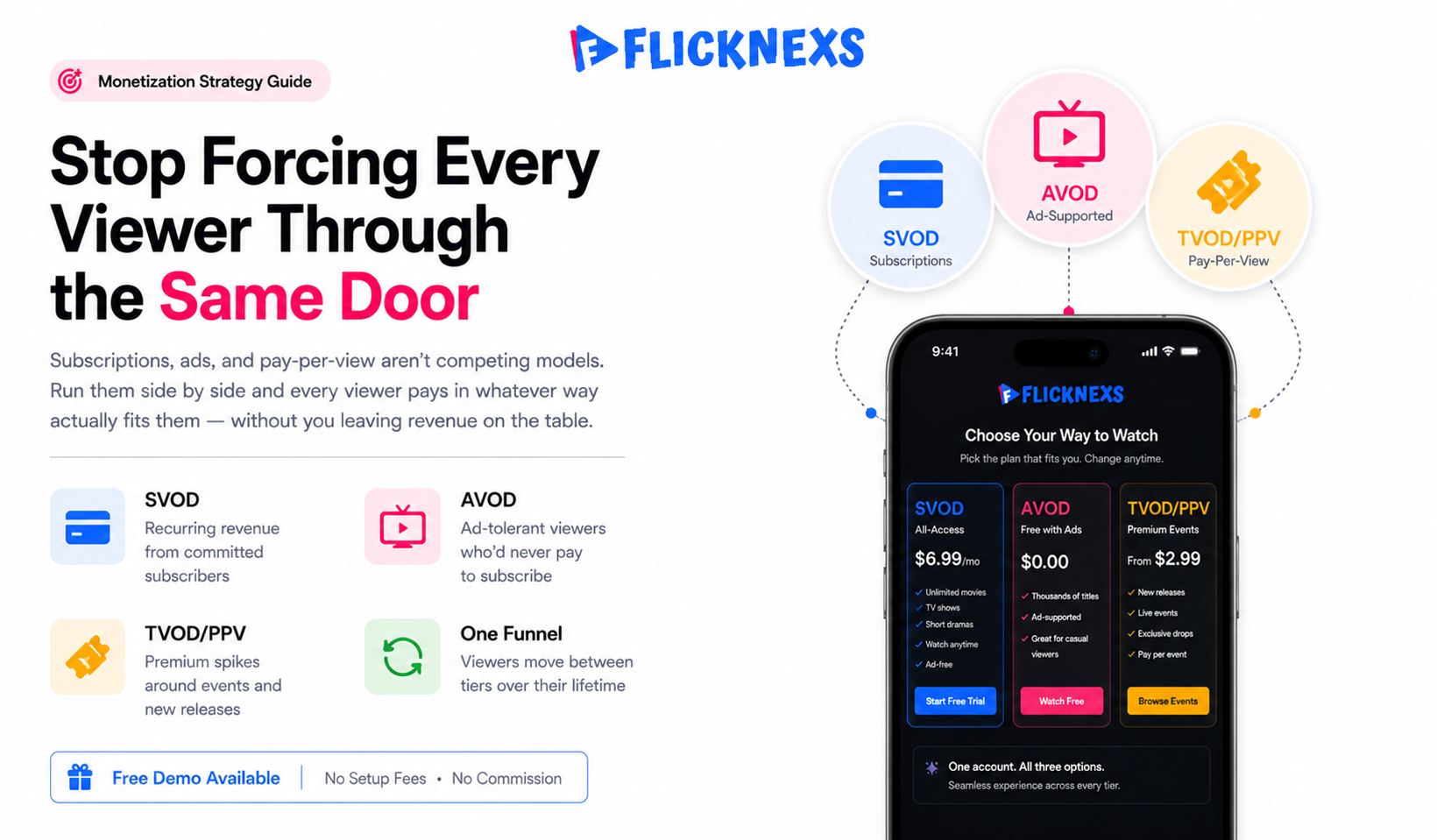
Hybrid monetisation means you’re not betting the whole platform on one revenue model. You’re running subscriptions, advertising and pay-per-view side by side, so each viewer pays in whatever way actually suits them instead of you forcing everyone through the same door.
Done properly, this lifts revenue per user across the board. You’re capturing the ad-tolerant free viewer who’d never pay a subscription and you’re capturing the viewer who’s happy to pay from day one, without losing either group to a model that doesn’t fit them. The free or ad-supported tier isn’t just there for its own sake either. It’s feeding the top of your funnel and your paid tiers are what actually converts that traffic into real revenue.
Here’s where most operators get it wrong though. They think hybrid means “turn everything on and see what sticks”. It doesn’t work like that. What actually drives profitability is deliberate plan design. Clear boundaries between tiers so nobody’s confused about what they’re paying for, ad load that doesn’t chase away the viewers you’re trying to keep happy, smart windowing around premium events, and analytics sharp enough to tell you which viewer should be nudged toward which tier and when.
That’s what this guide actually walks through. The models themselves, when combining them makes sense, how to architect the plans properly, the mechanics behind ad revenue and the mistakes that quietly chip away at margin until you notice it’s gone.
By the Flicknexs team. We build white-label OTT/VOD/IPTV streaming platforms, so this is written from hands-on streaming-platform experience.
What “hybrid monetization” actually means for OTT
Hybrid monetization is the practice of combining multiple revenue models inside one streaming service rather than betting the business on a single one. The three building blocks are well established:
- SVOD (subscription video on demand): This is the one most people default to first, mostly because Netflix made it the obvious shape for a streaming business. Someone commits monthly or yearly and as long as you keep giving them a reason not to cancel, that revenue just keeps showing up. It’s the steadiest model of the three, but it lives and dies on retention, not acquisition
- AVOD (ad-supported video on demand):Here the viewer pays with their attention instead of their wallet. Nobody’s pulling out a card, so the barrier to trying your platform basically disappears. Revenue grows the more people watch, which means this model rewards reach and volume over the kind of loyalty SVOD depends on.
- TVOD / PPV (transactional / pay-per-view): This one’s different again. Nobody’s renting a movie or buying a live event ticket out of habit. They want that specific thing, right now and they’ll pay a premium for it. Revenue here comes in spikes tied to demand, a big fight, a blockbuster release, rather than the steady drip you get from a subscriber base.
A pure single-model service leaves money on the table. SVOD-only ignores the large share of viewers who will watch ads but never subscribe. AVOD-only caps your revenue per user at whatever the ad market pays. PPV-only has no recurring base between events. Hybrid stitches these into one funnel, so a single viewer can move from “free with ads” to “paying subscriber” to “buys the championship fight” over their lifetime with you. For a model-by-model primer, see our video monetization models hub.
When does combining models make sense?
Hybrid isn’t automatically right for every operator. It adds product complexity, billing surface area and analytics overhead. It tends to pay off when at least one of these is true:
You have a broad-appeal catalog
Wide content (general entertainment, sports, regional film libraries) attracts viewers with very different willingness-to-pay. A free ad tier captures the casual majority; a subscription tier serves the committed minority. Narrow niche catalogs sometimes do better with a single focused model.
You run live or event content
Live sports, concerts, awards shows and premieres are natural PPV moments layered on top of a subscription base. The subscription keeps people around between events; PPV monetizes the spikes. If you stream live, our live streaming tooling is built to handle both entitlement models on the same stream.
You want a lower-friction entry point
An ad-supported free tier dramatically lowers the cost of trying your service, which feeds subscriber conversion later. This is why so many large services added free or cheaper ad tiers. The ad tier is a funnel, not just a revenue line.
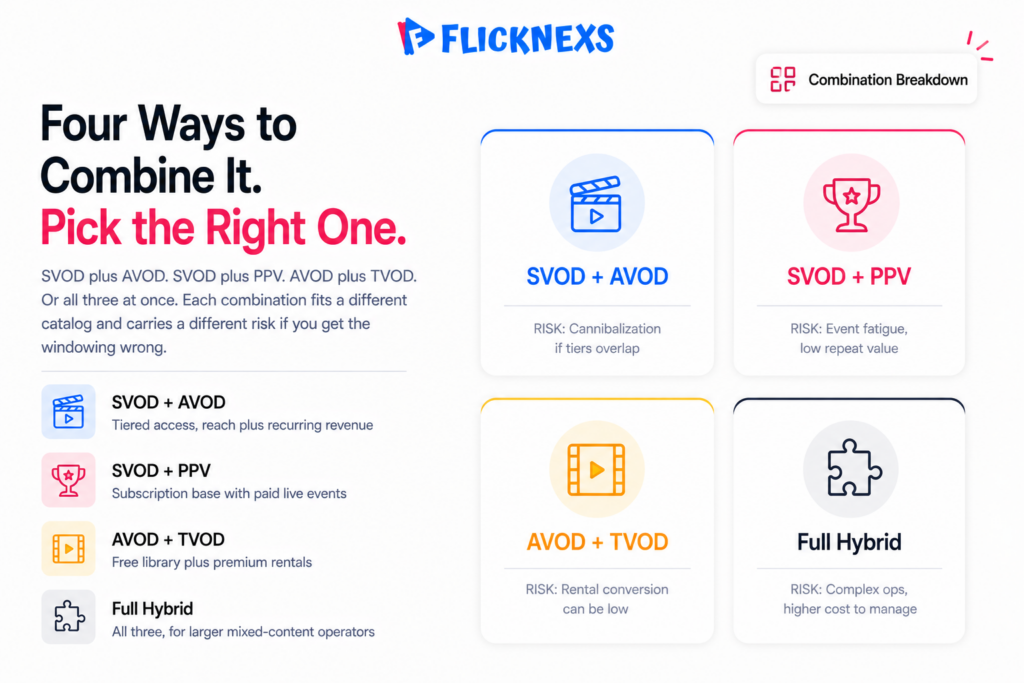
The four common hybrid combinations
| Combination | How it works | Best for | Main risk |
|---|---|---|---|
| SVOD + AVOD (tiered) | Cheaper/free ad tier plus a higher-priced ad-free tier | Broad catalogs wanting reach + recurring revenue | Cannibalizing premium subs if the ad tier is too good |
| SVOD + PPV | Subscription base plus paid live events or new releases | Services with regular tentpole events | Subscribers feeling “double charged” if windowing is unclear |
| AVOD + TVOD | Free ad-supported library plus paid premium rentals/buys | Film libraries, transactional storefronts | Low recurring revenue floor between purchases |
| Full hybrid (all three) | Free ad tier → paid subscription → PPV add-ons | Larger operators with mixed live + VOD | Complexity: billing, entitlements, analytics, support |
Most operators start with one combination and add a third model only once the first two are stable. “Full hybrid” is powerful, but it demands disciplined product and billing operations.
Designing tiers that don’t cannibalize each other
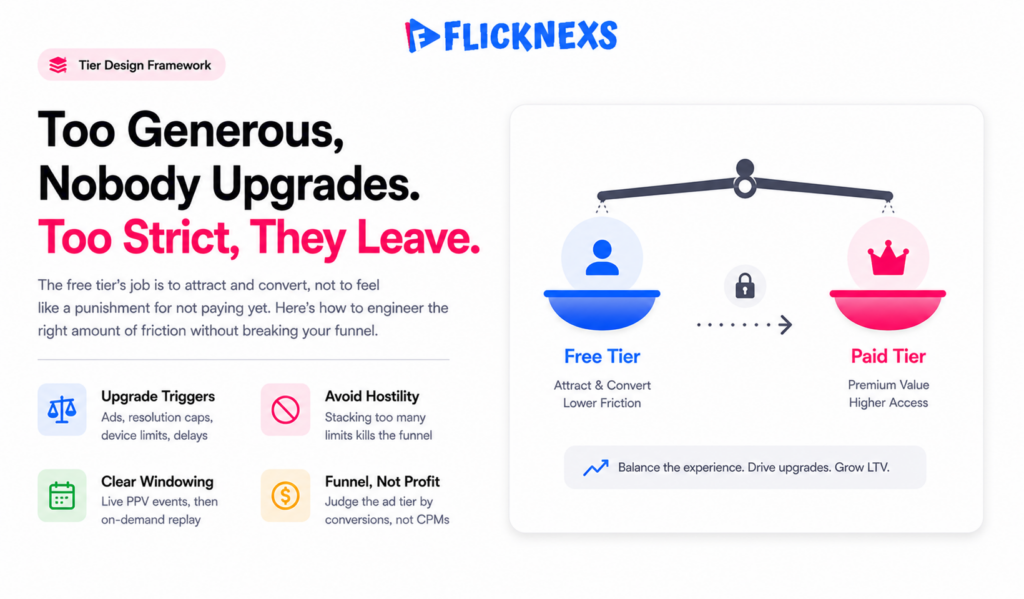
The single biggest cause of disappointing hybrid revenue is tiers that compete with themselves. If your free ad tier is nearly as good as your paid tier, few people upgrade. If your PPV events are also “free” inside the subscription, you can’t charge for them. Good tier design is about engineering the right amount of friction.
Use clear, defensible upgrade triggers
Every paid step you add should be removing something the viewer actually notices. Not something you’ve assumed matters to them in a planning meeting. Ads, lower resolution, fewer simultaneous streams, no downloads for offline viewing, a delay before new releases show up, a cap on how many devices someone can use at once. Pick the levers your specific audience genuinely cares about not the ones that just sound reasonable on a feature comparison chart. Not every friction lands the same way for every viewer and treating them like they all do is how you end up optimising for a problem nobody actually has.
What actually kills platforms is stacking too many of these onto the free tier at once, until using it for free starts feeling less like an entry point and more like a punishment for not paying yet.
The moment your free tier starts feeling hostile, you’ve broken the thing that was supposed to be bringing people in. That’s the whole top of your funnel gone and no amount of clever pricing on the paid tiers fixes a funnel that’s already empty.
Window premium and live content deliberately
For PPV layered on SVOD, decide in advance what’s included versus paid. A common pattern that actually holds up: marquee live events run as PPV or a paid add-on, on the day itself, then roll into the subscription catalogue as on-demand replay once the event’s over. Make sure you’re upfront about this timeline, because subscribers who feel like they’re being charged twice for the same thing will absolutely let you know about it.
And here’s the thing that catches operators off guard every single time. Someone who skipped buying the live PPV will inevitably email support asking why they can’t watch the replay that, as far as they’re concerned, should already be there. Don’t bury that replay date in a FAQ nobody reads. Put it right on the event page itself, where the person actually looking for it will see it before they ever need to ask.
Price the ad tier as a funnel, not a profit center
The ad tier’s job is reach and conversion. Judge it partly on how many viewers it converts to subscription over time, not only on its standalone ad revenue.
Making the advertising side profitable
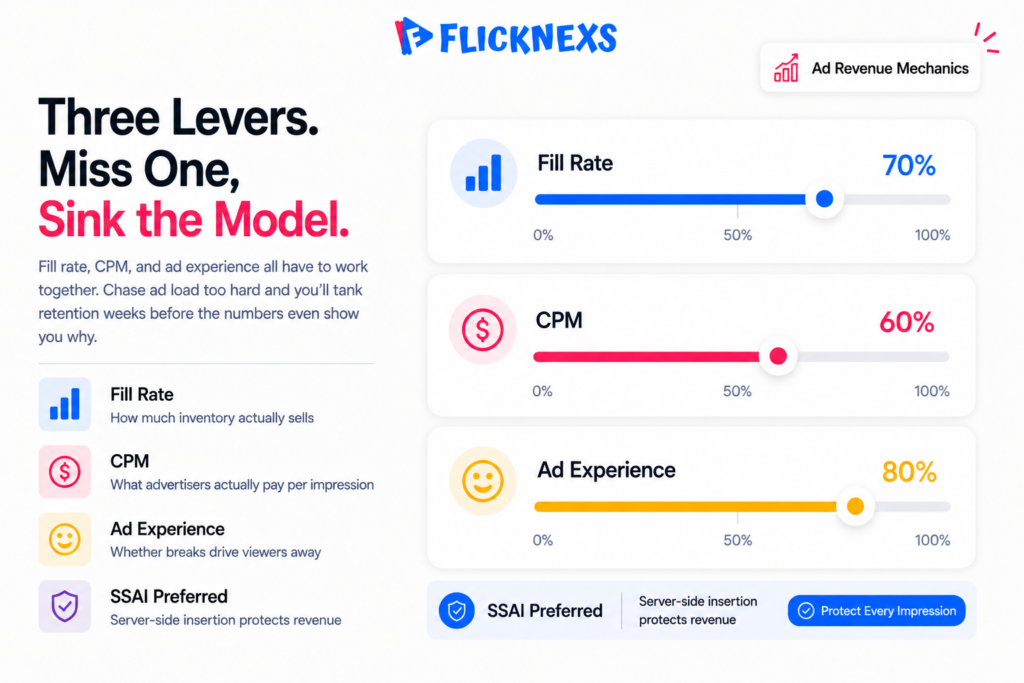
AVOD revenue comes down to three things and missing any one of them quietly sinks the whole model. Fill rate, meaning how much of your inventory actually gets sold rather than sitting empty. CPM, what advertisers are actually paying per thousand impressions. And ad experience, whether the ads themselves are driving viewers away the moment they show up.
Operators new to advertising almost always over-index on the wrong one. They chase ad load, cram in more breaks to push revenue up and end up tanking retention without realising it’s even happening until the numbers come in weeks later.
Mind your ad load
More ads per hour bumps short-term revenue, sure, but churn and abandonment go up right alongside it. There’s no magic number here that works the same way for everyone. It shifts by content type, by region, by how much your specific audience will actually put up with before they bail. Ad load isn’t a setting you pick once and walk away from. It’s something you keep testing and tuning.
Mid-roll placement at natural breaks in the content tends to outperform heavy pre-roll and here’s why that actually matters in practice. Crank pre-roll too high and people bail before the content even loads. That “impression” you logged never turns into actual watch time, it’s just a number sitting in a dashboard. The damage doesn’t even show up where you’d expect it to. It shows up as a retention dip weeks later, by which point almost nobody connects it back to the ad change that actually caused it.
Prefer server-side ad insertion for stability
Server-side ad insertion (SSAI) stitches ads into the video stream on the server, which improves playback consistency and resists ad blockers compared with client-side insertion. Both of those protect revenue. The trade-off is more infrastructure complexity. We compare the two approaches in depth in SSAI vs client-side ad insertion.
Consider a FAST channel as ad inventory
Free ad-supported streaming TV (FAST) channels turn your library into linear, ad-monetized channels, a low-friction way to grow ad impressions and brand reach that complements on-demand AVOD. If that’s on your roadmap, see how to launch a FAST channel in 2026. The IAB publishes useful standards and guidance for digital video advertising and measurement.
Billing, entitlements, and the operational reality
Hybrid monetization multiplies your billing complexity. A single viewer might be on a free ad tier, then a paid subscription and also buy a PPV event: three different entitlement states that your platform, players and support team all have to handle correctly.
Entitlements must be the source of truth
Your platform should resolve, per viewer per title, exactly what they’re allowed to watch and in what quality, with or without ads. Get this wrong and you either give content away or block paying customers. Both are expensive. This is where a purpose-built platform earns its keep versus a stack of bolted-together tools.
Payments and dunning
Subscriptions need recurring billing, proration, plan changes and failed-payment recovery (dunning). PPV needs reliable one-off charges with clear refund rules. Use a mature payment processor and reconcile carefully; involuntary churn from failed cards is a silent revenue leak many operators never measure.
Tax and regional rules
Digital video is taxed differently across jurisdictions and ad and privacy rules vary by region. Build for region-aware pricing and consent from the start rather than retrofitting it.
Using analytics to route viewers to the right model
The point of hybrid isn’t just to offer options. It’s to actively move each viewer toward the model that maximizes their lifetime value without pushing them to churn. That requires watching the right signals.
- Engagement depth: heavy free-tier viewers who hit ad fatigue are your best upgrade targets; prompt them at the right moment.
- Event intent: viewers who browse a PPV event page but don’t buy are warm; a reminder or bundle offer can convert them.
- Churn risk: subscribers with falling watch time may be better retained on a cheaper ad tier than lost entirely; a downgrade path beats a cancellation.
- Ad tolerance if abandonment rises with ad load in a segment, you’re over-monetizing that segment.
Modern audiences increasingly mix free, paid and transactional viewing rather than picking one, a pattern visible in industry reporting from sources like the streaming television ecosystem overview. Hybrid is, in effect, meeting that behavior where it already is.
A practical rollout sequence
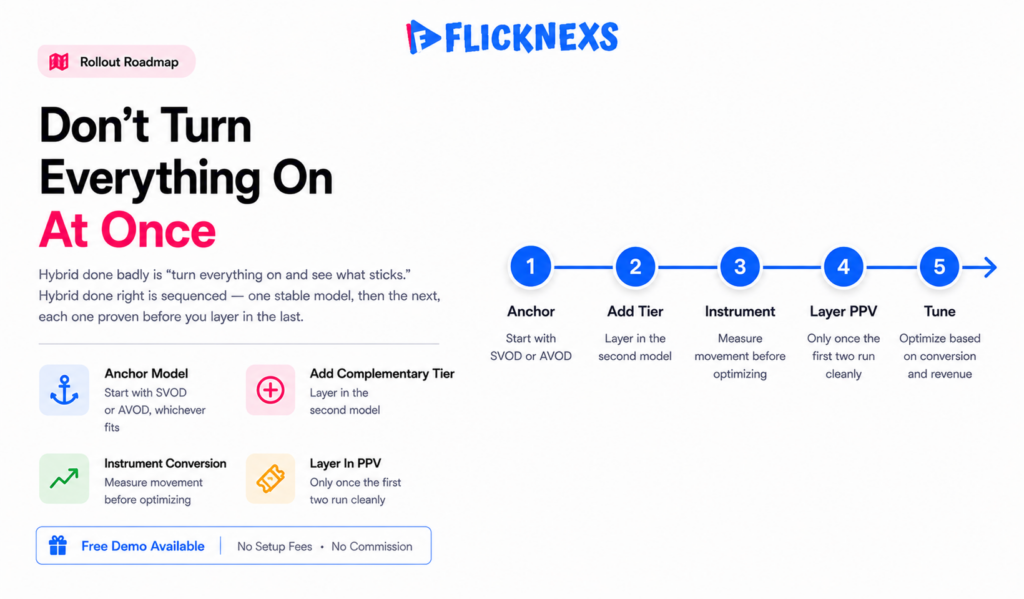
If you’re moving toward hybrid, sequence it so each step is stable before adding the next:
- Establish your anchor model. Usually SVOD for recurring revenue or AVOD for reach, depending on your catalog.
- Add the complementary tier. An ad tier under a subscription, or a paid tier over a free service.
- Instrument conversion. Make sure you can measure movement between tiers before optimizing.
- Layer in PPV for events. Only once subscriptions/ads are running cleanly.
- Tune continuously. Ad load, pricing and windowing are ongoing experiments, not one-time decisions.
If you’d rather not build entitlements, billing and ad insertion from scratch, a white-label platform like our VOD platform handles SVOD, AVOD and PPV on one stack so you can focus on content and pricing strategy.
Frequently asked questions
Related guides
- Video Monetization Models Explained: SVOD, AVOD, TVOD, PPV & Hybrid
- How to Launch a FAST Channel in 2026: Step-by-Step Setup & Distribution
- Server-Side Ad Insertion (SSAI) vs Client-Side: Which Boosts AVOD Revenue
Planning your own platform? Learn how to create your own OTT platform with Flicknexs — VOD, live, DRM, multi-device apps and hybrid monetization.
Ready to build?
If you’re planning your next OTT project, Flicknexs handles the video infrastructure end-to-end — so you can ship in weeks, not months.
- start streaming with Flicknexs
- see pricing and plans
More OTT platform guides
Continue exploring more on this topic across the Flicknexs blog.