
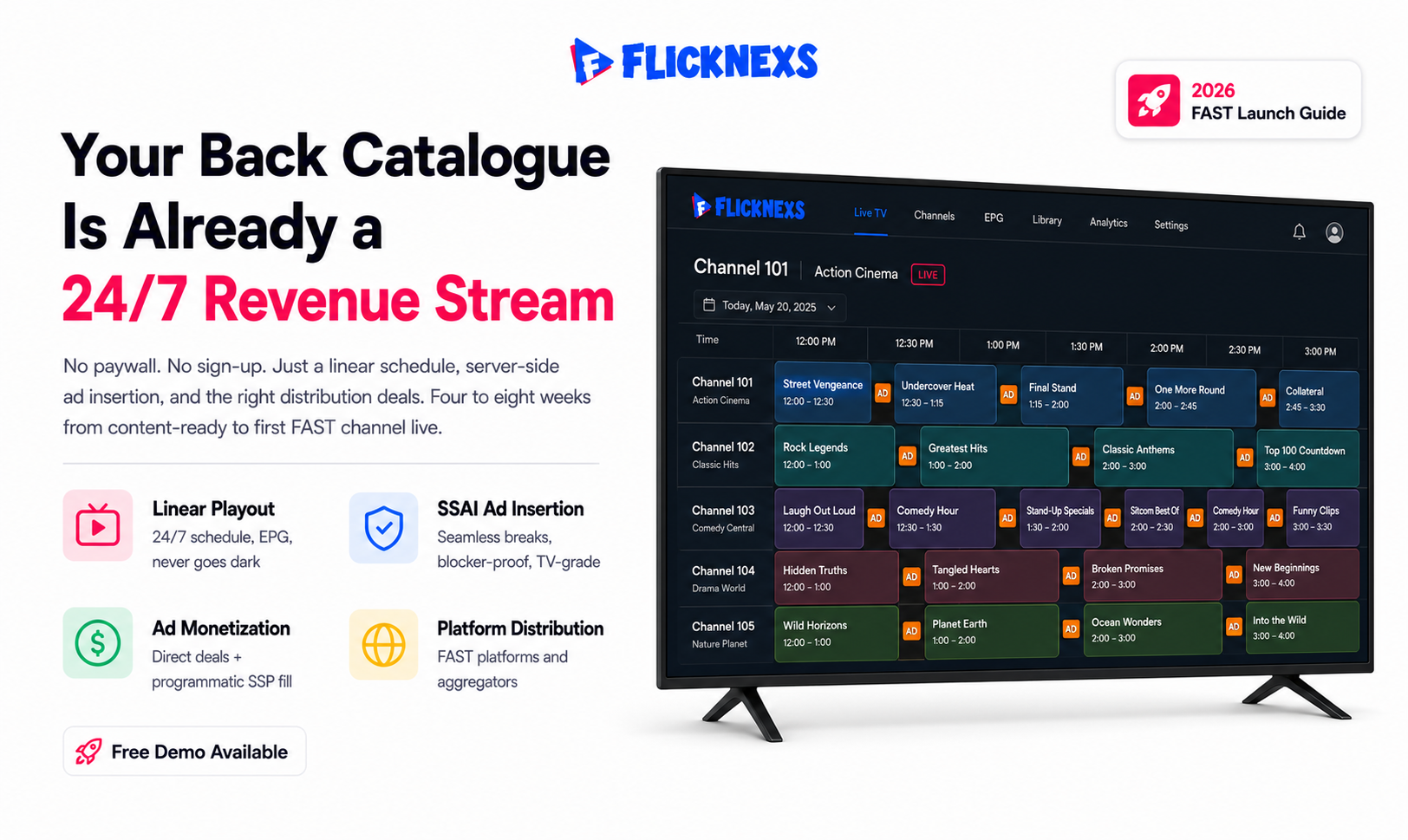
Launching a FAST channel in 2026 breaks down into five moves. Lock a programming niche and get your content rights cleared. To successfully launch a FAST channel, consider create your own OTT platform and secure necessary content rights before finalizing programming details.
By the Flicknexs team, we build white-label OTT/VOD/IPTV streaming platforms, so this is written from hands-on streaming-platform experience.
FAST channels are the fastest-growing corner of streaming right now, and the reason is pretty simple. They remove the two things that make most viewers bounce before they’ve watched a single frame: a paywall and a sign-up form. Nobody’s pulling out a credit card. Nobody’s creating an account. They just watch.
For content owners that’s a genuinely interesting shift. A back-catalogue sitting on a shelf earning nothing becomes a 24/7 revenue stream without changing a single frame of the content itself.
This guide covers exactly how to build one. What to build, what to license, how ad insertion actually works in practice and how to get your channel carried on the platforms where viewers actually are.
What is a FAST channel (and how it differs from VOD)
A FAST channel is a free, ad-supported linear stream. Viewers tune into a continuous broadcast-style schedule rather than picking individual titles from a catalogue. That linearity is the whole point. Unlike SVOD or AVOD where the viewer chooses what plays next, a FAST channel plays whatever’s scheduled at that moment, ad breaks and all. Traditional television, essentially, just delivered over IP instead of a cable wire.
FAST sits inside the broader ad-supported monetization family. If you are still deciding which model fits your business, our Video Monetization Models Explained: SVOD, AVOD, TVOD, PPV & Hybrid hub breaks down each option. Plenty of operators run FAST alongside on-demand and subscription tiers, a pattern we cover in our guide to hybrid monetization.
Why FAST is worth the effort in 2026
The economics are straightforward. A FAST channel monetises content you already own and the viewer doesn’t have to pay, sign up or do anything except watch. That same library can power on-demand rows elsewhere in your app at the same time, so nothing’s sitting idle.
The catch is that FAST revenue lives and dies on ad fill rates and CPMs, both of which depend on audience scale and the quality of your ad relationships. A clever niche alone won’t carry you. What actually moves the needle is consistent programming and getting the channel distributed broadly enough that the audience numbers start meaning something to advertisers.
Step 1: Pick a niche and clear your content rights
The channels that get carried have a sharp identity: a single genre, mood, language, or audience a platform can slot into its guide. “General entertainment” is the hardest pitch. “24/7 classic motorsport” or “Tamil family drama” is far easier to place. Before anything technical, do two things:
- Confirm rights. You need explicit linear streaming and ad-supported (AVOD/FAST) rights for every title, ideally with the territories you plan to distribute in. Theatrical or SVOD-only licenses do not automatically cover FAST. Music cue sheets and any embedded third-party clips matter here too.
- Size the library. A sustainable 24/7 channel needs enough hours to schedule without punishing repetition. As a rough working range, 100 to 300+ hours of programming lets you build a varied week. Below that you lean heavily on repeats, which is fine for a launch but should grow over time.
Get rights in writing before you schedule a single block. Re-clearing content after a platform has already carried it is the most expensive mistake in this space. What actually happens is a platform flags a title mid-flight, you have to pull it from the loop and now you have a gap in a schedule that is supposed to never go dark, so you scramble to backfill while the channel is live.
Step 2 :Build the 24/7 linear schedule (playout)
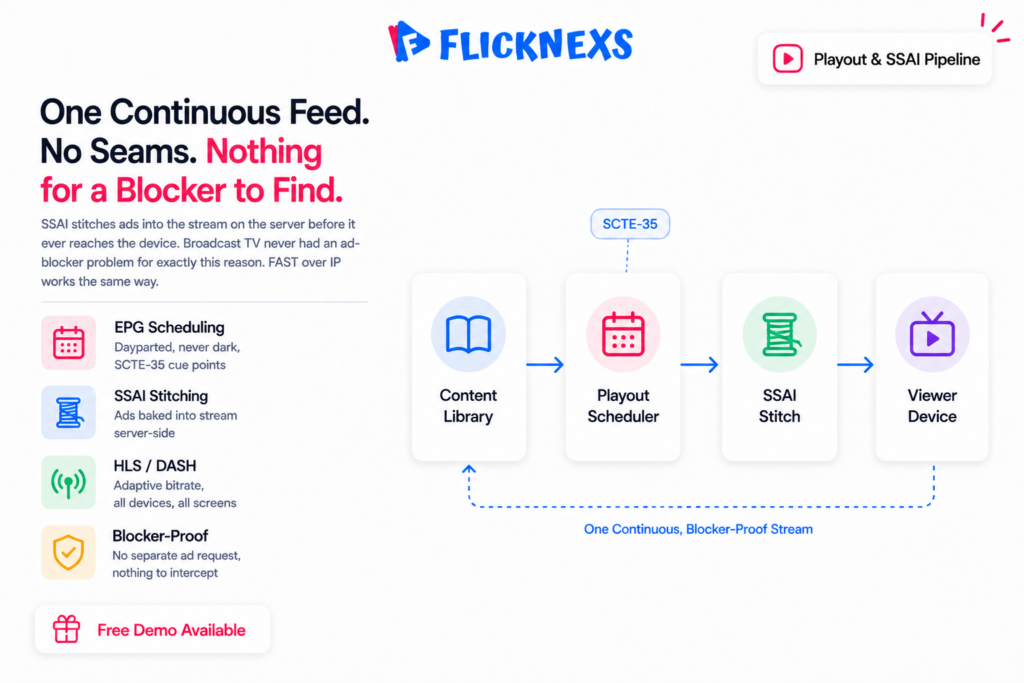
Playout is the engine that turns a content library into a continuous broadcast. A FAST playout system reads a schedule (an EPG, or electronic program guide), plays the right asset at the right second, inserts ad-break markers and loops cleanly so the channel never goes dark.
What a good schedule looks like
- Dayparting: match content to viewing patterns, lighter material during the day, your strongest titles in prime time when the audience is actually there.
- Ad-break cue points: mark where ads can run, typically program boundaries plus a few mid-roll points in longer titles. These cue points (SCTE-35 markers, in broadcast terms) tell the ad system when to insert.
- Interstitials: bumpers, channel idents and promos that keep the channel feeling produced rather than a raw playlist.
- An accurate EPG feed: platforms display your schedule in their guide, which means your metadata has to be correct hours or days in advance. Get this wrong and viewers see the wrong show listed, which erodes trust fast ad.
A white-label platform with a built-in scheduler handles the loop, the cue insertion and the EPG export for you, so you are configuring a calendar rather than writing playout software. Our OTT solutions include linear playout and scheduling for exactly this workflow.
Step 3:Encode, package and insert ads (SSAI)
Your linear feed needs to be encoded into adaptive bitrate renditions and packaged into HLS and DASH so it plays cleanly across TVs, phones and the web. Ad insertion sits on top of that and for FAST there’s really only one approach worth building around: server-side.
With SSAI, ads get stitched into the video stream on the server before anything reaches the device. What the viewer gets is one continuous feed, no handoff between content and ad, no buffering at the break, no seam an ad blocker can find and cut. Broadcast television never had an ad-blocker problem for exactly this reason. The ad was already inside the signal before it ever reached your screen. SSAI is just that same idea running over IP.
Why SSAI matters for FAST
SSAI stitches ads into the stream on the server before it ever reaches the device. One seamless feed, no buffering at the break, nothing for an ad blocker to catch. On living-room devices especially, where client-side ad SDKs are patchy at best, this is what actually delivers a TV-grade experience.
The trade-off is more backend complexity and there’s a longer version of that conversation worth having. But for FAST specifically, the short answer is just: use SSAI.
| Capability | Server-side (SSAI) | Client-side (CSAI) |
|---|---|---|
| Viewer experience | Seamless, TV-grade | Can buffer at the break |
| Ad-blocker resistance | High (ads in the stream) | Low (blockable requests) |
| Living-room device support | Broad | Variable by SDK |
| Implementation effort | Higher backend lift | Lower |
| Best fit | FAST / linear | Some on-demand AVOD |
The ad system communicates over IAB standards: VAST for ad responses and VMAP for break structure. You do not need to implement these by hand on a managed platform, but knowing the acronyms helps you talk to ad partners without sounding lost on the first call.
Step 4: Set up the ad-monetization stack
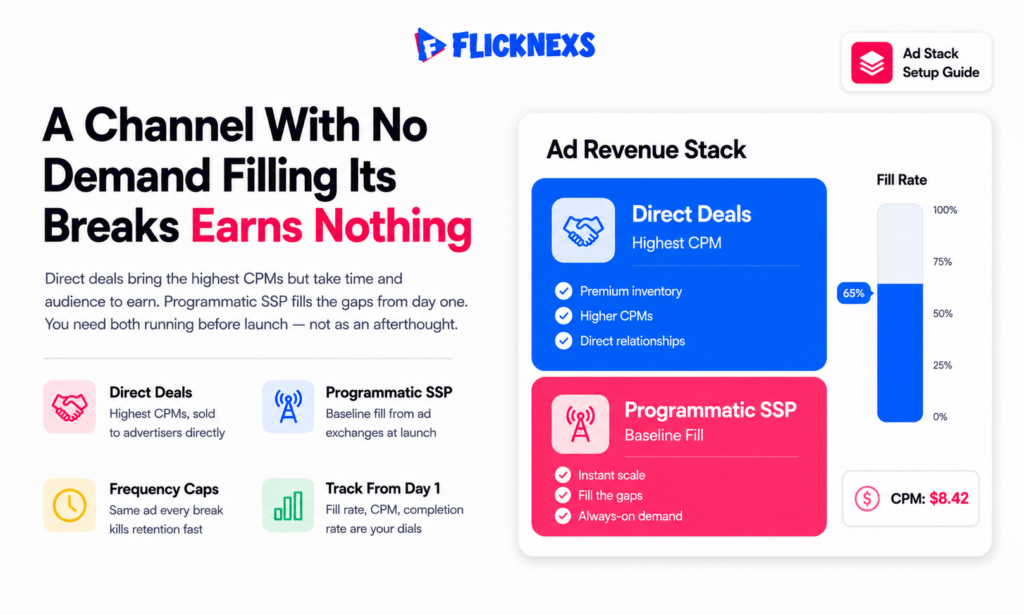
A channel with no demand filling its breaks earns nothing, so monetization is part of launch, not an afterthought. There are two complementary sources of ad demand:
- Direct / sold deals: advertisers or sponsors you go out and sell to yourself. Highest CPMs by a distance, but it takes a real sales effort and you need the audience numbers to back it up before anyone takes the meeting seriously.
- Programmatic: demand that routes automatically through SSPs and ad exchanges, filling whatever inventory you haven’t sold directly. For most early FAST channels this is where the bulk of ad breaks actually get filled, at least until the direct relationships are built.
Practical monetization checklist
- Connect at least one programmatic SSP for baseline fill.
- Set frequency caps so the same ad does not repeat every break. Repetition kills retention.
- Keep ad loads reasonable (a common range is a handful of minutes per hour at launch). Over-loading drives viewers away faster than it earns.
- Track ad fill rate, CPM and completion rate from day one. These are your revenue dials.
Honest expectation-setting: per-channel FAST revenue at launch is usually modest and scales with audience and distribution breadth. One thing that surprises first-timers is how much of your “sold” inventory still goes unfilled in the early weeks, your fill rate can sit well under what you projected until the channel has enough watch-time to interest demand partners. The operators who do well treat the first channel as a foothold and expand into a multi-channel network over time.
Step 5: Distribute to FAST platforms and aggregators
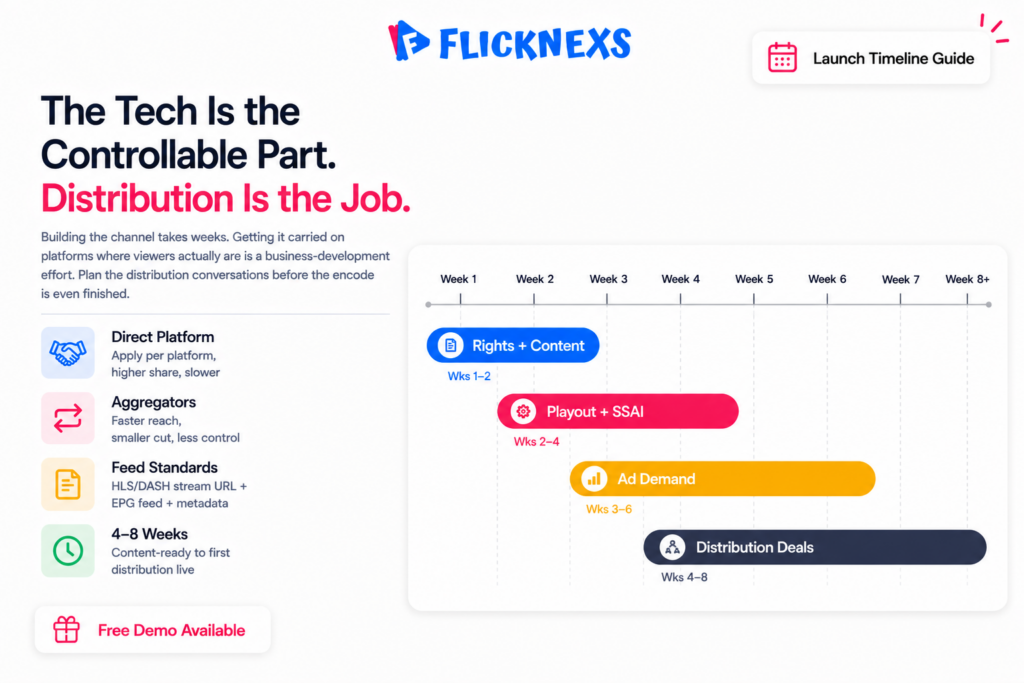
This is where most launches stall. Building the channel is the controllable part. Getting it carried on the platforms where viewers actually watch is a business-development effort, full stop. There are two routes:
Direct platform deals vs aggregators
- Direct: you apply to and contract with each FAST platform individually. Higher revenue share potential, but slower and more demanding on relationships and minimum-audience thresholds.
- Aggregators / channel distributors: a partner who already has platform relationships carries your channel onto many services at once in exchange for a revenue share. Faster reach, less control, smaller cut for you.
Either way, what you hand over is a standards-based feed: a stable HLS/DASH stream URL with SSAI ad markers, plus an accurate EPG/schedule feed and channel metadata (logo, description, genre, ratings). Platforms are strict about feed reliability and guide accuracy. A channel that drops or has a wrong EPG gets pulled and getting reinstated is a far slower conversation than the one that got you on in the first place.
A realistic launch timeline
- Weeks 1–2: niche locked, rights confirmed, content ingested and tagged.
- Weeks 2–4: schedule built, playout configured, encoding/packaging and SSAI tested end to end.
- Weeks 3–6: ad demand connected, fill verified on a test stream.
- Weeks 4–8+: distribution conversations and platform onboarding, the variable, relationship-driven part.
Build vs buy the honest comparison
| Factor | Build from scratch | White-label OTT/playout platform |
|---|---|---|
| Time to first channel | Months | Weeks |
| Playout, EPG, SSAI | Engineer yourself | Built in / configured |
| Upfront cost | High (team + infra) | Lower, predictable |
| Control / customization | Total | High within platform |
| Best for | Large media tech teams | Most content owners |
For the majority of content owners and broadcasters, buying the streaming stack and pouring your energy into content and distribution is the faster path to revenue.
Run your own 24/7 channel — try the Flicknexs playout engine →
Frequently asked questions
Related guides
- Video Monetization Models Explained: SVOD, AVOD, TVOD, PPV & Hybrid (hub)
- Server-Side Ad Insertion (SSAI) vs. Client-Side: Which Boosts AVOD Revenue
- Hybrid Monetization: Combining Subscriptions, Ads & Pay-Per-View Profitably
- Flicknexs OTT Solutions
Further reading on streaming standards: HTTP Live Streaming (HLS) and the Interactive Advertising Bureau (IAB) for VAST/VMAP ad standards.


Leave a Reply