
Quick answer
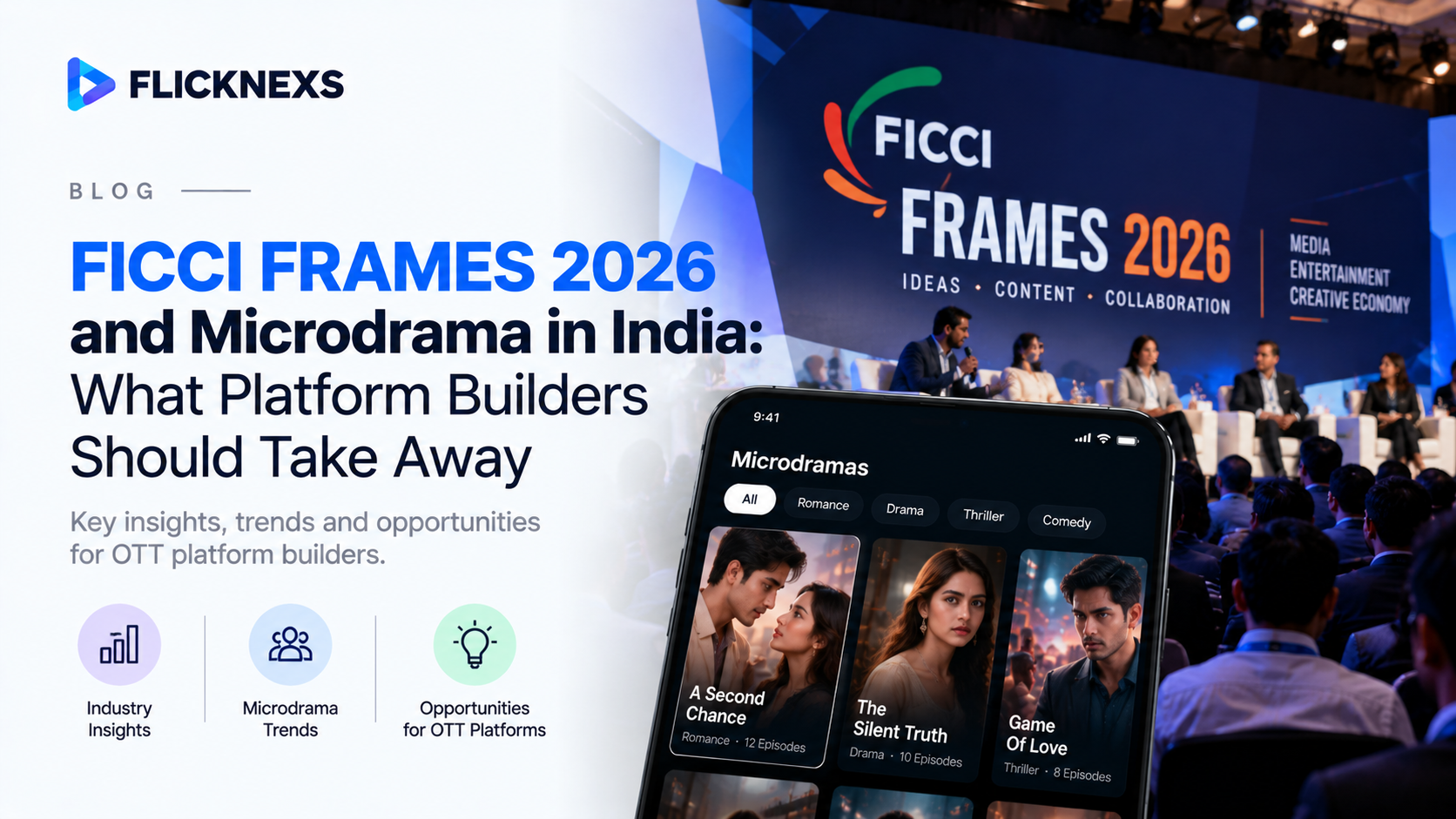
What did FICCI FRAMES 2026 signal about microdrama in India? It confirmed microdrama as a standalone business category, not a social-video side trend. A dedicated panel brought Meta, Zee’s BULLET Microdrama, Eloelo Group and Kuku together, and Eloelo’s CEO called India the fastest-growing market in a $15 billion global category. For OTT builders, the opening is the platform layer: vertical playback, episode-level paywalls, binge analytics and branded apps that studios can own instead of renting reach from social feeds.
What FICCI FRAMES 2026 put on record
The 26th edition ran on the theme of creating value in an age of abundant content, with an inaugural line-up that included FICCI President Anant Goenka, JioStar’s Kevin Vaz, Ayushmann Khurrana and Maharashtra CM Devendra Fadnavis (Indian Broadcasting World).
Three signals stand out for anyone building streaming products:
- Microdrama got its own session. The “Microdrama, Mega Business” panel examined how snackable fiction, creator-led series and platform-first originals change creation, distribution and monetisation (Indian Broadcasting World).
- The panel mixed platforms, studios and a social giant. Meta sat alongside Zee’s BULLET Microdrama, Eloelo Group and Kuku. That mix tells you distribution is still contested between social feeds and owned apps.
- The debate has shifted to ownership. Coverage framed the conversation as moving from audience acceptance to how big the business gets and who controls IP, talent and technology (Bollywood Hungama).
In a keynote on AI and storytelling, Eloelo founder Saurabh Pandey compared microdrama to the quick-commerce moment for entertainment (Social Samosa). The analogy is useful. Quick commerce did not replace supermarkets; it created a new habit with its own logistics. Microdrama is building a new viewing habit that needs its own streaming logistics.
The numbers behind the stage time
The spotlight follows real traction. Microdrama apps now outrank established OTT brands on installs, even though revenue per app is still small.
| Signal | Figure | Source |
| Global microdrama category size | $15 billion; India the fastest-growing market | Social Samosa (Eloelo keynote) |
| Eloelo / Story TV scale | 5,000+ titles, 120M+ users, 100+ min watched per day, 250 shows produced a month | Social Samosa |
| Download rankings | Kuku TV, Story TV and Quick TV in India’s top 5 video apps, ahead of ZEE5, SonyLIV and Netflix | Pitch, citing FICCI-EY |
| Kuku TV output | 150+ original shows a month, 200M+ downloads | exchange4media |
| Paid behaviour in India | In-app purchases up from $31M (2022) to $97M (2025) | Pitch, citing FICCI-EY |
Our read: production volume is the tell. When one studio ships 150–250 shows a month, the bottleneck is no longer shooting. It is ingesting, packaging, pricing and surfacing thousands of episodes a month, which is a platform problem. Note that the scale figures come from the companies themselves and have not been independently audited.
Why microdrama breaks the long-form OTT stack
A long-form OTT app is built around the title. A microdrama service is built around the next tap. That single difference ripples through every layer.
| Layer | Long-form OTT | Microdrama |
| Unit of value | Movie or 45-min episode | 60–90 sec episode, often 60–100 per series |
| Screen | Landscape, TV-first | Portrait, phone-first |
| Paywall moment | Signup, before the first play | Mid-story, at the cliffhanger |
| Pricing | Monthly or annual plan | Coins per episode, series pass, ads, plus plans |
| Catalogue load | Hundreds of titles | Thousands of episodes added monthly |
| Key metric | Watch hours | Next-episode rate and unlock conversion |
| Discovery | Rows and search | Swipe feed and auto-play trailers |
Retrofitting a long-form platform usually fails at the paywall row. If the app can only charge at signup, the most valuable moment in a microdrama, the cliffhanger at episode 8 or 10, earns nothing. For deeper engineering detail, see our guide to microdrama OTT platform architecture.
Five build decisions for a microdrama platform
These are the choices that decide whether a service retains viewers past episode 10. Settle them before writing a line of app code.
- Where the free line sits. Decide how many episodes are free per series and whether that number varies by genre. Your CMS must let editors change it per series without an app release.
- How viewers pay. Pick the mix of coins, series passes, subscriptions and rewarded ads. Coins need a wallet, top-up packs and Google Play and App Store billing; UPI top-ups matter for Indian users. See micro-drama monetization for model comparisons.
- How fast the next episode starts. Pre-load episode N+1 while N plays. On mid-range Android phones over 4G, a visible spinner between episodes is where binge sessions end.
- What you measure. Track drop-off by second within an episode, next-episode rate, unlock conversion at the paywall episode and revenue per series. Watch hours alone will hide a weak hook.
- Which languages ship first. India’s growth is vernacular. Plan metadata, subtitles and dubbed tracks per language at the series level, not as an afterthought in the player.
For the trend context behind these choices, read our micro-drama trends in 2026 breakdown.
Build from scratch, publish on social, or go white-label?
Most studios choose between three routes. The right one depends on how much of the audience and revenue you want to own.
| Route | Who owns users and data | Revenue control | Time to launch | Best for |
| Publish on social feeds only | The platform | Ad share or brand deals | Days | Testing story formats |
| Build a custom app from scratch | You | Full | 9–12 months, large team | Funded players with in-house engineering |
| White-label OTT platform | You | Full | Weeks | Studios and broadcasters with content ready now |
The social route is useful for proving a story works, but the payer relationship stays with someone else. A white-label base gives you branded Android, iOS and web apps, your own paywall and your own first-party data, without a year of platform engineering. Launch windows are estimates and vary with scope.
What to watch over the next 12 months
- Legacy TV IP entering the format. Broadcasters are already re-cutting classic shows into 90-second episodes (Bollywood Hungama). Their back catalogues will need new packaging and pricing.
- Public-market scrutiny. Kuku’s proposed IPO would be the first real test of microdrama economics in public view (exchange4media). Expect a sharper focus on paying users over downloads.
- AI in production. Pandey said AI backdrops now make genres like period drama viable on microdrama budgets (Social Samosa). More output means more catalogue load on the platform side.
- Quality pushback. Not everyone is convinced; one filmmaker dismissed the format as cheap content (Pitch). Platforms that surface better stories will win on retention, not volume.
Frequently asked questions
What is microdrama? Microdrama is scripted fiction told in very short episodes, usually 60–90 seconds, shot vertically for phones. A single story can run to dozens of episodes, each ending on a hook.
Why was microdrama discussed at FICCI FRAMES 2026? The convention ran a dedicated panel, “Microdrama, Mega Business: The Next Content Disruption,” with Meta, Zee’s BULLET Microdrama, Eloelo Group and Kuku. It reflects how quickly microdrama apps have climbed India’s download charts.
How big is the microdrama market in India? No audited India-only figure is public yet. Eloelo’s CEO put the global category at $15 billion and called India its fastest-growing market, and three microdrama apps now sit in India’s top 5 video apps by downloads.
Is microdrama the same as Reels or Shorts? No. Reels and Shorts are mostly standalone clips from creators. Microdrama is serialised, scripted and usually monetised per episode or per series.
How do microdrama apps make money? Common models are coins to unlock episodes, series passes, subscriptions, rewarded ads and hybrids of these. Most apps keep the first few episodes free and charge at a cliffhanger.
What features does a microdrama platform need? At minimum: a vertical video player with next-episode pre-loading, a CMS for series and episodes, per-episode paywalls, a coin wallet, in-app billing, multi-language metadata and episode-level analytics.
Can a studio launch its own microdrama app without a tech team? Yes. A white-label OTT platform supplies the apps, CMS, player and billing under the studio’s brand, so the studio focuses on content and marketing. See how to build a micro-drama app or a DramaBox-like app.
Own the platform, not just the stories
FICCI FRAMES 2026 made one thing clear: microdrama in India is now a business category with its own economics. The studios that keep the payer relationship will capture most of that value.
Flicknexs builds branded microdrama apps with vertical playback, episode-level paywalls, coin wallets, multi-language catalogues and binge analytics across Android, iOS and web.