
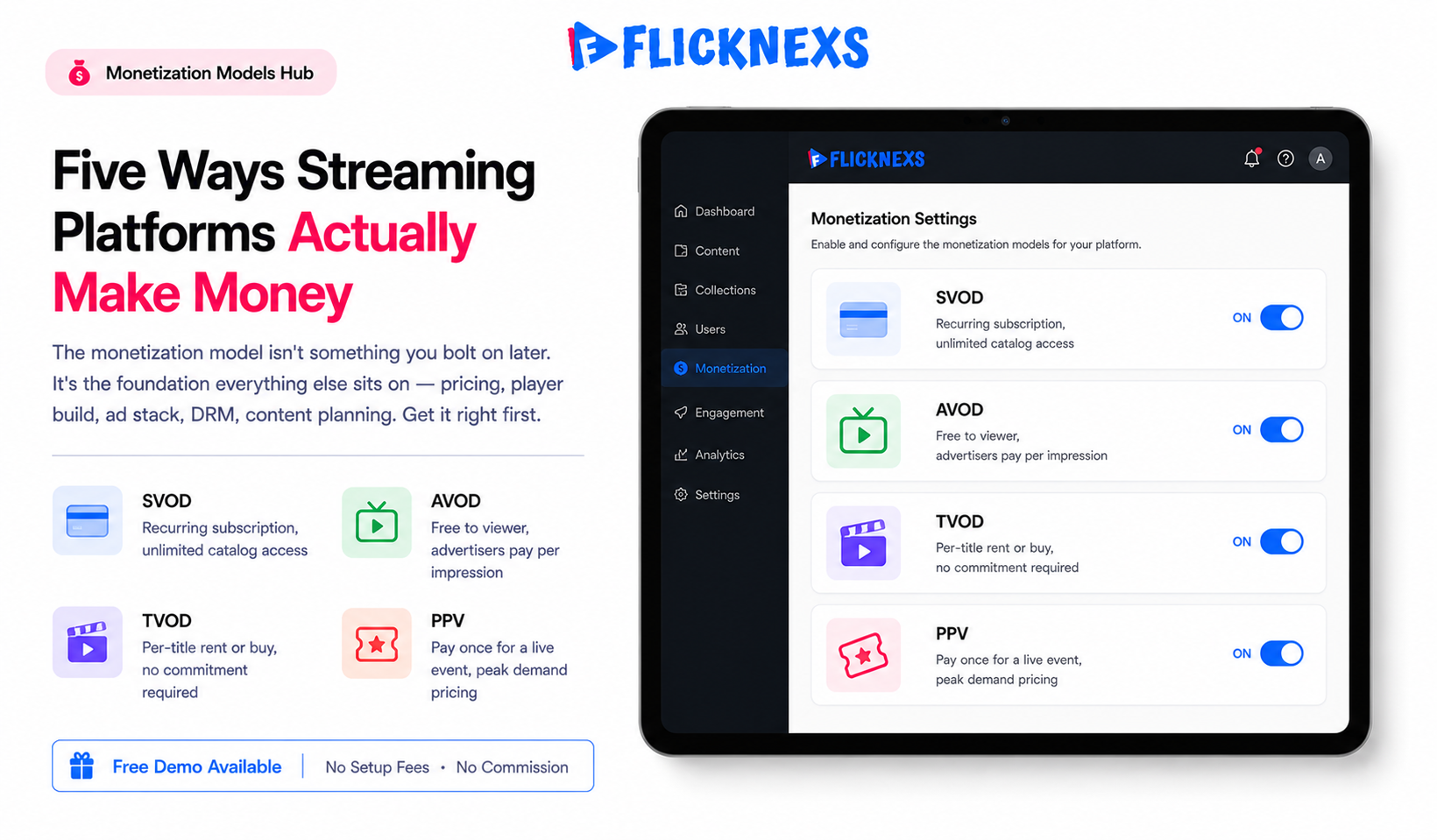
Here’s the thing nobody tells you before you launch a streaming service the video monetization models isn’t a business decision you bolt on later. It’s the foundation everything else sits on.
Get it wrong and you’ll feel it in the pricing page, player build, ad stack, DRM setup, even in how you plan content. Fixing that later means tearing out load-bearing walls.
So let’s talk about the five ways streaming platforms actually make money.
Getting these decisions right from day one matters even before you create your own OTT platform, since monetization shapes the whole build.SVOD is the gym membership model. You pay monthly, you get unlimited access and whether you show up matters less than the fact that you keep paying. Netflix runs on this.
AVOD flips it. The viewer pays nothing. Advertisers foot the bill instead, same way broadcast TV always worked, just with better targeting now.
TVOD charges per title. Think of it as renting or buying a movie the old Blockbuster way, except digital.
PPV is TVOD’s cousin for live events. You pay once for that boxing match or concert and once it’s over, that’s it.
Hybrid blends two or more of these into one platform, serving free viewers, subscribers and one-off buyers from the same catalog simultaneously.
Which one you pick depends on three things: how deep your content library is, how big your audience is and whether you’re releasing content on a steady schedule or just have a handful of high-demand titles to sell.
Here’s what most people miss though. Almost nobody who survives past year two sticks with just one model. They start with one and layer in others as they grow. Betting your whole business on a single revenue stream sounds clean in a pitch deck. It rarely survives contact with real viewers.
This guide walks through each model in plain language: where it wins, where it breaks down and why hybrid ends up being the default endpoint for platforms that actually last.
Written by the Flicknexs team. We build white-label OTT/VOD/IPTV streaming platforms, so this comes from actually building this stuff, not just researching it.
The five video monetization models at a glance
Before going deep, here is the shape of the landscape. Each model answers a different question: who pays, when do they pay and what do they get?
| Model | Who pays | Payment trigger | Best for | Main risk |
|---|---|---|---|---|
| SVOD | Viewer | Recurring (monthly/annual) | Deep, fresh catalogs | Churn |
| AVOD | Advertisers | Per ad impression | Large free audiences | Low per-user revenue |
| TVOD | Viewer | Per title (rent or buy) | New releases, niche titles | No recurring revenue |
| PPV | Viewer | Per live event | Sports, concerts, one-offs | Demand spikes, piracy |
| Hybrid | Both | Mixed | Most growing services | Complexity |
SVOD: Subscription Video on Demand
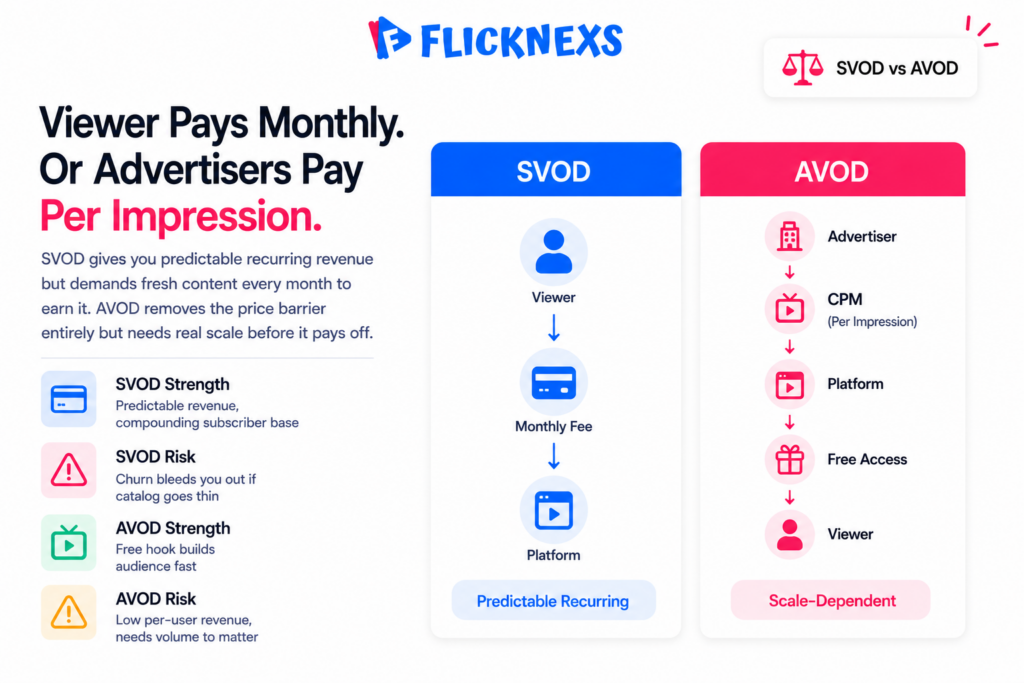
SVOD is the model most people picture when they think of streaming: a flat recurring fee unlocks the whole catalog. The viewer pays monthly or annually and watches as much as they want.
Why operators love it
Subscription revenue is predictable and predictable is a superpower most streaming businesses don’t have. You know roughly what’s coming in next month, which means you can actually plan reinvestment instead of guessing. A subscriber base compounds too.It’s an asset that carries forward, not a one-time transaction you have to hustle to replace every month.
No ads means a cleaner viewing experience. That’s exactly why premium and brand-led services lean SVOD. Nobody wants a pre-roll ad breaking up a luxury brand’s content.
Where it gets hard
Churn is the whole game. Lose subscribers faster than you add them and the model doesn’t crash, it just quietly bleeds out.
To keep people paying, you need a reason for them to stay that actually holds up every single month. That means a steady release cadence, exclusive content or a catalog deep enough that there’s always one more thing worth watching. Thin libraries don’t survive this test.
Here’s the part people get backwards: you’re not selling a video. You’re selling the ongoing promise that there’ll be something worth coming back for. That’s exactly why niche SVOD, think yoga, a specific sport, faith community and language often beats broad SVOD. A focused audience forgives a smaller catalog because everything in it feels relevant to them. Breadth doesn’t buy loyalty. Relevance does.
And a thin catalog doesn’t fail the way people expect. It’s not a slow fade. People binge everything good in the first two weeks, hit the bottom of the library and cancel before the second invoice ever shows up.
AVOD: Advertising Video on Demand
AVOD flips the whole equation. Viewer pays nothing, advertisers pay to reach them and revenue scales with watch time and how many ad impressions you can serve. Usually measured as CPM, cost per thousand impressions.
The trade-off
Free is the ultimate hook. Drop the price barrier to zero and you build an audience fast. But here’s the catch: revenue per user is usually a fraction of what a subscriber pays. You need real scale before AVOD actually pays off and scale doesn’t happen overnight.
Fill rate, CPMs, the quality of your ad stack, all of it matters enormously and all of it swings wildly by region and content category. We’re not going to hand you an “average CPM” figure here, because anyone who does is lying to you a little. Honest numbers move too much by geography, vertical and ad format to average into something useful.
How ads get inserted
There are two ways to do this and the choice you make directly affects both revenue and how the viewer experiences your platform.
Client-side ad insertion (CSAI) stitches ads together in the player itself. It’s simpler to set up, but ad blockers eat it alive and it can stutter when viewers change channels.
Server-side ad insertion (SSAI) splices ads directly into the video stream before it reaches the viewer. Same way a broadcast network builds its feed. The result is broadcast-quality playback that blockers can’t touch and it’s generally the better bet for revenue at scale. We break down the full comparison in our guide on SSAI vs client-side ad insertion.
AVOD is also what powers FAST channels, the free, always-on linear channels monetized entirely through ads. If that’s the direction you’re headed, see how to launch a FAST channel in 2026.
TVOD: Transactional Video on Demand
TVOD charges per title. The viewer either rents (time-limited access, e.g. 48 hours) or buys (permanent access) an individual piece of content. There is no commitment beyond the single transaction.
When TVOD shines
TVOD is ideal for high-value or time-sensitive content a brand-new film, a premium course, a documentary with a specific audience. Because the viewer pays directly for one title, the revenue per transaction is high and there is no expectation of an ongoing catalog. It is also the lowest-pressure model for the operator. You do not have to ship something new every month to justify a subscription.
The limitation
TVOD has no recurring revenue and no captive audience. Every title has to earn its sale on its own merits and you are re-acquiring the customer’s wallet with each release. For that reason TVOD is rarely run alone. It is most powerful as a layer on top of SVOD or AVOD, a way to monetize a marquee release without disrupting the base experience.
PPV: Pay-Per-View
PPV is TVOD’s live cousin. The viewer buys access to a single event (a fight, a concert, a conference, a match) usually streamed live and sometimes available on replay for a short window.
Why it is uniquely valuable
PPV captures peak demand at the moment of peak willingness to pay. A live event has scarcity built in: it happens once and missing it has a real cost. That urgency supports premium pricing that on-demand content cannot command. For sports, combat, faith and live entertainment, PPV is often the single most profitable model available.
The operational reality
PPV is the least forgiving model out there, technically speaking. You get one shot. If the stream buffers during the main event, there’s no second take. What follows is refunds, angry customers and reputation damage that sticks around a lot longer than the event did.
That means you need solid live infrastructure, real-time scaling for traffic that spikes in a matter of minutes and serious anti-piracy defenses, because a high-value live stream is basically a magnet for restreaming.
Here’s the thing nobody warns you about: it’s not the volume that gets you, it’s the shape. Ninety percent of your concurrent viewers show up in the ten minutes before the main card starts. Same way a stadium fills up right before kickoff, not steadily over the whole afternoon. So your origin and CDN don’t get a gradual ramp, they get slammed all at once. Plan your capacity for that wall. Planning for an average is how platforms go down on their biggest night.
If you’re weighing PPV, our VOD and live streaming platform is built to handle exactly these spikes, with DRM and concurrent-viewer scaling already in place
Hybrid: combining models
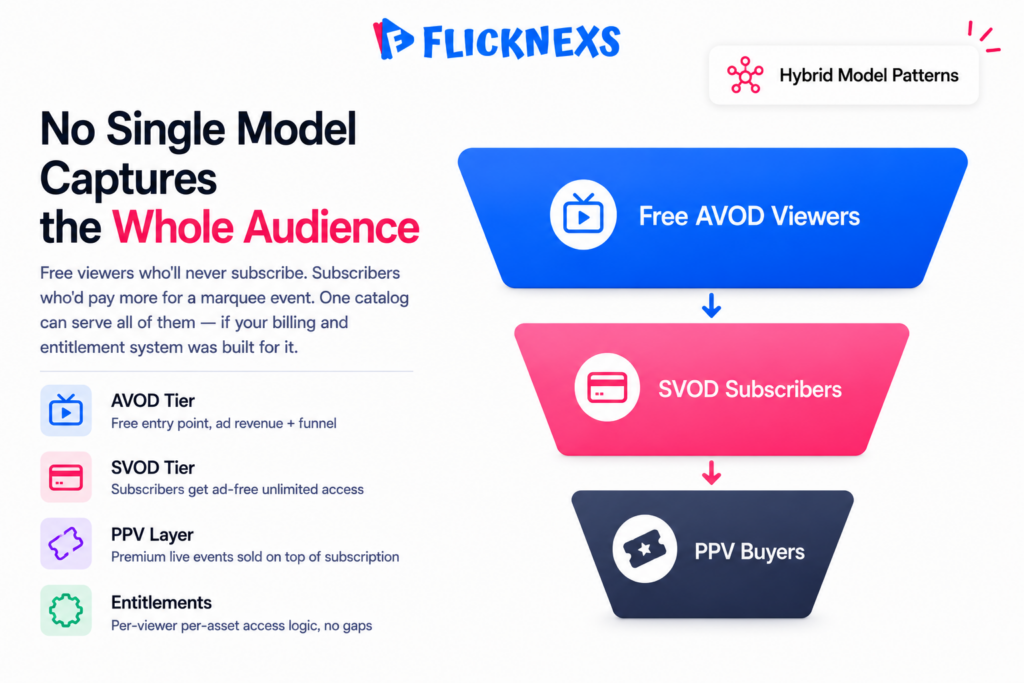
Here is the conclusion most operators reach after a year in the market: no single model captures the whole audience. Some viewers will pay a subscription. Many never will but will happily watch with ads. A subset will pay a premium for one marquee title or live event. Hybrid monetization lets one catalog serve all of them.
Common hybrid patterns
- SVOD + AVOD (freemium): a free, ad-supported tier funnels viewers into a paid, ad-free tier. The free tier is both a revenue stream and a marketing funnel.
- SVOD + TVOD: subscribers get the full catalog, but brand-new or premium releases get sold separately as rentals or purchases on top.
- AVOD + PPV: a free channel builds the audience and headline live events are sold as pay-per-view to that warm audience.
- All four: mature platforms run a free ad tier, a subscription tier, transactional rentals and PPV events at the same time, with the player and billing system deciding per asset which gating applies.
The benefit is obvious: you monetize the same content multiple ways and stop leaving money on the table from viewers who do not fit your primary model. The cost is complexity. Billing, entitlements, ad logic and analytics all have to coexist cleanly. This is exactly where a purpose-built platform earns its keep, because building entitlement and billing logic for four models in-house is a large engineering project. In practice the part that bites first isn’t the billing, it’s entitlements: deciding, per viewer per asset, whether someone who rented a title and also holds a lapsed subscription still gets to watch. Get that edge case wrong and you either refund angry customers or quietly give content away. We go deeper on the economics in our guide to hybrid monetization OTT strategy.
How to choose your video monetization model
There is no universally best model, only the best fit for your content and audience. A few questions cut through most of the decision:
- How deep and fresh is your catalog? Deep and regularly updated favors SVOD. Thin or static favors TVOD or AVOD.
- How big can your free audience get? AVOD needs scale to matter. If you cannot realistically reach a large audience, ad revenue will disappoint.
- Do you have marquee titles or live events? If yes, TVOD and PPV unlock premium pricing your base model cannot.
- What can your audience afford? Price sensitivity in your region and niche often decides between subscription and ad-supported as the primary tier.
- What is your operational capacity? PPV and full hybrid demand more from your tech and team than a single SVOD tier.
A practical path if you’re just starting out: pick one primary model that matches your strongest asset, prove out demand, then layer in a second model to catch the audience the first one leaves on the table.The Wikipedia overview of video on demand is a solid neutral primer and Google’s guidance on interactive media ads is useful background on how ad insertion actually works under the hood.
Ready to monetize your videos? Launch a VOD platform with Flicknexs →
Frequently asked questions
Related guides
- Video Monetization Models Hub (start here)
- How to Launch a FAST Channel in 2026: Step-by-Step Setup & Distribution
- Server-Side Ad Insertion (SSAI) vs Client-Side: Which Boosts AVOD Revenue
- Hybrid Monetization: Combining Subscriptions, Ads & Pay-Per-View Profitably
Ready to build?
If you’re planning your next Monetization project, Flicknexs handles the video infrastructure end-to-end — so you can ship in weeks, not months.
- monetize your OTT with Flicknexs
- see pricing and plans
More on video monetization
Continue exploring more on this topic across the Flicknexs blog.