
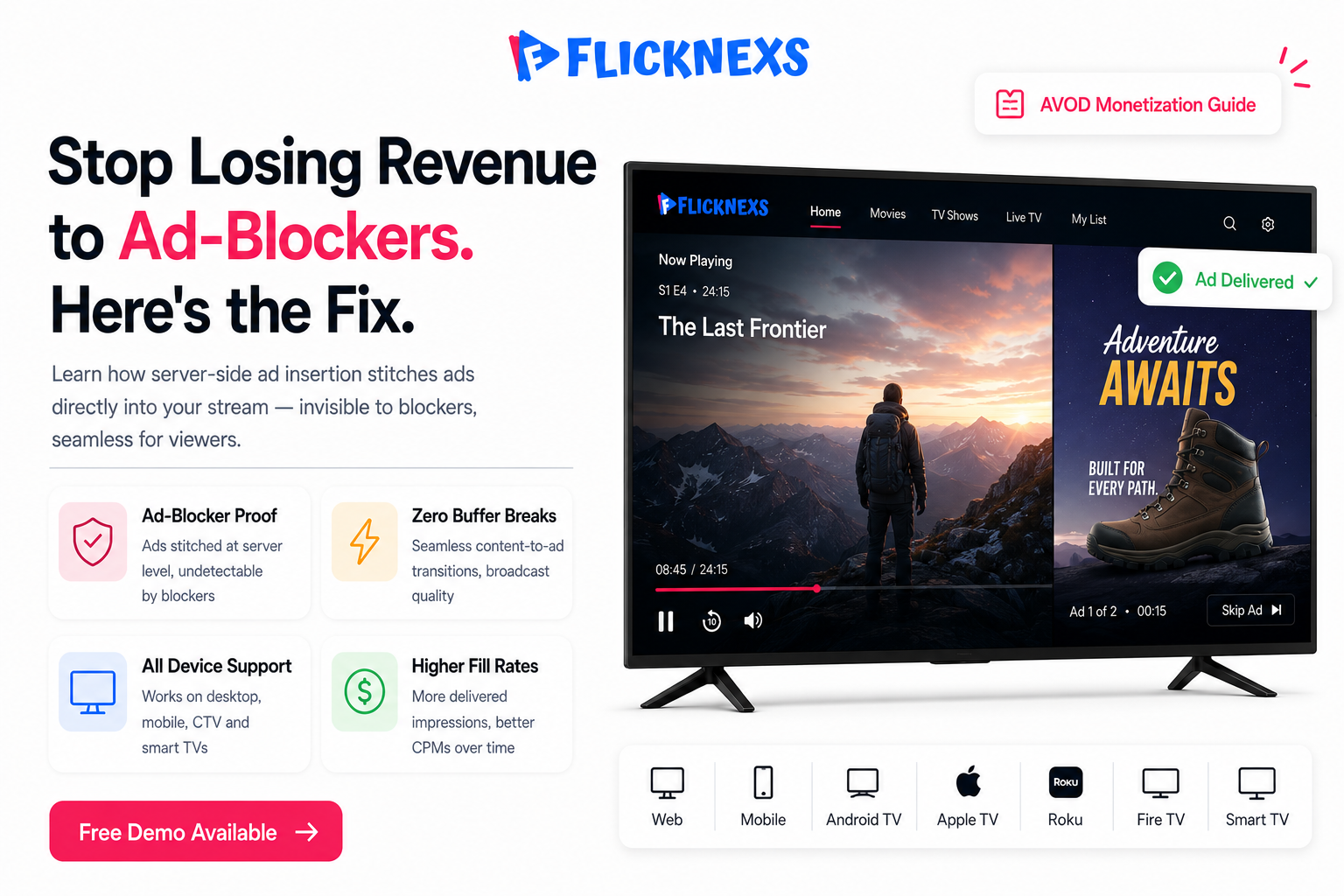
Quick Answer: Server-side ad insertion (SSAI) stitches ads directly into the video stream on the server before it reaches the viewer, making ads indistinguishable from content. Because ad-blockers rely on detecting separate ad requests in the browser, they can’t identify or block a stitched stream — which is why SSAI beats client-side ad-blocking.
Your view numbers look fine. Your ad revenue doesn’t. That gap isn’t a data anomaly to flag with your analytics team. It’s ad-blockers, and they’re skimming from you every hour your platform runs.
For anyone running an AVOD or hybrid OTT platform, this is probably the most quietly damaging problem in your revenue stack. You’ve invested in infrastructure, licensed content and sold your ad inventory. And then a chunk of that revenue doesn’t show up because the viewer’s browser or app killed the ad before it ever rendered. Client-side ad delivery makes this easy for them.
Server-side ad insertion (SSAI) is how platforms that actually figured this out solved it. Think of it like baking the ads into the video stream before it ever leaves your server. A TV broadcaster doesn’t send the show and the commercials as two separate things. It’s one signal. SSAI works the same way. By the time the stream reaches a viewer’s device, there’s nothing separate to intercept or block.
No paywalls. No guilt messages. No friction for the user at all. Just a different architecture for how the ad gets there.
This guide breaks down exactly what SSAI is, why it works where client-side methods keep failing and what you need to know before implementing it on your platform.
What Is Server-Side Ad Insertion (SSAI)?
Most ad delivery systems work like a relay race.Prepared to reformulate technical explanation clearlyPrepared to reformulate technical explanation clearlyMost ad delivery systems work like a relay race. Your content runs its leg, hands off to the ad server, the ad runs its leg, and the player tries to make the whole thing look . Every one of those handoffs is a point of failure and a point of interception.SSAI skips the relay entirely. The server stitches the ad into the video before the stream leaves. What the viewer receives isn’t content plus ads. It’s one continuous piece of video that already has everything in it.
SSAI skips the relay entirely. The server stitches the ad into the video before the stream leaves. What the viewer receives isn’t content plus ads. It’s just video. One continuous file that already has everything in it.. One continuous piece of video.
Think of how a cable broadcast works. The commercial doesn’t travel separately and get spliced in by your TV. It’s already in the signal. SSAI works on exactly the same principle, just for IP-delivered video.
Because it’s one stream, there’s no second URL being called on the viewer’s device. No separate ad request firing in the background. Ad-blockers are built to look for that request and kill it. When SSAI is running properly, there’s nothing to intercept. The technical layer they were designed to target simply doesn’t exist anymore.
That’s not a clever workaround. That’s a different architecture entirely.
How SSAI Actually Works
The mechanics are worth understanding before you commit to anything.
The moment a viewer hits play, your ad server gets notified that a session is starting. It pulls targeting parameters, selects the right ads and lines up the sequence. That part isn’t new. What happens next is where SSAI diverges from everything else.
Instead of sending that ad selection to the viewer’s device to be assembled there, the SSAI system takes your content and those ad creatives and stitches them into a single video manifest on the server, in real time, fast enough that the viewer never notices a gap.
What the player receives is one HLS or DASH stream with no technical boundary between content and ad. The transition is smooth not because the player is doing clever interpolation, but because at the delivery level there’s genuinely nothing to transition between. It’s the same stream throughout.
By the time any of this reaches the viewer’s device the ad is already inside the video. The ad-blocker is looking for a separate request to kill there isn’t one
SSAI vs CSAI(Client-Side Ad Insertion): The difference actually matters
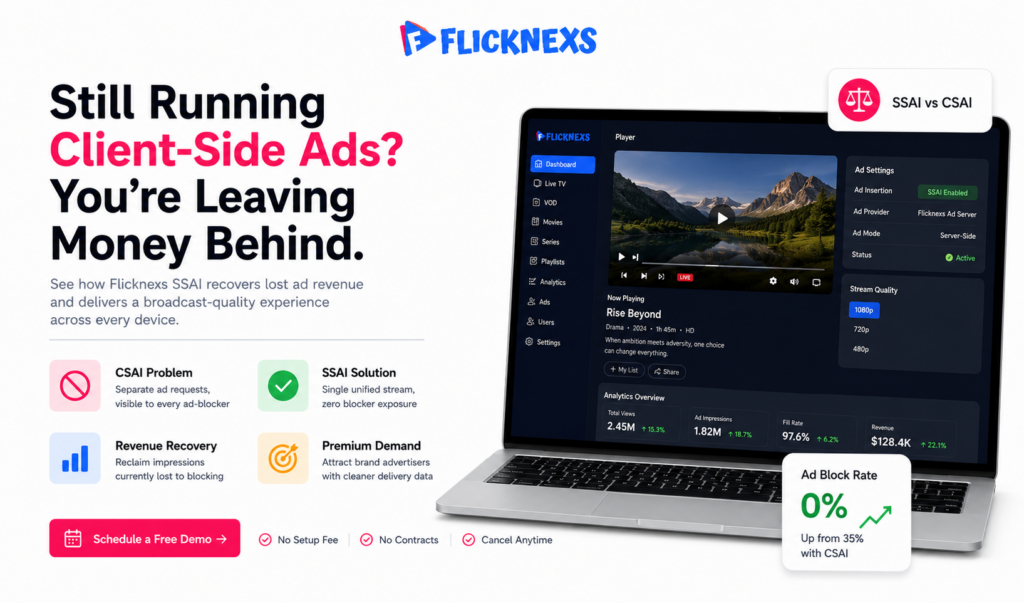
Most platforms start with client-side ad insertion because it’s easier to set up and doesn’t demand much from your server infrastructure. That reasonable place to start and it’s also why most platforms eventually hit a wall.
When a viewer hits an ad break in a CSAI setup the player pauses, fires a request to an ad server and gets back a URL pulls that ad from a separate CDN and then resumes your content. Every one of those steps leaves a footprint on the network. The pause. The outgoing request to an ad domain. The separate file loading from a different origin. Ad-blockers were built specifically to recognize that sequence and kill it.
SSAI removes every one of those signals because the stream arrives already complete. There’s nothing separate to detect.
But here’s what most people don’t mention when they’re comparing the two: ad-blocking isn’t even the only problem with CSAI. The viewer experience takes a hit regardless.
All that stopping, requesting and loading creates buffering gaps at ad breaks. On mobile that’s annoying. On a CTV device, where viewers expect something close to broadcast quality, it’s jarring enough to damage how they perceive your platform. Not your ads. Your platform.
With SSAI the ad was already inside the stream before it reached the device. No buffer spin. No load delay. The transition from content to ad is smooth because technically there is no transition. It’s the same video file the entire time.
Why Ad-Blockers Cannot Block SSAI
Ad-blockers run on a blocklist model. They maintain databases of known ad-serving domains, CDN patterns and request signatures. When a network request matches something in that database, it gets blocked.
That model has one structural dependency: something has to be identifiable as an ad request before it can be intercepted.
With SSAI, there’s nothing to identify. The content and the ads come from the same CDN and the same domain and the same manifest file. From the network’s perspective the viewer is just watching a video stream. No separate request. No distinguishable signature.
This isn’t a hack that ad-blockers will eventually patch around. To block SSAI ads, an ad-blocker would have to block all video playback entirely. No ad-blocker survives that decision with its user base intact.
Here’s what that means practically for your platform:
- Your ads and content share the same CDN and domain, so there’s no separate request pattern for blocklists to flag
- The stream manifest is unified, meaning there’s no technical seam an ad-blocker can locate and cut at
- Some ad-blockers have experimented with frame-level stream analysis to detect SSAI, but it’s computationally expensive and unreliable enough that it hasn’t become standard
- The real-world result is a significant recovery in ad delivery in environments where client-side blocking was quietly cutting into your fill rates
The protection isn’t a feature you configure. It’s a consequence of the architecture.
The Benefits That Go Beyond Defeating Ad-Blockers
Most conversations about SSAI start and end with ad-blocking. That’s understandable, but it undersells what you actually gain.
Viewer experience improves measurably
transitions between content and ads reduce the friction that causes viewers to leave during ad breaks. The lower friction means better completion rates. Better completion rates mean higher advertiser satisfaction and stronger CPMs over time.
Premium advertisers become more interested in your inventory
Brand advertisers moving budget into CTV and streaming are increasingly selective about viewability and measurability and brand safety. SSAI enables cleaner tracking, more reliable reporting and better delivery guarantees. That makes your inventory more attractive to the buyers paying the highest rates.
Live stream monetization becomes practical
Client-side ad insertion struggles with live streams because ad breaks have to be dynamically inserted into an ongoing real-time feed, and the failure modes are visible to viewers. SSAI handles dynamic ad insertion into live streams significantly more reliably.
For news platforms, sports broadcasters and live event streamers, this opens monetization capabilities that are genuinely difficult to achieve well with client-side approaches.
Player complexity decreases
With CSAI, your video player has to manage ad SDK integration, ad request logic, error handling for failed ad loads and fallback behavior when ads don’t deliver. That’s substantial complexity at the client layer, and it creates more things that can break across device types.
SSAI moves that complexity to the server. Your player just plays the stream.
The Hidden Cost of Letting Ad-Blockers Win
Most platforms calculate the cost of ad-blocking the same way: impressions lost times CPM. That number stings. It’s also incomplete.
Here’s what that calculation misses. When advertisers consistently see lower delivery rates or weaker viewability metrics on your inventory, they adjust their bids down. Lower bids mean lower CPMs. So now you’re not just losing impressions to blockers. You’re earning less on every impression that does deliver, because your platform looks less reliable than it actually is.
Ad-blocking doesn’t just shrink your volume. It quietly degrades the perceived value of your entire inventory.
SSAI fixes both sides of that at once. Higher delivery rates clean up your reported metrics. Better metrics rebuild advertiser confidence. Better confidence pushes CPMs back up.The real revenue impact over time tends to run significantly higher than the back-of-envelope blocking calculation most platforms start with, because that calculation only accounts for what you can directly see.
Source: Forasoft SSAI guide — concrete math showing recovered revenue dwarfs
stitching cost
What SSAI Still Can’t Fix
This is the section most SSAI vendors either skip or bury. It’s worth understanding clearly before you make a decision.
Ad tracking is more complex to set up correctly
With CSAI, tracking pixels fire directly from the viewer’s device. This is clean and straightforward for third-party verification. With SSAI, tracking events fire server-side, which some ad networks and measurement platforms treat differently.
Modern SSAI systems handle this in ways that satisfy most major ad platforms, but if you’re working with advertisers or DSPs that have strict client-side verification requirements, you need to have that conversation before implementation, not after.
Infrastructure costs increase
SSAI requires more server-side processing than CSAI because you’re stitching streams in real time. At scale, this increases CDN and compute costs. Most enterprise SSAI platforms have worked out efficient architectures for this, but you should factor it into your total cost modeling rather than comparing only the platform licensing fee.
Live stream latency can be affected
SSAI adds processing time to live streams because stitching happens in real time. For most viewers this delay is negligible, but for latency-sensitive use cases like live sports or betting, even a brief delay creates real problems. For most live content use cases, that’s acceptable.The latency-sensitive use cases like live sports or betting, even a few seconds of delay creates real problems. If that’s your scenario, ask SSAI vendors directly what their latency profile looks like for live ad insertion. How specifically they answer that question tells you more about their actual experience with it than anything in their sales deck.
One more thing worth saying plainly: SSAI solves a delivery problem. It doesn’t fix a bad ad strategy.
If your ads are poorly targeted, running at aggressive frequency or genuinely disruptive to watch, viewers won’t install a better ad-blocker. They’ll just leave. SSAI gives you a better mechanism for getting ads in front of people. What you put through that mechanism still determines whether they stick around.
Source: Sima Labs + iReplay.tv — traditional SSAI adds 4–8 sec; modern sub-2-sec
with AI
Common Mistakes Platforms Make When Implementing SSAI
These are the things most teams discover after they’ve already started building.
Assuming existing CDN configuration transfers over without changes
SSAI changes your CDN architecture because you’re serving stitched streams rather than separate content and ad files. Platforms that assume their current CDN setup will work without modification often hit performance and caching issues in the first weeks of deployment.
Testing only on VOD and skipping live stream validation
Live SSAI behaves differently from VOD SSAI in several important ways. Teams that only test on pre-recorded content are frequently surprised when live stream ad insertion doesn’t perform equivalently. Always test both scenarios before going live with either.
Not aligning tracking with ad partners before building
Discovering that a key ad network has reporting discrepancies with your SSAI implementation after you’ve launched is an expensive problem to untangle. Have the tracking and verification conversation with your ad partners during planning, not after deployment.
Choosing a vendor primarily on price
SSAI stream reliability directly determines your fill rates and your viewer experience. A cheaper provider with higher stitching failure rates will cost you more in lost revenue than you saved on the platform fee. Evaluate uptime metrics and reliability history, not just licensing cost.
What to Look for When Evaluating SSAI Solutions
If you’ve decided SSAI fits your platform’s trajectory, here is what separates providers worth using from ones that will create problems later.
Low-latency live SSAI support
Not all SSAI platforms handle live streams with equal competence. If live content is part of your roadmap now or in the next 12 months it confirm specifically what latency the provider achieves for live ad insertion before committing.
IAB VAST 4.x compatibility
Your SSAI solution needs to work with the ad standards your demand partners use. Ask specifically which VAST versions are supported and whether there are any known compatibility limitations with your ad tech stack.
Flexible ad decisioning
The best SSAI solutions let you connect your own ad server or work with multiple ad networks. If a vendor requires you to use their proprietary ad decisioning exclusively, you lose flexibility and negotiating over time.
Reliable uptime with documented redundancy
Ask specifically about uptime SLAs geographic redundancy and what happens to stream playback if the ad stitching service experiences an outage. That last answer tells you a lot about how seriously they’ve thought about failure scenarios.
Integrated analytics
You need visibility into fill rates, completion rates, stitching errors and revenue in one place. Solutions that require you to reconcile data across multiple dashboards create blind spots in your monetization visibility that will cost you.
Is SSAI Right for Your Platform Right Now?
SSAI is not a universal answer for every platform at every stage. Here is how to think about where your platform sits.
SSAI is probably the right move if:
while You running an AVOD or hybrid monetization model where ad revenue is material to your business.If your view counts and ad impression numbers have a gap that normal variance doesn’t explain, that’s your signal. Same if a meaningful chunk of your audience is on desktop browsers, where ad-blocker penetration runs highest. You want to attract direct brand deals and premium programmatic buyers. You’re building or scaling a live streaming monetization capability.
Source: Backlinko / GWI 2025 data — desktop still leads for ad-blocker installation
You might reasonably wait if:
You’re very early stage with traffic volumes where the revenue impact of ad-blocking is still minimal in absolute terms. Your audience is primarily on closed mobile environments like iOS and Android apps where ad-blocking is less prevalent. Subscriptions are your primary revenue model and ads are a genuinely secondary stream.
On the volume question:
There is no universal threshold that works for every platform, but as a general orientation: if ad revenue is a primary driver and you’re operating at meaningful scale, the revenue recovery from improved delivery rates typically makes the infrastructure cost worthwhile well before the end of your first year running it.
For platforms at earlier stages, cloud-based SSAI solutions with consumption-based pricing make the math accessible before you reach enterprise-level scale.
Source: Mixpanel 2026 benchmarks + Vodlix OTT benchmarks — MAU tiers for
monetization
Conclusion
Most people searching for SSAI are already losing money to ad-blockers. They just haven’t quantified it clearly enough to act on it yet.
You’ve now seen exactly how the problem works at a technical level and why client-side delivery was never built to solve it. You understand what SSAI actually does, where it genuinely helps and where its limits are. You know what to watch for in vendors and what mistakes to avoid before you build.
That puts you ahead of most operators who are still patching a structural problem with surface-level fixes.
The decision now is simple. Either ad revenue keeps leaking at its current rate, or you change the architecture that’s causing the leak.
SSAI isn’t the most glamorous infrastructure decision you’ll make for your platform. But it’s one of the few decisions that directly recovers revenue you’re already earning but not collecting.
If you want to see how Flicknexs handles server-side ad insertion as part of a complete OTT monetization stack, our team can walk you through the setup and help you map it to your specific platform model.
FAQ
Does SSAI completely eliminate ad-blocking?
How much does SSAI cost for an OTT platform?
Will SSAI affect video quality or stream performance?
How long does SSAI take to implement?
What is the difference between SSAI and DAI?
Ready to build?
If you’re planning your next Monetization / SSAI project, Flicknexs handles the video infrastructure end-to-end — so you can ship in weeks, not months.
- get SSAI-ready OTT
- see pricing and plans
More on server-side ad insertion
Continue exploring more on this topic across the Flicknexs blog.
- The definitive guide: How to Start OTT Platform in 2026
- What If Networks Want Control Over Their Own Ads?
Ready to build?
If you’re planning your next Monetization / SSAI project, Flicknexs handles the video infrastructure end-to-end — so you can ship in weeks, not months.
- get SSAI-ready OTT
- see pricing and plans
More on server-side ad insertion
Continue exploring more on this topic across the Flicknexs blog.
- The definitive guide: How to Start OTT Platform in 2026
- What If Networks Want Control Over Their Own Ads?
Ready to build?
If you’re planning your next Monetization / SSAI project, Flicknexs handles the video infrastructure end-to-end — so you can ship in weeks, not months.
- get SSAI-ready OTT
- see pricing and plans
More on server-side ad insertion
Continue exploring more on this topic across the Flicknexs blog.
- The definitive guide: How to Start OTT Platform in 2026
- What If Networks Want Control Over Their Own Ads?
Ready to build?
If you’re planning your next Monetization / SSAI project, Flicknexs handles the video infrastructure end-to-end — so you can ship in weeks, not months.
- get SSAI-ready OTT
- see pricing and plans
More on server-side ad insertion
Continue exploring more on this topic across the Flicknexs blog.
- The definitive guide: How to Start OTT Platform in 2026
- What If Networks Want Control Over Their Own Ads?
Ready to build?
If you’re planning your next Monetization / SSAI project, Flicknexs handles the video infrastructure end-to-end — so you can ship in weeks, not months.
- get SSAI-ready OTT
- see pricing and plans
More on server-side ad insertion
Continue exploring more on this topic across the Flicknexs blog.
- The definitive guide: How to Start OTT Platform in 2026
- What If Networks Want Control Over Their Own Ads?
Ready to build?
If you’re planning your next Monetization / SSAI project, Flicknexs handles the video infrastructure end-to-end — so you can ship in weeks, not months.
- get SSAI-ready OTT
- see pricing and plans
More on server-side ad insertion
Continue exploring more on this topic across the Flicknexs blog.
- The definitive guide: How to Start OTT Platform in 2026
- What If Networks Want Control Over Their Own Ads?
Ready to build?
If you’re planning your next Monetization / SSAI project, Flicknexs handles the video infrastructure end-to-end — so you can ship in weeks, not months.
- get SSAI-ready OTT
- see pricing and plans
More on server-side ad insertion
Continue exploring more on this topic across the Flicknexs blog.
- The definitive guide: How to Start OTT Platform in 2026
- What If Networks Want Control Over Their Own Ads?
Ready to build?
If you’re planning your next Monetization / SSAI project, Flicknexs handles the video infrastructure end-to-end — so you can ship in weeks, not months.
- get SSAI-ready OTT
- see pricing and plans
More on server-side ad insertion
Continue exploring more on this topic across the Flicknexs blog.
- The definitive guide: How to Start OTT Platform in 2026
- What If Networks Want Control Over Their Own Ads?
Ready to build?
If you’re planning your next Monetization / SSAI project, Flicknexs handles the video infrastructure end-to-end — so you can ship in weeks, not months.
- get SSAI-ready OTT
- see pricing and plans
More on server-side ad insertion
Continue exploring more on this topic across the Flicknexs blog.
- The definitive guide: How to Start OTT Platform in 2026
- What If Networks Want Control Over Their Own Ads?
Ready to build?
If you’re planning your next Monetization / SSAI project, Flicknexs handles the video infrastructure end-to-end — so you can ship in weeks, not months.
- get SSAI-ready OTT
- see pricing and plans
More on server-side ad insertion
Continue exploring more on this topic across the Flicknexs blog.
- The definitive guide: How to Start OTT Platform in 2026
- What If Networks Want Control Over Their Own Ads?
Ready to build?
If you’re planning your next Monetization / SSAI project, Flicknexs handles the video infrastructure end-to-end — so you can ship in weeks, not months.
- get SSAI-ready OTT
- see pricing and plans
More on server-side ad insertion
Continue exploring more on this topic across the Flicknexs blog.
- The definitive guide: How to Start OTT Platform in 2026
- What If Networks Want Control Over Their Own Ads?
Ready to build?
If you’re planning your next Monetization / SSAI project, Flicknexs handles the video infrastructure end-to-end — so you can ship in weeks, not months.
- get SSAI-ready OTT
- see pricing and plans
More on server-side ad insertion
Continue exploring more on this topic across the Flicknexs blog.
- The definitive guide: How to Start OTT Platform in 2026
- What If Networks Want Control Over Their Own Ads?
Ready to build?
If you’re planning your next Monetization / SSAI project, Flicknexs handles the video infrastructure end-to-end — so you can ship in weeks, not months.
- get SSAI-ready OTT
- see pricing and plans
More on server-side ad insertion
Continue exploring more on this topic across the Flicknexs blog.
- The definitive guide: How to Start OTT Platform in 2026
- What If Networks Want Control Over Their Own Ads?
Ready to build?
If you’re planning your next Monetization / SSAI project, Flicknexs handles the video infrastructure end-to-end — so you can ship in weeks, not months.
- get SSAI-ready OTT
- see pricing and plans
More on server-side ad insertion
Continue exploring more on this topic across the Flicknexs blog.
- The definitive guide: How to Start OTT Platform in 2026
- What If Networks Want Control Over Their Own Ads?
Ready to build?
If you’re planning your next Monetization / SSAI project, Flicknexs handles the video infrastructure end-to-end — so you can ship in weeks, not months.
- get SSAI-ready OTT
- see pricing and plans
More on server-side ad insertion
Continue exploring more on this topic across the Flicknexs blog.
- The definitive guide: How to Start OTT Platform in 2026
- What If Networks Want Control Over Their Own Ads?
Ready to build?
If you’re planning your next Monetization / SSAI project, Flicknexs handles the video infrastructure end-to-end — so you can ship in weeks, not months.
- get SSAI-ready OTT
- see pricing and plans
More on server-side ad insertion
Continue exploring more on this topic across the Flicknexs blog.
- The definitive guide: How to Start OTT Platform in 2026
- What If Networks Want Control Over Their Own Ads?
Ready to build?
If you’re planning your next Monetization / SSAI project, Flicknexs handles the video infrastructure end-to-end — so you can ship in weeks, not months.
- get SSAI-ready OTT
- see pricing and plans
More on server-side ad insertion
Continue exploring more on this topic across the Flicknexs blog.
- The definitive guide: How to Start OTT Platform in 2026
- What If Networks Want Control Over Their Own Ads?
Ready to build?
If you’re planning your next Monetization / SSAI project, Flicknexs handles the video infrastructure end-to-end — so you can ship in weeks, not months.
- get SSAI-ready OTT
- see pricing and plans
More on server-side ad insertion
Continue exploring more on this topic across the Flicknexs blog.
- The definitive guide: How to Start OTT Platform in 2026
- What If Networks Want Control Over Their Own Ads?
Ready to build?
If you’re planning your next Monetization / SSAI project, Flicknexs handles the video infrastructure end-to-end — so you can ship in weeks, not months.
- get SSAI-ready OTT
- see pricing and plans
More on server-side ad insertion
Continue exploring more on this topic across the Flicknexs blog.
- The definitive guide: How to Start OTT Platform in 2026
- What If Networks Want Control Over Their Own Ads?
Ready to build?
If you’re planning your next Monetization / SSAI project, Flicknexs handles the video infrastructure end-to-end — so you can ship in weeks, not months.
- get SSAI-ready OTT
- see pricing and plans
More on server-side ad insertion
Continue exploring more on this topic across the Flicknexs blog.
- The definitive guide: How to Start OTT Platform in 2026
- What If Networks Want Control Over Their Own Ads?
Ready to build?
If you’re planning your next Monetization / SSAI project, Flicknexs handles the video infrastructure end-to-end — so you can ship in weeks, not months.
- get SSAI-ready OTT
- see pricing and plans
More on server-side ad insertion
Continue exploring more on this topic across the Flicknexs blog.
- The definitive guide: How to Start OTT Platform in 2026
- What If Networks Want Control Over Their Own Ads?
Ready to build?
If you’re planning your next Monetization / SSAI project, Flicknexs handles the video infrastructure end-to-end — so you can ship in weeks, not months.
- get SSAI-ready OTT
- see pricing and plans
More on server-side ad insertion
Continue exploring more on this topic across the Flicknexs blog.
- The definitive guide: How to Start OTT Platform in 2026
- What If Networks Want Control Over Their Own Ads?
Ready to build?
If you’re planning your next Monetization / SSAI project, Flicknexs handles the video infrastructure end-to-end — so you can ship in weeks, not months.
- get SSAI-ready OTT
- see pricing and plans
More on server-side ad insertion
Continue exploring more on this topic across the Flicknexs blog.
- The definitive guide: How to Start OTT Platform in 2026
- What If Networks Want Control Over Their Own Ads?
Ready to build?
If you’re planning your next Monetization / SSAI project, Flicknexs handles the video infrastructure end-to-end — so you can ship in weeks, not months.
- get SSAI-ready OTT
- see pricing and plans
More on server-side ad insertion
Continue exploring more on this topic across the Flicknexs blog.
- The definitive guide: How to Start OTT Platform in 2026
- What If Networks Want Control Over Their Own Ads?
Ready to build?
If you’re planning your next Monetization / SSAI project, Flicknexs handles the video infrastructure end-to-end — so you can ship in weeks, not months.
- get SSAI-ready OTT
- see pricing and plans
More on server-side ad insertion
Continue exploring more on this topic across the Flicknexs blog.
- The definitive guide: How to Start OTT Platform in 2026
- What If Networks Want Control Over Their Own Ads?
Ready to build?
If you’re planning your next Monetization / SSAI project, Flicknexs handles the video infrastructure end-to-end — so you can ship in weeks, not months.
- get SSAI-ready OTT
- see pricing and plans
More on server-side ad insertion
Continue exploring more on this topic across the Flicknexs blog.
- The definitive guide: How to Start OTT Platform in 2026
- What If Networks Want Control Over Their Own Ads?
Ready to build?
If you’re planning your next Monetization / SSAI project, Flicknexs handles the video infrastructure end-to-end — so you can ship in weeks, not months.
- get SSAI-ready OTT
- see pricing and plans
More on server-side ad insertion
Continue exploring more on this topic across the Flicknexs blog.
- The definitive guide: How to Start OTT Platform in 2026
- What If Networks Want Control Over Their Own Ads?
Ready to build?
If you’re planning your next Monetization / SSAI project, Flicknexs handles the video infrastructure end-to-end — so you can ship in weeks, not months.
- get SSAI-ready OTT
- see pricing and plans
More on server-side ad insertion
Continue exploring more on this topic across the Flicknexs blog.
- The definitive guide: How to Start OTT Platform in 2026
- What If Networks Want Control Over Their Own Ads?
Ready to build?
If you’re planning your next Monetization / SSAI project, Flicknexs handles the video infrastructure end-to-end — so you can ship in weeks, not months.
- get SSAI-ready OTT
- see pricing and plans
More on server-side ad insertion
Continue exploring more on this topic across the Flicknexs blog.
- The definitive guide: How to Start OTT Platform in 2026
- What If Networks Want Control Over Their Own Ads?
Ready to build?
If you’re planning your next Monetization / SSAI project, Flicknexs handles the video infrastructure end-to-end — so you can ship in weeks, not months.
- get SSAI-ready OTT
- see pricing and plans
More on server-side ad insertion
Continue exploring more on this topic across the Flicknexs blog.
- The definitive guide: How to Start OTT Platform in 2026
- What If Networks Want Control Over Their Own Ads?
Ready to build?
If you’re planning your next Monetization / SSAI project, Flicknexs handles the video infrastructure end-to-end — so you can ship in weeks, not months.
- get SSAI-ready OTT
- see pricing and plans
More on server-side ad insertion
Continue exploring more on this topic across the Flicknexs blog.
- The definitive guide: How to Start OTT Platform in 2026
- What If Networks Want Control Over Their Own Ads?
Ready to build?
If you’re planning your next Monetization / SSAI project, Flicknexs handles the video infrastructure end-to-end — so you can ship in weeks, not months.
- get SSAI-ready OTT
- see pricing and plans
More on server-side ad insertion
Continue exploring more on this topic across the Flicknexs blog.
- The definitive guide: How to Start OTT Platform in 2026
- What If Networks Want Control Over Their Own Ads?
Ready to build?
If you’re planning your next Monetization / SSAI project, Flicknexs handles the video infrastructure end-to-end — so you can ship in weeks, not months.
- get SSAI-ready OTT
- see pricing and plans
More on server-side ad insertion
Continue exploring more on this topic across the Flicknexs blog.
- The definitive guide: How to Start OTT Platform in 2026
- What If Networks Want Control Over Their Own Ads?
Ready to build?
If you’re planning your next Monetization / SSAI project, Flicknexs handles the video infrastructure end-to-end — so you can ship in weeks, not months.
- get SSAI-ready OTT
- see pricing and plans
More on server-side ad insertion
Continue exploring more on this topic across the Flicknexs blog.
- The definitive guide: How to Start OTT Platform in 2026
- What If Networks Want Control Over Their Own Ads?
Ready to build?
If you’re planning your next Monetization / SSAI project, Flicknexs handles the video infrastructure end-to-end — so you can ship in weeks, not months.
- get SSAI-ready OTT
- see pricing and plans
More on server-side ad insertion
Continue exploring more on this topic across the Flicknexs blog.
- The definitive guide: How to Start OTT Platform in 2026
- What If Networks Want Control Over Their Own Ads?
Ready to build?
If you’re planning your next Monetization / SSAI project, Flicknexs handles the video infrastructure end-to-end — so you can ship in weeks, not months.
- get SSAI-ready OTT
- see pricing and plans
More on server-side ad insertion
Continue exploring more on this topic across the Flicknexs blog.
- The definitive guide: How to Start OTT Platform in 2026
- What If Networks Want Control Over Their Own Ads?
Ready to build?
If you’re planning your next Monetization / SSAI project, Flicknexs handles the video infrastructure end-to-end — so you can ship in weeks, not months.
- get SSAI-ready OTT
- see pricing and plans
More on server-side ad insertion
Continue exploring more on this topic across the Flicknexs blog.
- The definitive guide: How to Start OTT Platform in 2026
- What If Networks Want Control Over Their Own Ads?
Ready to build?
If you’re planning your next Monetization / SSAI project, Flicknexs handles the video infrastructure end-to-end — so you can ship in weeks, not months.
- get SSAI-ready OTT
- see pricing and plans
More on server-side ad insertion
Continue exploring more on this topic across the Flicknexs blog.
- The definitive guide: How to Start OTT Platform in 2026
- What If Networks Want Control Over Their Own Ads?
Ready to build?
If you’re planning your next Monetization / SSAI project, Flicknexs handles the video infrastructure end-to-end — so you can ship in weeks, not months.
- get SSAI-ready OTT
- see pricing and plans
More on server-side ad insertion
Continue exploring more on this topic across the Flicknexs blog.
- The definitive guide: How to Start OTT Platform in 2026
- What If Networks Want Control Over Their Own Ads?
Ready to build?
If you’re planning your next Monetization / SSAI project, Flicknexs handles the video infrastructure end-to-end — so you can ship in weeks, not months.
- get SSAI-ready OTT
- see pricing and plans
More on server-side ad insertion
Continue exploring more on this topic across the Flicknexs blog.
- The definitive guide: How to Start OTT Platform in 2026
- What If Networks Want Control Over Their Own Ads?
Ready to build?
If you’re planning your next Monetization / SSAI project, Flicknexs handles the video infrastructure end-to-end — so you can ship in weeks, not months.
- get SSAI-ready OTT
- see pricing and plans
More on server-side ad insertion
Continue exploring more on this topic across the Flicknexs blog.
- The definitive guide: How to Start OTT Platform in 2026
- What If Networks Want Control Over Their Own Ads?
Ready to build?
If you’re planning your next Monetization / SSAI project, Flicknexs handles the video infrastructure end-to-end — so you can ship in weeks, not months.
- get SSAI-ready OTT
- see pricing and plans
More on server-side ad insertion
Continue exploring more on this topic across the Flicknexs blog.
- The definitive guide: How to Start OTT Platform in 2026
- What If Networks Want Control Over Their Own Ads?
Ready to build?
If you’re planning your next Monetization / SSAI project, Flicknexs handles the video infrastructure end-to-end — so you can ship in weeks, not months.
- get SSAI-ready OTT
- see pricing and plans
More on server-side ad insertion
Continue exploring more on this topic across the Flicknexs blog.
- The definitive guide: How to Start OTT Platform in 2026
- What If Networks Want Control Over Their Own Ads?
Ready to build?
If you’re planning your next Monetization / SSAI project, Flicknexs handles the video infrastructure end-to-end — so you can ship in weeks, not months.
- get SSAI-ready OTT
- see pricing and plans
More on server-side ad insertion
Continue exploring more on this topic across the Flicknexs blog.
- The definitive guide: How to Start OTT Platform in 2026
- What If Networks Want Control Over Their Own Ads?
Ready to build?
If you’re planning your next Monetization / SSAI project, Flicknexs handles the video infrastructure end-to-end — so you can ship in weeks, not months.
- get SSAI-ready OTT
- see pricing and plans
More on server-side ad insertion
Continue exploring more on this topic across the Flicknexs blog.
- The definitive guide: How to Start OTT Platform in 2026
- What If Networks Want Control Over Their Own Ads?
Ready to build?
If you’re planning your next Monetization / SSAI project, Flicknexs handles the video infrastructure end-to-end — so you can ship in weeks, not months.
- get SSAI-ready OTT
- see pricing and plans
More on server-side ad insertion
Continue exploring more on this topic across the Flicknexs blog.
- The definitive guide: How to Start OTT Platform in 2026
- What If Networks Want Control Over Their Own Ads?
Ready to build?
If you’re planning your next Monetization / SSAI project, Flicknexs handles the video infrastructure end-to-end — so you can ship in weeks, not months.
- get SSAI-ready OTT
- see pricing and plans
More on server-side ad insertion
Continue exploring more on this topic across the Flicknexs blog.
- The definitive guide: How to Start OTT Platform in 2026
- What If Networks Want Control Over Their Own Ads?
Ready to build?
If you’re planning your next Monetization / SSAI project, Flicknexs handles the video infrastructure end-to-end — so you can ship in weeks, not months.
- get SSAI-ready OTT
- see pricing and plans
More on server-side ad insertion
Continue exploring more on this topic across the Flicknexs blog.