
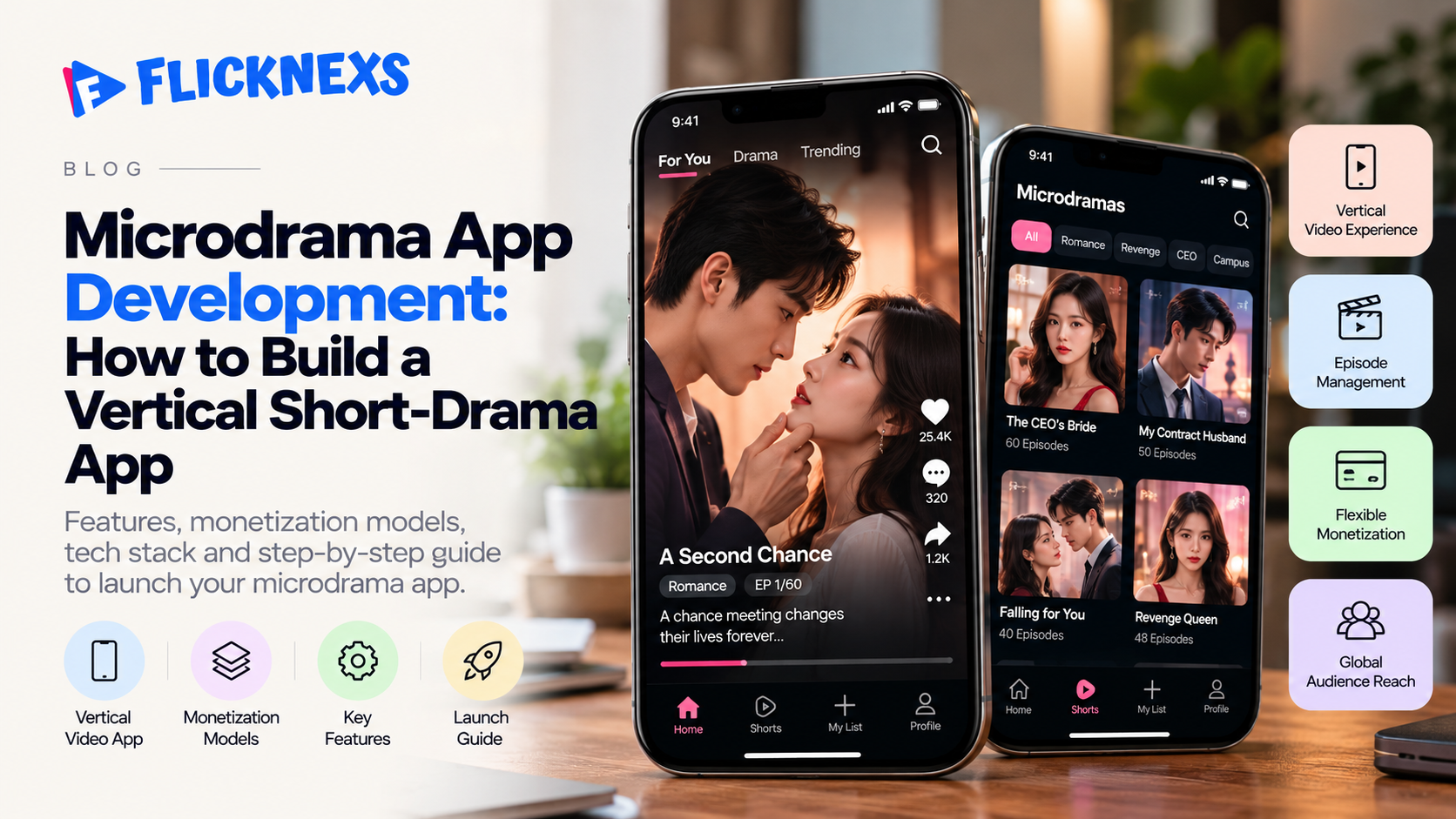
Microdrama app development is not a video-player project. It is the design of a product in which every one-to-three-minute episode has a job: hook the viewer, earn the next swipe, or earn a payment. Get that loop right and the technology choices follow. Get it wrong and a well-built app still loses viewers at episode six.
Flicknexs builds white-label OTT and microdrama streaming platforms for media companies, studios and entrepreneurs. This guide comes from that work. It covers what a microdrama platform needs, how to design the paywall episode by episode, how app-store billing rules affect coin sales, what to build first, and when a white-label platform is the faster route.
Quick answer: how do you build a microdrama app?
To build a microdrama app in 2026, you need five parts working as one system:
- A vertical, full-screen player with swipe-to-next and auto-play into the following episode.
- An episode-first content model: series → season → episode, with free or locked status set on each episode.
- Episode-level monetization: coins, pay-per-episode, subscriptions and ads, combined by rules you can edit.
- Streaming infrastructure: transcoding, adaptive bitrate, CDN delivery and fast start-up on mobile networks.
- A CMS and analytics layer that shows which episode viewers stop at and which unlock prompt converts.
In short: most media companies launch faster on a white-label microdrama OTT platform and spend their budget on content and user acquisition, not on rebuilding streaming infrastructure.
What is a microdrama app?
A microdrama app is a mobile-first streaming app for short, serialized dramas watched in vertical, full-screen format. Episodes run a few minutes, and most end on a cliffhanger that leads straight into the next one. Viewers swipe from episode to episode the way they scroll a social feed, but the content is scripted, produced and released as a series.
How a microdrama app differs from a standard OTT app
A standard OTT app sells access to a library. A microdrama app sells the next episode. That single shift changes the product, the data model and the revenue logic.
| Dimension | Standard OTT app | Microdrama app |
| Unit of value | The catalog (subscription) | The single episode |
| Screen orientation | Landscape-first | Vertical-first, full screen |
| Episode length | 20–60 minutes | Roughly 1–3 minutes |
| Discovery | Browse rows, search | Swipe feed, auto-play, cliffhanger into next |
| Paywall | At sign-up | Mid-series, often at one specific episode |
| Key metric | Monthly subscribers, churn | Episode-to-episode continuation, unlock rate |
| Catalog shape | Hundreds of titles | Fewer titles, thousands of episodes |
You cannot bolt microdrama onto a movie-streaming template. The paywall, the player and the analytics all have to treat each episode as an individual commercial unit.
Bottom line: a microdrama app is built around the episode, not the title. Every design decision that follows comes from that.
The engagement loop every feature serves
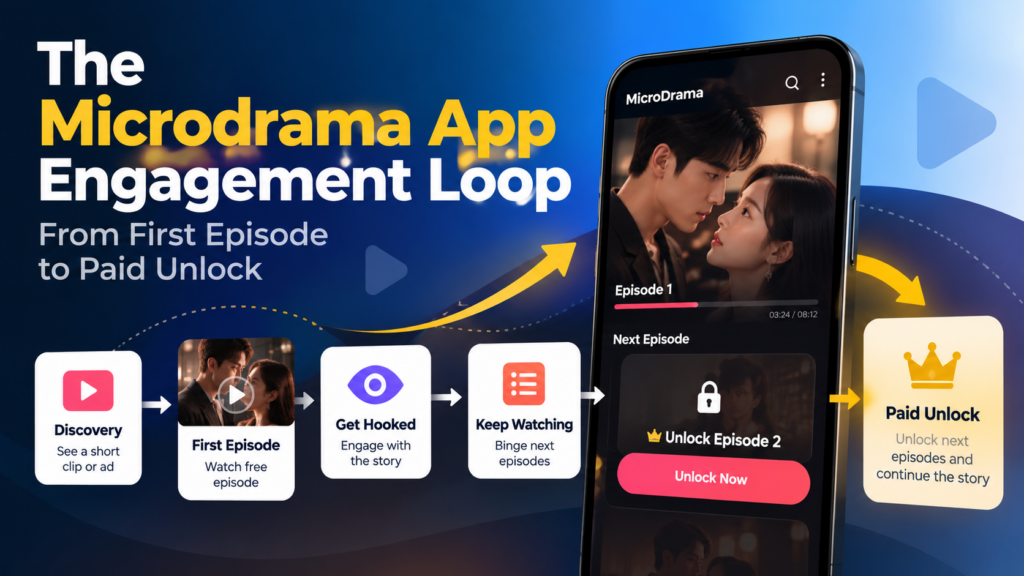
- The viewer opens the app and lands on an episode that is already playing.
- The episode ends on a cliffhanger.
- The next episode starts automatically.
- A few episodes later, the viewer reaches a locked episode.
- The viewer unlocks it with coins, a rewarded ad or a subscription.
- They keep watching until the latest released episode.
- A push notification brings them back when the next episode drops.
Every feature in the rest of this guide exists to shorten that loop or raise the share of viewers who complete it. When you review a feature request, ask which step of the loop it improves. If the answer is none, it can wait.
How to build a microdrama app: the eight platform layers
A production microdrama platform has eight layers. Each can be built in-house, licensed, or taken from a white-label platform, but all eight must exist before launch.
1. Vertical player and viewing experience
The player is the product. Build it for one-handed use:
- Full-screen 9:16 playback, with swipe up for the next episode and swipe down for the previous one
- Auto-play into the next episode after a short countdown, instead of a return to a catalog screen
- A progress bar across the whole series, so viewers see how far into the story they are
- Follow, favorite, share and add-to-list controls that work without leaving the video
- Pre-loading of the next episode, so it starts the moment the viewer swipes
- Subtitle toggle and playback speed, both reachable with a thumb
Test start-up time on a mid-range Android phone over a 4G connection, not on office Wi-Fi. That is where most of your audience will watch.
Bottom line: if the next episode doesn’t start instantly, the swipe habit never forms.
2. Episode-first content model
A movie library stores titles. A microdrama library stores series broken into many short episodes, so the data model needs more structure:
Series → Season → Episode → Video asset
Each episode record should carry its episode number, title, duration, vertical thumbnail, subtitle files per language, a short preview clip, release date and access rule (free, coins, ad-unlock or subscriber-only). Putting the access rule on the episode, not on the series, is what makes microdrama monetization possible later.
Plan the model for scale from the first day. A single series can hold 60 to 100 episodes, so a catalog of 50 series already means thousands of episode records to organize, localize and price.
3. Discovery for viewers who don’t know what they want
Most viewers open a microdrama app without a title in mind. Discovery should put an episode on screen within seconds:
- For You feed: episode one of series matched to past viewing
- Continue watching: always the first row for returning viewers
- Trending and new releases: refreshed daily
- Genre rails: romance, revenge, thriller, family, fantasy, mystery
- Search: by title, cast and genre, with vertical cover art in results
4. Video streaming infrastructure
Short episodes still need full streaming infrastructure: upload, transcoding into several renditions, adaptive bitrate delivery, CDN distribution and storage. Most platforms deliver with HTTP Live Streaming, which the IETF documents in RFC 8216. Adaptive bitrate lets the player drop to a lower rendition on a weak connection instead of stalling.
Short runtimes make start-up delay more visible, not less. A viewer who waits several seconds on every episode stops swiping. Tune your transcoding ladder for vertical 9:16 output and small screens, rather than reusing a 16:9 ladder built for TVs.
5. Content protection
Locked episodes are the product you sell, so they need protection: tokenized, expiring playback URLs, encryption, and DRM for premium catalogs. Without these, paid episodes can be shared or ripped, and the paywall loses its value.
6. Monetization engine
Coins, pay-per-episode, subscriptions and ads all read the per-episode access rule from layer 2. The engine also needs a coin ledger (balances, purchases, spends, refunds), subscription state, and the app-store billing integrations covered below.
7. CMS and operations
Content teams publish in volume, so the CMS has to handle bulk work: bulk episode upload, scheduled release drops, free or locked status per episode, coin price per episode, subtitles, artwork, and user and payment management. If publishing one series takes a day of clicks, the catalog will not grow fast enough to keep viewers.
[Image: flicknexs-cms-episode-lock.png, alt “Flicknexs CMS episode lock settings for a microdrama series”]
8. Apps across devices
Start with Android, iOS and mobile web, where vertical viewing happens. Keep the backend device-agnostic so web, Android TV, Fire TV, Roku, Samsung and LG apps can follow without rebuilding the platform. Connected-TV apps also let you repackage series into linear channels later, the model covered in our guide to FAST channels.
Design the paywall episode by episode
In microdrama, the paywall is a content decision, not a settings screen. Where you lock an episode shapes revenue more than which payment method you use. Plan it on paper before anyone writes code.
Monetization models your platform should support
| Model | How it works | Best for |
| Coins or credits | Viewers buy a coin pack and spend coins to unlock episodes | Impulse unlocks at cliffhangers |
| Pay-per-episode | Direct payment for a single episode | Markets used to small digital payments |
| Subscription | Weekly, monthly or annual pass to all locked episodes | Heavy viewers and binge behavior |
| Ad-unlock | Watch a rewarded ad to unlock one episode | Viewers who won’t pay yet |
| AVOD | Pre-roll or mid-roll ads on free episodes | Top-of-funnel reach |
| Hybrid | Free episodes + ads + coins + subscription | Most launches, because it shows what each market pays for |
A sample paywall map for one series
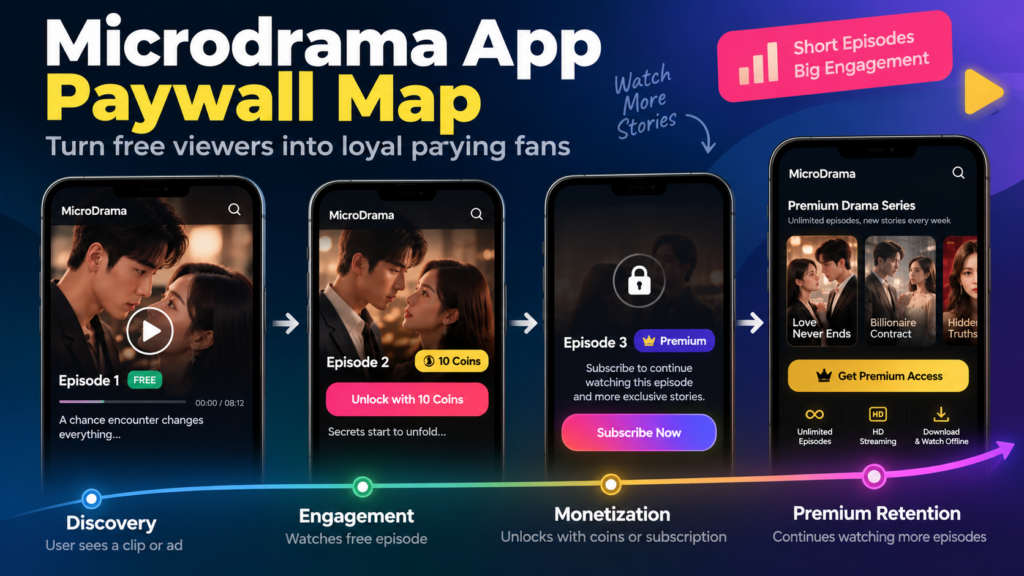
This is an illustrative starting template, not an industry benchmark. Test it against your own drop-off data.
| Episodes | Access | Why |
| 1–8 | Free | Establish the characters and the central conflict |
| 9 | Locked: coins or rewarded ad | First major cliffhanger, the highest-intent moment to ask |
| 10–40 | Coins per episode, or subscription | Core revenue stretch |
| 41–60 | Coins, subscription or ad-unlock | Keeps price-sensitive viewers moving |
| Finale | Subscription or coins | Viewers who reach it are the most committed |
Three rules keep a paywall map honest:
- Lock after the hook, not before it. A paywall that arrives before the story lands converts poorly and drives uninstalls.
- Always offer a free path. Rewarded-ad unlocks keep non-paying viewers in the funnel, where they can convert later.
- Make the rule editable per episode in the CMS. You will move the lock point several times after launch, and that should take minutes, not a developer ticket.
Bottom line: the lock point is your biggest revenue lever, so treat it as a variable you test, not a setting you choose once.
How app-store billing rules affect microdrama coins
Coins and subscriptions sold inside a mobile app are digital goods, and both major app stores require their own billing systems for them. Plan for this before you design your coin packs.
Apple’s App Store Review Guidelines, section 3.1.1, say that unlocking premium content, subscriptions or in-app currencies inside an iOS app must use in-app purchase. Google Play’s Payments policy likewise requires Google Play’s billing system for in-app purchases of digital goods, and lists virtual currencies and video subscriptions among them.
What this means for a microdrama platform:
- Price coin packs with store fees in mind. The store’s service fee comes out of each in-app sale, so model your revenue on net receipts, not list price.
- Keep one coin balance across platforms. A viewer who buys coins on the web should see the same balance on their phone. Both stores allow access to content bought elsewhere under conditions, so check the current rules for each storefront.
- Offer web checkout where it is allowed. Direct payment on your website avoids the in-app fee, but in-app links to outside payment are restricted and the rules vary by country. Confirm current policy before you add them.
- Use the store’s own tools for promotions, such as offer codes, rather than custom unlock codes, which can fail app review.
Bottom line: design the coin economy around app-store billing from day one, or you will rebuild it after your first rejected release.
Localization and regional payments
Microdrama is sold market by market, and each market changes what the platform must support.
- Subtitles and dubbing: store several subtitle and audio tracks per episode, and let the CMS publish a series in one language before others are ready.
- Regional pricing: coin packs and subscriptions priced in local currency, at levels that match local spending.
- Local payment methods: on the web, support the wallets, cards and UPI-style payment rails that each market already uses.
- Content rights by territory: geo-restrict series that are licensed only for certain countries.
- Local release schedules: drop episodes at peak viewing hours in each time zone.
If you plan to launch in more than one country, build these into the first version of the data model. Adding territories to a model that assumes one market is slow and error-prone.
Content sourcing: the part the app can’t build for you
A microdrama platform with too few complete series loses new viewers in the first session. Decide where the content comes from before development starts, because it affects the CMS, the rights model and the launch date.
| Source | What it involves | What the platform must support |
| In-house production | Your own writers, cast and shoots | Bulk upload, scheduled drops, full rights everywhere |
| Licensing | Existing series from studios or other platforms | Territory rules, license windows, revenue-share reporting |
| Commissioned studios | Studios produce to your brief | Studio or creator portals, delivery specs, approval workflow |
| Dubbing and adaptation | Existing series localized for new markets | Multiple audio and subtitle tracks per episode |
Whatever the mix, set a delivery spec early: 9:16 master resolution, safe areas for subtitles and UI, episode length range, and a cliffhanger at the end of each episode. Content that arrives in the wrong format costs more to fix than to shoot correctly.
Recommendations and AI workflows
Once the catalog passes a few dozen series, the For You feed matters more than any menu. Useful signals include completion rate per episode, series followed, episodes skipped, genre history and purchase history. Start with rules (genre match, trending in your region), then move to machine-learning ranking once you have enough viewing data to train on.
AI can also cut operating work behind the scenes:
- Metadata: draft synopses, tags and search keywords for each episode
- Localization: first-pass subtitle translation for human review
- Support: answer common questions about coins, subscriptions and account access
- Content operations: flag missing artwork, subtitles or access rules before a release goes live
Keep a person reviewing anything viewers see. AI speeds up the workflow; it does not replace editorial judgment.
Build from scratch or launch on a white-label microdrama platform?
Build from scratch only if the technology itself is your advantage. If your edge is content, audience or distribution, a white-label platform gets you to market faster and keeps engineering spend on what sets you apart. For a comparison of providers, see our list of white-label OTT platform providers.
| Factor | Build from scratch | White-label microdrama OTT platform |
| Time to launch | Longest: every layer built and tested | Shortest: infrastructure exists, you configure and brand it |
| Streaming infrastructure | You build transcoding, ABR, CDN and DRM | Included |
| CMS | Custom development | Existing, configured for episode workflows |
| Payments and coins | You integrate each gateway and ledger | Existing monetization framework |
| Apps | Separate builds per device | Branded apps from a shared codebase |
| Control | Every component | Brand, content, pricing and UX configuration |
| Ongoing maintenance | Your team, indefinitely | Shared with the platform provider |
Bottom line: build from scratch if technology is your product; choose white-label if content and audience are.
What drives microdrama app development cost
There is no honest single price, because scope varies widely. The main cost drivers are:
- Number of apps: mobile only, or mobile plus web and smart TV
- Depth of custom UI and UX versus configured templates
- Monetization complexity: a coin ledger, app-store billing, web gateways and regional pricing all add work
- Recommendation engine: rule-based or machine-learning
- Content protection and DRM requirements
- Number of languages and territories
- AI workflows for metadata, localization and support
- Hosting, storage and CDN bandwidth, which scale with viewers rather than with development
A better question than “how much does a microdrama app cost?” is “which parts of the business must the platform run on day one?” Price that list.
What to build first: MVP, growth and expansion
MVP (launch): registration, vertical player with auto-next, series and episode catalog, genre and search, continue watching, bulk-upload CMS, per-episode lock rules, one payment path (coins or subscription) through app-store billing, rewarded-ad unlock, core analytics, and Android plus iOS or mobile web.
Growth (after the first retention data): personalized For You feed, a full coin economy with packs and bonuses, push notifications for new episodes, referral rewards, A/B testing of lock points, and AI-generated metadata.
Expansion (after product-market fit): smart TV apps, regional payment methods, multi-language catalogs, advanced DRM, creator and studio portals, and programmatic advertising.
A 10-step roadmap to launch a microdrama platform
- Define audience and markets. Language, region and payment habits decide everything that follows.
- Commit a launch slate. Have enough complete series that new viewers never reach an empty feed.
- Draft the paywall map for each series before app development starts.
- Design the vertical player and swipe flow, then test it on real devices and real mobile networks.
- Set up the episode content model and CMS, including per-episode lock rules and territories.
- Configure streaming infrastructure: transcoding ladder, adaptive bitrate, CDN and content protection.
- Integrate payments: app-store billing for coins and subscriptions, rewarded ads, and web gateways for your markets.
- Ship Android, iOS and mobile web, with push notifications tied to new-episode releases.
- Instrument analytics and tracking on every episode, unlock prompt and call to action before launch day.
- Launch, read the drop-off data weekly, and move lock points based on what viewers actually do.
The metrics that matter in a microdrama app
Total views flatter you. Track these instead:
| Metric | What it tells you |
| Episode continuation rate | Share of viewers who start episode N+1 after finishing episode N |
| Drop-off episode | The exact episode where most viewers of a series stop |
| Paywall conversion | Share of viewers who unlock at the first locked episode |
| Unlock method mix | Coins versus subscription versus rewarded ad |
| Episodes per session | Depth of each binge |
| Day-1, Day-7 and Day-30 retention | Whether the viewing habit is forming |
| Revenue per active user | Whether the paywall map is working |
If thousands of viewers stop at the same episode, you have a precise brief: fix that story beat, move the lock, or change the price at that point.
Bottom line: measure continuation and drop-off per episode; total views hide the problems that cost you revenue.
Worked example: testing where to lock a series
Here is how a lock-point test runs in practice. The numbers are hypothetical, to show the method, not a benchmark.
A 60-episode romance series launches with episode 9 as the first locked episode. After two weeks, analytics show that most viewers who reach episode 9 leave without unlocking, and completion of episodes 6 to 8 is already falling.
The team runs a split test on new viewers:
| Variant | First locked episode | What the team watches |
| A (control) | Episode 9 | Paywall conversion, revenue per viewer |
| B | Episode 12, after a stronger cliffhanger | Paywall conversion, revenue per viewer |
| C | Episode 9, with a rewarded-ad unlock offered first | Ad-unlock rate, later coin purchases |
The winner is the variant with the highest revenue per viewer over 30 days, not the one with the highest conversion on day one. A later lock can convert fewer viewers but bring in more, because the viewers who reach it are more invested.
This test only works if the CMS lets the team change the lock point per episode, and analytics report by variant. Build both into the MVP.
Common microdrama app development mistakes
- Treating it as a standard OTT app. A landscape-first catalog with a sign-up paywall does not fit swipe-driven, episode-by-episode viewing.
- Locking episodes too early. A paywall before the story hooks the viewer mostly drives uninstalls.
- Hard-coding the paywall. If moving a lock point needs a developer and a release, you won’t test it often enough.
- Ignoring app-store billing. Coin systems that bypass store billing get rejected in review.
- Launching with too few series. Viewers who run out of content in one session rarely return.
- Measuring views, not continuation. Views hide the episode where the audience is leaving.
- Testing only on fast Wi-Fi. Your viewers watch on mobile data, where slow start-up kills the swipe habit.
How Flicknexs helps you build a microdrama platform
Flicknexs provides a white-label OTT platform that media companies, studios and entrepreneurs use to launch branded streaming services, including vertical microdrama apps, without assembling every layer themselves.
For a microdrama business, that covers:
- Branded apps for Android, iOS, web and smart TVs
- A video CMS with series, season and episode management
- VOD streaming with transcoding and CDN delivery
- Subscription, pay-per-view and advertising monetization
- Viewer analytics across content and revenue
- AI-assisted workflows for metadata and operations
You bring the dramas, the audience strategy and the pricing. Flicknexs carries the infrastructure, so your team can put its time into the paywall map, the content slate and growth.
Ready to launch? See how the platform handles episodes, paywalls and apps for your catalog.
Book a microdrama platform demo →
Frequently asked questions
What is a microdrama app?
A microdrama app is a mobile-first streaming app for short, serialized dramas watched in vertical, full-screen format. Episodes are usually a few minutes long and end on a cliffhanger that leads into the next one.
How long does it take to build a microdrama app?
It depends on scope. Building every layer from scratch takes much longer than launching on a white-label OTT platform, where streaming, CMS and payments already exist. On a white-label platform, the work is mostly configuration, branding, billing setup and content upload.
How do microdrama apps make money?
Most combine free episodes with coins or credits to unlock episodes, subscriptions, rewarded-ad unlocks and in-stream ads. The lock point for each series is the biggest single revenue lever.
Can I build an app like DramaBox or ReelShort?
Yes. The core parts are a vertical swipe player, an episode-first catalog, per-episode paywalls, a coin economy that follows app-store billing rules, and fast streaming. The platform can run on white-label infrastructure; your content slate and pricing strategy are what set the app apart.
Do I need my own content to launch a microdrama platform?
Yes. A platform without enough complete series loses new viewers quickly. Plan the launch slate before the app goes live, whether it is produced in-house, licensed, commissioned from studios, or dubbed from existing series.
Which devices should a microdrama app support first?
Android, iOS and mobile web, because microdrama is watched vertically on phones. Smart TV apps can follow once the core audience is established.
What is the difference between a microdrama app and a short-video app?
Short-video apps serve standalone clips, mostly user-generated. Microdrama apps serve professionally produced, serialized stories where each episode continues the last, which is why they need episode-level catalogs and paywalls.
What should a microdrama MVP include?
A vertical player with auto-next, a series and episode catalog, search, continue watching, a CMS with per-episode lock rules, one payment method through app-store billing plus a rewarded-ad unlock, and analytics that show where viewers drop off.
Final takeaway
Microdrama app development comes down to one design choice: treat every episode as the unit you sell. Build the player, the content model, the paywall and the analytics around that unit, follow app-store billing rules from the start, and launch with enough content to keep viewers swiping. For most media businesses, a white-label platform is the fastest way to get there.