
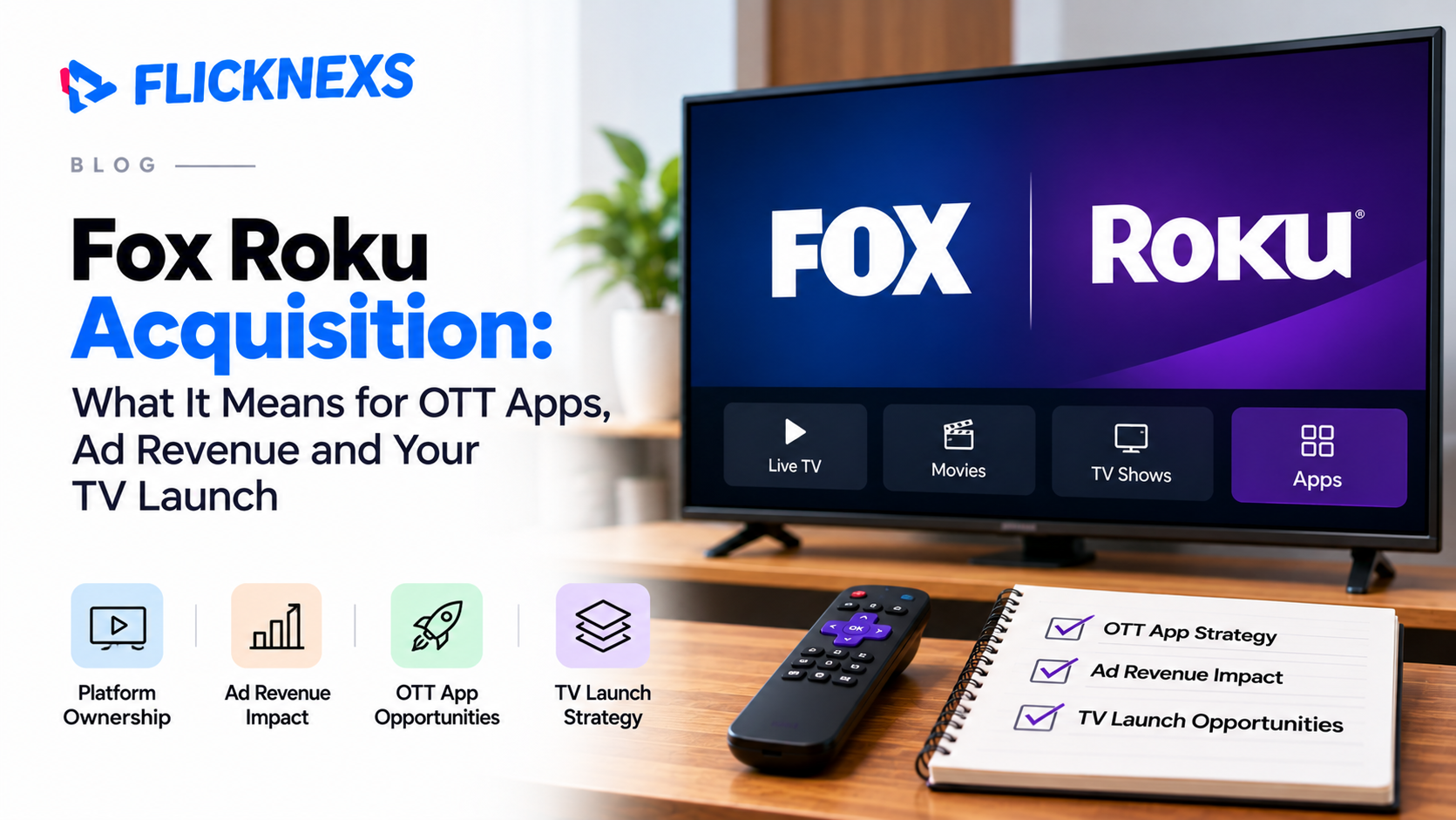
Quick answer
Quick answer: The Fox Roku acquisition is an announced, not yet closed, deal. Fox agreed on June 15, 2026, to buy Roku at about $22 billion in enterprise value, with closing expected in the first half of 2027 (Fox Corporation; Shacknews). No change to Roku’s app certification, inventory split or revenue share has been announced, and both companies say Roku will stay an open, partner-friendly platform (Advanced Television). In short: OTT apps should keep launching on Roku under current terms, but ad-supported apps should model their ad revenue carefully and avoid depending on Roku alone.
Flicknexs provides white-label OTT apps for Roku, Amazon Fire TV, Samsung Tizen, LG webOS, web and mobile, so this guide is written from the side of the operators who build on those platforms.
What the Fox Roku acquisition confirms (and what it doesn’t)
| Confirmed fact | Source |
| $160 per Roku share in cash plus Fox Class A stock; about $22B enterprise value | Pulse 2.0 |
| Fox shareholders to own about 73% of the combined company, Roku shareholders about 27% | Pulse 2.0 |
| Combined company becomes the third-largest US TV player by share of viewing, pro forma | Advanced Television |
| Roku reaches more than 100 million streaming households globally | Advanced Television |
| Roku founder Anthony Wood joins Fox’s board after closing | FOX 5 NY |
| Expected close: first half of 2027, subject to approvals | Shacknews |
Not announced: any change to certification rules, subscription revenue share, ad inventory split or store placement. If a vendor tells you Roku’s developer terms have already changed because of Fox, ask for the document.
Bottom line: today, the deal changes ownership on paper and nothing in your developer agreement.
Fox will own your competitors and your shelf
The deal combines Fox’s free streaming service Tubi with The Roku Channel (RBR). For subscription brands this matters less. For FAST and AVOD operators it is the main issue: after closing, the company that controls Roku’s home screen, search and ad sales will also own two large free, ad-supported services competing for the same viewers and the same advertisers.
[IMAGE 1 — original diagram] “Who owns what after closing”: Fox Corporation → Roku OS & devices, The Roku Channel, Tubi, Roku ad sales; independent app shown sitting on the Roku OS shelf beside the owner’s own services. Alt text: “Fox Roku acquisition ownership map showing Roku, The Roku Channel and Tubi under Fox”.
This does not mean independent apps will be pushed out. Roku’s value to advertisers and viewers depends on a broad catalog, and both companies have committed publicly to an open platform. It does change how a sensible operator hedges:
- Don’t make Roku your only TV platform if you are ad-supported. Plan Fire TV and at least one smart-TV OS within 12 months.
- Own your ad demand. Apps that rely entirely on Roku to sell their ads have the weakest negotiating position if terms are revisited.
- Own your audience data. Push sign-in, email capture and cross-device accounts so viewers follow your brand rather than one store listing.
New to Roku’s own free service? Read our explainer on The Roku Channel and how it works, and our practical guide to FAST channels.
Bottom line: the risk is concentrated in ad-supported apps that depend on Roku for both distribution and ad sales.
Four things to watch before the deal closes
None of these has been announced. They are the terms that would matter most to independent apps if they ever changed, so they are worth monitoring in Roku developer notices and your distribution agreement:
- The 30% inventory split. Any move in that percentage directly changes ad-supported app revenue.
- Sales Representation Program terms. The 60% net share and 15% fee decide whether handing Roku your ad sales is worth it.
- Home-screen and search placement. Watch whether The Roku Channel and Tubi gain placement that independent apps can’t buy.
- Data access. Changes to the audience and ad-performance data apps receive would affect how you sell your own inventory.
What to do now: save a dated copy of your current Roku distribution agreement and ad terms, so you can compare against any future version.
Should you launch on Roku now or wait?
| Your situation | Recommendation | Why |
| SVOD, US/Canada audience, Roku leads your device analytics | Launch now | Subscription terms are not part of the announced deal; waiting costs 6–9 months of subscribers |
| AVOD/FAST, you sell your own ads | Launch now, with Fire TV in parallel | Lock in your ad setup under current terms and spread platform risk |
| AVOD/FAST, you’d rely on Roku to sell all your ads | Launch, but model both ad options first | Your revenue depends most on terms that could be revisited after closing |
| Audience mainly outside North America | Prioritize by device share in your markets | Fire TV, Android TV, Samsung or LG may matter more |
| No TV app yet, still validating demand | Web and mobile first, TV in phase 2 | TV apps add certification and maintenance cost; prove retention first |
Bottom line: for most SVOD brands the answer is launch now; for ad-supported brands it is launch, but with a second platform planned.
The Roku launch process in brief
The Fox Roku acquisition hasn’t changed how apps get onto Roku. In summary: decide your monetization model, design for remote navigation, build in BrightScript and SceneGraph, integrate the Roku Advertising Framework if you run ads, test on real devices, and pass certification. For the full walkthrough, follow our step-by-step guide to starting a Roku channel, and check Roku’s own publishing guide and certification criteria for the current requirements.
Two points matter more because of the deal:
- Keep the developer account in your company’s name, not your vendor’s. Owning the account protects you if platform terms change.
- Log every ad request on your own ad server from day one, so you can reconcile Roku’s reports against your own data.
Roku Inventory Split vs Sales Representation Program: which pays more?
This is the decision that most affects an ad-supported app’s Roku revenue, and the one most exposed to the new owner.
How the two options work
| Inventory Split (default) | Sales Representation Program | |
| Who sells your ads | You sell 70% of inventory | Roku manages 100% of inventory |
| What you keep | 100% of gross revenue on your 70% | 60% of net revenue on ads Roku sells, after a 15% operational and serving fee |
| Roku’s share | 30% of inventory, keeping all revenue from it | 40% of net, plus the 15% fee |
| Fallback | — | Your own ad server can fill what Roku doesn’t |
| Eligibility | Every ad-supported app by default | Selected apps |
All terms above are from Roku’s video advertising documentation. Roku’s partner help center has cited a threshold of 5,000 new installs and 50,000 streaming hours in the prior month for Sales Rep consideration (Roku Partner Success); confirm current criteria with Roku.
The break-even formula (Flicknexs analysis)
Let yield = fill rate × CPM for a block of ad opportunities.
- Inventory Split revenue = 0.70 × your yield
- Sales Rep revenue, before fallback = 0.60 × 0.85 × Roku’s yield = 0.51 × Roku’s yield
Setting them equal gives 0.70 ÷ 0.51 ≈ 1.37.
Answer: the Sales Representation Program pays more only when Roku can earn at least about 37% more per ad opportunity than your own demand. Because Sales Rep also lets your ad server fill what Roku leaves unsold, this threshold is conservative; in practice the crossover is somewhat lower.
Worked example
These figures are illustrative assumptions, not Roku benchmarks. Assume 1,000,000 ad opportunities a month:
| Scenario | Your demand (assumed) | Roku’s demand (assumed) | Inventory Split | Sales Rep, before fallback |
| A: strong direct-sold ad book | 70% fill × $18 CPM | 85% fill × $16 CPM | 700k × 70% × $18 = $8,820 | 1M × 85% × $16 × 0.51 = $6,936 |
| B: programmatic remnant only | 45% fill × $8 CPM | 85% fill × $16 CPM | 700k × 45% × $8 = $2,520 | $6,936 |
Scenario A should stay on Inventory Split. Scenario B earns nearly 2.8× more under Sales Rep. Replace the assumptions with fill and CPM from your own ad server.
Developers on Roku’s community forum have raised concerns about verifying how the Roku-routed 30% is allocated (Roku Developer Forum), which is another reason to keep your own request logs.
After closing: the Sales Rep Program puts your ad revenue with a sales team that will also sell Tubi and Fox inventory. That could mean more demand from a bigger package, or questions about priority. A modest direct-sold book keeps Inventory Split as a credible fallback.
Roku vs Fire TV vs smart TVs: where to launch first
Approval on Roku does not carry over to any other platform. Each has its own SDK, testing and store review.
| Platform | Build environment | Choose it first when | Developer docs |
| Roku | BrightScript / SceneGraph | Viewers concentrated in the US/Canada and Roku leads your analytics | Roku |
| Amazon Fire TV | Fire OS (Android-based) | You already have an Android TV app, or Fire TV leads in your markets | Amazon Appstore |
| Samsung | Tizen (web-based) | Your audience skews to Samsung TVs | Samsung Developers |
| LG | webOS (web-based) | LG TVs are significant in your markets | LG webOS |
Recommended sequence for most independent OTT brands: one primary TV platform chosen from your analytics, the second within 90 days, then one smart-TV OS once retention justifies it.
Comparing vendors who can build these apps? See our ranking of white-label OTT providers and the Brightcove, Flicknexs and Vimeo OTT comparison.
7 questions to ask any OTT vendor before you sign
Whoever you evaluate, including Flicknexs, get written answers to these:
- Which TV apps (Roku, Fire TV, Tizen, webOS, Android TV, Apple TV) are included, and which cost extra?
- Who owns the source code and the Roku developer account?
- Is Roku Advertising Framework integration included, for both Inventory Split and Sales Rep setups?
- Who handles certification submissions and resubmissions?
- Who pays for and performs updates when Roku OS changes?
- Which playback, crash and ad analytics are included?
- What happens to my apps and accounts if I leave your platform?
Start a free Flicknexs trial and see the Roku and Fire TV apps
Frequently asked questions
Q: Is the Fox Roku acquisition final?
A: Not yet. Fox announced a definitive agreement on June 15, 2026, at $160 per share in cash and stock, valuing Roku at about $22 billion. Closing is expected in the first half of 2027, subject to approvals (Shacknews).
Q: Will Fox change Roku’s app certification rules?
A: No change has been announced. Follow Roku’s current certification criteria and watch official developer notices.
Q: Does Fox own Tubi and Roku?
A: Fox already owns Tubi. After the deal closes, Fox will also own Roku, including The Roku Channel (RBR).
Q: How much of my ad inventory does Roku take?
A: By default, 30% of your ad inventory goes to Roku, which keeps all revenue from it; you keep 100% of revenue on the other 70% (Roku Developer).
Q: Is the Roku Sales Representation Program better than Inventory Split?
A: Only when Roku’s yield (fill × CPM) beats yours by roughly 37% or more. Use the break-even formula in this guide with your own ad-server data.
Q: Does the deal affect independent FAST channels on Roku?
A: No policy change has been announced. Because one company will own Roku, The Roku Channel and Tubi, FAST and AVOD operators should diversify platforms and build their own ad demand as a hedge.
Q: Should I wait until the deal closes to launch my Roku app?
A: For most SVOD brands, no. Ad-supported brands should launch too, but model both Roku ad options and plan a second TV platform early.
Q: Where can I learn the steps to publish an app on Roku?
A: Our Roku channel setup walkthrough covers each step, alongside Roku’s own publishing guide.
The takeaway
Conclusion: the Fox Roku acquisition doesn’t change how apps get onto Roku today. It changes the risk of depending on Roku, especially for ad-supported apps. Launch on current terms, choose your ad model with real numbers, keep your developer account and audience data in your own hands, and add a second TV platform before you need one.