
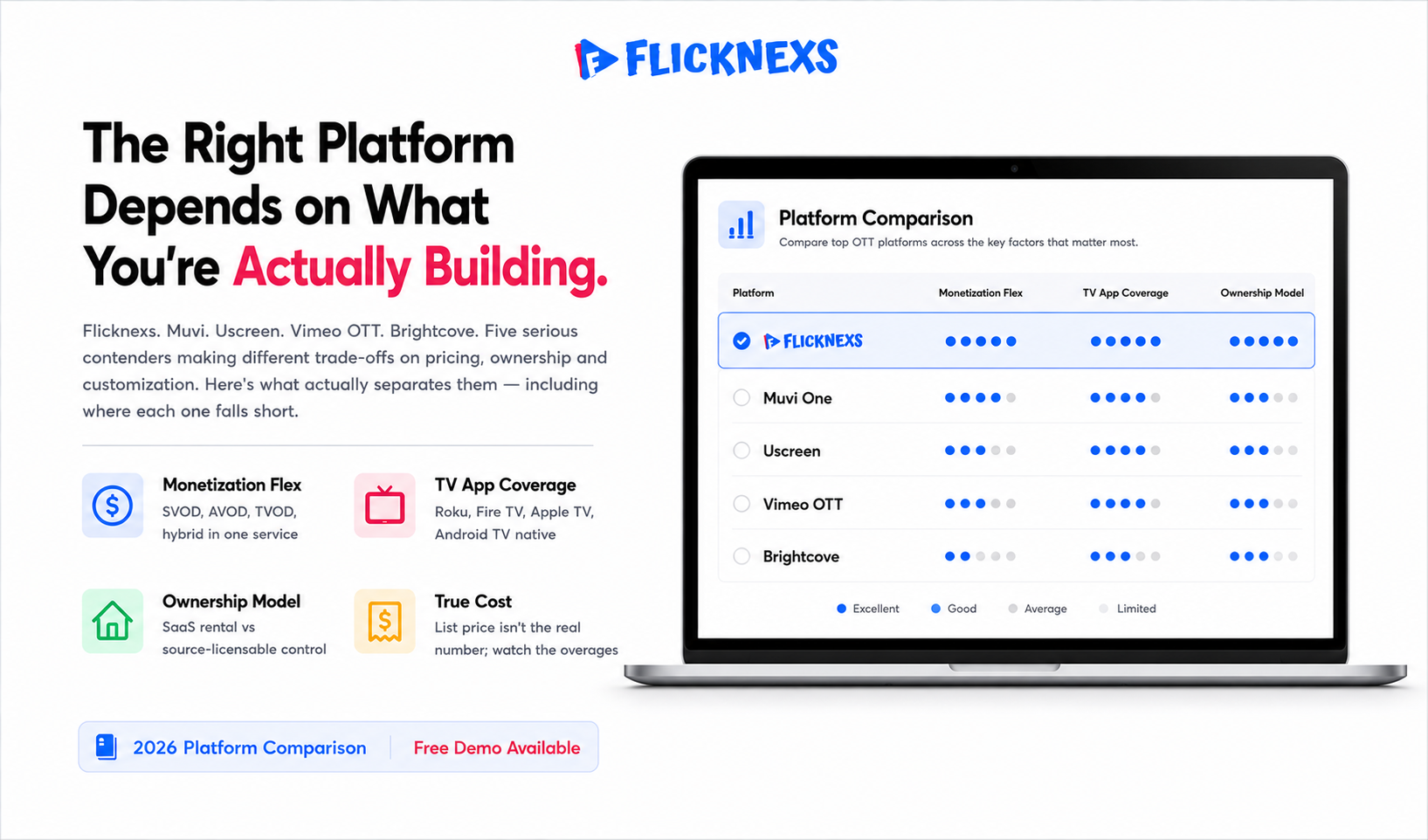
There’s no single best white-label OTT platform in 2026. The right one depends on your monetisation model, your content type and how much engineering you actually want to take on yourself. If you’re not ready to handle the technicalities of video streaming, consider create your own OTT platform and let experts handle it for you.
By the Flicknexs team. We build white-label OTT/VOD/IPTV streaming platforms, so this is written from hands-on streaming-platform experience.
What “white-label OTT platform” actually means
A white-label OTT platform lets you launch a fully branded streaming service, logo, domain, apps, without building the video infrastructure yourself. The vendor handles the hard parts ingest, transcoding, adaptive bitrate delivery, DRM, a CMS, monetisation and player apps across devices. You keep the catalogue, the brand and the customer relationship.OTT just means video over the public internet instead of through a cable or satellite operator. That’s genuinely all it means.
The category covers three overlapping needs on-demand libraries, live streaming for events and channels and monetisation that actually turns viewers into revenue. Where those three overlap is where most businesses actually live. Which platform makes sense for you comes down to which of those three dominates your business and how much control you need over the underlying codebase when the platform’s defaults don’t quite fit.
How we evaluate OTT platforms
Every marketing page sounds the same, so we score providers on the things that actually decide whether you succeed after launch:
1. Monetization flexibility
Can it run SVOD, AVOD, TVOD and hybrid in one service without duct tape holding it together? Does it handle coupons, free trials, multi-currency, regional pricing and a real ad server with VAST, VMAP and SSAI support or just a payment button with a subscription toggle? Revenue-model lock-in is the most expensive thing to discover six months after launch, when your audience is already built around a billing setup you can’t easily change.
2. Multi-platform app coverage
A web player is table stakes. The real differentiator is native, store-published apps for iOS, Android, Roku, Amazon Fire TV, Apple TV, Android TV and, for some operators, Samsung Tizen and LG webOS. Connected TV is where watch time and ad revenue actually concentrate, so thin coverage or anything labelled “coming soon” on TV apps is a genuine red flag worth taking seriously.
3. Ownership and lock-in
Pure SaaS means you’re renting everything and migrating painfully when you outgrow it. Source-licensed or self-hostable platforms cost more upfront but let you own and extend the codebase. This is the single biggest philosophical split in the market and worth deciding where you stand before you evaluate anything else.
4. Streaming quality and infrastructure
Adaptive bitrate (HLS/DASH), studio-grade DRM (Widevine, FairPlay, PlayReady), low-latency live and a credible CDN strategy. For live and IPTV, server-side resilience matters more than any feature checkbox.
5. Total cost of ownership
List price is rarely the real number. Watch for revenue share, per-stream or bandwidth overages, app-publishing fees and charges for “premium” connectors. We give ranges, not invented figures, because exact pricing shifts constantly and is usually quote-based anyway.
Best white-label OTT platforms in 2026 compared
The table below is a directional comparison based on publicly described positioning and our own hands-on category experience. Always confirm current specifics directly with each vendor, since feature sets and pricing change often.
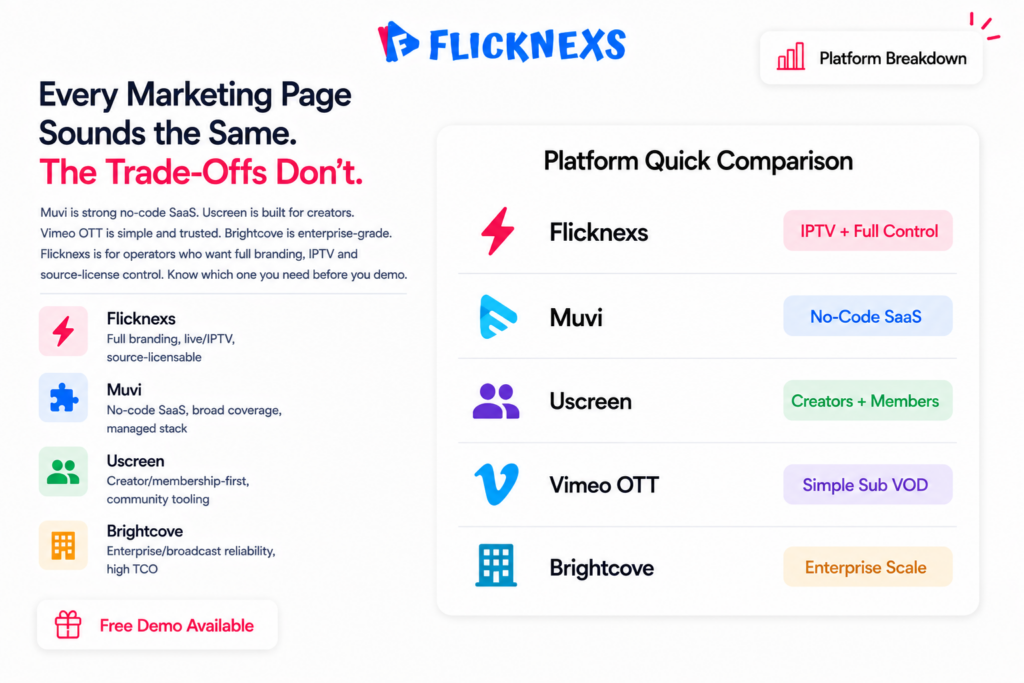
| Platform | Best For | Monetization | TV Apps | Ownership Model | Pricing Shape |
|---|---|---|---|---|---|
| Flicknexs | Operators wanting full branding, IPTV/live streaming, and flexible monetization | SVOD, AVOD, TVOD, Hybrid | Roku, Fire TV, Apple TV, Android TV, iOS, Android | White-label, source-licensable | License / Quote-based |
| Muvi One | No-code launch with an all-in-one SaaS solution | SVOD, AVOD, TVOD, Hybrid | Broad CTV coverage | SaaS (Managed) | Tiered monthly + usage |
| Uscreen | Creators, membership platforms, and community video | SVOD, TVOD, Community | Roku, Fire TV, Apple TV, Mobile | SaaS (Managed) | Monthly + per-member options |
| Vimeo OTT | Simple subscription VOD from a well-known brand | SVOD, TVOD | Roku, Fire TV, Apple TV, Mobile | SaaS (Managed) | Monthly + revenue share |
| Brightcove | Enterprise and broadcast-grade streaming | SVOD, AVOD (advanced ad-tech) | Available (often as an add-on) | Enterprise SaaS | Enterprise quote |
Flicknexs
This is for media businesses that want an actual branded, multi-screen service, not a reskinned template with your logo slapped on. It leans hard into live/IPTV support and gives you all four monetization models under one roof. What sets it apart is the combination white-label control, including source-licensing if your team wants to own and extend the platform, paired with a full CTV app lineup instead of a partial one.
Best fit operators launching SVOD, AVOD or hybrid services or running IPTV, who don’t want to get boxed into a pure-rental SaaS setup.Honest caveat a platform this configurable asks more of you upfront than a one-click SaaS does. That’s the trade. Flexibility isn’t free at setup, it just pays off later.
Muvi One
A strong no-code, all-in-one choice. You get a managed stack with broad device coverage and the major monetization models without touching infrastructure. Trade-off: it’s fully managed SaaS, so deep customization and code ownership are limited next to a source-licensed approach. See our deeper take in Muvi vs Uscreen vs Flicknexs.
Uscreen
Excellent for creators, coaches and membership businesses where community and recurring access matter more than broadcast-scale live. The membership and engagement tooling is a real strength. Trade-off: it’s tuned for the creator/membership use case rather than large catalogs or heavy AVOD ad operations.
Vimeo OTT
A sensible, low-friction way to launch subscription VOD under a trusted brand, with TV apps included. Trade-off: monetization breadth and customization are narrower than dedicated OTT stacks and revenue share can eat into TCO at scale.
Brightcove
The enterprise and broadcast end of the market: heavy-duty delivery, mature ad-tech, and reliability suited to large media organizations. Trade-off: pricing and complexity scale to enterprise, which is overkill (and over-budget) for most operators just getting off the ground.
How to choose the right platform for your business
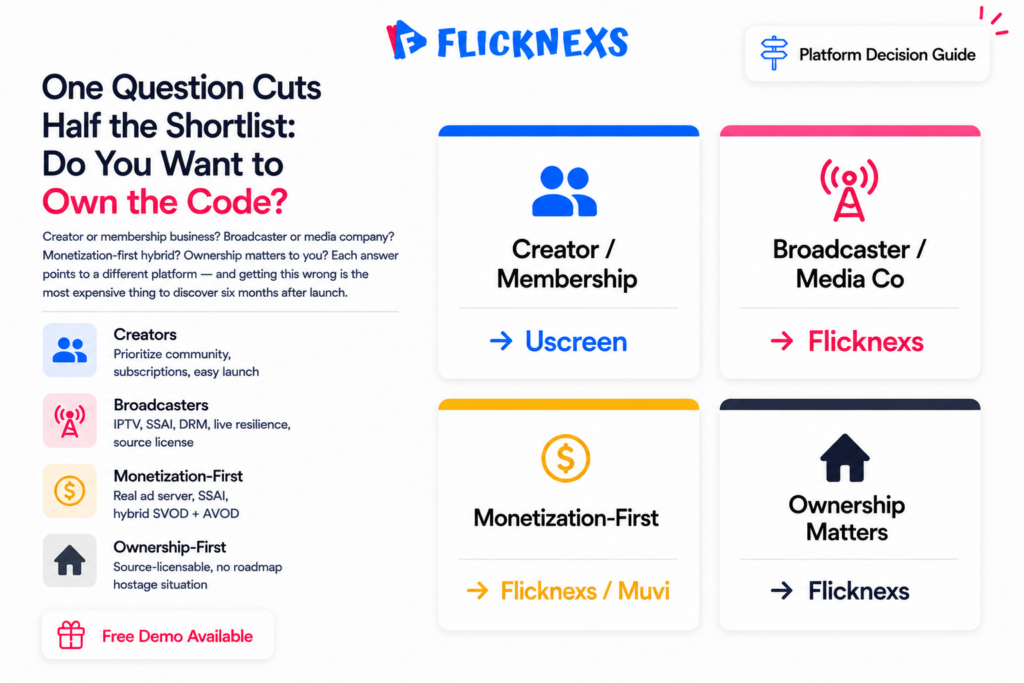
If you’re a creator or membership business
Prioritize ease of launch, community features and clean subscriber management over raw configurability. A managed SaaS with creator-focused tooling will get you live fastest.
If you’re a media company or broadcaster
Prioritize live/IPTV resilience, AVOD ad operations (SSAI, VAST/VMAP), DRM and the breadth of TV apps. You’ll also want to weigh source-licensing, so your engineering team can extend the platform without waiting on a vendor’s roadmap.
If you’re monetization-first (ads or hybrid)
Confirm the platform has a real ad server and supports server-side ad insertion, not just a pre-roll field. Hybrid SVOD+AVOD is where a lot of OTT revenue is heading and not every “supports AVOD” claim means the same thing. Our overview of white-label OTT platform features breaks down what to look for.
If ownership matters
Decide early whether you want to rent (faster, lower upfront, harder to migrate) or own/source-license (more control, higher upfront, no roadmap hostage situation). This one choice cuts half the shortlist on its own.
For deeper migration-specific guidance, see Top Kaltura Alternatives, Best JW Player Alternatives and Contus VPlayed Alternatives.
The technical foundations that separate good from great
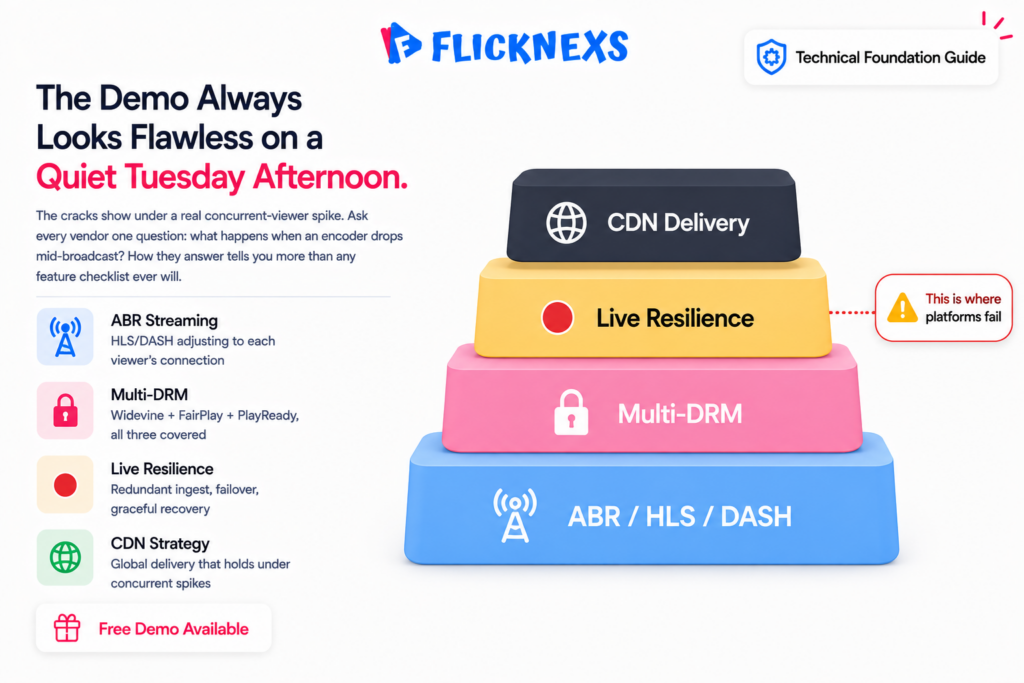
Underneath the dashboards, every platform that actually performs shares the same engineering fundamentals. Adaptive-bitrate streaming over HLS and MPEG-DASH is what keeps playback adjusting to each viewer’s connection in real time, instead of buffering every time someone’s wifi dips. For background on these delivery standards, the MDN media delivery documentation is a solid reference and Wikipedia’s over-the-top media entry covers the broader concept well.
Studio content also needs multi-DRM, meaning Widevine, FairPlay and PlayReady all covered. Skip that and licensed catalogs are simply off-limits to you.
For live and IPTV, the unglamorous stuff decides everything low-latency protocols, redundant ingest, server-side restream and loop handling, graceful failover. A platform can have a beautiful CMS and still fall apart mid-broadcast if the streaming core underneath isn’t hardened.
Same way a beautiful car dashboard doesn’t mean the engine won’t stall in traffic.
When you evaluate, ask vendors one question what happens when an encoder drops mid-broadcast. That’s the moment things actually go wrong, and how they answer tells you more than any feature list ever will.Here’s the part people learn the hard way. The demo always looks flawless on a quiet Tuesday afternoon. The cracks only show up under a real concurrent-viewer spike, when it’s too late to switch vendors. Performance best practices for the playback layer are well documented at web.dev’s media section.
Ready to build your own OTT platform? Get started with Flicknexs →
Frequently asked questions
Related guides
- Best White-Label OTT Platforms in 2026 (hub)
- Top Kaltura Alternatives for OTT & Video in 2026
- Best JW Player Alternatives for OTT Platforms in 2026
- Best Contus VPlayed Alternatives & Competitors in 2026
- Muvi vs Uscreen vs Flicknexs: Which OTT Platform Should You Choose?
- Flicknexs White-Label OTT Platform
Ready to build?
If you’re planning your next OTT · white label project, Flicknexs handles the video infrastructure end-to-end — so you can ship in weeks, not months.
- explore white-label OTT
- check plan pricing
More related guides
Continue exploring more on this topic across the Flicknexs blog.