
Quick answer
A linear to streaming migration moves a TV channel’s audience from a broadcast schedule to internet delivery (on-demand, live streams, or a streamed linear channel). The BBC’s own history shows the risk: when BBC Three went online-only in 2016, it lost most of its young audience and returned to TV in 2022. The safe approach is to simulcast first, keep the content on the TV set through connected-TV apps or FAST channels, hold the content budget steady, and switch off the broadcast signal only after streaming reach is measured and proven.
On 21 October 2026 the BBC confirmed that BBC Three, BBC Scotland and Radio 4 Extra will stop broadcasting as linear services in spring 2027 (IBC’s report on the BBC closures). Most coverage reads this as proof that streaming has won. For any broadcaster planning its own linear to streaming migration, the more useful fact is that the BBC has done this exact thing once before, with the same channel, and reversed it.
This guide uses that record. It covers what happened to BBC Three between 2016 and 2022, what is different in 2027, and how to decide, channel by channel, whether to keep broadcasting, simulcast, or switch off.
Key takeaways
1. BBC Three’s first move online coincided with a 60–70% audience loss, according to research cited by TVBEurope.
2. Even while online-only, about three-quarters of BBC Three viewing still happened on TV sets (Enders Analysis research reported by the RTS). Migrate to the TV screen, not away from it.
3. Closing a channel saves less than expected if distribution was never the big cost. Savings come from content and operations.
4. Run broadcast and streaming side by side until streaming reach is measured. Switch-off is the last step, not the first.
What the BBC announced, and why
The BBC said the closures are part of a plan to save £500m by 2028 (the BBC closure announcement reported by IBC). BBC Scotland becomes an iPlayer channel, with its programs also shown on BBC One and BBC Two in Scotland. BBC Three commissions move to iPlayer and other platforms, YouTube included. Radio 4 Extra programs move to BBC Sounds only.
The audience argument was made weeks earlier. Director-General Matt Brittin said some BBC channels reach around 100,000 live viewers while roughly 500,000 more watch the same programs on iPlayer (Brittin’s comments reported by Northeast Times). When five people watch on demand for every one who watches live, the broadcast slot is no longer where the audience is.
But one detail matters for anyone copying the move: industry observers noted that closing linear BBC Three may not save much straight away, because the channel shares broadcast capacity with CBBC (Cord Cutters News on the spectrum-sharing issue). The saving comes from what you stop making and running, not from the transmitter.
The experiment the BBC already ran: BBC Three, 2016–2022
BBC Three is the only national channel with a full, public record of going online-only and coming back. That makes it the best case study any broadcaster has.
| Date | What happened |
|---|---|
| Feb 2016 | Linear channel closes. Stated aims: follow 16–34 viewing habits and save £30m a year. (the RTS report on the 2016 move online) |
| 2016–2018 | Content budget falls from £81m (2013/14) to £30m (2017/18). (the RTS analysis of the online years) |
| 2016–2020 | Research cited by TVBEurope puts the audience loss at 60–70%. (TVBEurope’s report on Ofcom’s approval) |
| Mar 2021 | BBC finds a large group of younger viewers with a strong linear habit who were light BBC users. Announces return. (Advanced Television’s report on the BBC research) |
| Feb 2022 | BBC Three returns to TV. Ofcom requires a top-24 EPG slot and at least 75% original programming. (Ofcom’s EPG condition, reported by TVBEurope) |
| Oct 2026 | Linear closure confirmed again, effective spring 2027. (IBC’s coverage of the confirmed closures) |
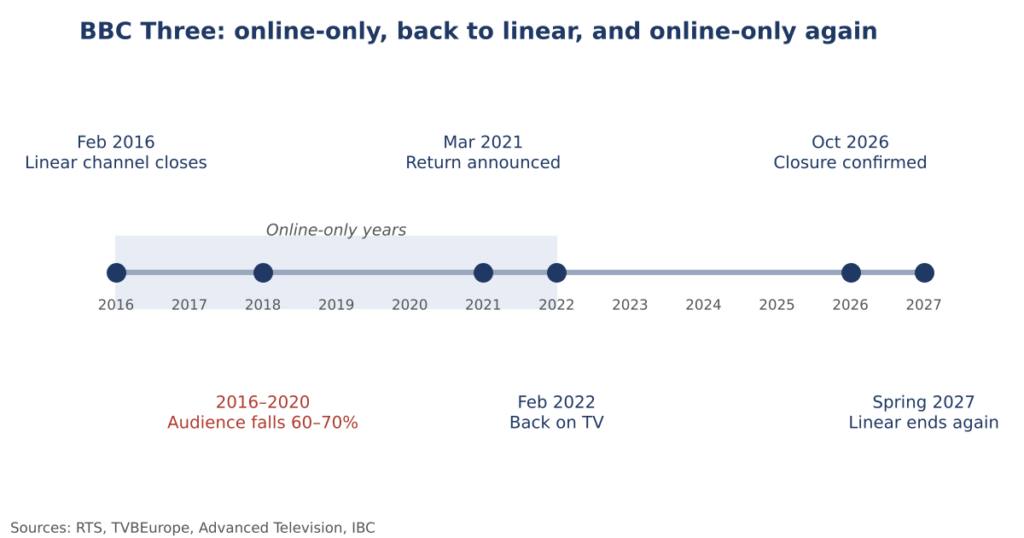
Alt text: Timeline of BBC Three going online-only in 2016, returning to TV in 2022 and closing as a linear channel again in 2027 — Original Flicknexs chart
Three numbers from that period should shape any migration plan:
- About 75% of online-era BBC Three viewing was still on TV sets, not phones or laptops (RTS, citing Enders Analysis). The audience didn’t leave the living room. The channel did.
- £0.8m a year was the BBC’s estimate for distribution, technology and operations of the returning channel, against a £5.7m marketing budget (the BBC cost estimate reported by informitv). The broadcast signal was never the main cost.
- “A tab behind a tab on iPlayer” is how Enders Analysis’ Tom Harrington described the online-only BBC Three (the RTS feature on BBC Three’s return). It lost its shelf space and nothing replaced it.
BBC Three is not the only precedent: DR3 in Denmark
Denmark’s public broadcaster DR ran a similar experiment a few years later. In 2018 DR said three of its channels would stop linear broadcasting from 2020 as part of absorbing a 20% budget cut, with DR3 and DR Ultra moving fully online (Wikipedia’s history of DR3).
DR3 stopped broadcasting on 2 January 2020. A 2017 DR study had found that 27% of viewers aged 20 to 39 no longer watched linear TV regularly (DR3 channel history). The online-only DR3 then lasted just over two years: on 5 April 2022 it was folded into DR’s youth radio brand, DR P3.
| BBC Three (2016) | DR3 (2020) | BBC Three (2027) | |
|---|---|---|---|
| Main driver | Savings and youth viewing habits | Government budget cut | BBC-wide savings program |
| Where content went | iPlayer, with repeats on BBC One and Two | DR online services | iPlayer and YouTube |
| What happened next | Audience fell; channel returned in 2022 | Brand merged into DR P3 in 2022 | Linear service ends spring 2027 |
The two cases fail in different ways, and both are useful. BBC Three shows that viewers can drift away when a channel loses its place on the TV guide. DR3 shows a quieter risk: once there is no schedule to fill, a channel becomes a label on a set of programs, and labels are easy to merge or drop.
So decide before switch-off whether the channel brand still matters. If it carries sponsor deals, advertiser recognition or carriage value, give it a home that keeps it visible: its own app, its own FAST channel, or its own rail on a partner platform. If it doesn’t, accept that it may be absorbed into a bigger brand, and plan that move on purpose rather than finding out two years later.
What current viewing data says about timing
The case for moving is stronger now than in 2016, but live TV has not gone away. Ofcom’s Media Nations 2026 data, as summarized by informitv, shows the average UK viewer watched 90 minutes a day of broadcast TV at transmission in 2025, down 12 minutes on 2024, while broadcaster on-demand viewing rose 3 minutes to 28 (informitv’s summary of Ofcom Media Nations 2026).
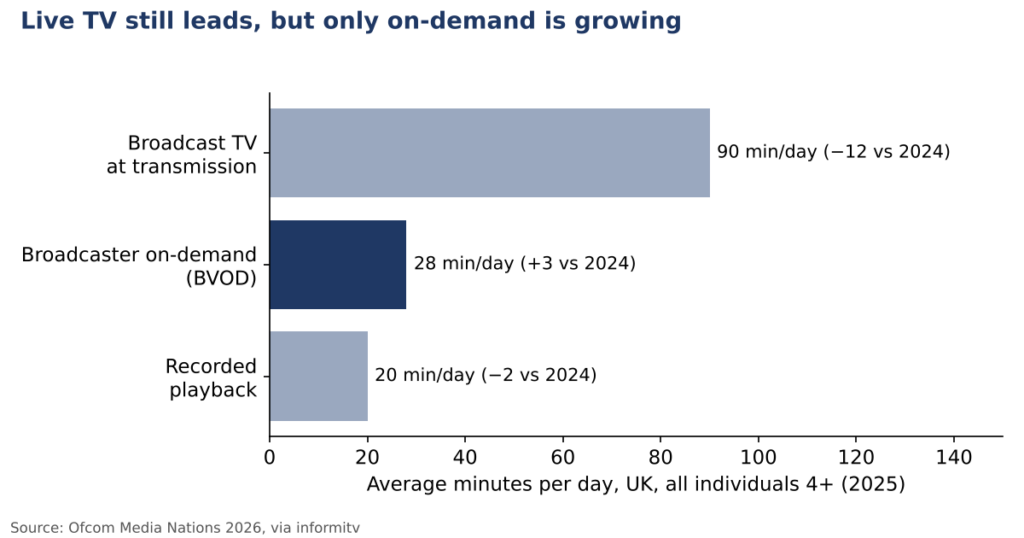
Alt text: Bar chart of UK daily viewing in 2025: 90 minutes of live broadcast TV, 28 minutes of broadcaster on-demand and 20 minutes of recorded playback — Original Flicknexs chart from Ofcom Media Nations 2026 data
Age changes the picture completely. People aged 25 to 34 watched only 18 minutes of live broadcast TV a day, 26 minutes less than in 2022, while viewers over 75 still spent 5 hours 45 minutes a day with broadcaster programming (Ofcom figures reported by informitv). A YouGov survey found 70% of UK adults still watch broadcast TV each week, from 49% of 18 to 24 year olds up to 81% of over-55s (YouGov data reported by IBC).
Even at the BBC, about three-quarters of viewing is still live or recorded, although the on-demand share rose from 14% to 26% between 2022 and 2025 (informitv on BBC viewing by mode).
For a migration plan this means two things. First, the audience you would lose by switching off depends heavily on each channel’s age profile, so run the keep, simulcast or sunset test per channel, not across the whole portfolio. Second, the growth in on-demand viewing is smaller than the fall in live viewing. Some of that time leaves broadcasters altogether: YouTube now takes 15% of all UK viewing, as much as Netflix, Amazon and Disney combined (Ofcom data via informitv). Switching off a channel does not mean its viewers will follow you to your app. That is one reason the BBC is putting BBC Three programs on YouTube this time.
Why 2027 is not 2016
It would be wrong to read the first experiment as proof that the second will fail. Three things have changed:
- Viewing has already moved. The 100,000-live versus 500,000-on-demand gap Brittin described (BBC Director-General interview coverage) did not exist in 2016.
- Connected TVs are the default screen. In 2016 “online” largely meant a browser or phone. Now an iPlayer or YouTube app sits on the same TV that showed the linear channel.
- Distribution is wider. This time BBC Three programs go to YouTube as well as iPlayer (IBC’s summary of where BBC Three content is going), rather than relying on one owned app.
What hasn’t changed is the core risk: when a channel loses its fixed place on the TV guide, discovery falls unless something else takes over that job. That is the problem every broadcaster has to solve before switch-off.
Five migration rules from the BBC Three record
1. Price the savings before you announce them
BBC Three’s returning channel was estimated to cost £0.8m a year to distribute and operate (informitv’s breakdown of BBC Three costs). If your saving case rests on transmission and playout, check the real number first. In most channels, content, staff and rights are the large lines. Decide which of those actually change after switch-off.
2. Stay on the TV set
If roughly three in four online viewers still watched on a TV (Enders Analysis via the RTS), the migration target is the connected TV: smart-TV apps, streaming sticks, and FAST (free ad-supported streaming TV) channels on platforms viewers already use. Our practical guide to FAST channels explains how the format works. A web player and a mobile app are not a replacement for a channel number.
3. Replace the shelf before you remove it
A linear channel gets discovered for free: viewers flick past it. Online, it has to earn a place on a home screen. Before switch-off, secure at least one of: a branded app on major TV platforms, a FAST channel with an EPG listing, or a dedicated rail in a partner’s app. For the distribution side, see how to get a FAST channel onto Roku, Samsung TV Plus, Tubi and Prime Video. Ofcom’s top-24 EPG requirement for the returning BBC Three (the Ofcom EPG ruling covered by TVBEurope) shows how much regulators value that placement.
4. Don’t cut content and distribution at the same time
BBC Three lost its broadcast slot and most of its content budget in the same period (RTS reporting on BBC Three’s budget cuts). When the audience then fell, nobody could say which change caused it. Change one variable at a time so the data tells you something.
5. Agree the reach metric before switch-off
The regulator challenged the BBC for not publishing a weekly reach figure for online BBC Three (informitv on the regulator’s reach challenge). Pick your measure first (weekly unique viewers, minutes viewed per week, or completed episodes), record a baseline on linear, and set the threshold streaming must reach before the signal goes off.
Keep, simulcast or sunset: decide per channel
Not every channel in a portfolio should move at the same speed. Use the signals below for each one.
| Signal | Keep linear | Simulcast first | Sunset linear |
|---|---|---|---|
| Where viewing happens | Mostly live, scheduled | Split between live and on demand | On-demand viewing clearly exceeds live (BBC example: Brittin’s live-versus-iPlayer figures) |
| Audience profile | Older, rural, or low broadband access | Mixed | Already app-first |
| Content type | Live news, sport, events (see OTT for news broadcasters) | Series, entertainment, documentaries | Box sets, archive, niche titles |
| Revenue tied to linear | Carriage fees, linear ad contracts | Ad contracts can move to streaming | Little or none |
| Discovery replacement in place | No | In progress | Yes: app on TV platforms, FAST/EPG slot |
| Public-service or universal-reach duty | Yes, binding | Yes, but alternatives exist | No |
If a channel lands in two columns, choose the slower one. Reversing a switch-off costs more than delaying it: BBC Three could not automatically get its old channel numbers back on some platforms when it returned (RXTV Info on lost channel numbers).
The migration plan, with exit criteria
Each phase ends with a test you must pass before starting the next one. That is the difference between a plan and a timeline.
| Phase | Work | Exit criterion |
|---|---|---|
| 1. Baseline | Measure linear reach, viewing minutes, ad revenue and full running cost per channel. List rights by territory and platform. | Signed-off baseline per channel; rights gaps listed |
| 2. Model | Pick the revenue model per channel: AVOD, SVOD, TVOD, FAST or hybrid. Build conservative / expected / high scenarios. | Break-even streaming reach known for each channel |
| 3. Platform | Select the OTT platform. Test live channel, VOD, TV apps, ad insertion and analytics on your own content. | Workflow test passed by the team that will run it daily |
| 4. Library | Clear rights, fix metadata and subtitles, encode for adaptive bitrate. Start with the titles most likely to be watched. | Priority titles play correctly on every target device |
| 5. Simulcast | Run the stream alongside broadcast. Promote it on air. Launch FAST or TV-app placement. | Streaming reach tracked weekly against baseline |
| 6. Prove | Hold for at least one full season of programming. Fix playback failures, support issues and drop-off points. | Streaming hits the reach threshold set in Phase 1 |
| 7. Switch off | Announce dates, guide viewers to the app, keep support staffed, end the broadcast signal. | Reach holds for two months after switch-off |
Switch-off readiness scorecard
Answer yes or no for each channel. Any “no” in the first four rows is a stop.
| Check | Go / No-go |
|---|---|
| Streaming weekly reach meets the threshold agreed before simulcast | Stop if no |
| Channel has a TV-screen presence (TV app on major platforms or a FAST/EPG slot) | Stop if no |
| Viewers without broadband have an alternative (or the duty doesn’t apply) | Stop if no |
| Ad, sponsorship and carriage contracts have been moved or ended cleanly | Stop if no |
| Content budget for the channel is unchanged through switch-off | Fix before go |
| Playback failure rate and support volume are stable | Fix before go |
| Data export rights for content, viewers and analytics are in the platform contract | Fix before go |
What you stop paying, and what you start paying
| Usually goes down | Usually goes up |
|---|---|
| Transmission and multiplex capacity | CDN delivery (scales with minutes watched) |
| Satellite/cable carriage fees | OTT platform or license fees |
| Linear playout for the closed channel | App development and updates per TV platform |
| Some scheduling and presentation staff | Customer support, payments, ad operations |
| Marketing to replace EPG discovery |
The right-hand column is why “close the channel, save money” often disappoints. Streaming costs rise with success, because delivery is paid per minute watched. Model costs at the high-demand scenario too, including your biggest live event.
Build your own switch-off business case
No published figure can tell you whether your channel should go. You need your own numbers, and most of them already sit somewhere in the business. The model below uses five inputs.
| Input | Where to get it | Why it matters |
|---|---|---|
| Linear running cost per channel (transmission, playout, carriage, presentation) | Finance and distribution contracts | Sets the ceiling on what switch-off can save |
| Content cost attributed to the channel | Commissioning budget | Usually the bigger number, but only saved if content is also cut (see rule 4) |
| Linear ad, sponsorship and carriage income | Ad sales and partner contracts | Revenue at risk on switch-off day |
| Expected streaming viewing hours | Simulcast data from Phase 5 | Drives delivery cost and streaming ad or subscription revenue |
| Streaming cost per viewing hour, plus fixed platform costs | OTT platform and CDN quotes | Turns viewing into cost |
Then work through five steps:
- Linear saving: the running cost that actually disappears. Leave out any shared transmitter, multiplex slot or playout chain that keeps running for another service.
- Revenue lost: linear ad, sponsorship and carriage income that will not move to streaming.
- Streaming cost: expected viewing hours multiplied by cost per viewing hour, plus fixed costs for the platform, TV apps and viewer support.
- Streaming revenue: ad impressions or subscriptions earned from the viewing you keep.
- Net case: linear saving, minus revenue lost, minus streaming cost, plus streaming revenue.
Run the net case at three retention levels: low, expected and high. Retention does most of the work in this model. BBC Three’s first online period is a reasonable low case to test against (TVBEurope’s report on the audience decline). Your own simulcast data should show where you actually sit. If the case only works at the high level, you are not ready to switch off.
Watch for the shared-capacity trap. Because linear BBC Three shares broadcast capacity with CBBC, closing it does not free a whole channel slot (Cord Cutters News on the shared slot). If your channel shares infrastructure, the saving can be close to zero until the other service moves too.
How to tell viewers the channel is moving
The viewers most likely to be lost are the ones who find a channel by its number. They need more notice and more practical help than a normal marketing launch provides. A simple sequence:
| Stage | What to say or do | Where |
|---|---|---|
| Announcement | Give the date, the reason and exactly where the content will be | On air, website, press |
| During simulcast | Run on-screen messages pointing to the app or FAST channel; publish setup guides for each TV platform | On air, social, help pages |
| Final weeks | Show countdown slates, update the EPG text, staff a help line for viewers who need setup help | On air, EPG, support |
| Switch-off day | Replace the channel with a slate showing where to watch now | The old broadcast slot, if still held |
| After switch-off | Track support tickets and reach; fix the most common problems first | Support, analytics |
The BBC announced its closures in October for a spring 2027 switch-off (IBC’s closure report), which leaves a few months of runway. A smaller broadcaster with less brand recognition should allow at least as long.
Tell advertisers, sponsors and carriage partners before the public. Their contracts often have notice periods, and a partner who learns about the move from the press is harder to bring across to streaming.
Measuring reach across broadcast and streaming
Rule 5 says to agree a reach metric before switch-off. In practice broadcast and streaming are measured in different ways, so comparisons need care.
| Metric | Broadcast source | Streaming source | Watch out for |
|---|---|---|---|
| Weekly reach | Audience panel (Barb in the UK) | Unique devices or signed-in accounts | A device is not a person; TVs are shared |
| Viewing minutes | Panel minutes | Playback minutes from player analytics | Autoplay can inflate streaming minutes |
| Completion | Rarely available | Completion rate per episode | Useful for content decisions, not for reach |
| Live peak | Panel peak audience | Concurrent streams | Peaks drive delivery cost |
| Ad delivery | Ratings on linear airtime | Impressions served through server-side ad insertion | Different currencies; agree them with buyers |
Choose one primary metric for the switch-off threshold and keep its definition fixed for the whole simulcast. Use the definition your board, regulator or advertisers will use to judge the result. If advertising is part of the plan, our comparison of server-side and client-side ad insertion explains how streaming ad impressions are counted.
Mistakes the BBC record warns against
- Treating the app as the channel. An app with no home-screen placement is the “tab behind a tab” problem again.
- Moving only to web and mobile. The audience is on the TV. Build for connected TVs first.
- Changing the content and the platform together. You lose the ability to learn what worked.
- Switching off on a date instead of a metric. Set the reach threshold first; the date follows.
- Forgetting viewers without broadband. Public-service and regional broadcasters may need to keep a broadcast or alternative route.
Where Flicknexs fits
Flicknexs builds branded OTT platforms for broadcasters and media businesses, covering live channels, video on demand, TV and mobile apps, and subscription, advertising or pay-per-view models. For a migration, that means you can run Phase 5 (simulcast) on your own branded service while the broadcast signal stays on, and measure reach against your baseline before deciding on switch-off.
Here is how that maps to the plan above:
- Phases 3 and 4 (platform and library): load a priority set of titles, test playback on the TV platforms your audience uses, and confirm metadata, subtitles and rights rules before anything goes public.
- Phase 5 (simulcast): run your live channel as an online TV channel built on Flicknexs while broadcast continues, and add a FAST channel launched through Flicknexs if you need a guide listing on connected-TV platforms.
- Phase 6 (prove): track weekly reach, viewing minutes and playback failures against the baseline you set in Phase 1, so the switch-off decision rests on your own data rather than a date.
- After switch-off: keep the same branded apps and accounts, so viewers who moved during the simulcast don’t have to move again.
Next step for a simulcast pilot: see how Flicknexs helps you launch an online TV channel alongside your broadcast, or start a free Flicknexs trial and talk to a streaming expert to test live and on-demand workflows on your own content. You can also compare Flicknexs pricing plans before you talk to the team.
Frequently asked questions
What is a linear to streaming migration?
It is the move of a TV channel’s distribution from a broadcast schedule to internet delivery. That can mean a live stream of the same channel, an on-demand library, a FAST channel, or a mix, with or without keeping the broadcast signal.
Why is the BBC closing BBC Three and BBC Scotland as linear channels?
The BBC says it needs to save £500m by 2028. Both services keep their content on iPlayer, and BBC Three programs also go to YouTube (IBC’s October 2026 closure report).
Didn’t BBC Three already go online-only once?
Yes. It left broadcast TV in February 2016 and returned in February 2022 after research found many younger viewers still had a strong linear habit (Advanced Television on the 2022 return).
How much audience can a broadcaster lose when it goes online-only?
There is no fixed figure. BBC Three’s first move online was linked to a 60–70% loss (TVBEurope on the audience decline), but that happened alongside large content cuts and weak online discovery.
Should a broadcaster keep linear TV while launching OTT?
In most cases, yes. Simulcasting lets you measure streaming reach against a known baseline before giving anything up.
What is a FAST channel and why does it matter for migration?
A FAST channel is a free, ad-supported linear channel delivered over the internet and listed in a TV platform’s guide. It keeps a channel on the TV screen and in an EPG, which is the discovery a broadcast slot used to provide.
Does closing a linear channel always save money?
No. If distribution was a small cost, as with BBC Three’s estimated £0.8m a year (informitv’s report on BBC Three’s return), the saving comes from content and staffing changes, while streaming adds delivery and app costs.
How long should a simulcast run before switch-off?
Long enough to measure a full season of programming and meet the reach threshold you set at the start. Switch off on a metric, not on a calendar date.
Which channels should a broadcaster move to streaming first?
Start with channels whose viewing is already mostly on demand, whose audience is younger or app-first, and whose revenue does not depend on carriage fees or linear ad contracts. Keep live news, sport and channels with a universal-reach duty on broadcast until streaming reach is proven.
Is a FAST channel a full replacement for a linear channel?
It replaces the scheduled, lean-back experience and the guide listing, which is what many linear viewers rely on. It does not replace over-the-air access for homes without broadband, and ad revenue depends on the platform’s ad-sharing terms, so treat it as one part of the plan rather than the whole answer.
What happened to DR3 after it went online-only?
DR3 stopped linear broadcasting on 2 January 2020 and was merged into DR’s youth radio brand DR P3 on 5 April 2022 (DR3 history on Wikipedia).
How do you compare broadcast and streaming audiences?
Use one agreed metric, such as weekly reach, and note the differences in how each side measures it: panels count people, while streaming analytics count devices or accounts.