
Quick answer: OTT break-even = monthly fixed costs ÷ (contribution per subscriber − monthly churn × acquisition cost). Using our assumptions, a ₹299/month service with ₹5 lakh fixed costs needs about 2,230 subscribers on paper but 2,840 once 8% monthly churn and ₹600 acquisition cost are counted. Bringing churn down from 12% to 5% lowers break-even more than cutting a ₹1 lakh salary.
Your OTT break-even point is set less by how many people you employ and more by how fast subscribers leave. That is the uncomfortable takeaway when you run the numbers behind this week’s Netflix headlines.
On October 9, 2026, Puck News reported that Netflix plans to cut about 5% of its workforce, with an announcement possible as early as the following week. Netflix declined to comment (Reuters via The Star). Most coverage stopped at “layoffs.” This post goes one step further: we built a break-even model for a small streaming service at Indian price points and tested 27 combinations of fixed cost, price and churn. The results show where a lean team actually helps, and where it barely moves the needle.
This guide is for founders, media companies and creators planning a subscription OTT service in 2027.
Key Takeaways
- Netflix’s reported cut is about restructuring at enormous scale, not a sign of a failing business. Q2 2026 revenue rose 13% year over year.
- The textbook break-even formula ignores churn. Our churn-adjusted version adds 9–93% to the subscriber target across our scenarios.
- At ₹199/month, churn decides whether the business works at all. At ₹499, it barely matters.
- At ₹299, cutting one ₹1 lakh salary lowers break-even by about 570 subscribers. Cutting churn from 12% to 5% lowers it by about 710 and keeps paying off every month.
- Keep content, pricing, rights and retention in-house. Rent the infrastructure.
What Did Netflix Actually Announce?
Nothing official yet. Here is what is reported and what is not:
| Status (as of October 12, 2026) | |
| Size of cut | About 5% of staff, per Puck News |
| Jobs affected | Roughly 800, based on about 16,000 full-time staff at end of 2025 (Variety) |
| Departments | Not disclosed |
| Netflix comment | Declined to comment |
| Last major layoff | 2022, after the company lost subscribers (same Variety report) |
| Upcoming milestone | Q3 2026 earnings on October 20 (AV Club) |
The context matters. Netflix is not cutting after a bad quarter. Second-quarter 2026 revenue reached $12.56 billion, up 13% year over year, with $3.4 billion in net income (Barrett Media). The pressure is on growth expectations: the stock has been weak this year, and the company narrowed its 2026 revenue guidance to $51–51.4 billion.
In other words, this is a growing, profitable company trimming cost to grow faster, a very different situation from a startup trying to reach its first profitable month.
Why Netflix’s Headcount Math Does Not Transfer to You
A quick calculation from the reported figures: $51
billion in guided annual revenue across about 16,000 employees works out to roughly $3.2 million in revenue per employee. That number exists because Netflix spreads one global catalog, one recommendation engine and one tech stack across hundreds of millions of members.
A niche OTT service cannot borrow that advantage. Its costs behave differently:
- Content is not amortized globally. A regional or niche library serves one audience, so content cost per subscriber stays high.
- Fixed costs dominate early. Before 1,000 subscribers, salaries and platform fees are most of the bill.
- Each lost subscriber hurts more. Netflix can absorb churn across a huge base. A 2,000-subscriber service losing 160 people a month has to replace them just to stand still.
So the lesson is not “copy Netflix and cut 5%.” It is “understand which cost actually sets your break-even point.” Let’s measure it.
How Do You Calculate OTT Break-Even?
The textbook version:
Break-even subscribers = Monthly fixed costs ÷ Contribution per subscriber
Contribution per subscriber is the monthly price minus the costs that scale with each subscriber: payment gateway fees, video delivery, per-user platform charges, support.
The problem: this formula assumes subscribers stay forever. In streaming they don’t. Every month a share of your base cancels, and you pay to replace them. That replacement spend is a running cost of keeping your subscriber count flat.
So we use a churn-adjusted OTT break-even formula:
Break-even subscribers = Fixed costs ÷ (Contribution − Churn rate × CAC)
Where:
- Churn rate = share of subscribers who cancel each month
- CAC = customer acquisition cost, what you spend to win one paying subscriber
If churn × CAC is larger than your contribution, there is no break-even point. Every new subscriber costs more to replace than they earn. That is the trap many low-price OTT launches fall into.
Our Model: 27 OTT Break-Even Scenarios
Assumptions (illustrative, not benchmarks; replace with your own numbers):
- Variable costs = 25% of price (payment fees, delivery, per-subscriber platform and support costs)
- CAC = ₹600 per paying subscriber
- Price points: ₹199, ₹299, ₹499 per month
- Fixed costs: ₹3 lakh, ₹5 lakh, ₹8 lakh per month (team, content amortization, platform base fee)
Table 1: Textbook break-even (no churn)
| Monthly fixed costs | ₹199/month | ₹299/month | ₹499/month |
| ₹3,00,000 | 2,010 | 1,338 | 802 |
| ₹5,00,000 | 3,350 | 2,230 | 1,336 |
| ₹8,00,000 | 5,360 | 3,567 | 2,138 |
Table 2: Churn-adjusted break-even (₹5 lakh fixed costs, ₹600 CAC)
| Monthly churn | ₹199/month | ₹299/month | ₹499/month |
| 0% (textbook) | 3,350 | 2,230 | 1,336 |
| 5% | 4,193 | 2,574 | 1,452 |
| 8% | 4,938 | 2,837 | 1,533 |
| 12% | 6,472 | 3,284 | 1,654 |
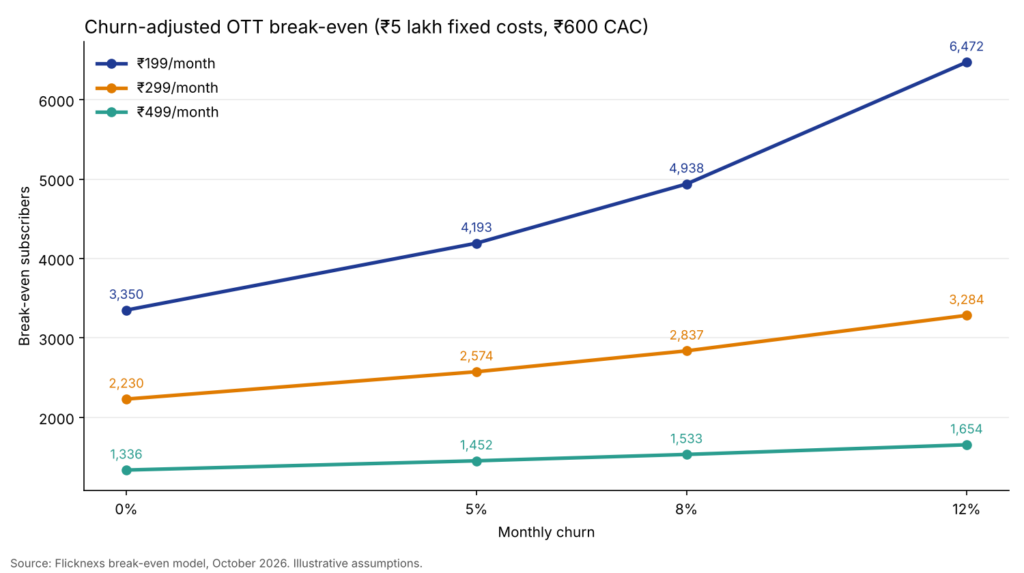
Churn raises break-even far faster at low price points. Source: Flicknexs break-even model.
What the tables show:
- At ₹199, churn nearly doubles the target. Going from zero to 12% churn takes break-even from 3,350 to 6,472 subscribers, a 93% jump.
- At ₹499, churn adds only 24%. Higher contribution absorbs the replacement cost.
- Low prices need loyal audiences. If you plan a ₹199 tier, your retention plan matters more than your marketing plan.
The replacement treadmill
At 2,000 subscribers, here is what you must acquire every month just to stay flat:
| Monthly churn | Subscribers lost per month | Monthly replacement spend at ₹600 CAC |
| 5% | 100 | ₹60,000 |
| 8% | 160 | ₹96,000 |
| 12% | 240 | ₹1,44,000 |
At 12% churn, replacement spending alone exceeds the salary of a senior hire. None of that money grows the business.
Why Churn Beats Headcount Cuts
Using the ₹299 scenario with ₹5 lakh fixed costs and 8% churn (break-even: 2,837), compare two moves:
| Move | New break-even | Subscribers saved |
| Cut one ₹1 lakh/month role (fixed costs → ₹4 lakh) | 2,270 | about 570 |
| Cut churn from 8% to 5% (no staffing change) | 2,574 | about 260 |
| Cut churn from 12% to 5% | 2,574 (from 3,284) | about 710 |
A staffing cut does help: at a small scale, every salary is a big share of fixed cost. But it is a one-time gain, and cutting the wrong role (support, content programming) usually raises churn and erases it. Reducing churn compounds: it lowers break-even and cuts monthly replacement spend.
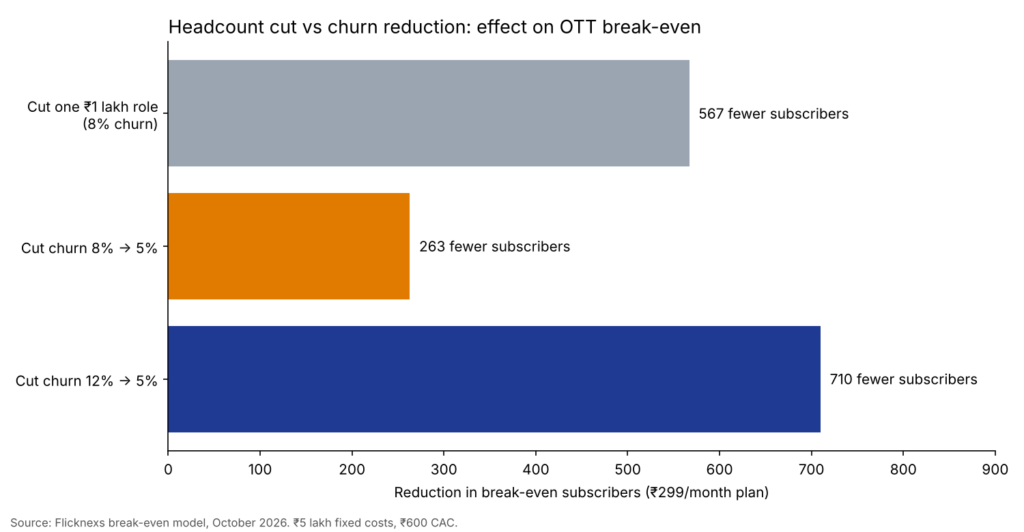
Cutting churn from 12% to 5% beats a one-role headcount cut. Source: Flicknexs break-even model.
Practical ways small OTT services reduce churn:
- Annual plans with a real discount. They lock in a year of revenue and smooth out monthly cancellations.
- A release calendar subscribers can see. People cancel when they think nothing new is coming.
- Failed-payment recovery. Retry UPI/card payments and send reminders before access ends; much “churn” is actually payment failure.
- Cancellation exit surveys. Ask one question at cancel time. The answers tell you whether the issue is content, price or playback.
- Playback quality monitoring. Buffering on low-end Android devices quietly drives cancellations.
What Should a Lean OTT Team Look Like?
There is no correct headcount. A curated video-on-demand library and a 24/7 live sports service are different businesses. What matters is which decisions stay with you.
| Function | Keep in-house | Why |
| Content strategy and programming | Yes | Decides retention: the biggest lever in our model |
| Pricing and plans | Yes | Decides contribution per subscriber |
| Rights and partner deals | Yes | Legal and commercial risk sits with you |
| Growth and retention | Yes (small team) | Owns CAC and churn (both in the formula) |
| Customer support | Partly | Automate FAQs; keep a human for billing and playback issues |
| Streaming infrastructure, apps, CDN | Usually rent | Not a differentiator for most niche services |
| Finance and reporting | Partly | Software plus a part-time specialist; you own the numbers |
A useful rule: if a function changes churn, CAC or price, keep control of it. If it doesn’t, consider renting it.
If you are still choosing a monetization model, our guides on TVOD platforms and what VOD is and how it works cover the trade-offs between rentals, subscriptions and ads.
Build vs. Managed OTT Platform: Cost Questions to Ask
Building your own stack turns infrastructure into fixed cost (engineers, DevOps, app maintenance), which raises the numerator in the break-even formula. A managed platform converts much of that into a predictable fee, but only if the pricing is transparent.
Before signing with any provider, get these in writing:
- The monthly base fee and exactly what it includes.
- Storage, transcoding and bandwidth rates, if charged separately.
- Which apps (Android, iOS, Smart TV, Roku, Fire TV) are included, and who maintains them.
- Supported payment gateways, including UPI and recurring mandates.
- Your right to export subscriber and content data if you leave.
- The support response time written into the contract.
Then plug the answers into the formula above. The cheapest-looking quote is not always the lowest break-even. Our comparison of white-label OTT platform providers walks through how the main vendors structure pricing.
Flicknexs provides a white-label OTT platform for launching branded streaming services on web, mobile and TV apps, with subscription, rental and ad-supported monetization built in. If you want to test your break-even numbers against a managed setup, you can review what’s included before committing.
Explore the Flicknexs OTT platform →
A 30-Day OTT Break-Even Checklist
Week 1: Get real numbers
- List every fixed monthly cost: salaries, platform fees, content amortization, tools.
- Calculate true variable cost per subscriber: gateway fees, delivery, per-user charges.
Week 2: Measure churn and CAC
- Monthly churn = cancellations ÷ subscribers at start of month.
- CAC = total acquisition spend ÷ new paying subscribers (not sign-ups or trials).
Week 3: Run the churn-adjusted formula
- If (contribution − churn × CAC) is negative or close to zero, fix pricing or retention before spending more on ads.
Week 4: Pick one lever
- Test an annual plan, a payment-retry flow, or a published release calendar. Re-measure churn after 30 days.
If you’re planning a launch rather than optimizing one, start with our step-by-step guide to creating a movie streaming website.
Frequently Asked Questions
Is Netflix laying off employees in 2026?
Puck News reported on October 9, 2026, that Netflix plans to cut about 5% of its workforce, roughly 800 jobs. Netflix declined to comment, and departments affected were not disclosed as of October 12.
What is OTT break-even?
OTT break-even is the number of paying subscribers a streaming service needs for monthly revenue, after variable costs, to cover its fixed costs. A churn-adjusted version also subtracts the cost of replacing subscribers who cancel.
How many subscribers does a small OTT platform need to break even?
It depends on price, costs and churn. In our model, a ₹299/month service with ₹5 lakh monthly fixed costs needs about 2,230 subscribers without churn and about 2,840 at 8% monthly churn.
What is a good churn rate for an OTT service?
There is no single benchmark; it varies by content type and pricing. Our model shows the practical test: if monthly churn × acquisition cost approaches your contribution per subscriber, the service cannot break even.
Is it cheaper to build an OTT platform or use a managed one?
Building raises fixed costs (engineering, maintenance), which raises break-even. A managed platform is often cheaper early on, but compare total costs including bandwidth, apps and data-exit terms.
Should a small streaming service cut staff to become profitable?
Only roles that don’t affect churn, price or acquisition. In our model, one ₹1 lakh role saved about 570 subscribers of break-even, but cutting support or programming can raise churn and cancel the saving.
Which OTT price point is safest for India?
Higher prices tolerate churn better. In our model, 12% churn raised break-even 93% at ₹199 but only 24% at ₹499. Low-price tiers need strong retention or ad revenue.
Final Verdict
Netflix’s reported cut is a scale story: a profitable company trimming to grow faster. For a small streamer, the more useful lesson comes from the arithmetic. Fixed costs matter, but churn decides whether the business works:
- Launching at ₹199: Retention and ad revenue come first; ads to win subscribers come second.
- Launching at ₹299–₹499: You have room. Keep the team small and rent infrastructure.
- Already live: Run the churn-adjusted formula this month before making any hiring or cutting decision.
Start a free Flicknexs trial or talk to an OTT expert →
Ready to build?
If you’re planning your next Netflix-clone project, Flicknexs handles the video infrastructure end-to-end — so you can ship in weeks, not months.