
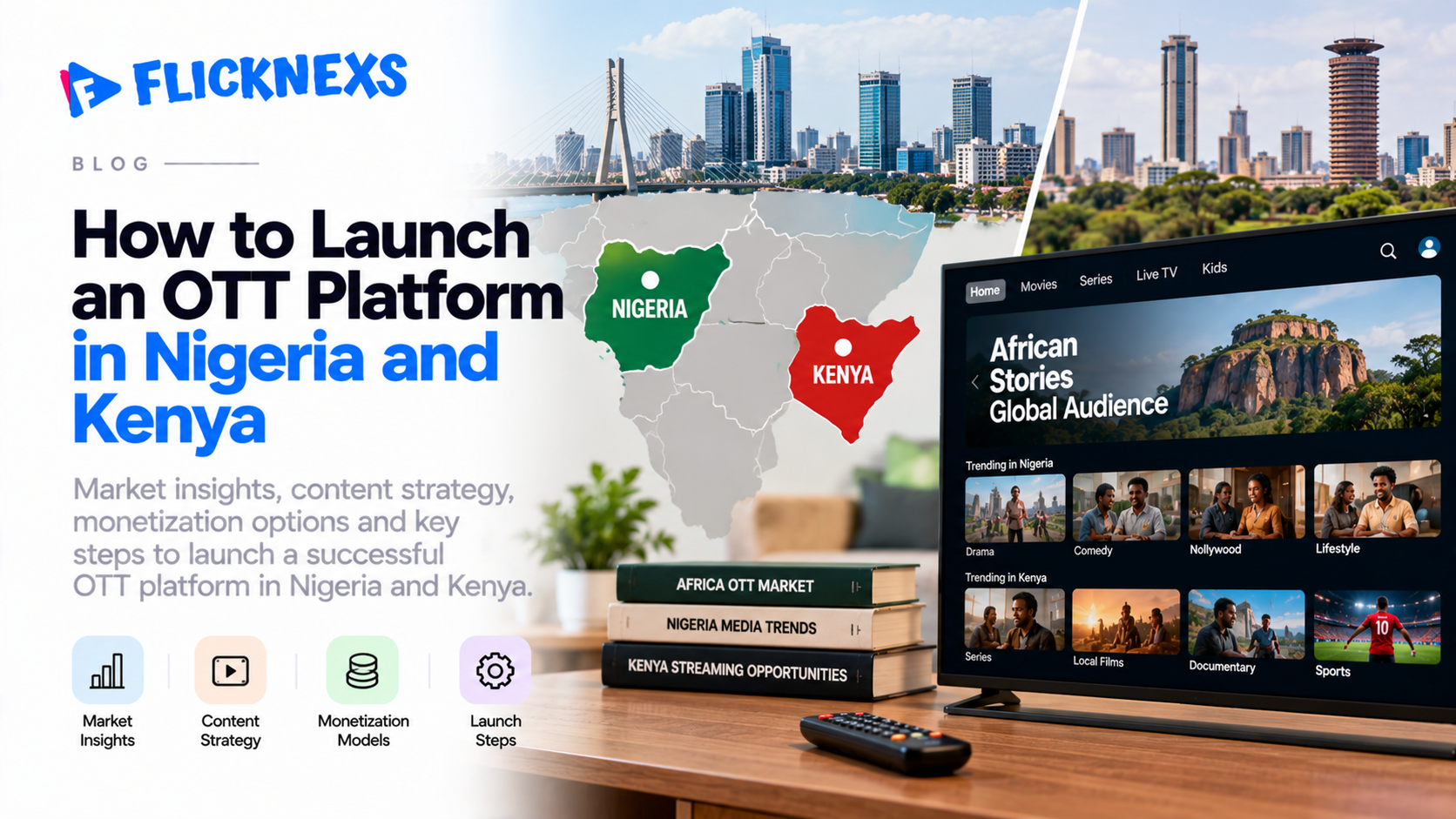
Quick answer: To launch an OTT platform in Nigeria or Kenya, pick one country and one audience niche, secure territorial rights, and match monetization to the market: subscriptions plus direct debit or card billing in Nigeria, advertising plus M-PESA payments in Kenya. Design for low data use, pilot for 90 days, and scale only once churn and acquisition costs work.
If you plan to launch an OTT platform in Nigeria or Kenya, the headline numbers look exciting. PwC’s Africa Entertainment and Media Outlook 2026–2030, released in Johannesburg on 13 October 2026, names Nigeria the world’s fastest-growing streaming video market and Kenya the world’s fastest-growing internet advertising market (TechAfrica’s summary of the PwC Africa outlook).
The less-quoted numbers matter more. The same outlook expects total OTT revenue of only about US78millioninNigeriaandUS31 million in Kenya by 2030 (TechAfrica’s breakdown of PwC’s 2030 OTT revenue forecast). And in March 2026, Africa’s best-funded local streamer, Showmax, announced it would close after its losses became unsustainable (BusinessTech’s report on the Showmax closure).
Flicknexs builds white-label OTT platforms with web, mobile and smart-TV apps, and we wrote this guide from the questions African broadcasters and content owners bring to our demos. It is for founders, broadcasters, content owners and media companies who want to enter either market without repeating that mistake. You will get the verified 2026 forecasts, our own calculations on what those forecasts mean for a new entrant, a market-by-market comparison, and a 90-day launch plan.
Key takeaways
- Growth is fast but the pie is small: PwC forecasts about US78MNigeriaandUS31M (Kenya) in total OTT revenue by 2030.
- Our calculation from PwC’s figures: that implies roughly 1.86M paid subscriptions in Nigeria and 0.57M in Kenya in 2030, across every service combined.
- Kenya’s internet advertising market is forecast at US$603M by 2030, about 19 times its OTT revenue, so ad-supported models deserve first look there.
- In Kenya, mobile data for a two-hour HD film can cost more than a month of average subscription revenue. Encoding and download features are a pricing decision, not just a technical one.
- Showmax’s 2026 shutdown shows that market share without unit economics is not a business.
What does PwC’s 2026 outlook say about Nigeria and Kenya?
PwC’s outlook covers South Africa, Kenya and Nigeria through 2030. The figures most relevant to an OTT launch are below. Every number is a forecast, not a guarantee.
| Metric (forecast to 2030) | Nigeria | Kenya | Source |
|---|---|---|---|
| OTT video revenue growth (CAGR) | 20.4% | 15.9% | Broadcast Media Africa on PwC’s OTT growth rates |
| Total OTT revenue in 2030 | ~US$78M | ~US$31M | TechAfrica on total 2030 OTT revenue |
| Average annual OTT revenue per subscription, 2030 | US$42 | US$54 | NexMedia’s summary of PwC revenue per subscription |
| Global average, same metric | Above US$100 | Above US$100 | NexMedia’s comparison with the global average |
| 5G subscription penetration, 2030 | 35.3% | 51.6% | Citizen Digital on Kenya’s 5G and ad forecasts |
| Connectivity share of total E&M revenue, 2030 | ~66% | ~75% | TechAfrica on connectivity’s share of media revenue |
| Internet advertising revenue | Not covered here | US313M2025toUS603M (2030), ~14% CAGR | Citizen Digital on Kenya’s internet ad growth |
| Video advertising growth | Not covered here | 18.2% CAGR | Broadcast Media Africa on Kenya’s video ad growth |
[IMAGE 1 — insert original chart: “Nigeria vs Kenya OTT forecast to 2030” (alt text: Nigeria vs Kenya OTT revenue and growth forecast to 2030 comparison)]
Three signals stand out:
- Traditional TV is not dying yet. In Kenya and Nigeria, traditional TV revenue is still growing, just more slowly than OTT (PwC’s note that traditional TV is still growing in Kenya and Nigeria). You compete with free-to-air and pay-TV habits, not only with Netflix.
- Telcos hold most of the money. Connectivity makes up two-thirds to three-quarters of entertainment and media revenue in these markets. That is why telco partnerships matter more here than in mature markets.
- Revenue per subscription is low. At US42toUS54 a year, African OTT revenue per subscription is less than half the global average. Your cost base has to reflect that from day one.
Read PwC’s own landing page for the full report: PwC’s Africa Entertainment and Media Outlook landing page.
How big is the OTT opportunity really?
Most articles stop at growth rates. Growth from a small base can still leave a small market, so we ran the numbers.
Our calculation (derived from PwC’s published forecasts):
- Nigeria: US78MtotalOTTrevenueUS42 per subscription ≈ 1.86 million paid subscriptions in 2030
- Kenya: US31MtotalOTTrevenueUS54 per subscription ≈ 0.57 million paid subscriptions in 2030
These are rough, market-wide estimates. PwC’s revenue line may include revenue streams that are not tied to a subscription, and one viewer can hold several subscriptions. Treat them as an order-of-magnitude check, not a count of people.
Even so, the implication for a new entrant is clear. Those figures cover every streaming service combined, including Netflix, Prime Video and pay-TV streaming apps. A newcomer that wins 1% of Nigeria’s 2030 subscriptions would hold about 18,600 subscriptions, worth roughly US780,000ayearatPwC′saverage.InKenya,1310,000 a year.
That is a real business for a focused, lean operator. It does not fund a general-entertainment catalog built to rival global platforms.
Kenya’s advertising math is different. Kenya’s internet advertising forecast of US$603M for 2030 is about 19 times its forecast OTT revenue (our ratio from the Citizen Digital and TechAfrica figures above). If you plan for Kenya, the larger pool of money is advertisers’ budgets, not viewers’ wallets.
What can new entrants learn from the Showmax shutdown?
Showmax had every advantage a local streamer could want. It launched in 2015, rebuilt its app in 2024 on technology developed by NBCUniversal for Peacock, and commissioned originals across Nigeria, South Africa and Kenya (What Kept Me Up’s history of Showmax originals). It operated in 44 Sub-Saharan markets (Sinema Focus on Showmax’s 44-market footprint).
On 5 March 2026, MultiChoice’s new owner Canal+ announced Showmax would be discontinued, citing substantial annual losses (BusinessTech’s coverage of the Canal+ decision). The service ended on 30 April 2026, and its originals moved into a section of DStv Stream (AfroTools on the move of Showmax originals to DStv Stream).
Four lessons for anyone planning a launch:
- Subscriber growth did not save it. Scale bought with heavy content spend can grow losses as fast as it grows users.
- Premium originals are expensive in a low-ARPU market. Commission costs do not fall just because subscription prices are lower.
- Bundling is where the large players are heading. Canal+ has said it intends to extend its Netflix bundling partnership across English-speaking Sub-Saharan Africa (News24 on Canal+’s Netflix bundling plans). Independent services need a niche that a bundle does not serve well.
- There is now a gap. Viewers who used Showmax for local drama and reality content now need to find that content elsewhere. A focused service built around specific local genres can target that demand.
The point is not that streaming in Africa fails. The point is that the winning shape for a new entrant is narrow, lean and partnership-led.
Nigeria vs. Kenya: which market should you enter first?
| Decision factor | Nigeria | Kenya |
|---|---|---|
| Forecast OTT growth to 2030 | 20.4% CAGR, fastest in the world | 15.9% CAGR |
| Forecast total OTT revenue, 2030 | ~US$78M | ~US$31M |
| Revenue per subscription, 2030 | US42/year( US3.50/month) | US54/year( US4.50/month) |
| Average cost of 1 GB mobile data (2026) | US$0.23 | US$0.82 |
| Strongest revenue pool for a newcomer | Subscriptions in a defined niche | Advertising, especially video |
| Key payment rail for recurring billing | Cards and bank direct debit | M-PESA standing orders |
| First model to test | SVOD or hybrid | AVOD or hybrid |
Monthly figures are our division of PwC’s annual forecasts. Data prices: Cable.co.uk’s 2026 global mobile data price league.
Choose Nigeria first if
- You own or can license a catalog a specific audience will pay for: Nollywood back catalog, Yoruba, Igbo or Hausa-language films, faith content, or licensed sports.
- You can run a subscription business with low content costs.
- You want the larger total market and cheaper data for your viewers.
Choose Kenya first if
- Your content attracts frequent, repeat viewing that advertisers want to reach.
- You can sell ads directly or through partners, and measure viewing well enough to prove value.
- Your audience already pays for services through M-PESA.
Why not both at once?
Rights, payments, pricing and marketing all differ by country. A two-country launch doubles that work before you have proof that either market responds. Launch one, measure, then expand with evidence.
Which monetization model fits each market?
SVOD (subscription video on demand)
Viewers pay a recurring fee for a catalog. At an average of about US$3.50 a month in Nigeria in 2030, SVOD works only if your content and delivery costs are low. It suits niche catalogs with loyal fans: faith content, regional-language film, or a creator’s community.
AVOD (advertising-supported video on demand)
Viewers watch free, and ads pay. Kenya’s forecast 18.2% annual growth in video advertising makes this the first model to test there. The risk is that advertisers buy audiences, not apps. You need enough monetizable viewing hours and credible measurement before ad revenue becomes reliable.
TVOD and pay-per-view
Viewers pay per title or event. This fits premieres, concerts, licensed fixtures and faith events, and it avoids the churn problem of subscriptions. We cover the model in more depth in our guide to TVOD platforms in 2026.
Hybrid
A free, ad-supported tier brings people in; a paid tier removes ads or adds premium titles. Hybrid is the most common end state, but it is harder to run on day one. Start with one model, then add the second when the data shows demand.
FAST channels
Free ad-supported streaming TV means scheduled, linear channels delivered over the internet. It suits owners of large libraries who want distribution on smart-TV platforms. See how to get a FAST channel on Roku, Samsung TV Plus, Tubi and Prime Video.
| Your situation | Model to test first |
|---|---|
| Exclusive niche catalog, loyal fans | SVOD |
| Broad catalog, high repeat viewing, Kenya focus | AVOD |
| Big one-off events or premieres | TVOD / pay-per-view |
| Large library, wants smart-TV reach | FAST |
| Premium titles plus a free acquisition catalog | Hybrid |
How does mobile data cost shape your product?
This is the part most market-entry guides skip. In both countries, most viewers watch on phones over mobile data, and they pay for every gigabyte.
The average price of 1 GB of mobile data in 2026 is about US0.23inNigeriaandUS0.82 in Kenya (Cable.co.uk’s 2026 per-gigabyte price data). Netflix’s published usage rates are about 0.3 GB per hour on its lowest setting, 0.7 GB per hour for SD and 3 GB per hour for HD (Firsty’s summary of Netflix’s published data rates).
Our calculation: data cost to the viewer for one two-hour film
| Quality | Data used | Cost in Nigeria | Cost in Kenya |
|---|---|---|---|
| Low (~0.3 GB/hr) | ~0.6 GB | ~US$0.14 | ~US$0.49 |
| SD (~0.7 GB/hr) | ~1.4 GB | ~US$0.32 | ~US$1.15 |
| HD (~3 GB/hr) | ~6 GB | ~US$1.38 | ~US$4.92 |
Compare that with PwC’s forecast revenue per subscription of about US$4.50 a month in Kenya. One HD film over mobile data costs a Kenyan viewer more than a month of average subscription revenue. In practice, your viewer’s data bill competes with your subscription price.
What to build because of this:
- A low-bitrate rendition that still looks good on a phone. Tune your encoding ladder for small screens rather than copying a TV-first ladder.
- A data-saver default on mobile networks, with HD on Wi-Fi.
- Offline downloads, so people can download on Wi-Fi or cheaper night bundles and watch later. Check that your licenses allow it.
- Visible data estimates next to quality settings, so viewers can choose with confidence.
- Telco zero-rating or bundles. Telcos in Kenya and Nigeria already partner with streaming services to make access cheaper (Business Tech Africa on telco-streamer partnerships). A data-free or bundled offer removes the biggest hidden cost your viewer faces.
Data prices change often and vary by operator and bundle, so rerun these numbers with current local tariffs before you set prices.
Which payment rails work for subscriptions?
Payment failure is a silent churn driver. Pick rails that support true recurring billing in each country.
Nigeria: cards and direct debit
Paystack’s Subscriptions API supports card and, in Nigeria, bank direct debit for recurring billing (Paystack’s Subscriptions API documentation). Direct debit lets a business charge a customer’s bank account after the customer gives a mandate, and Paystack offers it to businesses in Nigeria only (Paystack’s Direct Debit documentation for Nigeria).
One detail many teams miss: Paystack’s documentation states that subscription charges are not retried automatically (Paystack’s note that subscriptions are not retried). Build your own dunning flow, with reminders and a simple way to pay manually by transfer, or you will lose subscribers whose cards fail once.
Kenya: M-PESA standing orders
Safaricom’s M-PESA Ratiba lets M-PESA users set up recurring payments, including subscriptions, to other users or Lipa na M-PESA shortcodes (Safaricom’s M-PESA Ratiba product page). Payments can run daily, weekly, monthly or yearly, and customers opt in from the M-PESA app or via USSD (Safaricom’s M-PESA Ratiba launch announcement).
For a Kenyan streaming service, this matters because it gives subscriptions a recurring rail that does not depend on cards.
Flicknexs already supports PesaPal, which takes M-PESA, Airtel Money, MTN Mobile Money, cards and bank transfers and settles in KES and other East African currencies. See how Flicknexs supports PesaPal payments for African creators. Confirm recurring-billing behavior for your plan during setup.
Price in short cycles
Low-income viewers often prefer to pay in small amounts. Test weekly and daily passes alongside monthly plans. Short passes also give you a natural way to sell event access.
Payment checklist before launch
- Which rails support recurring charges, and in which currencies?
- What happens when a charge fails? Who sends the reminder?
- How fast does money settle to your account?
- Can viewers cancel easily? Hidden cancellation hurts trust and invites complaints.
What content strategy works for a new African streamer?
Content is why people find you and why they come back. With a small market, your content has to be specific.
Build around one audience
Examples worth researching:
- Nollywood classics and indie films.
- Regional-language drama in Nigeria or Kenya.
- Local reality and telenovela formats, now without their main streaming home after Showmax closed.
- Faith content and church broadcasts.
- Licensed lower-tier sports that big broadcasters ignore.
- Learning and professional-skills video.
- Diaspora audiences who want content from home.
These are hypotheses to test with search data, surveys and a pilot. None is proven profitable by this article.
Secure rights before you spend on marketing
Confirm in writing:
- Territories covered (Nigeria, Kenya, diaspora markets).
- Formats allowed (on-demand, live, linear, downloads).
- Whether advertising is allowed against the content.
- Devices covered (mobile, web, smart TV).
- Exclusivity and license length.
- Rights to cut clips and trailers for social media.
Rights in one country do not carry over to another. Download rights are often separate from streaming rights, and you need them for the data-saving strategy above.
What technology does the platform need?
Your technology should follow your business model, not the other way round.
| Capability | Why it matters in Nigeria and Kenya |
|---|---|
| Adaptive bitrate streaming | Keeps playback going on unstable mobile connections |
| Mobile-tuned encoding ladder | Cuts the data bill your viewers pay |
| Offline downloads with DRM | Lets viewers watch on cheaper Wi-Fi or night data |
| Content management system | Manages titles, metadata, artwork and territorial availability |
| Subscription and entitlement management | Controls who can watch what, by plan and country |
| Payment integrations | Connects card, direct debit and mobile money rails |
| Ad insertion (client or server side) | Required for AVOD, hybrid and FAST |
| Geo-restriction | Enforces territorial licenses |
| Analytics | Tracks viewing, churn, payment failure and ad revenue |
| Apps for Android, iOS, web and smart TV | Android matters most for mobile reach; smart TV for premium viewing |
Questions to ask any OTT platform provider
- Can you show me your lowest-bitrate rendition playing on a mid-range Android phone?
- Do you support offline downloads with DRM?
- Which payment gateways and mobile money integrations are live today, not just on the roadmap?
- How do you handle failed recurring payments?
- Can I restrict titles by country?
- Which ad servers and ad formats do you support?
- Where are your delivery servers or CDN points closest to Lagos and Nairobi?
- What are the setup fee, monthly fee and bandwidth costs at 10,000 and 100,000 monthly viewers?
- How long does a white-label app take to reach the app stores?
- Can I export my subscriber and viewing data if I leave?
For a broader view of vendors, see our comparison of white-label OTT platform providers.
[ADD FIRST-HAND EXPERIENCE BLOCK: Flicknexs team to insert a real example, e.g. a screenshot of the encoding ladder or data-saver setting configured for a mobile-first deployment, with a one-paragraph note on what was tested and the result. Do not publish without a real asset.]
If you are planning a branded streaming service, Flicknexs’s white-label OTT platform includes web, mobile and smart-TV apps, subscription and ad monetization, and content management. You can start a 14-day Flicknexs free trial to test it before committing. Ask us the ten questions above during your demo and compare answers across vendors.
How should you market and distribute the service?
Search
Build pages around real searches from your target audience: specific film titles, genres, actors and event names. Avoid thin pages that only swap the country name. Check search volume and competition before you invest.
Social video and creators
Short clips, trailers and behind-the-scenes content travel well on social platforms, as long as your license covers promotional use. Track how many people go from a clip to a sign-up and then to a second viewing session. Views alone do not pay.
Telco and partner distribution
Given that connectivity is the largest revenue pool in both markets, telcos are natural partners. Options include bundled subscriptions, zero-rated viewing and carrier billing. Also consider producers, churches, schools, sports clubs and diaspora associations that already have your audience.
Partnerships work only if you can see the data. Agree up front on what customer and viewing data you will receive. To decide between a telco deal and a direct launch, use the scoring test and revenue-share math in our guide to OTT market entry: telco partner or D2C launch.
Retention
Fresh content on a predictable schedule, good recommendations and reliable playback keep people coming back. For subscriptions, track renewal rates and cancellation reasons. For AVOD, track repeat sessions per week.
A 90-day market-entry plan
Days 1–30: Validate
- Pick one country and one audience.
- Research competitors, current prices and viewing habits.
- Confirm content rights, including downloads and advertising.
- Model revenue using the subscription and data math above.
- Choose payment rails and test them with real local accounts.
Days 31–60: Build
- Configure the catalog, encoding ladder and data-saver defaults.
- Integrate payments and a failed-payment recovery flow.
- Test playback on mid-range Android phones on real local networks.
- Set up analytics and conversion tracking on every sign-up and payment step.
- Prepare launch content and partner outreach.
Days 61–90: Pilot
- Launch to a defined group: a community, a church network, a partner’s customers.
- Track sign-ups, first and second viewing sessions, paid conversion and payment failures.
- Fix the biggest drop-off point before spending more on acquisition.
- Decide: scale, adjust, or change market.
This is a planning framework. License negotiations, app-store approvals and payment onboarding can take longer than 90 days.
Which metrics prove the business works?
| Metric | What it tells you |
|---|---|
| Sign-ups | Interest at the top of the funnel |
| Playback start success rate | Whether people can actually start watching |
| Rebuffering ratio | Whether your encoding and delivery suit local networks |
| Second-session rate | Whether viewers come back |
| Trial-to-paid conversion | Whether your price matches perceived value |
| Payment failure rate | Whether your payment rails work |
| Monthly churn | Whether paying viewers stay |
| Customer acquisition cost (CAC) | What each paying viewer costs you |
| Net revenue per subscriber | What you keep after fees and revenue shares |
| Ad fill rate and eCPM | Whether your ad inventory is selling |
| Contribution margin | Whether each viewer covers the costs they create |
Report these separately by country, channel and content category. A healthy average can hide a loss-making segment.
Common mistakes to avoid
- Treating growth rate as market size. A 20% growth rate on a US$78M market is still a small market. Size your costs to the pie.
- Copying the Showmax model at a smaller budget. Broad catalogs and premium originals need scale that new entrants do not have.
- Ignoring the viewer’s data bill. In Kenya especially, data can cost more than your subscription.
- Relying on cards alone. Use direct debit in Nigeria and M-PESA in Kenya, and build your own retry flow.
- Launching in both countries on day one. Prove one market first.
- Licensing streaming but not downloads. You lose the most useful data-saving feature.
- Measuring downloads of your app instead of paid, retained viewers.
Frequently Asked Questions (FAQ)
Is Nigeria a good market to launch an OTT platform in 2026?
Yes, for a focused service. PwC forecasts Nigerian OTT revenue to grow 20.4% a year through 2030, the fastest of any market it tracks. But total OTT revenue is forecast at only about US$78M by 2030, so a new entrant should target a specific niche with low content costs.
Is Kenya better for subscription or ad-supported streaming?
Kenya favors testing ad-supported or hybrid models first. PwC forecasts Kenya’s internet advertising at US$603M by 2030, about 19 times its forecast OTT revenue, with video advertising growing 18.2% a year. Subscriptions can work too, especially with M-PESA recurring payments.
How much do viewers pay for streaming in Nigeria and Kenya?
PwC forecasts average annual OTT revenue per subscription of US42inNigeriaandUS54 in Kenya by 2030, compared with more than US100globally.ThatworksouttoroughlyUS3.50 and US$4.50 a month. These are market averages, not suggested prices.
Why did Showmax shut down?
MultiChoice, now owned by Canal+, said Showmax’s annual losses had become unsustainable. The service closed on 30 April 2026, and its originals moved into DStv Stream. The lesson for new entrants is that subscriber growth without profitable unit economics does not last.
How much mobile data does streaming use in Nigeria and Kenya?
Using Netflix’s published rates, a two-hour film uses about 1.4 GB in SD and 6 GB in HD. At 2026 average data prices, that is roughly US0.32SDtoUS1.38 (HD) in Nigeria and US1.15toUS4.92 in Kenya.
Which payment methods support streaming subscriptions in Nigeria and Kenya?
In Nigeria, Paystack supports recurring billing by card and by bank direct debit. In Kenya, M-PESA Ratiba lets users set up standing-order payments for subscriptions. Build your own retry and reminder flow, because failed recurring charges are a major cause of churn.
Do I need separate apps for Nigeria and Kenya?
Not necessarily. One branded platform can serve both if it supports country-specific catalogs, prices, payment methods and geo-restriction. You will still need separate marketing and, often, separate content licenses.
How long does it take to launch an OTT platform in Africa?
With a white-label platform, the technical setup can fit within a 90-day pilot plan. Content licensing, payment onboarding and app-store approval often take longer, so start those first.
Final verdict
| If you are… | Start with |
|---|---|
| A Nollywood or regional-language content owner | Nigeria, SVOD or TVOD, direct debit + card billing |
| A media company with a large, broad library | Kenya, AVOD or FAST, with an ad partner |
| A faith or community organization | Either market, low-cost SVOD or donation-supported free tier |
| An events or sports rights holder | Pay-per-view in the country where you hold rights |
| A diaspora-focused service | Price in USD/GBP abroad; keep local pricing for home markets |
Nigeria offers the faster-growing and larger OTT market. Kenya offers the larger advertising pool. Neither rewards a broad, expensive launch. Pick a niche, design for the viewer’s data bill, choose payment rails that support recurring billing, and prove retention before you scale.
Planning to launch a streaming service in Nigeria or Kenya? Create your OTT platform with Flicknexs or start your free Flicknexs trial and see how a white-label OTT platform handles mobile-first playback, local payments and ad monetization for your audience.