
Quick answer: Streaming prices are rising, and viewers are responding by rotating subscriptions instead of paying for everything at once. That shift favors niche OTT platforms — services built around one sport, one creator community, one faith audience, one genre, or one region. A niche OTT platform doesn’t need millions of subscribers. It needs a smaller, highly engaged audience and a hybrid monetization model that combines SVOD, PPV, AVOD, and TVOD, so viewers pay for the moments they actually value.
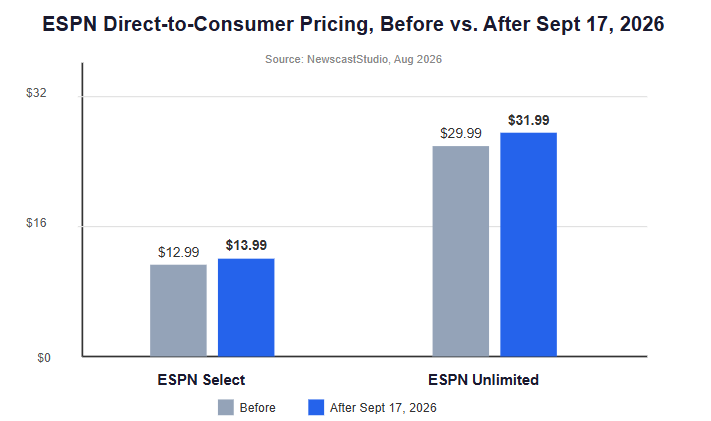
Streaming is getting more expensive. ESPN’s direct-to-consumer plans are a clear example: ESPN Select rose from $12.99 to $13.99 per month and ESPN Unlimited rose from $29.99 to $31.99 per month, effective September 17, 2026 (NewscastStudio).
That single price change isn’t the story. The story is what happens after price increases like this ripple across the whole streaming market: consumers stop asking “which streaming services exist?” and start asking “which services are worth paying for this month?” That question is exactly where a niche OTT platform has room to compete.
Streaming Consumers Are Becoming More Selective
Consumers already juggle multiple streaming services, and they’re getting pickier about which ones survive the monthly budget review.
According to Deloitte’s Digital Media Trends 2026 research, 90% of U.S. households have at least one paid SVOD (subscription video on demand) service, and subscribing households average four services, while 41% of consumers say they canceled an SVOD service in the previous six months (senalnews.com summary of Deloitte’s Digital Media Trends).
Price sensitivity compounds that behavior. The same research found that 61% of consumers would likely cancel their favorite service if its monthly price rose by $5, and roughly three in four say they’re frustrated that entertainment services keep raising prices (Deloitte Digital Media Trends 2026 findings, reported by ScreenVoice).
Key takeaway: the question consumers are asking has changed from “which services exist” to “which services are worth it this month.” A niche platform’s whole value proposition is built to answer exactly that question, on a much smaller, more relevant scale than a general entertainment giant can.
The Rise of Subscription Rotation
There’s an important distinction between subscription churn and permanent customer loss.
A viewer might subscribe to a sports service because a major tournament is starting, watch the games, and cancel once it ends. Months later, another event begins, and they subscribe again. That’s subscription rotation, not abandonment.
Deloitte’s 2026 research found that 22% of consumers had both canceled an SVOD service and later returned to that same service within the previous six months (Deloitte press summary of the Digital Media Trends 2026 findings). For streaming businesses, that means cancellation doesn’t have to be the end of the relationship. The objective becomes: give viewers a reason to subscribe, deliver value, maintain the relationship, and create a reason to return.
Design for Rotation, Don’t Fight It
This is where niche OTT gets interesting. A niche service doesn’t need to convince a viewer to pay every month forever. It can build around specific moments of value.
Consider a combat-sports platform. A fan might subscribe because:
- a major fight is coming
- a tournament is starting
- a new season has begun
- a particular athlete is competing
- exclusive content has just been released
A one-month subscription isn’t automatically a failed customer relationship. With a strong database, a content pipeline, and a win-back strategy, that viewer becomes a returning customer, not a lost one.
A Niche OTT Platform Does Not Need a Massive Audience
The biggest misconception about streaming is that a successful OTT (over-the-top) service needs millions of subscribers.
A niche service can work with a much smaller but highly engaged audience. Imagine a sports organization with 25,000 engaged followers. If 4% convert to paying subscribers during an important season, that’s 1,000 subscribers at $9.99/month, roughly $9,990 in monthly recurring revenue, before PPV (pay-per-view), advertising, sponsorships, merchandise, premium events, annual memberships, or partnerships are added.
That example is illustrative, not a forecast. But it demonstrates the basic economics: a highly relevant audience can be more commercially useful than a much larger general audience.
Niche OTT Competes on Relevance, Not Catalog Size
A major streaming platform might have thousands of movies and shows. A niche platform doesn’t need to compete on catalog size. It competes on relevance.
| Audience | The pitch |
| Combat sports fans | “Watch the fights you care about.” |
| Regional sports fans | “Follow your league.” |
| Faith communities | “Watch your church’s services, conferences, and programming.” |
| Micro-drama viewers | “Follow the next episode of your favorite series.” |
| Music fans | “Watch performances and events from the artists you follow.” |
| Learners | “Access the courses and experts in your field.” |
The value proposition isn’t “we have everything.” It’s “we have something specifically for you.”
One Audience, Multiple Revenue Models
A niche platform doesn’t have to rely entirely on monthly subscriptions. Different viewers can be monetized differently, and stacking models is where OTT technology earns its keep.
| Viewer behavior | Fitting OTT model |
| Wants one tournament | PPV |
| Follows a season | Monthly SVOD |
| Watches occasionally | AVOD (advertising-based video on demand) |
| Follows one creator | Channel subscription |
| Wants a premium event | TVOD (transactional video on demand) / PPV |
| Returns for major events | Win-back subscription |
| Heavy year-round viewer | Annual subscription |
| Large free audience | Advertising + sponsorship |
PPV makes niche content more accessible. Instead of requiring every viewer to buy a yearly subscription, a regional sports organization can sell access to championship matches, tournaments, finals, exclusive interviews, or premium broadcasts. The viewer pays only for what they actually want, which lowers the commitment required to try a new service.
AVOD expands the audience. Not every viewer will pay immediately. A free-content-then-advertising-then-premium path lets a niche OTT business build an audience before requiring everyone to become a paying subscriber. Deloitte’s 2026 research also shows the growing importance of ad-supported streaming: 68% of SVOD subscribers now have at least one ad-supported tier (VideoNuze, reporting Deloitte Digital Media Trends data).
How Four Different Niches Actually Monetize
The table above shows which model fits which viewer behavior. In practice, most niche platforms don’t pick one model, they blend two or three based on what their specific audience actually does. Four patterns show up repeatedly:
Combat sports and regional sports. These audiences are event-driven, so PPV carries the peaks (title fights, finals, derbies) while a season-length SVOD pass covers the in-between games. Advertising fills the gap for casual viewers who watch highlights but never buy a ticket to the main event. The mistake most sports niches make is defaulting to a flat monthly subscription and ignoring the fact that interest spikes around specific dates.
Faith content. Congregations and multi-site ministries tend to under-monetize because the instinct is to make everything free. A workable model keeps live services and core teaching free (building reach and community), while conference recordings, courses, and premium series sit behind SVOD or a one-time purchase. Donation and sponsorship layers often outperform subscription revenue here, which is worth planning for from day one rather than bolting on later.
Micro-dramas. These platforms live or die on release cadence. TVOD (pay to unlock the next episode) and short SVOD passes both work, but only if new episodes ship on a predictable schedule. A micro-drama platform with a three-week gap between releases will bleed subscribers regardless of how good the content is, because the entire model depends on habitual, near-daily return visits.
Music and creator communities. These audiences respond well to channel-level subscriptions tied to a specific artist or creator, plus PPV for one-off events like a livestreamed concert or listening party. AVOD works as a top-of-funnel layer for previously released performances, feeding viewers toward the paid tier once they’ve found an artist they want to follow closely.
Bottom line: none of these four patterns is “just add a subscribe button.” Each one maps a specific viewer behavior to a specific price point and packaging decision, which is exactly what the monetization table above is for.
Common Mistakes When Launching a Niche OTT Platform
Most failed niche OTT launches don’t fail because the content was weak. They fail because of avoidable structural decisions made in the first few months:
- Picking one monetization model and refusing to adjust it. A pure-SVOD platform in an event-driven niche (sports, live events) leaves PPV revenue on the table every single time there’s a marquee moment.
- Treating every cancellation as churn instead of rotation. Without a win-back sequence, a platform loses subscribers permanently who would have returned for the next season or tournament if someone had simply re-engaged them.
- Under-communicating value before asking for payment. AVOD and free previews exist precisely to solve this. A platform that goes straight to a paywall skips the step where a casual viewer becomes a fan.
- No content calendar past the launch window. A single strong launch moment (a debut season, a flagship event) creates a spike in signups and an equally sharp drop-off if nothing is scheduled afterward.
- Underestimating the technical stack. Video hosting, transcoding, CDN (content delivery network) delivery, authentication, and payments are each their own engineering problem. Platforms that try to stitch these together from scratch often spend their first year on infrastructure instead of content and audience growth.
- Ignoring CTV and mobile from day one. A niche audience that discovers a platform on social media still expects to watch on a television. Launching web-only and adding mobile and CTV (connected TV) apps later means re-acquiring the same audience twice.
- Assuming one payment method covers every subscriber. A niche audience is rarely confined to a single country. A platform that only accepts one card network or one regional payment gateway loses subscribers at checkout before they ever watch a minute of content, especially for audiences with a meaningful international or diaspora following.
A Worked Example: Sizing a Hybrid Model
This is a hypothetical planning example to illustrate the math, not a documented case study. Swapping this for a real Flicknexs client outcome is the one piece we can’t fix from here — see the note in my reply below.
Scenario one: a regional sports league. Picture a regional football league with 40,000 social followers launching a niche OTT channel for one season.
- SVOD base: 3% convert to a $9.99/month season pass = 1,200 subscribers = ~$11,988/month during the season.
- PPV finals: 1,800 one-off buyers at $6.99 for the championship match = ~$12,582 in a single event.
- AVOD tier: the remaining free viewers generate ad revenue on match highlights and pre-game shows, monetizing people who would never have paid for a subscription at all.
- Win-back push: at the start of the next season, the platform re-targets last year’s PPV buyers and lapsed SVOD subscribers instead of starting audience acquisition from zero.
Scenario two: a multi-site congregation. Picture a church network with 15,000 people across its physical and social audience launching a platform for teaching series and conference content.
- Free tier: live weekend services and core teaching stay free, building reach and normalizing the platform as part of the weekly routine.
- SVOD or one-time purchase: an in-depth teaching series or small-group course sits behind a $7.99/month pass or a $19.99 one-time unlock, aimed at the most engaged segment of the audience rather than everyone.
- PPV for flagship events: an annual conference sells individual access at $14.99, capturing people who wouldn’t commit to an ongoing subscription but will pay for one event.
- Sponsorship and donation layer: unlike the sports example, a meaningful share of revenue here often comes from donations and sponsorships tied to specific ministries or campaigns, not subscription fees alone.
Neither scenario requires the platform to out-produce a national broadcaster. Each one requires the platform to be relevant to a specific moment for a specific audience, and to have the technology in place to switch between monetization models without rebuilding the stack each time.
The Technology Barrier Has Changed
Building a streaming service used to require a full technology operation: video hosting, transcoding, CDN delivery, apps, authentication, payments, subscriptions, analytics, content management, advertising, and live streaming.
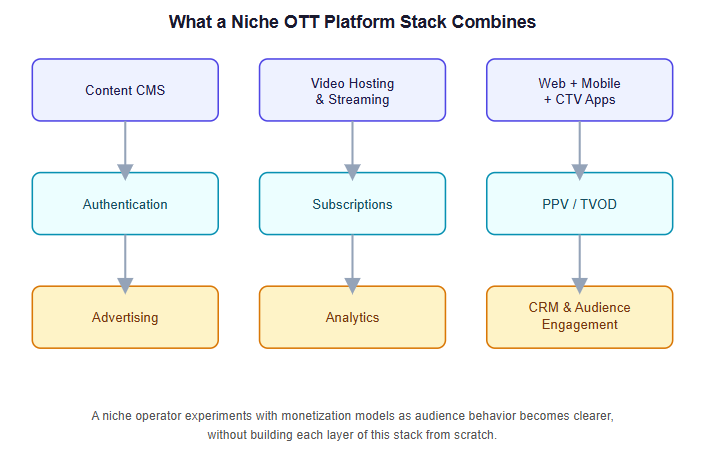
Modern SaaS (software-as-a-service) OTT platforms reduce much of that infrastructure burden. A sports organization, creator, broadcaster, or niche content company can test a streaming business without building an entire streaming technology stack from scratch. A modern niche streaming platform typically combines a content management system, video hosting and streaming, web, mobile, and CTV apps, authentication, subscriptions, PPV/TVOD, advertising, analytics, and CRM (customer relationship management) and audience engagement tools, letting the business experiment with monetization models as audience behavior becomes clearer. Flicknexs builds and provides exactly that stack through its online video platform.
Don’t Build “Another ESPN”
A new OTT business generally cannot compete with ESPN on rights portfolio, brand recognition, content volume, production infrastructure, or marketing budget, and it doesn’t need to. A niche platform competes on specificity.
A regional football league knows its supporters. A martial-arts promoter knows its fighters and fans. A creator knows the community around their content. A church knows its congregation. A micro-drama publisher (see our guide to micro-drama app development) knows its audience down to the episode. That relationship is the foundation of a streaming business.
The old question was: “How do I get millions of subscribers?” The better starting question for a niche OTT business is: “Who cares enough about this content to pay for it?” Then build the business around that audience, combining subscription, PPV, advertising, sponsorship, and annual memberships as the platform allows.
A Short Glossary of the Monetization Terms Above
- SVOD (Subscription Video on Demand): a recurring monthly or annual fee for ongoing access to a content library, the model Netflix and most general entertainment platforms use.
- AVOD (Advertising-based Video on Demand): free access to content, monetized through ads instead of a subscription fee.
- TVOD (Transactional Video on Demand): viewers pay per title or per episode, common for renting a single film or unlocking one micro-drama episode.
- PPV (Pay-Per-View): viewers pay a one-time fee for access to a single live event, such as a championship match or a livestreamed concert.
- CTV (Connected TV): apps built for television hardware and streaming devices (smart TVs, Roku, Fire TV, Apple TV), as opposed to web or mobile.
Getting Started: A Practical Checklist
Before committing budget to a niche OTT launch, work through these five questions in order. Skipping ahead to “which platform vendor” before answering the first three is the most common planning mistake.
- Who is the audience, specifically? Not “sports fans” but “fans of this regional league” or “fans of this fighter.” The narrower the definition, the sharper the marketing and the content calendar can be.
- What triggers a subscription? A season, a tournament, a release schedule, a live event calendar. Write down the actual calendar dates for the next 12 months before launch, not just the concept of “recurring events.”
- Which monetization models fit which viewer segments? Map the audience against the SVOD/PPV/AVOD/TVOD table above before defaulting to a single subscription price for everyone.
- What’s the win-back plan for lapsed subscribers? Rotation is normal. A platform without a re-engagement plan (email, push notifications, a returning-subscriber discount tied to the next event) treats every cancellation as a permanent loss instead of a pause.
- What does the content calendar look like for the next 12 months? Multiple reasons to return beat one big launch moment. If the answer is “we’ll figure out content after launch,” that’s a sign the launch is premature.
Bottom line: answer all five before talking to a vendor. If you’d rather work through this list with someone who’s scoped niche launches before, get a quote from Flicknexs and bring the answers with you.
What to Look for in an OTT Platform Vendor
Once the audience, monetization mix, and content calendar are defined, the technology decision comes down to a shorter list than most first-time operators expect. Look for:
- Multi-model monetization out of the box. The platform should support SVOD, AVOD, TVOD, and PPV natively, not require custom development to add a second revenue model after launch. Revisit the SVOD/PPV/AVOD/TVOD table above and confirm the vendor covers every row you actually need.
- CTV and mobile apps, not just a web player. A niche audience discovered on social media still expects to watch on a television. Confirm Roku, Fire TV, Apple TV, Android TV, and mobile app support before signing, not after launch.
- Content management that doesn’t require an engineer for every upload. Non-technical team members (coaches, church media staff, creators) should be able to schedule and publish content without filing a developer ticket.
- Built-in analytics and CRM, or clean integrations to the tools already in use. Win-back campaigns require knowing who lapsed and when. A platform with no audience data layer makes the rotation strategy in this article impossible to execute.
- Live streaming support if the content calendar includes live events. Sports, faith services, and music performances are frequently live-first. Confirm live-to-VOD workflows exist, not just pre-recorded upload.
- A pricing model that scales with the business, not against it. Watch for vendors that charge per-feature add-ons for PPV or AVOD after the fact; those costs should be visible before signing, not discovered during the first PPV event.
Flicknexs provides platform features built around this checklist directly, so a niche operator can compare the list above against what’s actually included rather than what’s sold as an add-on later.
If You’re Already Running an OTT Platform
Not every reader here is starting from zero. If a platform already exists and growth has stalled, the diagnosis usually isn’t “we need more content.” It’s one of three things:
The platform is stuck on a single monetization model. A sports or events-driven niche running pure SVOD is leaving PPV revenue on the table at every marquee moment. Adding a second model to an existing platform is typically a configuration change, not a rebuild, if the underlying stack supports it.
There’s no win-back motion for lapsed subscribers. Existing platforms often have years of cancellation data sitting unused. Segmenting lapsed subscribers by why they likely left (a season ended, an event passed, a price increase) turns that list into a re-engagement campaign instead of dead weight in a database.
The content calendar reacts to launches instead of planning around them. A platform that only markets around new releases is competing for attention in the same narrow window every time. Mapping the next 12 months of content against the audience’s actual calendar (seasons, holidays, recurring events specific to the niche) creates more entry points for both new and returning subscribers.
None of these fixes require replacing the platform. They require treating monetization mix, win-back, and content calendar as ongoing operational work, not one-time launch decisions.
If all three apply, start with win-back. It’s the fastest to execute (a segmented email and push campaign against an existing subscriber list), it doesn’t require a product change, and the revenue it recovers can fund the monetization and content-calendar work that follows.
Build a Niche OTT Platform With Flicknexs
You don’t need millions of subscribers to test a niche streaming business. You need an audience with a reason to watch.
Flicknexs builds and provides the technology foundation for launching OTT services: centralized content management, streaming, applications, and multiple monetization options. A niche content business can use the platform to experiment with SVOD, AVOD, TVOD, PPV, advertising, and hybrid monetization across web, mobile, and connected TV, and to test formats like a dedicated live TV channel alongside on-demand content.
The objective isn’t to build the next ESPN. It’s to build the streaming destination for your audience.
Ready to see this working for your audience? Request a free demo of the Flicknexs OTT platform and get a quote scoped to your content calendar and monetization mix.
Frequently Asked Questions
Q: What is a niche streaming service? A: A niche streaming service focuses on a specific audience, content category, community, sport, creator, region, or interest rather than trying to serve the entire entertainment market.
Q: Can a niche OTT platform make money? A: Yes, depending on audience size, engagement, content economics, and monetization. A niche platform can combine subscriptions, PPV, advertising, sponsorships, and other revenue models rather than relying on one.
Q: What is subscription rotation? A: Subscription rotation describes subscribing to a service for a period, canceling it, and returning later when new or relevant content becomes available. It’s a pattern of temporary pauses, not permanent churn.
Q: Is PPV better than SVOD for niche OTT? A: They serve different behaviors. SVOD fits recurring content consumption; PPV fits individual premium events. A hybrid model lets a platform serve both instead of forcing every viewer into one pricing structure.
Q: Does a niche OTT platform need millions of users? A: No. A niche platform can be built around a smaller but highly engaged audience. The economics depend on customer acquisition cost, engagement, pricing, content costs, and monetization mix, not raw subscriber count.
Q: How can niche OTT platforms reduce churn? A: Content calendars, personalized recommendations, flexible plans, win-back campaigns, live events, PPV, advertising, and new releases all create reasons for viewers to return instead of canceling for good.
Q: Do I need millions of subscribers to launch a streaming service? A: No. A niche OTT platform can be built around a smaller, highly engaged audience and multiple monetization models rather than mass-market scale.
Q: How long does it take to launch a niche OTT platform? A: It depends on how much of the technology stack is built versus bought. Platforms built from scratch on custom infrastructure can take many months to cover video hosting, apps, payments, and authentication alone. Platforms built on an existing SaaS OTT foundation can move faster because that infrastructure already exists, though the exact timeline still depends on content readiness, app store review, and payment setup.
Q: What’s the biggest factor in whether a niche OTT platform succeeds? A: Audience specificity and monetization fit matter more than catalog size or production budget. A platform that knows exactly who it serves, what triggers a subscription for that audience, and which mix of SVOD, PPV, AVOD, and TVOD matches real viewer behavior has a clearer path to revenue than a platform trying to be broadly appealing.