
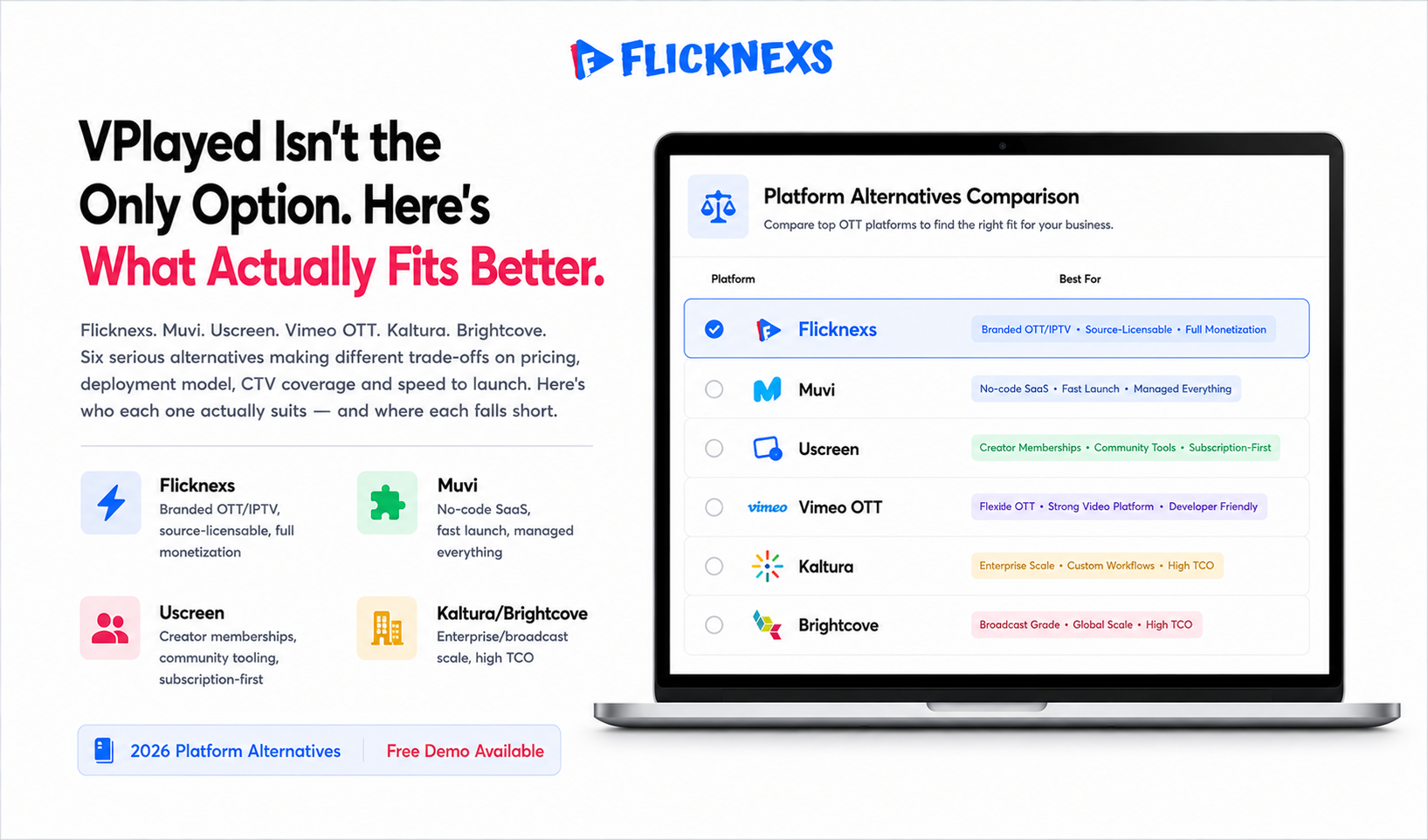
Contus VPlayed isn’t the only game in town anymore, and if you’re paying enterprise-level overhead just to get white-label OTT control, you’re overpaying.
The real contenders in 2026 are Flicknexs, Muvi, Uscreen, Vimeo OTT, Kaltura, and Brightcove. But “best” depends entirely on what you’re actually building. Want fully branded multi-tenant OTT with either source-code access or no-code flexibility? Go with Flicknexs or Muvi. Running a creator-led membership business? Uscreen fits that model specifically. Need large-enterprise video infrastructure with all the compliance and scale that comes with it? That’s Kaltura or Brightcove territory, and honestly, overkill for most independent operators.
Here’s what most people miss when they shop for OTT platforms: a generic video player or a bolt-on plugin will never give you what a dedicated white-label provider gives you, which is ownership. Your branding, your monetization across SVOD, AVOD, and TVOD, your apps across web, mobile, and CTV. Same reason you wouldn’t run a restaurant on rented kitchen equipment you can’t customize.
Below, we break down the features, the pricing models, and the trade-offs that actually bite you once you’re mid-migration, not the ones that look bad in a sales deck.
By the Flicknexs team. We build white-label OTT/VOD/IPTV streaming platforms, so this is written from hands-on streaming-platform experience.
Contus VPlayed is a well-known name in the end-to-end OTT and video CMS space, often pitched to broadcasters and enterprises who want a customizable, self-hosted-leaning solution. It is not the only option, though and for plenty of media businesses it is not the best fit on price, deployment model, or speed to launch. This guide breaks down the strongest VPlayed alternatives for 2026, who each one suits, and how to choose without getting locked into the wrong architecture.
Why look for a VPlayed alternative?
VPlayed positions itself as a fully customizable, end-to-end OTT solution, and that flexibility is genuinely useful for large broadcasters. The catch is that “fully customizable enterprise OTT” usually means longer implementation cycles, higher upfront cost, and more dependence on the vendor’s professional services team. Teams shopping for alternatives tend to cite the same handful of reasons.
Common triggers for switching
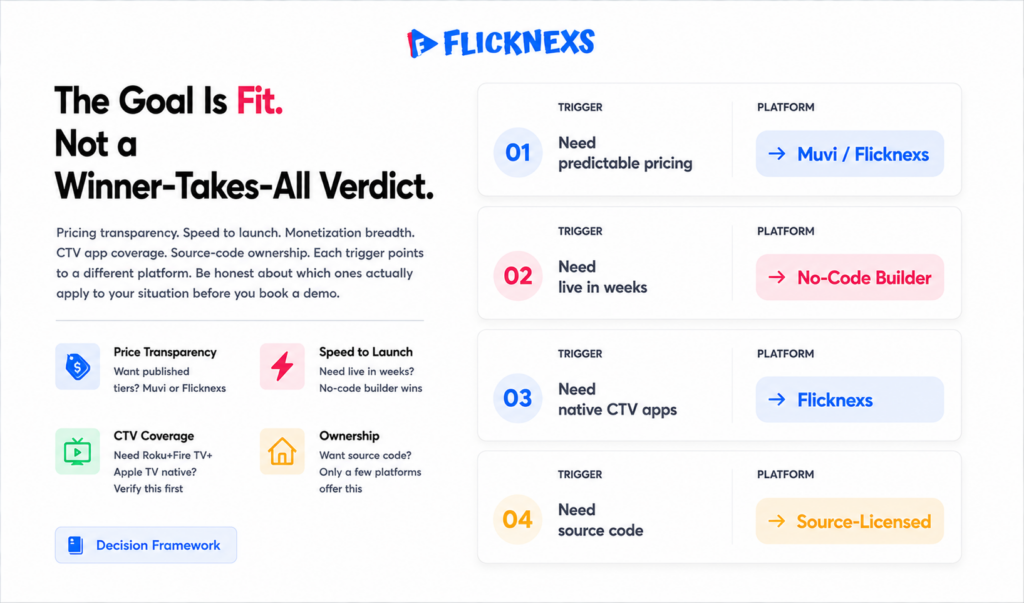
- Pricing transparency. Enterprise OTT quotes are often custom and opaque. Smaller operators want predictable, published pricing tiers.
- Speed to launch. If you need a branded app live in weeks, not quarters, a no-code or template-driven platform moves faster.
- Monetization breadth. You may need SVOD, AVOD, TVOD, and hybrid models, plus coupons, pay-per-view events, and multi-currency, all out of the box.
- App and CTV coverage. Web is table stakes. The real value is native iOS/Android plus Roku, Fire TV, Apple TV, and Android TV apps published under your brand.
- Ownership and control. Some operators want source-code access or self-hosting. Others want a fully managed SaaS so they never touch infrastructure.
None of this makes VPlayed a bad product. It just means a different platform may map better to your business model. The goal is fit, not a winner-takes-all verdict.
The best Contus VPlayed alternatives in 2026
Here is how the leading alternatives stack up at a glance, followed by a deeper look at each.
| Platform | Best for | Deployment | Monetization | White-label apps |
|---|---|---|---|---|
| Flicknexs | Branded multi-tenant OTT/VOD/IPTV | Managed + source-code options | SVOD, AVOD, TVOD, hybrid | Web, mobile, CTV |
| Muvi | No-code all-in-one OTT | Managed SaaS | SVOD, AVOD, TVOD | Web, mobile, CTV |
| Uscreen | Creator memberships & communities | Managed SaaS | Subscriptions, rentals, bundles | Web, mobile, some CTV |
| Vimeo OTT | Simple subscription channels | Managed SaaS | SVOD, TVOD | Web, mobile, CTV |
| Kaltura | Enterprise & education video | Cloud / hybrid | Configurable | Configurable |
| Brightcove | Enterprise broadcast-grade video | Cloud | Ad & subscription via integrations | Via SDKs |
1. Flicknexs, branded OTT with deployment flexibility
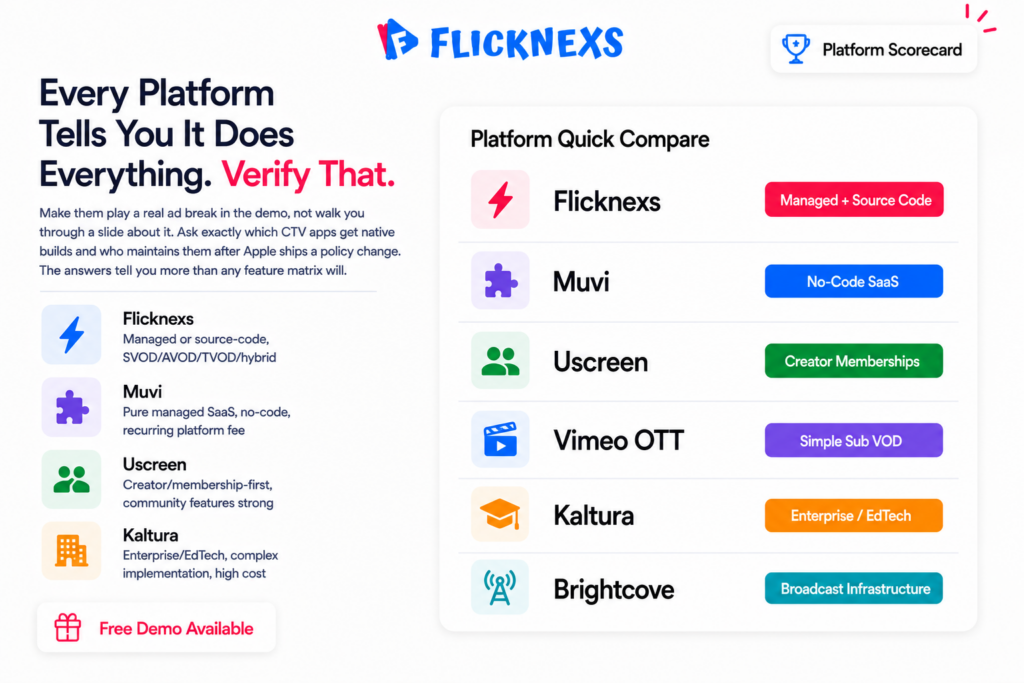
Flicknexs is a white-label OTT, VOD and IPTV platform built for media businesses that want a fully branded experience across web, mobile and connected TV. SVOD, AVOD, TVOD and hybrid monetization all come standard, along with live streaming, pay-per-view events and multi-tenant setups for operators running several channels at once. What actually separates it from a pure enterprise tool is deployment flexibility. Run it managed, or take source-code-level control when you’re ready to own and customize the stack yourself. If you’re looking at VPlayed because you want broadcaster-grade capability without wading through an opaque enterprise sales process, Flicknexs is a direct fit. See the Flicknexs white-label OTT platform for the full feature set.
2. Muvi, no-code, all-in-one
Muvi makes sense if you want a genuine no-code launch. It bundles hosting, CDN, DRM, apps and monetization into one managed SaaS package, so a non-technical team can get a branded streaming service live fast. The trade-off is the one every managed SaaS carries you give up low-level control and you’re paying a recurring platform fee indefinitely. For a head-to-head on positioning, see our Muvi vs Uscreen vs Flicknexs comparison.
3. Uscreen, creator memberships and community
Uscreen is purpose-built for creators, coaches, and niche publishers who sell membership video and bundle community features. If your model is recurring subscriptions to a focused audience (fitness, education, faith, hobby content) Uscreen’s membership tooling and marketing features are excellent. It is less oriented toward large multi-channel broadcaster setups or heavy IPTV use cases, which is where dedicated OTT platforms pull ahead.
4. Vimeo OTT, simple subscription channels
Vimeo OTT, built on Vimeo’s video infrastructure, works well for operators who just want a straightforward subscription channel with apps and minimal setup. It’s reliable, and everyone already knows the name. But power users often hit a ceiling here. The customization and monetization flexibility is narrower than what dedicated OTT platforms offer.
5. Kaltura, enterprise and education video
Kaltura spans OTT, enterprise communications, and education, and its EdTech footprint in particular is significant. It’s highly configurable and genuinely built for scale, but that configurability comes at a cost: implementation gets complex fast. If you’re evaluating it seriously, our Kaltura alternatives guide breaks down exactly where lighter platforms win instead. Kaltura’s open-source heritage is documented on its Wikipedia entry.
6. Brightcove, broadcast-grade enterprise video
Brightcove has been around long enough to earn its reputation for reliability, backed by a mature player and API ecosystem. It excels at large-scale ad-supported and media-company video. But here’s the catch: it behaves more like an infrastructure layer than a turnkey branded OTT storefront. You’re assembling monetization and apps around it yourself, not getting them out of the box. If all you need is the player layer, our JW Player alternatives guide covers the player-first options instead.
How to choose the right VPlayed alternative
The platforms above are all credible, so the decision comes down to matching your business model to the architecture. Work through these dimensions before you commit.
Monetization model
First question to answer honestly are you SVOD, AVOD, TVOD or some hybrid of the three? Because not every platform handles all four equally well and vendors will happily tell you they do. If ads matter to your business, confirm the platform actually supports VAST/VMAP ad insertion and server-side ad stitching. The IAB VAST standard is the spec you want to ask about by name. Here’s a trick worth using in every demo make them play a real ad break, not walk you through a slide about it. Client-side ad insertion and server-side stitching behave completely differently once an ad blocker or a slow CTV chipset gets involved and that’s exactly where revenue quietly walks out the door.
Deployment and ownership
Managed SaaS keeps your operational burden low, but you’re locked into a recurring fee and someone else’s roadmap. Source-code or self-hosted options cost more effort upfront, but you get real long-term control and customization. Be honest with yourself here do you actually have the engineering capacity to run this or do you just want to believe you do?
App and device coverage
Get specific about which platforms get native, white-labeled apps, and who’s actually responsible for store submission, updates, and ongoing maintenance. Connected-TV apps, Roku, Fire TV, Apple TV, Android TV, are where a lot of “OTT” platforms quietly fall short once you look closely. Nobody mentions this part until month three: Apple and Google ship policy changes on their own schedule, not yours. If your vendor isn’t the one re-submitting your builds when that happens, that work lands on your team, and it always lands at the worst possible time.
Scale, DRM and delivery
For premium content, studio-grade DRM, meaning Widevine, FairPlay, and PlayReady, along with a solid CDN, isn’t optional. Ask directly about concurrent-viewer limits, adaptive bitrate, and live latency if you’re streaming events. Adaptive streaming through HLS and MPEG-DASH is just the baseline, not a differentiator. The MDN media delivery guide is a solid primer if you want to understand what’s actually happening under the hood.
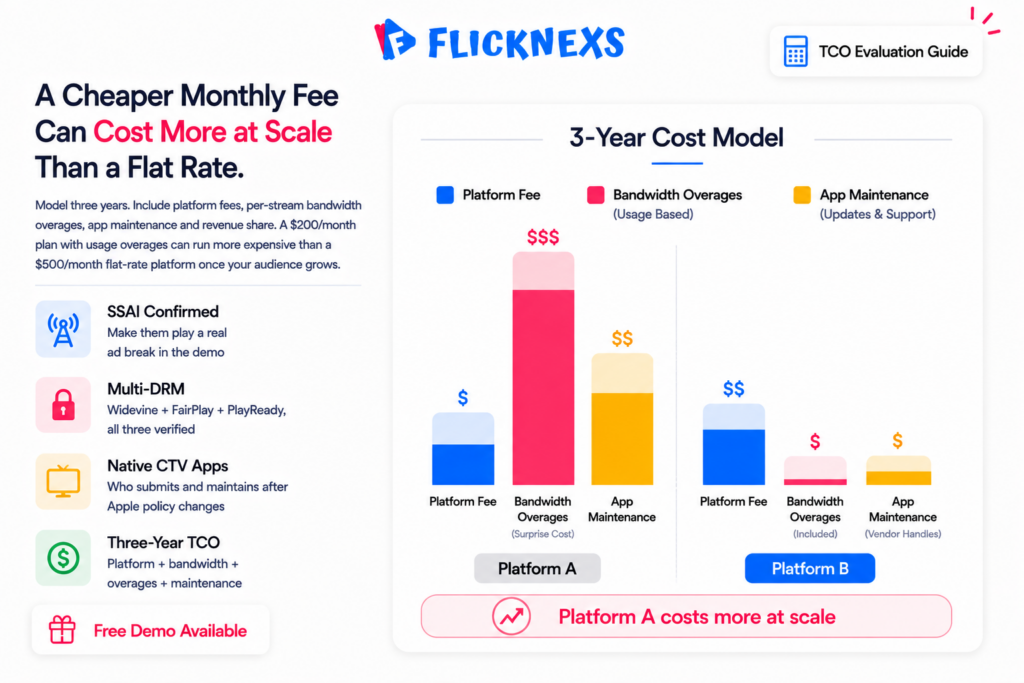
Total cost over three years
Don’t compare sticker prices. Model the three-year total including platform fees, per-stream/bandwidth charges, app maintenance and revenue share. A cheaper monthly fee with high bandwidth overage can cost more at scale than a flat-rate platform.
Frequently Asked Question
Related guides
- Best White-Label OTT Platforms in 2026: Top Providers Compared (hub)
- Top Kaltura Alternatives for OTT & Video in 2026
- Best JW Player Alternatives for OTT Platforms in 2026
- Muvi vs Uscreen vs Flicknexs: Which OTT Platform Should You Choose?
Ready to build?
If you’re planning your next OTT alternatives project, Flicknexs handles the video infrastructure end-to-end — so you can ship in weeks, not months.
- explore Flicknexs vs the rest
- get a quote
More related guides
Continue exploring more on this topic across the Flicknexs blog.