
For decades, launching a TV channel meant one thing: a serious capital budget. Satellite uplinks, transponder leases, racks of playout hardware, an engineering team to babysit it all. With the rise of digital technology, launching a TV channel can now be done by simply create your own OTT platform.
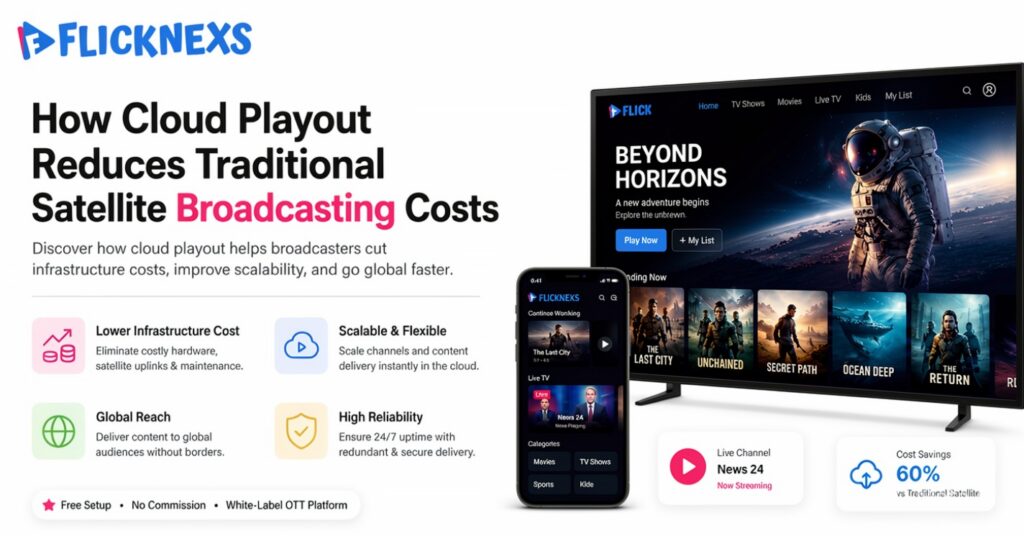
For decades, launching a TV channel meant one thing: a serious capital budget. Satellite uplinks, transponder leases, racks of playout hardware, an engineering team to babysit it all. If you wanted to run a 24/7 linear channel, that was the price of entry — and it kept broadcasting in the hands of a few well-funded players.
That’s no longer true, and the gap between what channels think they need and what they actually need has become huge. We work with broadcasters, content owners, and creators launching linear channels on Flicknexs, and the most common reaction we get is the same: “Wait — we don’t need a satellite for this?”
You don’t. Here’s how cloud playout removes most of the cost — and complexity — of running a linear TV channel.
Quick answer: Cloud playout runs your channel’s scheduling, branding, and broadcast from software in the cloud instead of on-site hardware and satellite infrastructure. You skip the satellite uplink, the transponder lease, and the physical playout servers, and deliver your 24/7 channel over the internet (HLS) to OTT apps, smart TVs, FAST platforms, and IPTV. The result is far lower upfront cost, faster launch, and global scale without new hardware.
What “playout” actually means (and where the cost hides)
Playout is the part of broadcasting that takes your content library and schedule and turns it into a continuous, live channel — the thing a viewer tunes into and sees running 24/7, with the right show at the right time, your logo in the corner, and ad breaks in place.
In a traditional setup, that job is done by dedicated playout servers in a facility, and the channel is then pushed up to a satellite for distribution. The cost isn’t one line item — it’s stacked:
- Satellite uplink + transponder lease — recurring, expensive, and often locked into multi-year contracts.
- Playout hardware — servers, encoders, redundancy systems, all bought upfront and depreciating.
- Facility + power + cooling — running broadcast-grade hardware 24/7 isn’t cheap.
- Engineering staff — someone has to maintain, monitor, and fix it.
- Slow scaling — adding a second channel or a new region means more hardware and more lead time.
Every one of those is a barrier to entry. Cloud playout removes or shrinks most of them.
How cloud playout changes the math
Cloud playout moves the entire playout chain — scheduling, graphics, branding, ad markers, the live broadcast signal — into software running in the cloud. Here’s what that does to each cost:
No satellite uplink infrastructure. Your channel is delivered over the internet, not a transponder. The single largest recurring cost in traditional broadcasting simply disappears. Distribution becomes an HLS stream, not a satellite feed.
No heavy hardware to buy or maintain. There are no playout servers to purchase, rack, power, or replace. The infrastructure is managed in the cloud, so there’s no upfront capital outlay and no depreciation cycle.
Faster deployment. A traditional channel launch is measured in months. A cloud channel can be scheduled and on-air in days — you upload your content, build your schedule, set your branding, and go live.
Run 24/7 from anywhere. Because it’s cloud-based, your channel runs continuously without a physical control room. Your team manages the schedule from a browser, whether they’re in one office or three countries.
Lower operational and maintenance cost. No facility, no cooling bills, no hardware refresh, and a much smaller engineering burden. Costs shift from large fixed capital to predictable operating spend that scales with what you actually run.
Faster global scaling. Launching a second channel, a regional variant, or a new market is a software action, not a hardware project. You’re not waiting on procurement — you’re cloning a configuration.
The honest version: cloud playout isn’t “free” — you still pay for the platform, encoding, and delivery. But you trade a large, rigid capital cost for a smaller, flexible operating cost, and you remove the single biggest barrier (satellite) entirely. For most channels launching today, that changes the project from “needs investor funding” to “runs on a normal marketing or content budget.”
Traditional broadcasting vs cloud playout, side by side
| Traditional satellite broadcast | Cloud playout | |
| Distribution | Satellite uplink + transponder | Internet (HLS) |
| Upfront hardware | High (servers, encoders) | None |
| Time to launch | Months | Days |
| Scaling a new channel | New hardware + lead time | Software configuration |
| Reach | TV via satellite/cable | OTT apps, smart TVs, FAST, IPTV, web — any device |
| Cost model | Large fixed capital | Flexible operating spend |
“But our viewers watch on TV” — they still can
This is the worry that keeps people tied to satellite, and it’s based on an outdated assumption. Cloud playout doesn’t mean “web only.” A single channel feed delivered over HLS can reach:
- OTT apps (your own branded app on Roku, Fire TV, Apple TV, Android TV)
- Smart TVs directly
- FAST platforms (the free ad-supported channels growing fastest in living rooms)
- IPTV and cable operators who can take your HLS feed
- Mobile, tablet, and web
So you’re not giving up the television screen — you’re reaching it and every other screen your audience already uses, from one feed. That’s the part traditional broadcasters consistently underestimate: cloud playout usually expands reach while cutting cost.
Where the savings get reinvested: monetization
Lower infrastructure cost is only half the story. Because cloud playout channels are digital, they’re built for modern monetization. With ad markers (SCTE) and server-side ad insertion, a FAST channel can run pre-roll, mid-roll, dynamic and regionally targeted ads — and even let network partners insert their own ads. The money that used to go to a transponder lease can instead go into content and growth, while the channel itself generates ad revenue. (We cover this in depth in [How FAST Channels Make Money Through Ads] and [What Are SCTE Markers].)
What this looks like on Flicknexs
We built Flicknexs Playout to be exactly this: modern digital linear TV infrastructure without traditional broadcast complexity. In practice that means you can:
- Schedule and run a 24/7 linear channel from the cloud, no hardware
- Ingest live content via RTMP (straight from OBS, an encoder, or a camera) for live events, news, or sports
- Deliver one HLS feed to OTT apps, smart TVs, FAST networks, IPTV, and your own website
- Use GPU-accelerated transcoding for adaptive, multi-resolution streams that stay smooth across devices
- Insert SCTE ad markers for FAST monetization and network-level ad control
- Embed the live player and EPG into your existing website or app — no rebuild, no migration headache
The bottom line
You don’t need a satellite, a transponder lease, or a rack of broadcast hardware to run a real 24/7 TV channel anymore. Cloud playout delivers the same linear channel experience — to more screens — at a fraction of the cost and a fraction of the launch time. The infrastructure that used to gatekeep broadcasting is now software.
If you’ve been assuming a linear channel is out of budget, it’s worth rechecking that assumption against what cloud playout actually costs today.
Thinking about launching a linear or FAST channel? See how Flicknexs Playout runs 24/7 channels from the cloud — no satellite, no hardware. Try the Flicknexs playout engine or see how the platform is put together.
Frequently Asked Questions
Ready to launch your own channel? See how to create your own online TV channel with Flicknexs — cloud playout, multi-device apps and built-in monetization in one platform.


Leave a Reply